
Yes/No/Not Given is the IELTS Reading question type that candidates get wrong because they treat it as a relabelled version of True/False/Not Given. It is not. YNNG tests the author's opinions and claims, not the factual accuracy of statements, and that single distinction decides whether you select Yes, No, or Not Given correctly. If your TFNG accuracy is 8 out of 10 but your YNNG accuracy drops to 5 or 6 out of 10, start a free IELTS Reading practice on IELTSArena and look at your YNNG errors specifically before continuing. The fix is a different reading strategy, not harder practice.
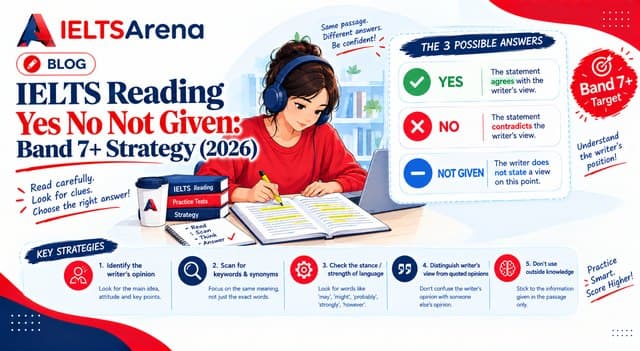
Quick answer: IELTS reading Yes No Not Given (YNNG) is a question type where you decide whether statements agree with, contradict, or fall outside the author's opinion or claim in a Reading passage. You answer "Yes" if the statement matches the author's view, "No" if it contradicts the author's view, and "Not Given" if the author does not express a view on that specific point. YNNG appears mostly in Academic Reading passages that contain argumentative or persuasive writing (editorials, academic arguments, position papers). It is distinct from True/False/Not Given, which tests factual information. Using TFNG strategy on YNNG questions is the single most common Reading mistake at Band 6.5, and it caps overall Reading band at Band 7 for most affected candidates.
Try it before you read. The fastest way to confirm YNNG is your specific Reading gap is to attempt one timed YNNG question set. Take a free IELTS Reading practice test on IELTSArena and compare your YNNG accuracy with your True/False/Not Given accuracy. If YNNG is 2 or more marks lower, the framework in this guide is specifically designed for you.
In This Guide
- What Yes No Not Given Actually Is
- Why YNNG Is a Different Question Type from TFNG
- How YNNG Compares to Other Reading Question Types
- The 3 Opinion-Tracking Traps Unique to YNNG
- YNNG Raw Scores and Your Overall Reading Band
- A Real Student's Story: 5/10 to 10/10 on YNNG in Four Weeks
- The Data Behind This Question Type
- The Right Approach: A 4-Week YNNG Fix Plan
- The Author-Position Tracking Framework
- The 5 Opinion Markers That Signal an Author's View
- Sample YNNG Passage with Full Walkthrough
- How IELTSArena Helps You Drill YNNG Specifically
- Self-Diagnosis: Is YNNG Capping Your Reading Band?
- Key Takeaways
- Frequently Asked Questions
Advertisement
What Yes No Not Given Actually Is
IELTS reading Yes No Not Given is one of the standard IELTS Reading question types, alongside multiple choice, matching headings (covered in detail in our IELTS Matching Headings guide), matching information, sentence completion, summary completion, and the related True/False/Not Given type (covered in our IELTS Reading True False Not Given guide).
In YNNG questions, you read a passage and a set of statements. For each statement, you decide whether the statement agrees with the author's view (Yes), contradicts the author's view (No), or whether the author does not express a view on that point in the passage (Not Given). Each correct answer is worth 1 mark toward your 40-question Reading raw score. The raw score converts to a Reading band using the standard table (full conversion in our IELTS Band Score Chart and the IELTS Band Score Calculator).
YNNG questions appear predominantly in Academic Reading passages that contain argumentative, persuasive, or opinion-based writing. Typical passage types include academic debates (two positions on a contested topic), position papers (one author arguing a thesis), editorial essays, and literary or cultural criticism. YNNG rarely appears in General Training Reading, which focuses on factual and functional texts rather than argumentative ones. For context on how Academic and General Training Reading differ overall, see our IELTS Academic Reading vs General Training guide.
Why YNNG Is a Different Question Type from TFNG
This is the single most important thing to understand about YNNG, and it is where most Band 6.5 candidates lose marks. Yes/No/Not Given is not True/False/Not Given with different labels. The two question types measure different things.
TFNG asks whether a statement about facts in the passage is True, False, or Not Given. The evidence you look for is factual: dates, measurements, named entities, cause-and-effect relationships, descriptions of events. If the passage says a species lives in freshwater and the statement says it lives in saltwater, that is False.
YNNG asks whether a statement about the author's opinion or claim is Yes (the author agrees), No (the author disagrees), or Not Given (the author expresses no view on this specific point). The evidence you look for is opinion-based: argumentative claims, persuasive statements, positions the author advocates for, concerns the author raises, judgements the author makes. If the author argues that renewable energy is the only viable solution, a statement claiming the author believes renewable energy is sufficient on its own might be Yes, No, or Not Given depending on exactly what the author argued.
The practical implication is specific. On a TFNG question, you compare the statement to factual information in the passage. On a YNNG question, you must first identify the author's position on the topic, then compare the statement to that position, not to factual content. Candidates who use TFNG strategy (keyword scanning for factual match) on YNNG questions almost always get them wrong, because the facts in the passage may be consistent with the statement while the author's actual argument is not. This is why YNNG is the question type that most reliably separates Band 6.5 from Band 7 in Reading.
For candidates working through the Band 6.5 to Band 7 plateau, YNNG and matching headings together account for the largest share of marks lost (covered extensively in our IELTS Band 7 guide). For candidates pushing further to Band 7.5, Band 8, or Band 8.5, zero-error YNNG performance is a prerequisite.
How YNNG Compares to Other Reading Question Types
Understanding where YNNG sits in the full Reading question-type set is the fastest way to prepare for it correctly.
| Question type | Where it appears | What it tests | Primary challenge |
|---|---|---|---|
| Yes/No/Not Given | Mostly Academic | Author's opinion or claim | Separating opinion from fact |
| True/False/Not Given | Both versions | Factual accuracy | Distinguishing False from Not Given |
| Multiple choice | Both versions | Specific detail or main idea | Resisting distractors |
| Matching headings | Both versions | Paragraph main idea | Paraphrase recognition |
| Matching information | Both versions | Locating specific info | Scanning paragraph by paragraph |
| Matching features | Both versions | Attributing opinions to people | Multi-source attribution |
| Sentence completion | Both versions | Specific detail with grammar fit | Grammatical and semantic match |
| Summary completion | Both versions | Overall gist with gaps | Paraphrase of broader meaning |
| Short answer | Both versions | Factual question | Precision, word count |
Three distinctions matter most. First, YNNG is the only question type (other than matching features in some cases) that tests opinion rather than fact. Everything else in the Reading test is factual precision work. Second, YNNG passages are heavily academic. YNNG almost never appears in General Training Reading, which is why General Training candidates sometimes miss YNNG preparation entirely until they take a mock Academic test. Third, YNNG is where the critical thinking skill (what is the author arguing?) is tested most directly, which is why the question type correlates strongly with academic success at university level.
The 3 Opinion-Tracking Traps Unique to YNNG
Three specific traps account for most YNNG marks lost at the Band 6 to Band 7 level.
Trap 1: Confusing the author's view with reported views. Academic passages often summarise other researchers' positions before stating the author's own. A paragraph might begin "Many economists argue that X" and then shift to "However, this view overlooks Y, and the real picture is Z". The author's view is Z, not X. Candidates who match a YNNG statement to the "Many economists argue that X" section get the question wrong because they matched a reported view, not the author's view. Fix: train yourself to identify opinion attribution markers ("according to", "critics argue", "it has been suggested") and separate them from the author's own voice.
Trap 2: Treating implied agreement as explicit agreement. A passage might present evidence that strongly supports a position without the author explicitly saying "I believe this position is correct". On a factual question (TFNG), you can answer True based on evidence in the passage. On an opinion question (YNNG), you need the author to actually express the view. If the author presents evidence consistent with a view but never endorses it, the correct answer is Not Given, not Yes. Fix: for every Yes answer, locate the exact sentence where the author explicitly states or endorses the view. If you cannot find explicit endorsement, the answer is Not Given.
Trap 3: Overgeneralising from partial agreement. The author may agree with part of a statement and disagree with another part. For example, the statement might be "Economic growth has no environmental cost" and the author might argue "Economic growth has significant environmental cost in developing economies but less in post-industrial ones". The statement is too absolute to match either Yes or No cleanly. The answer here is almost always No, because the statement is a universal claim that the author's qualified position contradicts. Fix: read each YNNG statement for its scope (universal, partial, qualified) and compare to the author's scope. Universal statements rarely survive a qualified authorial position.
These three traps are specific to opinion-based reading. Factual reading does not involve attribution, implication, or scope in the same way. The techniques in IELTS Reading Tips and IELTS Reading Skimming vs Scanning apply across all Reading question types, but YNNG needs this specific opinion-tracking framework on top of them.
YNNG Raw Scores and Your Overall Reading Band
YNNG typically appears in sets of 4 to 7 questions within a single Academic Reading passage. Multiple passages across the Reading test may include YNNG, so the total YNNG mark weight is usually 8 to 12 marks out of 40.
If your YNNG accuracy is 5 out of 10 with 8 out of 10 on other question types, your overall Reading raw score sits around 29 to 30, which maps to Reading Band 7. If you lift YNNG to 9 out of 10 while holding the other types, your overall raw score moves to 33, which maps to Reading Band 7.5 to Band 8 depending on exact distribution.
For candidates targeting Band 8 (approximately 35 out of 40, roughly 88 percent correct) or Band 9 (39 or 40 out of 40), YNNG accuracy must be 10 out of 10 consistently. The one or two careless answers that separate Band 8 from Band 9 almost always include at least one YNNG misread.
For context on how overall Reading band maps to visa, university, and professional registration thresholds, see our IELTS Score for Canada PR 2026, IELTS Score for Australia PR 2026, IELTS Score for Ireland, IELTS for New Zealand, IELTS for UK Visa, and IELTS for NMC UK Nursing threshold guides.
Mid-article check. If your YNNG accuracy sits at 5 or 6 out of 10 while your TFNG is 8 or 9, your Reading band is being capped by the TFNG-strategy-on-YNNG mistake. Start structured YNNG practice on IELTSArena with Academic Reading question sets filtered by question type.
A Real Student's Story: 5/10 to 10/10 on YNNG in Four Weeks
Thandiwe, a PhD researcher from Harare applying for a postdoctoral position at a UK university, needed IELTS Academic 7.5 overall. Her first attempt returned Reading 7, blocked almost entirely by YNNG. Her other Reading question types averaged 8 to 9 out of 10. YNNG was 5 out of 10.
I was reading passages at PhD level in my own research, so I honestly thought Reading would be my easiest band. The problem was I kept answering YNNG questions as if they were TFNG. I would find a sentence in the passage that related to the statement, see if the facts matched or did not match, and tick Yes or No. Half the time the author had never actually said what I was ticking Yes to. The author had just presented evidence. The correct answer was Not Given, and I was consistently getting it wrong because I was reading like a researcher, not like a test-taker.
Her diagnostic was clean. She had the comprehension skill. She did not have the opinion-tracking framework. For her second attempt, she spent four weeks exclusively on YNNG.
Week 1: she drilled author-voice recognition. She practised identifying the author's own position in each paragraph versus reported positions attributed to others. Week 2: she drilled the explicit-endorsement test. For every potential Yes answer, she located the exact sentence where the author explicitly stated or endorsed the view. If she could not find explicit endorsement, she answered Not Given. Week 3: she drilled scope matching, specifically identifying universal claims in statements and matching them against the author's qualified or partial positions. Week 4: she did full Academic Reading mocks with YNNG focus, tracking her YNNG accuracy by question across all passages.
Her second sitting scored Reading at 8.5, with YNNG at 10 out of 10. Overall band: 8. UK postdoc clearance within the normal processing window. The techniques Thandiwe used are compatible with the broader programme in our IELTS Study Plan 3 Months and IELTS 30-Day Study Plan guides. For candidates using the One Skill Retake route to lift Reading alone, see the IELTS One Skill Retake 2026 guide.
The Data Behind This Question Type
Cambridge Assessment English publicly identifies True/False/Not Given, Yes/No/Not Given, and matching headings as the three Reading question types with the highest error rates at the Band 6 to Band 7 plateau (Cambridge Assessment English, IELTS Test Statistics 2024 to 2025).
British Council guidance explicitly separates the YNNG framework from the TFNG framework in its official preparation materials, noting that candidates frequently conflate the two. IELTS.org (2026 test specification) confirms YNNG continues as a standard Academic Reading question type with no format changes in 2026, and that the Reading test overall is unchanged.
For the broader academic skill YNNG tests (identifying an author's position within an argumentative text), university admissions bodies and research positions place particular weight on YNNG performance because it directly simulates the critical reading required of university students. For candidates targeting Academic study abroad, YNNG preparation has disproportionate downstream value beyond the IELTS test itself.
The Right Approach: A 4-Week YNNG Fix Plan
Fixing YNNG is a focused four-week process, structured around the three traps covered above.
Week 1: Author-voice recognition. Spend 30 minutes per day. Pick an argumentative article from The Economist, The Guardian opinion pages, The Atlantic, or a research review paper. Read a paragraph and underline every sentence where the author expresses their own view. Mark separately every sentence where the author summarises or reports someone else's view. The goal is to train your eye to distinguish author voice from reported voice automatically. Do this with 10 different articles over the week.
Week 2: Explicit-endorsement discipline. Spend 30 minutes per day on real IELTS YNNG question sets. For every potential Yes answer, locate the exact sentence where the author explicitly states or endorses the view. If no such sentence exists, answer Not Given. Build the habit of refusing to answer Yes on inference. The authored content is the only evidence that justifies a Yes.
Week 3: Scope matching. Spend 30 minutes per day on scope analysis. Read each YNNG statement and label its scope: universal ("all", "every", "always", "no"), majority ("most", "generally", "usually"), partial ("some", "certain", "in certain contexts"), or specific ("in cases where X", "for Y specifically"). Then compare to the author's scope on that topic. Universal statements rarely match qualified authorial positions.
Week 4: Full Academic Reading mocks with YNNG focus. Take 2 full timed Academic Reading mocks per week and track YNNG accuracy specifically. Target 9 or 10 out of 10 on YNNG consistently. If you reach the threshold, your YNNG fix is complete. If not, extend the plan by two weeks on the specific trap (author voice, endorsement discipline, or scope) that is still weakest.
For parallel Reading improvement across all question types, see IELTS Reading Tips, IELTS Reading Skimming vs Scanning, IELTS Matching Headings, and the dedicated IELTS Reading True False Not Given guide for the factual sibling question type.
The Author-Position Tracking Framework
YNNG reading is a different cognitive activity from factual reading. The author-position tracking framework has four steps and should become automatic by end of Week 2 of the fix plan.
Step 1: Identify the paragraph's thesis. Each paragraph in an argumentative passage has a thesis sentence that states the author's position for that paragraph. It is usually the first or second sentence. Underline it. This is the author's view for the paragraph.
Step 2: Identify any reported views. Within the paragraph, flag any sentences that attribute views to other sources ("according to", "many argue", "critics claim", "a 2024 study suggested"). These are not the author's views. They may or may not be consistent with the author's position.
Step 3: Identify qualifications and limits. The author's position often comes with qualifications ("to some extent", "under certain conditions", "with important exceptions", "while this is largely true"). These qualifications matter because they constrain the scope of the author's view.
Step 4: Compare the YNNG statement to the identified position with its qualifications. If the statement matches the author's qualified position, the answer is Yes. If it contradicts (including contradicting the qualifications), the answer is No. If the author does not express a view on the specific point in the statement, the answer is Not Given.
With this four-step framework applied consistently, YNNG accuracy becomes mechanical rather than intuitive. The techniques overlap partially with those in IELTS Reading Tips and IELTS Matching Headings, but the author-position step is specific to YNNG.
The 5 Opinion Markers That Signal an Author's View
Authors signal their own views with recognisable markers. Band 8 candidates learn to spot these markers in real time.
Marker 1: First-person position statements. Phrases like "I argue that", "in my view", "it is my contention that" are the most explicit. These are rare in formal academic writing but common in opinion essays and editorials.
Marker 2: Judgement verbs. Verbs like "wrongly", "mistakenly", "correctly", "rightly", "surprisingly", "unfortunately", "regrettably" carry the author's judgement. If the author says "critics have wrongly dismissed this view", the author is endorsing the view and disagreeing with the critics.
Marker 3: Emphatic adverbs. Adverbs like "crucially", "importantly", "ultimately", "fundamentally", "undoubtedly" flag the author's own emphasis. The content that follows the adverb is usually the author's own view.
Marker 4: Contrastive signalling. Transitions like "however", "yet", "nevertheless", "in reality", "the truth is" often introduce the author's view after summarising opposing positions. The content after the transition is typically what the author argues.
Marker 5: Evaluative noun phrases. Phrases like "the central argument", "the strongest objection", "the real difficulty", "the main concern" tell you the author considers something important. The content described this way is the author's own emphasis.
Train yourself to spot these five markers automatically during Academic Reading. Candidates targeting Band 7, Band 7.5, Band 8, or above should recognise them within 2 seconds of reading. The IELTSArena practice library includes marker-identification drills across the full range of Academic passage types.
Sample YNNG Passage with Full Walkthrough
Here is a sample YNNG passage covering an argumentative topic in environmental economics, with walkthrough answers.
Passage excerpt:
"The debate over whether economic growth is compatible with environmental sustainability has intensified over the past decade. Many economists argue that technological progress will decouple growth from environmental damage, pointing to improvements in energy efficiency and the rise of renewable energy sources. This optimistic view, however, overlooks a crucial dimension: the rebound effect, whereby efficiency gains lead to increased consumption that offsets or exceeds the original savings. A 2024 study by the Jevons Institute found that energy efficiency improvements in household appliances led to a 24 percent increase in overall household energy use within three years, as consumers purchased more appliances and used them more intensively.
More fundamentally, the growth-sustainability compatibility thesis rests on a questionable assumption: that technology will continue to improve at a rate sufficient to outpace growing resource demands. There is little historical evidence for such sustained acceleration. While specific industries have achieved remarkable efficiency gains, aggregate resource use has risen in nearly every economy that has pursued growth. Decoupling, in the sense claimed by growth optimists, has not been empirically demonstrated at the economy-wide level.
This does not mean that growth is impossible to pursue responsibly. The policies that enable responsible growth, however, must include active constraints on consumption and resource use, not just reliance on efficiency improvements. Carbon pricing, resource taxes, and binding emissions caps are necessary complements to technological progress, not substitutes for them."
YNNG statements:
Statement 1: The author believes technology alone will solve the growth-sustainability tension.
Analysis: The author explicitly rejects this view. The second paragraph argues the growth-sustainability compatibility thesis "rests on a questionable assumption" and that decoupling has "not been empirically demonstrated". The third paragraph says policies must include "active constraints on consumption and resource use, not just reliance on efficiency improvements". Answer: No.
Statement 2: The rebound effect undermines claims that efficiency improvements reduce environmental impact.
Analysis: The author argues exactly this in the first paragraph, citing the Jevons Institute study. The author's view directly supports the statement. Answer: Yes.
Statement 3: Economic growth is inherently incompatible with environmental sustainability.
Analysis: The author never states this. In fact, the third paragraph explicitly says "this does not mean that growth is impossible to pursue responsibly". The author believes growth can be compatible with sustainability if the right policies are in place. The statement is too absolute. Answer: No. (If the statement had read "the author believes technology alone cannot solve the growth-sustainability tension", the answer would have been Yes.)
Statement 4: Carbon pricing is more effective than technological progress at reducing emissions.
Analysis: The author argues both are necessary, calling them "necessary complements, not substitutes". The author does not compare their relative effectiveness. The statement makes a comparative claim the author does not address. Answer: Not Given.
Each answer follows the author-position tracking framework: identify the author's actual position with qualifications, then compare the statement to that position with its scope. For practice with full YNNG question sets, take the Free IELTS Reading Practice Test 2026 and filter by question type. Candidates should also drill the sibling IELTS Matching Headings, IELTS Academic Reading vs General Training, and IELTS Reading True False Not Given for full Reading coverage.
How IELTSArena Helps You Drill YNNG Specifically
IELTSArena's Reading library lets you filter practice by question type, so you can drill YNNG in isolation without taking a full 40-question Reading test every session. Each YNNG practice uses the CBT interface used in the real exam, with authentic argumentative passages and the exact answer-selection mechanics of the official test.
The platform's analytics track YNNG accuracy separately from TFNG, multiple choice, matching headings, and other Reading question types. This granularity is specifically what the TFNG-strategy-on-YNNG candidate needs. If your TFNG accuracy sits at 9 out of 10 and your YNNG accuracy drops to 5 out of 10, the dashboard surfaces the gap directly and the practice library targets it.
IELTSArena's platform also provides full IELTS Academic Practice Tests, IELTS General Training Practice Tests, and section-by-section results that highlight exactly where marks are being lost. The YNNG-specific drill library is the most frequently used Reading resource among candidates targeting Band 7 and above.
Start your free IELTS Reading practice on IELTSArena and take a YNNG-focused practice this week.
Self-Diagnosis: Is YNNG Capping Your Reading Band?
Work through these questions honestly against your last Reading practice session or mock test.
Compare your YNNG accuracy to your TFNG accuracy. Is there a gap of 2 marks or more, with YNNG being lower? When you see a YNNG question, do you consciously switch to opinion-tracking mode, or do you apply the same scanning strategy you use for TFNG? Can you identify the author's thesis sentence in each paragraph of an argumentative passage within 10 seconds of reading? Can you distinguish reported views ("according to", "many argue") from the author's own voice automatically? For every Yes answer you select, can you locate the exact sentence where the author explicitly states or endorses the view, or do you sometimes answer Yes based on inference? When a YNNG statement is universal ("all", "always", "no"), do you check whether the author's position has qualifications that contradict the universal scope? Do you recognise the 5 opinion markers (first-person statements, judgement verbs, emphatic adverbs, contrastive signalling, evaluative noun phrases) in real time?
If you hesitated on more than two of these, YNNG is likely the specific question type capping your Reading band. Four weeks of targeted drilling using the author-position tracking framework should move YNNG to 9 or 10 out of 10 consistently.
For broader skill-level diagnostics, see our guides on IELTS Writing Mistakes to Avoid, IELTS Speaking Common Mistakes, and IELTS Listening Section 3 for parallel work on the other three skills.
Key Takeaways
- IELTS reading Yes No Not Given tests the author's opinion or claim, not factual accuracy. It is a different question type from True/False/Not Given, not a relabelled version of it.
- Using TFNG strategy (keyword scanning for factual match) on YNNG questions is the single most common Band 6.5 Reading mistake. YNNG requires author-position tracking, not factual verification.
- The three opinion-tracking traps are: confusing the author's view with reported views (fix with voice-separation drilling), treating implied agreement as explicit agreement (fix with explicit-endorsement discipline), and overgeneralising from partial agreement (fix with scope matching).
- The four-step author-position tracking framework: identify the paragraph's thesis, identify any reported views, identify qualifications and limits, then compare the YNNG statement to the identified position with its qualifications.
- The five opinion markers that signal an author's view are: first-person position statements, judgement verbs, emphatic adverbs, contrastive signalling, and evaluative noun phrases. Train real-time recognition.
- Four weeks of focused YNNG drilling (author-voice recognition, explicit-endorsement discipline, scope matching, full mocks) typically moves YNNG accuracy from 5 out of 10 to 9 or 10 out of 10 for most candidates. This is often the single-highest-leverage Reading intervention for Band 7 targeting.
Related Guides on IELTSArena
Reading cluster:
- IELTS Reading True False Not Given: The Strategy That Actually Works
- IELTS Matching Headings: Stop Getting It Wrong
- IELTS Reading Tips: 10 Proven Strategies to Score Band 8
- IELTS Reading Skimming vs Scanning Explained
- IELTS Academic Reading vs General Training Reading
- IELTS Reading Practice Test 2026: Best Free Resources Ranked
Listening cluster:
- IELTS Listening Form Completion: Band 8 Precision Guide
- IELTS Listening Section 3: Academic Discussion Strategy
- IELTS Listening Section 4: The Academic Monologue Guide
- IELTS Listening Multiple Choice: Why Students Lose Marks
- IELTS Listening Tips 2026
Band target posts:
- IELTS Band 6: How to Reach It
- How to Get Band 7 in IELTS
- How to Get Band 7.5 in IELTS
- IELTS Band 8 Guide 2026
- How to Get Band 8 in IELTS
- How to Get Band 8.5 in IELTS
- IELTS Band 9 Guide 2026
Visa and immigration routes:
- IELTS for UK Visa: Score Requirements
- UK Skilled Worker Visa IELTS Requirement 2026
- IELTS Score for Canada PR 2026
- IELTS Score for Australia PR 2026
- IELTS Score for Ireland 2026
- IELTS for New Zealand 2026
- IELTS for NMC UK Nursing
Study plans and tools:
- IELTS Study Plan 3 Months: Zero to Band 7 in 90 Days
- IELTS 30-Day Study Plan: Prepare and Score Band 7
- IELTS One Skill Retake 2026: Complete OSR Guide
- IELTS Band Score Chart 2026
- IELTS Band Score Calculator 2026
- IELTS Practice Tests Online 2026
- IELTS General Training 2026: Full Test Guide
Fix YNNG This Month
Take a free YNNG-focused Reading practice on ieltsarena.com, apply the four-step author-position framework, and drill the five opinion markers until they are automatic. Four weeks of structured work should take your YNNG accuracy from 5 or 6 out of 10 to a reliable 9 or 10.
Start your free IELTS practice on IELTSArena
Frequently Asked Questions
What is the difference between Yes No Not Given and True False Not Given? True/False/Not Given tests whether a statement about facts in the passage is True (the passage confirms the fact), False (the passage contradicts the fact), or Not Given (the passage does not address the fact). The evidence is factual: dates, measurements, descriptions, cause-and-effect. Yes/No/Not Given tests whether a statement about the author's opinion or claim is Yes (the author agrees), No (the author disagrees), or Not Given (the author does not express a view on this point). The evidence is opinion-based: argumentative claims, positions the author advocates, judgements the author makes. The key difference is what you are matching against: facts in the passage (TFNG) versus the author's expressed views (YNNG). Using TFNG strategy on YNNG questions is the single most common Band 6.5 Reading mistake because the facts in the passage may be consistent with a statement while the author's actual position is not.
How do I answer Yes No Not Given in IELTS reading? Follow a four-step framework. Step 1: identify the paragraph's thesis sentence, which states the author's own view for that paragraph. Step 2: identify any reported views within the paragraph, flagged by phrases like "according to", "many argue", or "critics claim". These are not the author's views. Step 3: identify qualifications and limits on the author's position, like "to some extent", "with important exceptions", or "under certain conditions". Step 4: compare the YNNG statement to the author's qualified position. If the statement matches, answer Yes. If it contradicts (including contradicting qualifications), answer No. If the author does not express a view on the specific point, answer Not Given. For every Yes answer, locate the exact sentence where the author explicitly endorses the view. If you cannot find explicit endorsement, the correct answer is Not Given, not Yes.
Why do I get Yes No Not Given wrong? There are three common reasons. First, you may be confusing the author's view with reported views. Academic passages often summarise other researchers' positions before stating the author's own, and candidates who match a statement to a reported view get the question wrong. Second, you may be treating implied agreement as explicit agreement. If the author presents evidence consistent with a view but never explicitly endorses it, the correct answer is Not Given, not Yes. Third, you may be overgeneralising from partial agreement. A statement that is universally scoped ("all", "always", "no") rarely matches an author who has taken a qualified position. The fix for all three is the four-step author-position framework: identify the thesis, flag reported views, note qualifications, then compare the statement with explicit evidence from the author's own voice.
What counts as a claim in IELTS reading Yes No Not Given? A claim in YNNG is any statement where the author expresses a position, judgement, or opinion on a topic. Claims appear in several forms. First, explicit position statements where the author states what they believe ("the central argument is", "the strongest objection to this view is"). Second, judgement-loaded statements where the author uses evaluative language ("critics have wrongly dismissed", "surprisingly, this view has not been widely accepted"). Third, prescriptive statements where the author argues what should be done ("policies must include active constraints", "the right approach would be to"). Fourth, interpretive statements where the author draws a conclusion from evidence they have presented ("this suggests", "the implication is"). The common feature is that the author is expressing a view, not just reporting facts or summarising others' views. Factual statements, by contrast, belong in TFNG territory.
Can I use True False Not Given strategy for Yes No Not Given? No. This is the single most common Band 6.5 Reading mistake. TFNG strategy involves scanning for factual match or contradiction between a statement and the passage. YNNG strategy requires identifying the author's position first, then comparing the statement to that position. The two require different cognitive processes. On a TFNG question, you can be certain of a True answer based on evidence in the passage. On a YNNG question, evidence alone is not enough: the author must have expressed the view. If the author presents evidence consistent with a view but does not endorse it, the correct YNNG answer is Not Given, not Yes, even though TFNG logic would say True. Train yourself to switch strategies consciously when you see "Yes/No/Not Given" at the top of a question set versus "True/False/Not Given". The labels are not interchangeable, and neither are the strategies.
Last updated September 2026 by the IELTSArena Editorial Team, a team of IELTS tutors, certified CBT examiners, and Reading preparation specialists who publish weekly research-backed guides on ieltsarena.com.