IELTS matching headings is consistently ranked as the most feared question type in Reading by test-takers worldwide. The reason is not that the texts are unusually hard. The reason is that most students employ fundamentally flawed strategies from the very first question — strategies that look reasonable and produce wrong answers.
Test designers deliberately build the heading list to mislead. Distractor headings contain paragraph vocabulary without capturing the actual main idea, and candidates who rely on keyword matching fall into the trap every time. According to IELTSArena tutor analysis, keyword-matching errors account for over 55% of all incorrect answers in the matching headings question type.
This guide shows you the six-step strategy that consistently raises matching headings accuracy, the synonym trap to watch for, and the specific habits that separate Band 7+ readers from those who stay stuck at Band 6.
Why Matching Headings Is the Hardest Reading Question Type
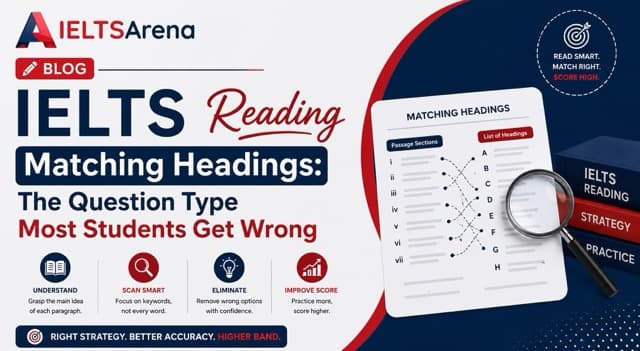
The matching headings task gives you a list of 8 to 12 possible headings and asks you to match the correct one to each paragraph in a passage. There are always more headings than paragraphs, so several headings exist purely as distractors.
The challenge has three layers. First, you must identify the main idea of each paragraph, not just any topic it touches. Second, you must distinguish that main idea from supporting details, examples, and side points. Third, you must do all of this under exam time pressure, where the temptation to grab the first heading that contains familiar vocabulary is enormous.
The result: students who score Band 7+ on every other Reading question type often drop to Band 5.5 on matching headings alone, dragging their overall Reading band down with them.
Three Strategy Failures That Sink Most Candidates
Almost every wrong matching headings answer traces back to one of three approaches.
Reading the entire passage before matching. Many candidates read the full passage carefully, then attempt to match headings paragraph by paragraph. This wastes 15+ minutes per passage on detailed reading the questions did not require, leaving no time for the other 26+ questions on the test. Detailed reading does not improve matching headings accuracy — it just slows you down.
Comparing full paragraphs to ten headings without method. When candidates try to hold an entire paragraph and ten headings in working memory simultaneously, they confuse themselves. The result: they pick the heading that "sounds right" based on shared vocabulary, falling straight into the distractor trap.
Not eliminating used headings. Once you confidently match a heading to a paragraph, that heading is gone. It cannot also match a different paragraph. Candidates who do not cross used headings off their working list keep re-considering them for later paragraphs, doubling their cognitive load and increasing errors.
The Six-Step Strategy That Works
Use this approach for every matching headings task. Practise it until it becomes automatic.
Step 1: Read the headings list first. Before reading any paragraph, scan the headings. Get a general sense of what they describe. Do not memorise them — just notice the range of options.
Step 2: Identify obvious distractors immediately. Headings that are too specific (mentioning a single example, a single name, a single year) are usually distractors. Main-idea headings tend to be general statements that summarise an entire paragraph's argument. Specific headings often refer to details the paragraph mentions but does not focus on.
Step 3: Read only the topic sentence of each paragraph first. The main idea is almost always in the first sentence. Read it, then check the heading list for a match. If the first sentence makes the paragraph's purpose clear, you can match without reading further.
Step 4: Read the final sentence if the opening is unclear. Some paragraphs build to a point, with the main idea appearing in the conclusion. If the topic sentence is descriptive or sets up an example, jump to the last sentence before considering the middle.
Step 5: Eliminate used headings from your list immediately. Cross them off as you go. This reduces the options for the next paragraph and prevents you from second-guessing earlier choices.
Step 6: Skip uncertain matches and return. If two headings seem plausible for the same paragraph, mark both, move on, and return after you have matched the easier paragraphs. The remaining options will narrow your choice naturally.
The Synonym Trap
The single most dangerous mistake in matching headings is matching by vocabulary similarity rather than meaning.
A paragraph about climate change might mention "rising sea levels" in one sentence as an example of broader effects. A distractor heading reads "The threat of rising sea levels." It contains the exact phrase from the paragraph. Candidates pick it.
But the paragraph's actual main idea might be about how climate change drives migration patterns. Sea level rise was a single supporting example, not the focus. The correct heading is about migration, not sea levels.
Test designers excel at writing headings that sound like main ideas but actually capture details, examples, or supporting points. The defence: always ask "what is the paragraph trying to argue?" before you ask "which heading shares vocabulary with this paragraph?"
Priscilla's Jump from Band 6 to Band 7.5
Priscilla, a 26-year-old from the Philippines preparing for a Canadian Express Entry application, scored Band 6 in Reading on her first attempt. Her error pattern was consistent: she missed almost every matching headings question while scoring 8+ on other question types.
"I was reading every word of every paragraph and then trying to match," she said. "By the time I got to Passage 3, I had no time left and I was guessing."
She switched to a topic-sentence-first approach using IELTSArena's question-type-filtered practice. For five weeks she did matching headings practice only, using topic sentences and elimination, never reading full paragraphs unless a match was unclear.
Her next mock test put Reading at Band 7.5. She finished all three passages with four minutes to spare and answered 38 out of 40 questions correctly.
The strategy did not require better English. It required reading differently.
Data on Strategy and Accuracy
IELTSArena's analysis of timed Reading practice shows clear patterns.
Students using the topic-sentence-first strategy are 40% faster to complete matching headings tasks than students who read entire paragraphs, while scoring equivalently in accuracy. The time saved transfers directly to other question types in the same Reading section.
Students who complete six timed matching headings practice sets show an average improvement of 1.4 correct answers per passage compared to their baseline. Six sets is a small commitment for that level of gain.
Students who actively eliminate used headings from their working list achieve around 12% higher accuracy on the final two to three headings per passage, where the choice narrows naturally.
The consistent finding: matching headings rewards method more than reading ability. A reader at Band 7 English level with poor method will be beaten by a reader at Band 6.5 English level with strong method.
How IELTSArena Helps You Master Matching Headings
The matching headings question type rewards repeated, targeted practice with feedback that explains exactly why each distractor mislead you.
IELTSArena's Reading practice library lets you filter by question type, so you can drill matching headings specifically without wading through unrelated questions. Every practice passage is delivered through the real CBT interface with the highlighter and navigation panel you will use on test day.
Each question comes with full answer explanations that show why the correct heading captures the paragraph's main idea and why each distractor fails — usually by capturing a detail, an example, or a side argument instead. This is the explanation layer that separates serious practice from random test-taking.
For candidates targeting Band 7.5+, expert tutor feedback adds human commentary on your error patterns over multiple sessions, identifying the specific reading habits holding your score back.
Start free on IELTSArena and access matching headings practice with full answer explanations.
Self-Diagnosis: Is Your Strategy Working?
Five questions to check before your next practice session.
- Do you read the headings list before reading any paragraph?
- Do you focus on opening (and closing) sentences rather than reading every paragraph completely?
- Do you cross off headings after you use them?
- Do you skip uncertain matches and return to them after the easier ones?
- When you review wrong answers, do you identify why the distractor mislead you (which detail it pulled vocabulary from)?
A "no" on any of these is the habit to change first.
Take a Free Matching Headings Test Today
The fastest way to fix matching headings is targeted practice with explained answers — not more general Reading practice.
Start Your Free Matching Headings Practice on IELTSArena →
Frequently Asked Questions
Why are IELTS matching headings questions answered incorrectly so often?
Matching headings is the most error-prone question type because distractor headings are deliberately designed to share vocabulary with paragraphs without capturing the main idea. Candidates who match by keyword similarity rather than meaning fall into the trap. According to IELTSArena tutor analysis, keyword-matching errors account for over 55% of all incorrect answers in this question type. The fix is reading the topic sentence (and closing sentence if needed) to identify the paragraph's main argument, then checking which heading captures that argument — not which heading shares words with the paragraph.
How do I speed up matching headings without losing accuracy?
Use the topic-sentence-first strategy. Read only the first sentence of each paragraph, check the heading list, and match if the meaning is clear. Read the final sentence if the opening is unclear, and only read middle sentences if both opening and closing are insufficient. This approach is 40% faster than reading whole paragraphs while producing equivalent or better accuracy, based on IELTSArena's timed practice data. Combined with active elimination of used headings, this method consistently raises matching headings scores within four to six practice sessions.
Should I read entire paragraphs or just topic sentences for matching headings?
Read topic sentences first. The main idea of a paragraph is almost always in the first sentence, and the second-most-likely location is the final sentence. Reading entire paragraphs wastes time you need for the other 26+ questions in the Reading section without improving your matching accuracy. Reserve full-paragraph reading for the few cases where topic and closing sentences are both unclear. IELTSArena's matching headings practice with explained answers helps you develop the judgment to know when topic-sentence reading is enough and when to dig deeper.
How many distractor headings are usually included?
The matching headings task always includes more headings than paragraphs — typically 2 to 4 additional distractor headings. If a passage has 6 paragraphs to match, the heading list might contain 9 or 10 options. This is why active elimination matters so much: as you confidently match headings, crossing them off your working list narrows the remaining choices for harder paragraphs. Distractor headings often look plausible because they capture a detail or example from one of the paragraphs without representing the main idea.
What is the most dangerous mistake in matching headings questions?
The synonym trap. Test designers deliberately write distractor headings that paraphrase or repeat specific phrases from supporting details, examples, or side arguments within a paragraph — not the main idea. Candidates who match by vocabulary similarity pick these distractors and lose marks. The defence is to always ask "what is the paragraph arguing as a whole?" before asking "which heading shares words with the paragraph?" Practising on IELTSArena with answer explanations that reveal why each distractor was designed to mislead is the fastest way to build this judgment.