You have 60 minutes to answer 40 questions across three long passages. That works out to roughly 20 minutes per passage, including the time it takes to read, locate answers, and transfer them. Most test-takers run out of time on the third passage and lose five to eight marks they could have won.
The problem is almost never vocabulary. It is speed, focus, and the type of text you have trained your brain to handle. If your daily reading is limited to social media posts and short news headlines, the dense academic passages on test day will feel like a different language.
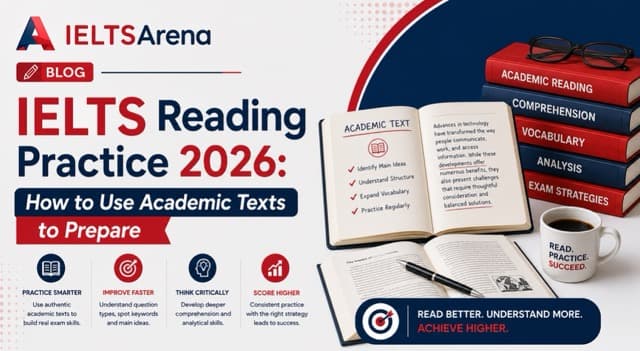
This guide shows you how to build real IELTS reading practice into your week using the right texts, so your comprehension speed matches what the exam demands.
The Real Challenge in the Reading Section
The IELTS Academic Reading test uses three passages taken from journals, magazines, newspapers, and academic books. These texts are written for an educated general audience. They are long, argument-driven, and full of unfamiliar topics.
You will not know most of the subjects in advance. One passage might cover coral reef biology, the next might discuss the history of urban planning. The skill being tested is not background knowledge. It is your ability to read quickly, find specific information, and understand the writer's meaning under time pressure.
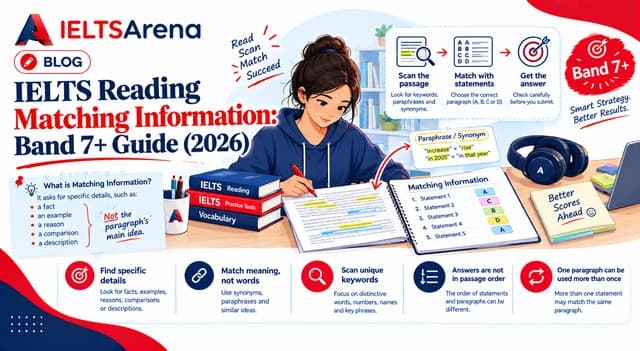
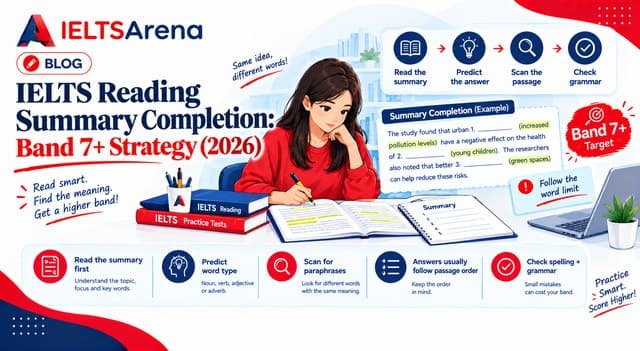
The 40 questions come in many formats. You will face matching headings, True/False/Not Given, multiple choice, sentence completion, and matching information to paragraphs. Each format tests a slightly different reading skill.
This is why generic reading does not prepare you fully. Reading a novel builds fluency, but it does not train you to scan for a date, spot a paraphrase, or decide whether a statement is False or Not Given. Focused IELTS reading practice trains exactly those skills.
Advertisement
Why Common Approaches Fail
Most test-takers make one of three mistakes when they prepare for Reading.
The first mistake is reading every word. They treat the passage like a school comprehension exercise and try to understand every sentence before looking at the questions. On a 900-word passage with 20 minutes on the clock, this guarantees a rushed final passage.
The second mistake is doing endless practice tests without review. They complete passage after passage, check the score, feel bad, and move on. They never study why they got an answer wrong. Without review, the same errors repeat on test day.
The third mistake is confusing quantity with quality. They read three newspapers a day and assume their score will rise. Casual reading helps with speed and vocabulary, but it does not build the exam-specific techniques of skimming, scanning, and locating paraphrases.
Good IELTS reading practice combines two things: exposure to the right academic texts, and repeated, reviewed exposure to real IELTS question types. One without the other leaves a gap.
A Realistic Student Story
Grace, a nurse from Nigeria, needed Band 7.0 in Reading for her registration application. She read the news every morning and assumed her English was strong enough.
Her first mock test result was Band 6.0. She had answered the first two passages well but scored badly on the third because she ran out of time. She had also lost four marks on True/False/Not Given questions, choosing False when the correct answer was Not Given.
"I thought reading a lot of English was the same as IELTS reading practice," Grace said. "It was not. I had never practised finishing three passages in exactly 60 minutes, and I had never learned the difference between False and Not Given."
Grace changed her routine. She did one full timed passage every day and spent 20 minutes reviewing every wrong answer. She started reading longer feature articles instead of short news pieces. After five weeks, her IELTS reading practice paid off and she scored Band 7.0.
Data and Insight Layer
The Reading section produces some of the widest score gaps of any IELTS module. According to data published by the IELTS partners in their global test-taker performance reports, Academic candidates typically average around Band 6.0 to 6.3 in Reading, yet many university and professional pathways demand Band 7.0 or higher.
That gap of roughly one full band is significant. In raw terms, moving from Band 6.0 to Band 7.0 in Academic Reading usually means answering about seven or eight more questions correctly out of 40.
Analysis of common error patterns shows that a large share of lost marks come from just two question types: True/False/Not Given and matching headings. These formats punish readers who guess based on general impression rather than locating the exact information in the text.
The encouraging insight is that Reading is often the fastest module to improve. Because it rewards technique as much as vocabulary, focused IELTS reading practice can lift a score by half a band in a few weeks, faster than Writing or Speaking usually allow.
The Right Approach to IELTS Reading Practice
Building real reading skill takes a structured routine. Follow these steps.
- Read the right texts daily. Choose long, argument-driven articles similar to exam passages. Good IELTS reading materials include feature articles from quality newspapers, science and history magazines, and academic summaries. Aim for pieces of 800 words or more, not short news bites.
- Practise skimming and scanning separately. Spend one week practising skimming, reading a passage in three minutes to grasp the main idea. Spend another week scanning, finding specific facts as fast as possible. These are the two core exam skills.
- Do one timed passage every day. Set a strict 20-minute limit for one passage and its questions. This single habit trains the pacing that most test-takers lack. Timed IELTS reading exercises are the closest thing to real exam conditions.
- Master paraphrase recognition. IELTS answers are almost never in the same words as the question. Train yourself to spot synonyms and reworded ideas. When you review, underline the phrase in the passage that matched the question.
- Review every wrong answer. This is the step most people skip. For each mistake, ask why. Was it a vocabulary gap, a paraphrase you missed, or a timing panic? Reviewing turns practice IELTS reading sessions into real learning.
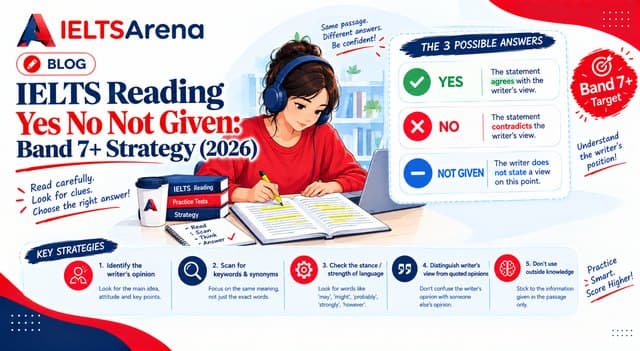
- Learn the logic of Not Given. Not Given means the information is simply absent, not contradicted. False means the passage says the opposite. Drill this distinction until it is automatic.
How IELTSArena Makes Reading Practice Work
Reading a newspaper builds fluency, but it cannot tell you whether your answer was right, why you were slow, or which question types are costing you marks. This is where IELTSArena changes the picture.
IELTSArena gives you real exam-style Reading passages inside a computer-based test interface that mirrors the actual IELTS CBT. You get the same highlighter, the same review panel, and the same on-screen timer you will face on test day. Practising in this environment removes the shock of the real interface.
Every set of IELTS reading practice texts on IELTSArena comes with answers and clear explanations. You do not just see that you were wrong. You see exactly where the answer sat in the passage and why the correct choice beat the wrong one. This turns each session into targeted improvement.
IELTSArena also tracks your performance across every mock test. If you keep losing marks on True/False/Not Given, the analytics dashboard shows it, so you know precisely what to drill next. That focus is impossible with random reading.
For test-takers doing IELTS reading self practice without a coach, IELTSArena acts as the missing feedback layer. It shows your reading speed, your accuracy by question type, and your progress over time. More than 10,000 learners have used the platform to close the gap between casual reading and real exam performance.
The difference between a Band 6 and a Band 7 reader is rarely vocabulary. It is knowing exactly where to look and never wasting a second.
You can start IELTS reading practice free on IELTSArena and take a full timed Reading section without paying anything. That first result shows you your true starting band.
Self-Diagnosis: Is Your Reading Practice Working?
Answer these honestly to see where your preparation stands.
- Can you finish all three passages and transfer your answers within exactly 60 minutes?
- Do you know the precise difference between a False answer and a Not Given answer, and can you apply it under pressure?
- When you get a question wrong, do you go back and find the exact sentence that held the correct answer?
- Are the texts you read every day as long and as dense as real IELTS passages, or are they short news snippets?
- Do you know which question type costs you the most marks right now?
If you hesitated on any of these, your current IELTS reading practice has a gap that targeted, feedback-driven practice can close.
Start Your Free Reading Practice Today
You will never know your true Reading band by guessing. Take one full timed Reading test on IELTSArena and see exactly where you stand, which question types are strong, and where your marks are leaking.
In one free test, you will know your real starting point and the fastest path to your target band.
Take a Free Reading Test on IELTSArena →
Frequently Asked Questions
How do I practise IELTS reading if I do not have access to many academic texts?
You do not need a library of journals. Free quality feature articles from reputable science, history, and news publications work well because they match the style of exam passages. The most efficient option is a dedicated platform. IELTSArena provides real exam-style IELTS reading practice texts with answers and explanations inside a computer-based test interface. This means you practise on material designed for the exam, get instant feedback, and see which question types cost you marks, all without hunting for academic texts on your own.
Is reading newspapers every day enough to improve my IELTS reading score?
Reading newspapers helps with vocabulary and fluency, but on its own it is not enough. The IELTS Reading test rewards specific skills like skimming, scanning, paraphrase recognition, and time management across three passages in 60 minutes. Newspaper reading does not train those skills or tell you if your answers are correct. Combine daily reading with timed practice on real IELTS question types, and review every wrong answer. That combination, not reading alone, is what lifts a Reading band score.
How is practising IELTS reading passages different from general English reading?
General reading builds background fluency and helps you enjoy the language. IELTS reading practice is targeted training under exam conditions. You read to locate specific information fast, recognise reworded answers, and manage a strict clock across matching headings, True/False/Not Given, and other question types. General reading has no time limit and no questions. IELTS practice always pairs a passage with question types and a timer, then requires review of every error, which is why it improves your test score far faster.
What kind of texts should I read to improve my IELTS academic reading score?
Choose long, argument-driven texts on unfamiliar subjects, similar to what the exam uses. Good IELTS reading materials include feature articles from quality newspapers, popular science and history magazines, and academic summaries of 800 words or more. Avoid short headlines and social media posts, which train the wrong habits. The best approach is to combine this reading with real exam-style passages. IELTSArena offers passages that match actual test difficulty, so you practise on the exact type of text you will see on exam day.
How long should I spend practising IELTS reading per day to see improvement?
Consistency matters more than long sessions. Around 30 to 45 minutes of focused IELTS reading practice per day is enough for most test-takers to see gains within a few weeks. Spend part of that time on one timed passage and the rest reviewing every wrong answer to understand your errors. Reading Academic passages is often the fastest IELTS module to improve because it rewards technique. Using a platform like IELTSArena, which tracks your accuracy by question type, helps you target the weak areas that a daily routine alone might miss.