
Matching information is the IELTS Reading question type candidates get wrong because they prepare for it the same way they prepare for matching headings. The two question types share the word "matching" but test completely different skills. Matching information asks you to locate which paragraph contains specific pieces of information. Matching headings asks you to summarise each paragraph's main idea. Confusing the two strategies is the single most common Band 7 Reading mistake. If your matching information accuracy is below 7 out of 10, start a free IELTS Reading practice on IELTSArena and check your matching information errors specifically before continuing. The fix is a different scanning technique, not more reading practice.
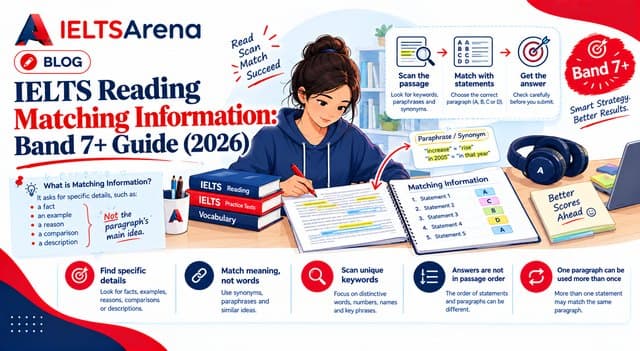
Quick answer: IELTS reading matching information is a question type where you decide which paragraph of a passage contains specific pieces of information. You are given a list of statements (each describing a specific detail, fact, example, or definition) and asked to assign each one to the correct paragraph letter (A, B, C, D). Unlike matching headings, matching information does not test paragraph main ideas. It tests whether you can locate specific information quickly, usually paraphrased, within a long academic passage. Matching information appears in both Academic and General Training Reading. The question type typically carries 4 to 6 marks per set and causes disproportionate time loss because candidates scan paragraph-by-paragraph without a locating framework.
Try it before you read. The fastest way to confirm matching information is your specific Reading gap is to attempt one timed matching information question set. Take a free IELTS Reading practice test on IELTSArena and compare your matching information accuracy with your matching headings accuracy. If the two are different, you are probably using the wrong strategy for one of them.
In This Guide
- What Matching Information Actually Is
- Why Matching Information Is Not Matching Headings
- How Matching Information Compares to Other Reading Question Types
- The 3 Locating Traps Unique to Matching Information
- Matching Information Raw Scores and Your Overall Reading Band
- A Real Student's Story: 5/10 to 10/10 on Matching Information in Four Weeks
- The Data Behind This Question Type
- The Right Approach: A 4-Week Matching Information Fix Plan
- The Paragraph-Scanning Framework
- The 5 Information Types to Scan For
- Sample Passage with Full Walkthrough
- How IELTSArena Helps You Drill Matching Information Specifically
- Self-Diagnosis: Is Matching Information Capping Your Reading Band?
- Key Takeaways
- Frequently Asked Questions
Advertisement
What Matching Information Actually Is
IELTS reading matching information is one of the standard IELTS Reading question types, alongside multiple choice, matching headings (covered in our dedicated IELTS Matching Headings guide), True/False/Not Given (see our IELTS Reading True False Not Given guide), Yes/No/Not Given (see our IELTS Reading Yes No Not Given guide), sentence completion, summary completion, and short answer questions.
In matching information questions, you are given a Reading passage divided into labelled paragraphs (A, B, C, D, E, F, G) and a list of statements. Each statement describes a specific piece of information (a fact, a detail, an example, a definition, a reason, a comparison). Your job is to locate which paragraph contains that specific information and write the paragraph letter next to the statement. Each correct match is worth 1 mark toward your 40-question Reading raw score. For the raw-score-to-band conversion see our IELTS Band Score Chart and IELTS Band Score Calculator.
Matching information typically appears in Academic Reading passages where the passage structure supports detail-level navigation (research reports, long academic articles, review papers). It also appears in General Training Reading Section 3, which uses longer passages similar to Academic. Each set usually contains 4 to 6 statements against 5 to 8 labelled paragraphs. Some paragraphs may not be referenced in any statement, and some paragraphs may contain multiple statements, which is why the instruction almost always says "NB: You may use any letter more than once".
Why Matching Information Is Not Matching Headings
This is the single most important distinction in Reading preparation, and it is where most Band 7 candidates lose marks. Matching information and matching headings share the word "matching" but test different cognitive skills.
Matching headings asks: "What is the main idea of each paragraph?" The task is to summarise each paragraph in one phrase and match it to a provided heading. The scanning target is the paragraph's thesis sentence or overall argument. Distractor headings share vocabulary with paragraphs but miss the main idea (the mechanic covered in detail in our IELTS Matching Headings guide).
Matching information asks: "Which paragraph contains this specific piece of information?" The task is to locate specific details within paragraphs. The scanning target is a factual claim, example, definition, or specific detail that may appear anywhere in a paragraph, not just the main idea. A paragraph can contain information that is not its main point. For example, a paragraph whose main idea is "cities have adopted various cooling strategies" may contain a specific detail that "Toronto's green infrastructure programme launched in 2019 reduced temperatures by 1.8 degrees". If a matching information statement asks "which paragraph mentions Toronto's green infrastructure programme", the answer is this paragraph, even though Toronto is not its main idea.
The practical implication is that matching information requires paragraph-scanning for specific details, while matching headings requires paragraph-skimming for main ideas. These are different cognitive activities with different speeds and different error patterns. Candidates who use the matching-headings strategy on matching information miss answers because they look only at thesis sentences and skip over supporting details. Candidates who use the matching-information strategy on matching headings miss answers because they match on surface vocabulary rather than main idea.
For candidates working through the Band 6.5 to Band 7 plateau, matching information and matching headings together often account for a quarter or more of marks lost (covered extensively in our IELTS Band 7 guide). For Band 7.5, Band 8, and Band 8.5, both question types need near-perfect accuracy.
How Matching Information Compares to Other Reading Question Types
Understanding where matching information sits in the full Reading question-type set is the fastest way to prepare for it correctly.
| Question type | What it asks | Scanning target | Main challenge |
|---|---|---|---|
| Matching information | Which paragraph contains this detail? | Specific facts, examples, definitions | Locating paraphrased detail quickly |
| Matching headings | What is each paragraph's main idea? | Thesis sentence, overall argument | Avoiding surface vocabulary match |
| True/False/Not Given | Is this factual statement correct? | Factual information in the passage | False vs Not Given distinction |
| Yes/No/Not Given | Does the author agree with this view? | Author's expressed opinion | Opinion vs fact, implied vs explicit |
| Multiple choice | Which option is correct? | Specific detail or main idea | Resisting distractor options |
| Sentence completion | What word completes this sentence? | Specific detail with grammar fit | Grammatical and semantic match |
| Summary completion | What words fill the summary gaps? | Overall gist and specific details | Paraphrase of broader meaning |
| Short answer | What is the specific answer? | Factual detail, usually a name | Precision, word count |
Three distinctions matter most for matching information. First, matching information is the question type where paragraph-by-paragraph scanning is a required skill. Multiple choice, True/False/Not Given, and other question types usually give you line references or allow sequential reading. Matching information requires jumping across the whole passage to find specific details. Second, matching information rewards systematic paragraph coverage. Candidates who guess a paragraph and move on without checking the alternatives almost always get the question wrong. Third, matching information is where paraphrase recognition is tested most intensively. The information in the statement is almost never worded identically to the information in the passage.
The 3 Locating Traps Unique to Matching Information
Three specific traps account for most matching information marks lost at the Band 6.5 to Band 7 level.
Trap 1: Confusing main idea with contained information. Candidates look at each paragraph's thesis sentence to decide whether the paragraph "is about" the topic in the statement. This works for matching headings but fails for matching information. A paragraph whose main idea is X can still contain detail Y as a supporting example. If the statement describes Y, the correct answer is that paragraph, even though its main idea is X. Fix: train yourself to scan every paragraph for specific detail match, not just thesis sentence match.
Trap 2: Locking in a candidate paragraph too early. Candidates find one paragraph that seems to match the statement and immediately write that letter without checking the other paragraphs. Multiple paragraphs may discuss related content, and the correct answer is usually the one with the most specific match to the statement's exact wording. Fix: for every match, verify by scanning the other paragraphs quickly. If a different paragraph has a stronger match, update the answer.
Trap 3: Matching on surface vocabulary. The information in the statement is almost always paraphrased from the passage. A statement that mentions "renewable energy sources" might match a paragraph that uses the phrase "solar and wind power" without using the words "renewable energy". Candidates who scan for exact word match miss these paraphrased answers. Fix: translate the statement into likely synonyms before scanning. If the statement says "a decrease in biodiversity", scan for "species decline", "fewer species", "ecological loss", not just "biodiversity".
These three traps are specific to information location. Matching headings has different traps (surface vocabulary conflation, inverse main-idea logic) covered in the IELTS Matching Headings guide. The techniques in IELTS Reading Tips and IELTS Reading Skimming vs Scanning apply across all Reading question types, but matching information needs this specific locating framework on top of them.
Matching Information Raw Scores and Your Overall Reading Band
Matching information typically appears in sets of 4 to 6 questions per Reading passage. Across the full Reading test, total matching information mark weight is usually 6 to 10 marks out of 40.
If your matching information accuracy is 5 out of 10 with 8 out of 10 on other Reading question types, your overall raw score sits around 29 to 30, which maps to Reading Band 7. If you lift matching information to 9 out of 10 while holding the other types, your raw score moves to 33 to 34, which maps to Reading Band 7.5 to Band 8 depending on your Reading version (Academic or General Training) and exact distribution.
For candidates targeting Band 8 (approximately 35 out of 40 in Academic Reading, 37 out of 40 in General Training) or Band 9 (39 or 40 out of 40), matching information accuracy must be 10 out of 10 consistently. The one or two careless answers that separate Band 8 from Band 9 almost always include at least one matching information misread.
For context on how overall Reading band maps to visa, university, and professional registration thresholds, see our IELTS Score for Canada PR 2026, IELTS Score for Australia PR 2026, IELTS Score for Ireland, IELTS for New Zealand, IELTS for UK Visa, UK Skilled Worker Visa IELTS Requirement 2026, and IELTS for NMC UK Nursing threshold guides.
Mid-article check. If your matching information accuracy is 5 or 6 out of 10 while your other Reading question types are higher, you are probably using matching-headings strategy on an information-location task. Start structured matching information practice on IELTSArena with Academic Reading question sets filtered by question type.
A Real Student's Story: 5/10 to 10/10 on Matching Information in Four Weeks
Lin, a researcher from Taipei applying for a PhD position at the University of Melbourne, needed IELTS Academic 7.5 overall. Her first attempt returned Reading 7, with matching information at 5 out of 10 and other question types at 8 to 9. Her matching headings accuracy was also 9 out of 10, which initially masked the matching information problem because she assumed matching skills were transferring.
I had drilled matching headings for weeks. I thought matching information would be easier because I was good at matching headings. But every time I did a matching information set, I was staring at thesis sentences trying to decide which paragraph was "about" the statement. The problem is matching information does not ask that. It asks where a specific detail appears, and specific details are rarely in the thesis sentence. I was looking in the wrong place.
Her diagnostic was clean. She had the comprehension skill. She did not have the paragraph-scanning framework specific to information location. For her second attempt, she spent four weeks exclusively on matching information.
Week 1: she drilled paraphrase recognition. For each matching information statement, she wrote 3 to 5 possible paraphrases before scanning the passage. This trained her eye to search for synonymous phrasing rather than exact word match. Week 2: she drilled systematic paragraph coverage. For every answer, she verified by scanning the other paragraphs rather than locking in the first match. Week 3: she drilled the distinction between main idea and contained information, specifically practising passages where supporting details appeared in paragraphs whose main idea was different. Week 4: she did full Academic Reading mocks with matching information focus.
Her second sitting scored Reading at 8.5, with matching information at 10 out of 10. Overall band: 8. Melbourne cleared her within the normal processing window. The techniques Lin used are compatible with the broader programme in our IELTS Study Plan 3 Months and IELTS 30-Day Study Plan guides. For candidates using the One Skill Retake route to lift Reading alone, see the IELTS One Skill Retake 2026 guide.
The Data Behind This Question Type
Cambridge Assessment English publicly identifies matching information, matching headings, and True/False/Not Given as the three Reading question types with the highest time costs at the Band 6 to Band 7 plateau (Cambridge Assessment English, IELTS Test Statistics 2024 to 2025). Matching information specifically correlates with time management problems because candidates re-scan the full passage multiple times without a systematic locating framework.
British Council guidance separates matching information from matching headings in its official preparation materials, noting the two require different scanning techniques. IELTS.org (2026 test specification) confirms matching information continues as a standard Reading question type across both Academic and General Training versions, unchanged in format for 2026.
For the broader academic skill matching information tests (locating specific supporting information within a long structured text), university study and research positions place particular weight on this ability. For candidates targeting Academic study abroad through routes like UK universities or Australian student visas, matching information preparation has disproportionate downstream value beyond the IELTS test itself.
The Right Approach: A 4-Week Matching Information Fix Plan
Fixing matching information is a focused four-week process, structured around the three traps covered above.
Week 1: Paraphrase recognition drilling. Spend 30 minutes per day. For each matching information statement in a practice set, write down 3 to 5 possible paraphrases before you start scanning the passage. If the statement says "a reduction in urban temperature", your paraphrase list might include "cooling of cities", "lower city heat", "decreased urban warmth", "temperature drop in metropolitan areas". The scanning target then expands from one phrase to five, and your eye finds the paraphrased match faster. Build this habit until paraphrasing takes 15 seconds per statement.
Week 2: Systematic paragraph coverage. Spend 30 minutes per day on real IELTS matching information sets. For every answer you select, verify by scanning the other paragraphs. If paragraph C seems to match, scan A, B, D, E, F, G quickly for stronger matches before confirming C. This prevents the lock-in error that causes most "obvious but wrong" matching information mistakes.
Week 3: Main idea versus contained information discipline. Spend 30 minutes per day on paragraphs where supporting details appear outside the thesis sentence. Train yourself to scan every sentence of a paragraph, not just the first one, when looking for information location. The thesis sentence tells you the main idea. The supporting sentences contain the details that matching information tests.
Week 4: Full Academic Reading mocks with matching information focus. Take 2 full timed Academic Reading mocks per week and track matching information accuracy specifically. Target 9 or 10 out of 10 consistently. If you reach the threshold, your matching information fix is complete. If not, extend the plan by two weeks on the specific trap (paraphrase recognition, systematic coverage, or main-idea discipline) that is still weakest.
For parallel Reading improvement across all question types, see IELTS Reading Tips, IELTS Reading Skimming vs Scanning, the dedicated IELTS Matching Headings guide for the sibling matching question type, and the IELTS Reading True False Not Given and IELTS Reading Yes No Not Given guides for the statement-matching question types.
The Paragraph-Scanning Framework
Matching information scanning is a different cognitive activity from matching headings skimming. The paragraph-scanning framework has four steps and should become automatic by end of Week 2 of the fix plan.
Step 1: Read the statement carefully. Identify what specific information you are looking for: a fact, a definition, an example, a reason, a comparison, a cause-effect relationship, a date, a name. The type of information guides the scanning target.
Step 2: Generate paraphrase alternatives. Before scanning, write down 3 to 5 ways the information might be worded in the passage. Common paraphrase patterns include synonym substitution, change of word form (noun to verb), active to passive voice, and specific example to general category.
Step 3: Scan each paragraph systematically. Go through paragraphs A, B, C, D in order. For each paragraph, scan every sentence for match with any of your paraphrase alternatives. Note any candidate matches without committing.
Step 4: Verify and commit. Once you have candidate matches, compare them. The correct answer is the one with the strongest specific match to the statement, including scope and context. Confirm the match and move on to the next statement.
With this four-step framework applied consistently, matching information accuracy becomes mechanical. The techniques overlap partially with those in IELTS Reading Tips and IELTS Reading Skimming vs Scanning, but the paraphrase-first step is specific to matching information and the related sentence completion and summary completion question types.
The 5 Information Types to Scan For
Matching information statements almost always describe one of five information types. Recognising the type guides your scanning target.
Type 1: Specific facts. Statements that describe a factual claim: "a figure for the global cost of climate adaptation", "the year a particular study was published", "the number of countries covered by a treaty". Scan for numbers, dates, named entities, and specific measurements.
Type 2: Definitions. Statements that describe a conceptual definition: "an explanation of what the rebound effect means", "a definition of urban heat islands". Scan for sentences that introduce a term followed by "is", "refers to", "means", "is defined as", or similar signalling.
Type 3: Examples. Statements that describe an illustrative example: "an example of a city that reduced its emissions through policy change", "a case study illustrating the limits of technological solutions". Scan for signalling phrases like "for example", "for instance", "a case in point", "such as".
Type 4: Reasons and causes. Statements that describe a causal explanation: "a reason why some economies struggle to decouple growth from emissions", "a cause of the observed decline in biodiversity". Scan for causal connectives like "because", "due to", "as a result of", "owing to", "the reason is".
Type 5: Comparisons and contrasts. Statements that describe a comparative claim: "a comparison between the Scandinavian and Mediterranean models", "a contrast between the author's view and that of critics". Scan for comparative language like "compared to", "in contrast to", "unlike", "whereas", "on the other hand".
Candidates targeting Band 7, Band 7.5, Band 8, or above should classify matching information statements by type within 10 seconds and scan accordingly. The IELTSArena practice library includes drills across all five information types with timed scanning challenges.
Sample Passage with Full Walkthrough
Here is a sample Reading passage covering urban climate adaptation, with matching information statements and walkthrough answers.
Passage excerpt:
Paragraph A. The concept of the urban heat island, where cities experience significantly higher temperatures than surrounding countryside, was first systematically documented by British meteorologist Luke Howard in his 1818 study of London. His work remained a scientific curiosity for over a century, with little practical application until rising global temperatures in the 1970s renewed interest in the phenomenon.
Paragraph B. Research since 2000 has identified three main factors contributing to urban heat island intensity: building density, vegetation cover, and surface albedo. In cities with high building density such as Singapore and Hong Kong, concrete and asphalt absorb solar radiation during the day and release it slowly at night, maintaining elevated overnight temperatures. Vegetation cover below 15 percent of urban area is associated with the strongest heat island effects.
Paragraph C. Cities have adopted various strategies to mitigate urban heat islands. Toronto's green infrastructure programme, launched in 2019, planted over 50,000 trees in heat-vulnerable neighbourhoods and achieved average summer temperature reductions of 1.8 degrees Celsius within five years. Los Angeles's cool pavement initiative painted reflective coatings on asphalt streets, reducing surface temperatures by up to 10 degrees Celsius in treated areas.
Paragraph D. The economic case for urban heat mitigation is now well established. A 2024 analysis by the World Bank estimated that unmitigated urban heat will cost major cities globally an average of 1.4 percent of GDP annually by 2050 through healthcare costs, labour productivity losses, and energy consumption increases. Mitigation investments at scale typically return 4 to 7 times their initial cost over 20 years.
Paragraph E. Critics argue that current mitigation strategies, while beneficial, address symptoms rather than causes. The fundamental driver of urban warming is the ongoing accumulation of greenhouse gases in the atmosphere, which no amount of local tree-planting can address. This structural critique has gained traction among climate scientists who argue that mitigation efforts, while worthwhile, risk distracting from the global emissions reduction imperative.
Matching Information Statements:
Statement 1: A specific example of a city that reduced temperatures through tree planting.
Analysis: Paragraph C mentions Toronto's green infrastructure programme planting 50,000 trees and achieving 1.8 degrees Celsius reduction. This is a specific example of tree planting reducing temperatures. Answer: C.
Statement 2: A critique arguing that current approaches do not address underlying causes.
Analysis: Paragraph E explicitly states that critics argue current strategies "address symptoms rather than causes" and that the "fundamental driver" is greenhouse gas accumulation. This is the critique described. Answer: E.
Statement 3: An estimate of the economic cost of inaction on urban heat.
Analysis: Paragraph D cites a 2024 World Bank estimate of 1.4 percent of GDP annually by 2050 from unmitigated urban heat. This is a specific economic cost estimate. Answer: D.
Statement 4: Historical context for when the urban heat island phenomenon was first identified.
Analysis: Paragraph A describes Luke Howard's 1818 London study as the first systematic documentation of the phenomenon. This is historical context for its initial identification. Answer: A.
Statement 5: A threshold below which vegetation cover produces the strongest heat effects.
Analysis: Paragraph B states that vegetation cover below 15 percent of urban area is associated with the strongest heat island effects. This is the threshold described. Answer: B.
Each answer applies the paragraph-scanning framework: classify the information type (example, critique, estimate, historical context, threshold), paraphrase the statement, scan each paragraph for match, verify. The correct paragraphs are rarely the "obvious" ones because the statements use paraphrased language. For practice with full matching information question sets at multiple band levels, take the Free IELTS Reading Practice Test 2026.
How IELTSArena Helps You Drill Matching Information Specifically
IELTSArena's Reading library lets you filter practice by question type, so you can drill matching information in isolation without taking a full 40-question Reading test every session. Each matching information practice uses the CBT interface used in the real exam, with authentic Academic and General Training passages and the exact answer-selection mechanics of the official test.
The platform's analytics track matching information accuracy separately from matching headings, True/False/Not Given, Yes/No/Not Given, multiple choice, and other Reading question types. This granularity is specifically what the matching-headings-strategy-on-matching-information candidate needs. If your matching headings accuracy sits at 9 out of 10 and your matching information accuracy drops to 5 out of 10, the dashboard surfaces the gap directly and the practice library targets it.
IELTSArena also provides full IELTS Academic Practice Tests, IELTS General Training Practice Tests, and section-by-section results that highlight exactly where marks are being lost. The matching information drill library is one of the most frequently used Reading resources among candidates targeting Band 7 and above.
Start your free IELTS Reading practice on IELTSArena and take a matching-information-focused practice this week.
Self-Diagnosis: Is Matching Information Capping Your Reading Band?
Work through these questions honestly against your last Reading practice session or mock test.
Compare your matching information accuracy to your matching headings accuracy. If both are below 8 out of 10, you likely have a strategy problem on both. If matching information is 2 or more marks lower than matching headings, you are probably using matching-headings strategy on matching information. When you see a matching information question, do you consciously look for specific details, or do you look at thesis sentences to decide what each paragraph is "about"? Do you generate paraphrase alternatives before scanning the passage, or do you scan for exact word match? For every match you select, do you verify by scanning the other paragraphs, or do you lock in the first candidate match? Can you classify matching information statements by type (fact, definition, example, reason, comparison) within 10 seconds? Do you track specific signalling words that indicate each information type in the passage?
If you hesitated on more than two of these, matching information is likely the specific question type capping your Reading band. Four weeks of targeted drilling using the paragraph-scanning framework should move matching information to 9 or 10 out of 10 consistently.
For broader skill-level diagnostics, see our guides on IELTS Writing Mistakes to Avoid, IELTS Speaking Common Mistakes, and IELTS Listening Section 3 for parallel work on the other three skills.
Key Takeaways
- IELTS reading matching information asks which paragraph contains specific information. It is a different question type from matching headings, which asks about paragraph main ideas. Using one strategy on the other is the most common Band 7 Reading mistake.
- Matching information rewards paragraph-scanning for specific details, not paragraph-skimming for main ideas. A paragraph can contain information that is not its main point, and matching information frequently targets exactly this type of detail.
- The three locating traps are: confusing main idea with contained information (fix with sentence-by-sentence paragraph scanning), locking in a candidate paragraph too early (fix with systematic verification across all paragraphs), and matching on surface vocabulary (fix with paraphrase alternative generation before scanning).
- The four-step paragraph-scanning framework: read the statement carefully to identify information type, generate paraphrase alternatives, scan each paragraph systematically, verify and commit.
- The five information types to scan for are: specific facts, definitions, examples, reasons and causes, and comparisons and contrasts. Each type has its own signalling words in the passage.
- Four weeks of focused matching information drilling (paraphrase recognition, systematic coverage, main-idea discipline, full mocks) typically moves accuracy from 5 out of 10 to 9 or 10 out of 10. Combined with matching headings mastery, this closes two of the biggest Reading gaps at the Band 7 threshold.
Related Guides on IELTSArena
Reading cluster:
- IELTS Matching Headings: Stop Getting It Wrong
- IELTS Reading True False Not Given: The Strategy That Actually Works
- IELTS Reading Yes No Not Given: Band 7+ Strategy
- IELTS Reading Tips: 10 Proven Strategies to Score Band 8
- IELTS Reading Skimming vs Scanning Explained
- IELTS Academic Reading vs General Training Reading
- IELTS Reading Practice Test 2026: Best Free Resources Ranked
- IELTS Reading Multiple Choice Questions
Listening cluster:
- IELTS Listening Form Completion: Band 8 Precision Guide
- IELTS Listening Section 3: Academic Discussion Strategy
- IELTS Listening Section 4: The Academic Monologue Guide
- IELTS Listening Multiple Choice: Why Students Lose Marks
- IELTS Listening Tips 2026
Band target posts:
- IELTS Band 6: How to Reach It
- How to Get Band 7 in IELTS
- How to Get Band 7.5 in IELTS
- IELTS Band 8 Guide 2026
- How to Get Band 8 in IELTS
- How to Get Band 8.5 in IELTS
- IELTS Band 9 Guide 2026
Visa and immigration routes:
- IELTS for UK Visa: Score Requirements
- UK Skilled Worker Visa IELTS Requirement 2026
- IELTS Score for Canada PR 2026
- IELTS Score for Australia PR 2026
- IELTS Score for Ireland 2026
- IELTS for New Zealand 2026
- IELTS for NMC UK Nursing
Study plans and tools:
- IELTS Study Plan 3 Months: Zero to Band 7 in 90 Days
- IELTS 30-Day Study Plan: Prepare and Score Band 7
- IELTS One Skill Retake 2026: Complete OSR Guide
- IELTS Band Score Chart 2026
- IELTS Band Score Calculator 2026
- IELTS Practice Tests Online 2026
- IELTS General Training 2026: Full Test Guide
Fix Matching Information This Month
Take a free matching-information-focused Reading practice on ieltsarena.com, apply the four-step paragraph-scanning framework, and drill the five information types until recognition is automatic. Four weeks of structured work should take your matching information accuracy from 5 or 6 out of 10 to a reliable 9 or 10.
Start your free IELTS practice on IELTSArena
Frequently Asked Questions
What is matching information in IELTS reading? Matching information is a Reading question type where you decide which paragraph of a passage contains specific pieces of information. You are given a list of statements, each describing a specific detail, fact, example, definition, reason, or comparison, and you assign each statement to the correct paragraph letter (A, B, C, D). Matching information appears in both Academic and General Training Reading, usually in sets of 4 to 6 questions per passage. Some paragraphs may contain multiple statements, and some may contain none, which is why the instruction usually says "NB: You may use any letter more than once". Matching information is a different question type from matching headings. Matching headings asks about paragraph main ideas, while matching information asks about specific details that can appear anywhere in a paragraph. Using the wrong strategy on either question type is the most common Band 7 Reading mistake.
How do I answer matching information questions in IELTS reading? Use the four-step paragraph-scanning framework. Step 1: read the statement carefully to identify what specific information you are looking for and classify its type (fact, definition, example, reason, comparison). Step 2: generate 3 to 5 paraphrase alternatives before scanning. The information in the statement is almost always paraphrased in the passage, so you need to search for synonymous phrasing rather than exact word match. Step 3: scan each paragraph systematically from A to the last letter, checking every sentence for match with any of your paraphrase alternatives, noting candidate matches. Step 4: verify and commit. If multiple paragraphs seem to match, compare them and select the one with the strongest specific match to the statement including scope and context. Then move to the next statement. The framework becomes automatic by week 2 of structured drilling.
What is the difference between matching information and matching headings? Matching information and matching headings are two different Reading question types that share the word "matching" but test different skills. Matching headings asks "What is the main idea of each paragraph?" and the task is to summarise each paragraph in one phrase and match it to a provided heading. The scanning target is the paragraph's thesis sentence. Matching information asks "Which paragraph contains this specific piece of information?" and the task is to locate specific details that may appear anywhere in a paragraph. The scanning target is a factual claim, example, definition, or specific detail. A paragraph can contain information that is not its main point. For example, a paragraph about "cooling strategies in cities" may contain the specific detail "Toronto planted 50,000 trees". If matching information asks about Toronto, this is the right paragraph even though Toronto is not the main idea. Candidates who use matching-headings strategy on matching information fail because they look only at thesis sentences.
Why do I get matching information wrong? There are three common reasons. First, you may be confusing main idea with contained information. If you look at each paragraph's thesis sentence to decide whether the paragraph is "about" the statement, you miss paragraphs where the information appears as a supporting detail rather than the main point. Second, you may be locking in a candidate paragraph too early. Multiple paragraphs may discuss related topics, and the correct answer is usually the one with the most specific match. If you commit without checking the alternatives, you often choose a weaker match. Third, you may be matching on surface vocabulary. The information in the statement is almost always paraphrased in the passage. If you scan for exact word match, you miss the correct answer. The fix for all three is the four-step paragraph-scanning framework: identify information type, generate paraphrases, scan systematically, verify and commit.
Can I use matching headings strategy for matching information? No. This is the single most common Band 7 Reading mistake. Matching headings strategy focuses on paragraph thesis sentences and main ideas. Matching information requires scanning every sentence of every paragraph for specific details. The two require different cognitive processes and different scanning targets. On a matching headings question, you summarise each paragraph in one phrase and match it to the provided heading options. On a matching information question, you find a specific detail that may appear anywhere in a paragraph, often as a supporting example rather than the main idea. Train yourself to switch strategies consciously when you see the two different question types. The labels are not interchangeable, and neither are the strategies. If you consistently score 9 out of 10 on matching headings and 5 out of 10 on matching information, strategy confusion is almost certainly the cause.
Last updated September 2026 by the IELTSArena Editorial Team, a team of IELTS tutors, certified CBT examiners, and Reading preparation specialists who publish weekly research-backed guides on ieltsarena.com.