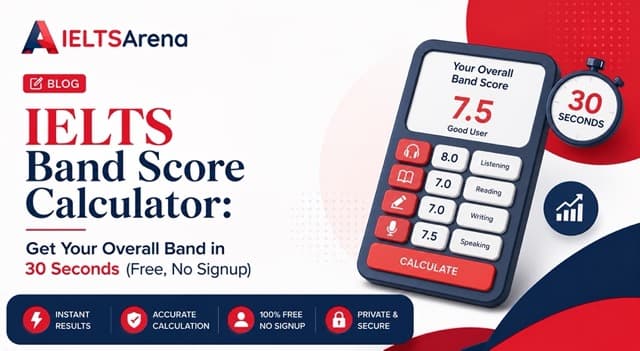
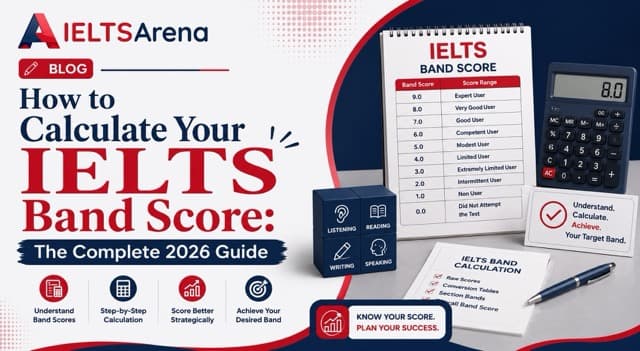
You just finished a practice test and you are staring at your raw score, wondering what it actually means. You got 32 out of 40 in Listening. Is that a Band 7 or a Band 7.5? And if your four section scores are 7, 7, 6.5, and 8, what is your overall band? The IELTS band score calculator system confuses nearly every test-taker at some point, and the confusion leads to unrealistic targets or unnecessary disappointment.
Understanding exactly how IELTS band scores are calculated gives you a major strategic advantage. You stop guessing and start knowing precisely how many more correct answers you need to move from Band 6.5 to Band 7. This guide breaks down the complete calculation system, with the exact conversion tables and the most common errors students make when estimating their scores.
How the IELTS Scoring System Actually Works
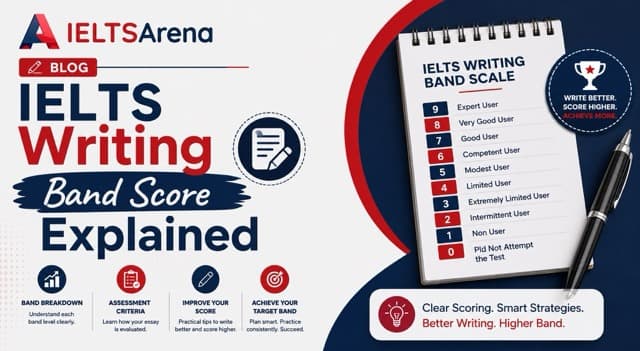
IELTS scores are reported on a nine-band scale. Each band represents a level of English proficiency, from Band 1 (non-user) to Band 9 (expert user). Scores are reported in whole and half bands: 5.0, 5.5, 6.0, 6.5, and so on.
Your overall IELTS band score is the average of your four section scores rounded to the nearest whole or half band. The four sections are Listening, Reading, Writing, and Speaking. Each section is scored separately and contributes equally to the overall.
The IELTS band score calculator process works differently for different sections. Listening and Reading are scored from raw marks. Writing and Speaking are assessed by trained examiners using detailed criteria.
Understanding each calculation method helps you know exactly where your score comes from and what it takes to improve it.
Advertisement
Why Students Get Their Band Score Estimates Wrong
The most common mistake is assuming IELTS uses percentage-based scoring, like many school exams. It does not.
A student scores 30 out of 40 in Listening and thinks: that is 75 percent, so roughly Band 7.5. Actually, 30 correct answers in Listening is Band 7.0. The conversion is not linear and it differs between Academic and General Training Reading.
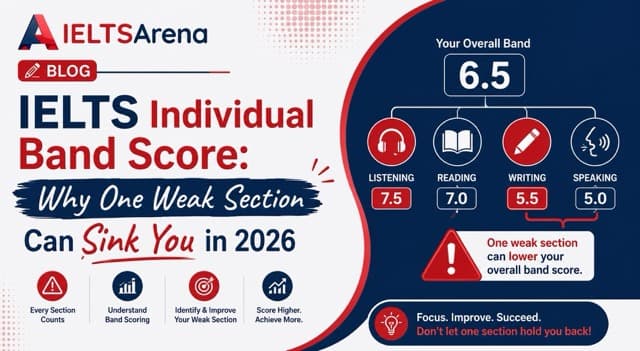
The second mistake is averaging section scores incorrectly. The overall band is rounded to the nearest 0.5. This means the calculation can produce results that feel counterintuitive. If your four section scores are 5.0, 6.0, 7.0, and 8.0, the average is 6.5. If your scores are 5.0, 6.0, 7.0, and 7.5, the average is 6.375, which rounds to 6.5. Two very different performances produce the same reported band.
The third mistake is applying Academic Reading conversion tables to General Training Reading scores, or vice versa. The two tests have different passing thresholds for each band.
One Test-Taker Who Mastered Score Calculation
Marcus, an engineer from Nigeria pursuing immigration to Australia, needed an overall Band 7 for his visa application. He had been scoring around 6.5 in his practice tests and could not understand why his score would not move.
When he started using IELTSArena's IELTS band score calculator tools, he realised the problem immediately. His Writing section was dragging his average down to 6.5 every time, even when his other sections were strong.
"I thought my Listening and Reading were enough to pull my Writing up," he said. "But IELTSArena showed me the exact maths. My Writing at 6.0 was costing me 0.25 of a band overall, and that gap between 6.75 and 7.0 was the whole problem."
He spent four weeks focused entirely on Writing Task 2 structure and vocabulary range. His next practice test on IELTSArena showed Writing at 6.5. His overall jumped to 7.0. He passed his actual exam with 7.5 overall.
The fix came from understanding the numbers, not from working harder in every section equally.
The Exact IELTS Raw Score to Band Conversion
Here is how the IELTS band score calculator works for each section.
Listening: Raw Score to Band
IELTS Listening has 40 questions. Each correct answer earns one mark. The raw score converts to a band as follows:
- 39 to 40 correct: Band 9
- 37 to 38 correct: Band 8.5
- 35 to 36 correct: Band 8
- 32 to 34 correct: Band 7.5
- 30 to 31 correct: Band 7
- 26 to 29 correct: Band 6.5
- 23 to 25 correct: Band 6
- 18 to 22 correct: Band 5.5
- 16 to 17 correct: Band 5
These conversions are approximate and may vary slightly by test version. IELTSArena uses the official conversion ranges in its scoring system.
Academic Reading: Raw Score to Band
Academic Reading also has 40 questions. Conversion to band:
- 39 to 40 correct: Band 9
- 37 to 38 correct: Band 8.5
- 35 to 36 correct: Band 8
- 33 to 34 correct: Band 7.5
- 30 to 32 correct: Band 7
- 27 to 29 correct: Band 6.5
- 23 to 26 correct: Band 6
- 19 to 22 correct: Band 5.5
- 15 to 18 correct: Band 5
General Training Reading: Raw Score to Band
General Training Reading has 40 questions but the scoring threshold is higher:
- 40 correct: Band 9
- 39 correct: Band 8.5
- 37 to 38 correct: Band 8
- 36 correct: Band 7.5
- 34 to 35 correct: Band 7
- 32 to 33 correct: Band 6.5
- 30 to 31 correct: Band 6
- 27 to 29 correct: Band 5.5
- 23 to 26 correct: Band 5
Writing and Speaking: Criteria-Based Scoring
Writing and Speaking do not use raw scores. Trained examiners assess responses using four criteria, each weighted equally at 25 percent.
For Writing Task 1: Task Achievement, Coherence and Cohesion, Lexical Resource, Grammatical Range and Accuracy.
For Writing Task 2: Task Response, Coherence and Cohesion, Lexical Resource, Grammatical Range and Accuracy.
For Speaking: Fluency and Coherence, Lexical Resource, Grammatical Range and Accuracy, Pronunciation.
Each criterion is scored from 0 to 9 in whole and half bands. The four scores are averaged to produce the section band. IELTSArena's AI scoring system assesses Writing and Speaking using these exact criteria and provides detailed feedback on each one.
How to Calculate Your Overall IELTS Band Score
The IELTS overall band score is calculated by averaging your four section scores and rounding to the nearest 0.5.
Here is how the rounding works:
- If your average ends in .125 or below, round down to the nearest 0.5 (e.g. 6.125 rounds to 6.0)
- If your average ends in .25 to .374, round up to the nearest 0.5 (e.g. 6.25 rounds to 6.5)
- If your average ends in .375 to .624, round up to the nearest 0.5 (e.g. 6.5 stays at 6.5)
- If your average ends in .625 to .874, round up to the nearest whole number (e.g. 6.625 rounds to 7.0)
- If your average ends in .875 or above, round up to the nearest 0.5 (e.g. 6.875 rounds to 7.0)
This rounding rule explains why two students with apparently different section profiles can end up with the same overall band. It also explains why improving your weakest section by just 0.5 can sometimes produce a full band improvement in the overall score.
The IELTSArena band calculator automatically applies these rounding rules and shows you exactly what you need to improve in each section to hit your target overall band.
How IELTSArena Simplifies Band Score Tracking
The manual IELTS band score calculator approach works, but it takes time and it is easy to make errors. IELTSArena does all of this automatically.
When you complete a full practice test on IELTSArena, the platform instantly converts your Listening and Reading raw scores to band equivalents using official conversion tables. Your estimated Writing and Speaking bands are generated through IELTSArena's AI assessment engine, which evaluates your responses against the same criteria used by real IELTS examiners.
IELTSArena then calculates your overall band score, shows you where each section sits, and highlights exactly how many marks or band points you need in each section to reach your target overall score.
The IELTSArena score dashboard shows your progress over time. You can see whether your Listening is improving, whether your Writing plateau has broken, and which sections are closest to your target. This makes your IELTS band score calculator information useful for planning your next study sessions rather than just reporting your current performance.
IELTSArena also offers a target score planner. You enter your required overall band, and the IELTSArena system shows you what combination of section scores would achieve that target, including which sections give you the most room to improve. For students where one section is particularly challenging, this is genuinely useful strategic information.
Self-Diagnosis: Do You Understand Your Current Score Position?
Before your next practice test, answer these questions:
Do you know exactly how many correct answers you need in Listening to reach your target band? If not, you are preparing without a clear target to aim at.
Have you calculated what your overall band would be if you improved your weakest section by 0.5 while keeping your others the same? This is the single most efficient way to find your highest-value improvement area.
Are you aware of how your Writing and Speaking sections are currently being assessed, and specifically which of the four assessment criteria is your weakest point?
Do you know the difference between IELTS Academic and General Training Reading conversion tables, and are you using the right one for your test type?
Have you used an accurate IELTS band score calculator to check your practice test results, rather than estimating your band based on percentage scores?
IELTSArena gives you clear answers to all five of these questions after every practice test, so you are never guessing about your performance.
Get Your Accurate Band Score Today
Understanding the IELTS band score calculator system is not just academic. It changes how you prepare. When you know exactly how many marks separate you from your target band in each section, you stop wasting time on areas you are already strong in and start investing in the areas where improvement is worth the most.
IELTSArena provides the most accurate free IELTS band score calculator and practice test experience available, with instant scoring across all four sections and AI-powered feedback on Writing and Speaking.
Take Your First Free Practice Test on IELTSArena →
Frequently Asked Questions
How is the IELTS overall band score calculated from four sections?
The IELTS overall band score is the average of your four section scores in Listening, Reading, Writing, and Speaking, rounded to the nearest whole or half band. For example, if your section scores are 7.0, 6.5, 7.0, and 7.5, the average is 7.0. If your scores produce an average ending in .25 or higher, the score rounds up to the next half band. IELTSArena's IELTS band score calculator applies these rules automatically.
If I get 7 in three sections and 6 in one, what is my overall IELTS band score?
If you score 7.0 in three sections and 6.0 in one section, your average is 6.75. Using IELTS rounding rules, 6.75 rounds up to 7.0 overall. This is why improving your weakest section is often more valuable than marginal gains in sections where you are already performing well. IELTSArena shows you exactly how your section scores combine to produce your overall band.
How many correct answers do I need to get Band 7 in IELTS Listening?
To achieve Band 7 in IELTS Listening, you need to answer 30 to 31 questions correctly out of 40. For Band 7.5, you need 32 to 34 correct. These thresholds can vary slightly by test version. IELTSArena uses official conversion tables to calculate your Listening band score from your raw score after every practice test.
Does IELTS round up or round down when calculating the overall band score?
IELTS uses a specific rounding rule. If your average ends in .25 or above, the score rounds up to the next half band. If it ends below .25, it rounds down. So an average of 6.25 rounds to 6.5, but an average of 6.124 rounds to 6.0. IELTS does not use simple rounding to the nearest 0.5 in all cases. The IELTSArena IELTS band score calculator applies the correct rounding formula automatically.
What is the minimum score I can get in each IELTS section and still get overall Band 7?
To achieve an overall Band 7 with the lowest possible section scores, you would need your four sections to average exactly 7.0 or slightly above (before rounding). For example, scores of 6.5, 7.0, 7.0, and 7.5 average to 7.0. Or scores of 6.0, 7.0, 7.5, and 7.5 also average to 7.0. This means a single section at 6.0 is possible if your other sections compensate. However, many visa and university programmes require minimum section scores as well as an overall band, so check the specific requirements for your destination.