You hit your overall band and you still got rejected. If that has happened to you, the problem is almost never your overall score. It is your IELTS individual band score, the number you earned in each separate section, and in 2026 that single-section figure decides more outcomes than the headline band ever did.
Universities across the UK and beyond tightened their 2026 entry rules to check each module, not just the average, with several competitive courses now demanding Writing 6.5 or higher even when the overall requirement sits lower (Envision Education, 2026). Visas work the same way: a per-section floor that one weak skill can break.
This guide explains exactly how the individual band score works, why one weak module quietly fails strong applicants, and the fastest reliable way to lift the section that is holding you back.
What an IELTS individual band score actually is
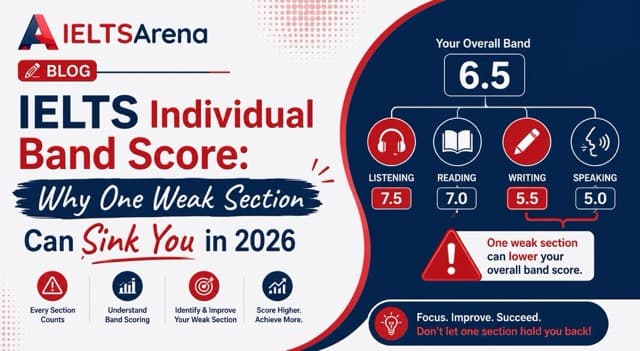
An IELTS individual band score is the band you receive in each of the four sections separately: Listening, Reading, Writing and Speaking. Your overall band is the average of those four, rounded to the nearest 0.5. So a candidate with 7.0, 7.0, 6.5 and 5.5 averages to 6.5 overall, yet still has a 5.5 sitting underneath.
That gap is the whole problem. The overall band hides the weakest skill, but admissions teams and visa officers look straight at the sections. Most UK universities now publish a minimum in each module alongside the overall requirement, and the offer depends on clearing both.
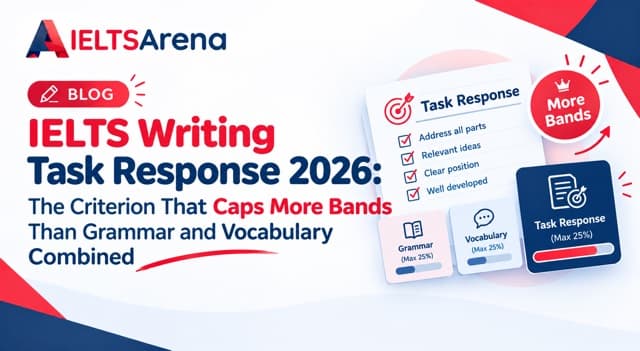
The four sections are scored against fixed criteria. Writing and Speaking are each judged on four equally weighted bands, including Task Response, Coherence and Cohesion, Lexical Resource, and Grammatical Range and Accuracy for Writing. A weak criterion drags the section, and a weak section drags your offer.
Advertisement
Why a good overall band still gets rejected
Most candidates optimise the wrong number. They chase a higher overall band by pushing their already strong skills, when the rejection risk lives entirely in their lowest section score.
The first reason is the module minimum. A course may state "6.5 overall with no band below 6.0." A candidate with a 7.5 overall built on a 5.5 in Writing fails that condition, despite a far higher average than the requirement.
The second reason is the visa floor. The UK Student visa, for example, requires you to meet a minimum in every section, so one section below the line blocks the visa even after a university offer.
The third reason is rounding. A 6.25 average rounds up to 6.5 overall, which feels safe, but the sections it is built on can still contain a number below a required floor. The overall band gives false comfort while the individual band score does the real gatekeeping.
A real student story: Maria from the Philippines
Maria, a 26-year-old nurse from Cebu in the Philippines, applied to a UK master's programme for 2026 that required 7.0 overall with no band below 6.5. Her result looked excellent at first glance: an overall band of 7.0.
The breakdown told a different story. Listening 8.0, Reading 7.5, Speaking 7.0, and Writing 5.5. Her overall met the requirement exactly, but her Writing of 5.5 was a full band below the 6.5 module minimum, so her offer was withheld.
"I celebrated the 7.0 for a whole day before I read the rejection," Maria said. "My overall was perfect. One section ended it."
She stopped trying to raise her already strong skills and put everything into Writing. She practiced Task 1 and Task 2 under timed conditions and had each essay scored against the four criteria so she could see precisely where she lost marks. Eight weeks later her Writing reached 6.5, her overall rose to 7.5, and her offer was confirmed. She did not need a higher average. She needed to fix her lowest section score.
The data behind the module-score problem
The reason Writing fails so many applicants is not bad luck. It is the hardest skill for most test-takers worldwide. IELTS test-taker performance data has consistently shown Writing as the lowest-scoring of the four skills, with the global mean Writing band sitting below Listening, Reading and Speaking (IELTS.org test taker performance, 2024).
That pattern collides with where the bar is rising. In 2026, UK universities placed greater emphasis on individual module scores, especially Writing and Speaking, because those skills predict whether a student can produce academic essays and join classroom discussion (Envision Education, 2026; Gradding, 2026). The skill candidates score lowest in is the skill institutions now scrutinise most.
The result is a structural mismatch. A candidate can be strong in three skills, hit the overall band comfortably, and still miss because the one weak section is the exact section the 2026 rules care about.
Your overall band is an average. Your offer is decided by your weakest number. In 2026, those are rarely the same thing.
How to raise a weak IELTS individual band score
Lifting one section is faster than lifting an overall band, because you concentrate all your effort on a single skill. Here is the approach that works.
First, identify the exact section and the exact criterion. Do not just note "Writing is weak." Find out whether you are losing marks on Task Response, Coherence and Cohesion, Lexical Resource, or Grammatical Range and Accuracy.
Second, stop practicing your strong skills. Another point in Listening will not fix a Writing floor. Redirect your study time entirely to the lowest section until it clears the required minimum.
Third, practice under exam timing. Many candidates can write a good essay in an hour but not in the 40 minutes Task 2 allows. The clock is part of the skill.
Fourth, get scored feedback, not just more practice. Writing and Speaking improve from criterion-level correction, not repetition. You need to see which specific criterion is capping your band.
Fifth, retest only when your weak section reliably clears the floor in mock conditions, not when you feel ready. Feelings round up. Mock scores do not.
How IELTSArena fixes the section that is holding you back
The problem with a weak individual band score is that generic practice does not reveal which criterion is costing you marks. IELTSArena is built to expose and close that exact gap.
IELTSArena's AI Writing feedback scores your Task 1 and Task 2 essays instantly against all four criteria and shows the precise sentences and patterns pulling your band down, so you stop guessing and start fixing. For Speaking, the AI scores fluency, pronunciation, vocabulary and grammar so you can see your weakest criterion clearly.
When you want a human standard, expert tutors give band-focused corrections that mirror examiner judgement, the kind of nuance AI-only platforms cannot fully replicate. That matters most for the half-band that separates a 6.0 from a 6.5 in the section blocking your offer.
Progress analytics track each module separately across every mock, so you watch your weakest section climb toward the floor it needs to clear. You practice in the real CBT interface throughout, so the format never costs you marks on test day. Start free and see all four of your individual band scores in your first sitting.
Quick self-check: is one section about to fail you?
Run through these before you book or rebook your test.
Do you know your required minimum in each section, not just the overall band you need?
Do you know which single module is currently your lowest, and by how much?
For your weakest skill, do you know the exact criterion costing you marks?
Can you hit the required band in your weakest section under full exam timing, not just relaxed practice?
Have you confirmed your sectional scores on a real CBT mock, or only on paper or by feel?
A hesitation on any of these is the gap between a strong overall band and an offer that actually arrives.
Find your weakest section before the examiner does
You should never discover your weakest section score from a rejection letter. Take one free mock test on IELTSArena and you will see your band in every section, plus the exact criterion holding each one back.
In a single test you will know which section needs the work, and exactly what to do about it.
Take Your First Free Mock on IELTSArena →
Frequently Asked Questions
What is the minimum IELTS band score in each section?
There is no single universal minimum, because each university, programme and visa route sets its own per-section floor. As a guide, many UK Student visa routes require at least the stated minimum in every section, and competitive university courses often demand no band below 6.0 or 6.5 even when the overall requirement is 6.5 or 7.0. The key point is that your band in each section is checked separately from your overall band. Always confirm both the overall requirement and the per-section minimum for your exact programme, then aim to clear the higher of the two in every skill.
Can I fail a visa with a good overall IELTS band?
Yes. Many visa and admission routes check a minimum in each section, so a strong overall band does not protect you if one section falls below the required floor. For example, a 7.0 overall built on a 5.5 in Writing can fail a programme that requires no band below 6.5, despite the high average. This is the most common reason capable candidates are refused. The fix is to treat the requirement as four separate targets and clear the minimum in every section, not just on average, before you submit your application or sit your visa-qualifying test.
Why does my IELTS Writing score matter more than my overall band?
Writing matters more in practice because it is both the hardest section for most test-takers and the section institutions scrutinise most in 2026. IELTS test-taker performance data has long shown Writing as the lowest-scoring skill globally (IELTS.org, 2024), while universities increasingly set a specific Writing minimum to confirm you can produce academic essays (Envision Education, 2026). A high overall band built on a weak Writing score frequently fails a module requirement. Raising that one section, with criterion-level feedback on Task Response, Coherence and Cohesion, Lexical Resource and Grammar, is usually the fastest route to an offer.
What IELTS individual band score do UK universities need in 2026?
It varies sharply by institution and course. In 2026, mid-tier UK universities commonly ask for 6.5 overall with no band below 6.0, while top institutions such as Oxford and Cambridge require around 7.5 overall with 7.0 in every section (IELTS International, 2026). Many programmes now state a specific Writing or Speaking minimum on top of the overall figure. Always check your exact course page rather than relying on a general guide, and prepare each section to its required band. The safest target is to clear the per-section minimum your programme states, in every skill, with a small margin.
How do I raise one weak IELTS module?
Concentrate entirely on the weak section instead of spreading effort across all four. First, identify the exact criterion losing you marks, for example Coherence and Cohesion in Writing or Pronunciation in Speaking. Second, practice that section under full exam timing, since speed is part of the skill. Third, get scored, criterion-level feedback rather than just doing more practice, because repetition alone rarely moves a band. Platforms such as IELTSArena score your Writing and Speaking against each criterion and track that single module across mocks, so you can watch it climb toward the floor you need before you book a retake.