
You know the word. It is on the tip of your tongue. But for three full seconds you say nothing, and in those three seconds the examiner has already noted a hesitation.
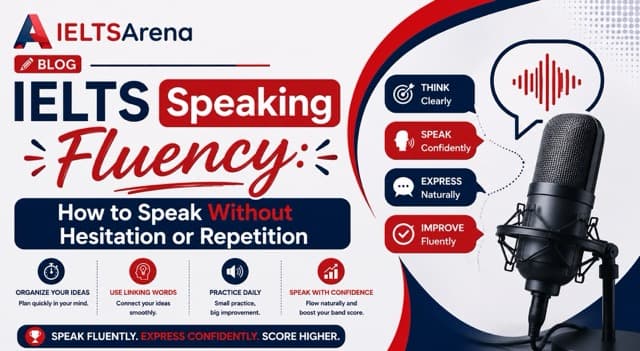
IELTS speaking fluency is not about speaking fast. It is about speaking smoothly, without the long pauses, the constant self-correction, and the repetition that pull your band down. The examiner is listening for flow, and flow is the first thing that breaks under pressure.
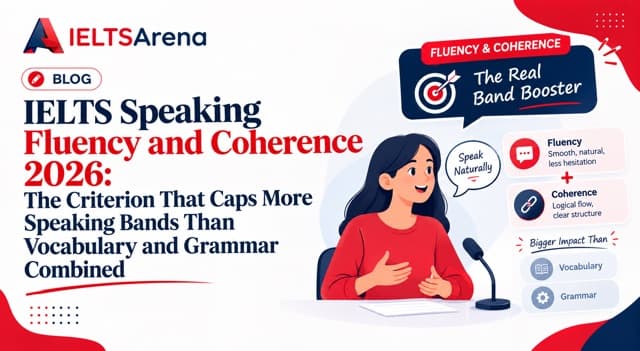
Fluency and Coherence is one of four criteria in the Speaking test, worth a full 25 percent of your score. Many test-takers have the vocabulary and grammar for Band 7 but get stuck at Band 6 because their delivery stalls. This guide shows you how to fix that.
What Examiners Actually Mark as Fluency
Fluency and Coherence is the first of the four Speaking criteria, alongside Lexical Resource, Grammatical Range and Accuracy, and Pronunciation. Each is worth 25 percent.
Fluency measures how smoothly and continuously you speak. The examiner is listening for your ability to keep going at a natural pace without unnatural pauses, without losing your thread, and without repeating yourself to fill silence.
Coherence sits beside it. This measures whether your ideas connect logically and whether you use linking words to guide the listener. The IELTS speaking coherence criterion rewards answers that develop, not answers that jump around.
Here is the part many test-takers miss. Fluency is not speed. An examiner does not reward fast talkers. They reward speakers who maintain a steady flow, even at a measured pace.
You can speak slowly and still score Band 8 for fluency, as long as your pauses are natural thinking pauses and not breakdowns. The goal is continuous, controlled speech, not a race.
Advertisement
Why Common Approaches to Fluency Fail
Most test-takers try to improve fluency the wrong way, and it costs them in the exam room.
The first mistake is memorising answers. Students learn full scripted responses and recite them. Examiners are trained to spot memorised speech, and when you hit a question that does not match your script, your fluency collapses completely.
The second mistake is chasing big words. Test-takers stuff in advanced vocabulary they are not comfortable with, then hesitate while searching for the next showy word. The reach for fancy language is one of the biggest causes of hesitation.
The third mistake is silent panic. When students do not know what to say, they freeze. A long silent pause reads as a fluency breakdown, even when the student knows the topic well.
The fourth mistake is over-correcting. Some speakers stop mid-sentence to fix every small grammar slip. This constant restarting destroys IELTS speaking flow and signals a lack of confidence.
The honest reality is that fluency comes from how you handle not knowing, not from how much you have memorised. Band 7 speakers keep going. Band 6 speakers stop.
Fluency is not the absence of thinking. It is the ability to keep speaking while you think.
A Real Student Story: From Band 6 to Band 7.5 Speaking
Amara, a 26-year-old marketing graduate from Nigeria, needed Band 7 in Speaking for a university place in Canada. Her English was strong in daily life, but her Speaking band stalled at 6.0 across two attempts.
The problem was not vocabulary or grammar. It was hesitation. In Part 2, she would pause for several seconds searching for the perfect word, and in Part 3 she restarted sentences whenever she felt an answer was not clever enough.
"I thought every pause made me look thoughtful," Amara said. "Then I learned the examiner was marking those pauses as broken fluency. I was sabotaging myself by trying too hard."
She changed her approach. She practised speaking for two full minutes without stopping, using simple linking phrases to buy thinking time instead of going silent. She stopped chasing rare words and used vocabulary she actually owned.
After four weeks, her IELTS speaking fluency transformed. Her next result was Band 7.5 in Speaking. Her vocabulary had not expanded much. She had simply stopped interrupting her own flow.
Amara's story shows the core truth. Most test-takers stuck at Band 6 are not missing knowledge. They are missing smoothness, and smoothness is trainable.
What the Data Says About Speaking Bands
Speaking is often where test-takers feel most exposed, and the score distribution reflects it. The global mean for IELTS Speaking has hovered around Band 5.9 to 6.0 in recent reporting from the official IELTS partners.
The jump from Band 6 to Band 7 in Speaking is one of the most requested improvements in IELTS preparation. According to band descriptors published by the official test makers, the key difference at Band 7 is the ability to speak at length without noticeable effort, even if some hesitation remains.
That phrase, "without noticeable effort," is the whole game. At Band 6, hesitation is usually content-related, meaning you pause to find ideas and words. At Band 7, your pauses are mostly to find ideas, not words, and they are far less frequent.
Consider the weighting. Fluency and Coherence is 25 percent of your Speaking score. A speaker who fixes hesitation can lift this single criterion by a full band, which can raise the overall Speaking score by 0.5 once the four criteria are averaged.
For nursing registration, many bodies require Band 7 in each section. For skilled migration to Australia, Band 7 is common. Half a band on fluency can decide an entire application.
The Right Approach: Daily Exercises That Build Fluency
Fluency is a physical skill, like a sport. It improves with daily, specific practice. Use these exercises.
Exercise 1: The two-minute non-stop talk. Pick any Part 2 cue card topic. Speak for two full minutes without stopping. If you get stuck, use a filler phrase and keep going. This trains your brain to maintain flow under pressure.
Exercise 2: Buy time with natural phrases. Learn three or four phrases that fill thinking gaps smoothly. Examples include "That is an interesting question," "Let me think about that for a moment," and "I suppose the main thing is." These replace silent pauses with natural IELTS speaking flow.
Exercise 3: Shadow native speakers. Play a short clip of a podcast or interview, then repeat it sentence by sentence, copying the rhythm and pace. Shadowing builds the muscle memory of smooth, connected speech.
Exercise 4: Record and review. Record yourself answering questions, then listen back and count your long pauses and repetitions. You cannot fix what you do not measure. This single habit drives more IELTS speaking confidence than any tip.
Exercise 5: Use simple linking words. Connect your ideas with "because," "for example," "on the other hand," and "as a result." These signal coherence and naturally keep you talking, which supports fluency.
Now a critical fluency rule. Filler words like "um," "ah," and "you know" are not automatically penalised when used occasionally, because natural speakers use them too. The problem is overuse. When every other word is "um," it reads as a fluency breakdown. Aim to replace empty fillers with meaningful linking phrases.
Self-correction is the same. Correcting one major error is natural. Constantly restarting sentences is not. Let small slips go and keep your flow moving forward.
How IELTSArena Helps You Build Fluency
The hardest part of Speaking practice is that you cannot hear your own hesitations the way an examiner does. You need feedback, and you need it on your actual delivery.
IELTSArena solves this directly with AI speaking feedback. You record your answers to real Speaking questions, and the platform scores your fluency, pronunciation, vocabulary, and grammar, then shows you exactly where your hesitation and repetition appear.
The feedback is specific to your delivery. Instead of a vague "speak more smoothly," IELTSArena's AI speaking feedback identifies the pauses and repeated phrases that are pulling your fluency below Band 7.
For deeper correction, IELTSArena offers expert tutor feedback. A human tutor listens to your Speaking response and gives band-focused guidance on flow, coherence, and how to manage thinking time, the kind of nuance an AI-only tool cannot fully replicate.
You also build the habit of speaking at length. IELTSArena gives you structured daily goals, so you practise the two-minute long turn and Part 3 discussion every day. Daily practice is what turns hesitant speech into smooth speech.
The progress analytics track your fluency band across every practice session. Over 10,000 learners have used IELTSArena to watch their Speaking scores climb session by session, so you know your fluency work is actually moving the number.
You can record one answer today on IELTSArena and get an instant read on your fluency band. That single recording tells you more than weeks of guessing.
Self-Diagnosis: Is Hesitation Holding Your Band Back?
Answer these five questions honestly about your last Speaking practice.
- Can you speak for the full two minutes in Part 2 without a long silent pause?
- Do you reach for advanced words you are not comfortable with, then hesitate while searching for them?
- How often do you restart sentences to correct small errors that did not really matter?
- Do you fill thinking gaps with natural phrases, or do you go completely silent?
- When did you last hear a recording of your own answer and count your pauses and repetitions?
If these questions exposed a gap, hesitation is likely the single thing standing between your current band and Band 7. It is also one of the most trainable parts of the test.
Find Out Your Speaking Fluency Band Today
You do not need to wonder whether your fluency is Band 6 or Band 7. You can hear it for yourself with feedback.
Record a Speaking Answer on IELTSArena →
Frequently Asked Questions
How do I speak more fluently in the IELTS speaking test without long pauses?
To speak more fluently without long pauses, train your brain to keep going instead of going silent. Practise the two-minute non-stop talk daily, where you speak about a Part 2 topic without stopping. When you need thinking time, use natural phrases like "That is an interesting question" or "Let me think about that" instead of falling silent. Stop chasing advanced words you are not comfortable with, because reaching for them is a major cause of hesitation. Use simple linking words such as "because" and "for example" to connect ideas and keep talking. IELTSArena's AI speaking feedback shows you exactly where your pauses appear so you can target them directly.
Does using filler words like um and ah reduce my IELTS speaking fluency score?
Occasional fillers like "um" and "ah" are not automatically penalised, because natural speakers use them too. The problem is overuse. When fillers appear in almost every sentence, they read as a fluency breakdown and pull your Fluency and Coherence score down. The fix is to replace empty fillers with meaningful phrases that buy you the same thinking time, such as "I suppose the main point is" or "on the other hand." These keep your speech flowing while sounding natural. Recording yourself and counting your fillers is the fastest way to notice the habit and reduce it before your IELTS speaking test.
What exercises improve fluency specifically for the IELTS speaking test?
The most effective fluency exercises are the two-minute non-stop talk, shadowing, and record-and-review. For the non-stop talk, pick a Part 2 cue card and speak for two full minutes without stopping, using filler phrases rather than silence when stuck. Shadowing means repeating short clips of natural English to copy the rhythm and pace. Record-and-review means recording your answers, then listening back to count pauses and repetitions. Add daily practice with linking words to build coherence. IELTSArena provides structured daily speaking goals and AI feedback, so you can run these exercises with real Speaking questions and measure your fluency band as it improves.
How do examiners differentiate between band 6 and band 7 fluency in IELTS speaking?
The key difference is effort. At Band 6, speakers can keep going but with noticeable hesitation, frequent self-correction, and pauses to search for both ideas and words. At Band 7, the speaker talks at length without noticeable effort, and the remaining pauses are mostly to find ideas rather than basic vocabulary. Band 7 speakers also use a wider range of linking words to connect ideas smoothly. In short, Band 7 sounds controlled and continuous, while Band 6 sounds like it is working hard to stay afloat. Reducing word-search hesitation and constant restarting is the clearest path from Band 6 to Band 7 fluency.
Can I improve IELTS speaking fluency in two weeks before my exam?
Yes, meaningful improvement in two weeks is realistic if you practise daily and target the right habits. Focus on three things. First, do the two-minute non-stop talk every day so you train continuous speech. Second, learn three or four natural phrases to replace silent pauses. Third, record yourself daily and count your hesitations so you can see progress. You will not transform your vocabulary in two weeks, but you can significantly smooth your delivery, which is often what separates Band 6 from Band 7. IELTSArena's daily goals and AI speaking feedback make this two-week sprint structured and measurable, so you walk into the exam with steadier flow.