
You already scored Band 8.0 in IELTS. Your English is genuinely strong, your Listening and Reading are near the top of the scale, and yet your scholarship, fellowship, or doctoral admission asks for 8.5. The half-band gap feels surreal at this level: you have run out of obvious mistakes to fix.
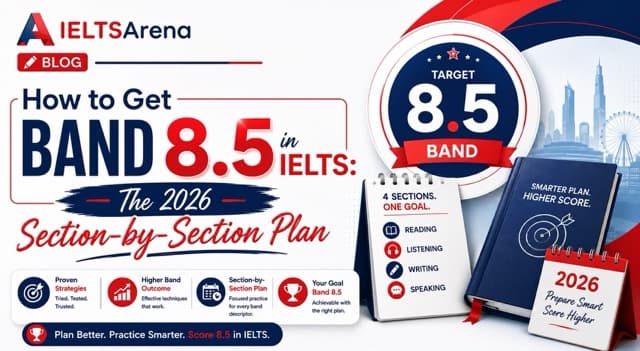
Learning how to get Band 8.5 in IELTS in 2026 is the most surgical version of test preparation. At Band 8, you are no longer adding vocabulary or learning structure. You are eliminating tiny, intermittent slips that an examiner notices precisely because everything else is so clean.
This guide shows you the exact raw-score targets per section, the realistic timeline, and the precision plan that moves a strong Band 8 to a Band 8.5.
What Band 8.5 in IELTS Actually Means
Band 8.5 sits at the top tier of IELTS performance, between "very good user" (Band 8) and "expert user" (Band 9). On the 1 to 9 scale, your overall band is the average of your four section scores, rounded to the nearest 0.5.
To land an overall 8.5 you generally need your four sections to average 8.25 or higher. For example, 9, 9, 8, 7.5 averages to 8.375 and rounds up to 8.5. A profile of 8, 8, 8, 8 averages to exactly 8.0, so a single section moving from 8 to 9 is often the difference.
Band 8.5 is therefore not about being perfect everywhere. It is about being excellent in three skills and at least very good in the fourth, with no single section pulling the average down to 8.0.
This is why the IELTS Band 8.5 target is best attacked per section, not as a vague overall goal. At this level, you need to know the precise raw score and the exact slip that is capping each skill.
Advertisement
How to Get Band 8.5 in IELTS in Each Section
Here are the section targets to aim for. These are the raw-score bands that typically map to a Band 8.5 result.
Listening. Band 8.5 needs roughly 37 to 38 correct out of 40, about 93 percent. The Listening scale is the same for Academic and General Training, so the target does not change between modules.
Reading (Academic). Aim for about 37 to 38 correct out of 40. At this level, the gap between 8.0 and 8.5 is one or two questions, almost always on the hardest matching or True/False/Not Given items.
Reading (General Training). Aim for about 38 to 39 correct out of 40, since General Training passages are more accessible and the band boundaries are stricter at the top.
Writing. Scored against four equally weighted criteria. A Band 8.5 essay is well-developed, accurate, and uses a wide range of vocabulary and structures with rare and minor slips that do not affect communication.
Speaking. Scored on Fluency and Coherence, Lexical Resource, Grammatical Range and Accuracy, and Pronunciation. Band 8.5 speech is fluent, flexible, precise, and natural, with rare hesitation and confident use of less common features.
If someone asks how do I get Band 8.5 in IELTS in each section, the short answer is: about 37 to 38 out of 40 in Listening and Academic Reading, 38 to 39 in General Training Reading, and consistent very-good-to-excellent performance against all four criteria in Writing and Speaking.
Why Most Band 8 Candidates Cannot Reach Band 8.5
At this level, the usual study advice breaks down. The errors capping you at 8.0 are not patterns; they are isolated slips. Four common reasons strong candidates stall here.
The first is the comma and article trap. Native-level grammar is still penalised when a few stray article omissions or comma splices appear across an essay. At Band 8, examiners notice them precisely because the rest is so clean.
The second is over-elaboration in Writing. Strong candidates write longer, more complex sentences to "showcase" range, and lose accuracy in the process. Examiners reward precision and clarity at the top of the scale, not length.
The third is missing the last hardest questions in Reading and Listening. The gap between 35 and 37 correct comes from True/False/Not Given, matching headings, and the multi-speaker section in Listening, not from speed.
The fourth is Speaking that is fluent but not flexible. Band 8.5 needs natural use of less common vocabulary and varied structures across the full interview, not just within prepared answers.
The fix is a precision feedback loop, not more practice.
Real Student Story: Mei from Shanghai, From 8.0 to 8.5
Mei, a 26-year-old doctoral candidate from Shanghai applying for a competitive fellowship in the UK, needed Band 8.5 overall. Her first result was 8.0: Listening 8.5, Reading 8.5, Writing 7.5, Speaking 7.5.
She had already prepared for months. The score had moved from 7.5 to 8.0 with broad study, but the next half-band would not budge.
When her Writing essays were analysed against the criteria, the pattern was small but consistent. She lost half a band on Grammatical Range and Accuracy from intermittent article slips, and on Lexical Resource from over-using two or three favourite linking phrases.
She switched to micro-correction. She wrote shorter, sharper Task 2 essays focused on accuracy and precise word choice, received band-level feedback, and rewrote each one until the same slips stopped appearing. For Speaking, she recorded Part 3 responses and replaced repeated phrases with more varied alternatives.
Five weeks later she retook the test: Listening 9.0, Reading 9.0, Writing 8.0, Speaking 8.0, for an overall 8.5. The fellowship was hers.
Band 8.5 is not about studying more. It is about removing the four invisible slips that keep you at 8.0.
The Data: How Rare Band 8.5 Really Is
Band 8.5 is one of the rarest results in IELTS. Examiner data and concordance summaries from the British Council and IDP Education suggest that fewer than 1 percent of test-takers reach Band 8.5 or higher overall, placing a Band 8.5 candidate in the top tier of all who sit the test (British Council and IDP test statistics, 2024 to 2026).
The section most likely to hold back a Band 8.5 attempt is Writing. Global IELTS performance data puts the mean Writing band around 5.9, and the distribution thins sharply above 7.5. A Band 8 Writing score is already top-decile; reaching 8.5 or 9.0 demands flawless control over Task Response, Coherence, Lexical Resource, and Grammatical Range and Accuracy.
For scholarships, doctoral admissions, and the most competitive academic positions, a Band 8.5 is often what separates two otherwise identical applicants. The realistic timeline is encouraging: moving from Band 8.0 to Band 8.5 usually takes about 4 to 6 weeks of precision practice with feedback, since the gap is small but specific.
The lesson is that Band 8.5 is rare but reachable in weeks once you stop adding and start subtracting.
The Right Way to Score Band 8.5 in IELTS
Use this micro-correction plan instead of more broad study.
- Take a full timed mock test first. You cannot fix what you have not measured. At Band 8 you need a precise breakdown per section.
- Identify the single skill that is below 8.5. For most Band 8 candidates, Writing or Speaking is the blocker.
- In Reading and Listening, drill the hardest two question types. The jump from 35 to 38 correct comes from True/False/Not Given, matching headings, and the multi-speaker section, not from speed.
- In Writing, shorten and sharpen. Stop chasing complex sentences. Get feedback against all four criteria and rewrite until tiny grammar and lexical slips disappear.
- In Speaking, vary deliberately. Record Part 3 answers and replace repeated linking phrases with more varied alternatives. Practise less common features in natural contexts.
- Practise on a real computer-based interface. At this level, on-screen pace and the timer matter even more, because a few seconds saved on transfer time can win you the last marks.
How IELTSArena Helps You Get Band 8.5 in IELTS
Knowing how to get Band 8.5 in IELTS is one thing. Closing the half-band gap from Band 8.0 needs precision feedback on the slips you cannot see, and that is what IELTSArena provides.
IELTSArena's AI Writing feedback scores your Task 1 and Task 2 against the four criteria and pinpoints the exact sentences losing you marks, so you can stop the intermittent errors that cap strong candidates at 8.0. The AI Speaking feedback does the same for fluency, vocabulary, grammar, and pronunciation.
For the hardest jump, expert tutor feedback gives you band-focused, examiner-style correction on Writing and Speaking, the two sections where Band 8.5 is won or lost. AI alone can flag patterns, but human review explains why a sentence stays at 8.0 instead of 8.5.
The progress analytics track every mock so you can watch your weakest section climb toward 8.5, and the real CBT interface means you train in the exact conditions of test day. Start free on IELTSArena and see your current band before you build your plan.
Self-Diagnosis: Can You Reach Band 8.5?
Be strict with yourself on each one.
- Can you consistently get 37 or more out of 40 in a timed Listening mock?
- In Academic Reading, do you reach 37 or more correct, including the True/False/Not Given questions?
- Can you write a Task 2 essay in 40 minutes with rare and minor grammar slips, against all four criteria?
- Do you know the one or two intermittent errors that appear in your essays?
- Can you speak for two minutes with natural fluency, varied grammar, and confident use of less common features?
If you cannot say yes to most of these, your gap is small but specific. A measured mock with band-level feedback will name the slip.
See Your Real Band Today and Close the Final Half-Band
Band 8.5 is rare, but it is reachable in weeks once you stop adding new study material and start subtracting the few slips that cap you at 8.0.
Take a Free Band 8.5 Diagnostic on IELTSArena →
Frequently Asked Questions
How do I get Band 8.5 in IELTS in each section?
To get Band 8.5 in IELTS you need about 37 to 38 out of 40 correct in Listening, roughly 37 to 38 in Academic Reading or 38 to 39 in General Training Reading, and consistent very-good-to-excellent performance against all four criteria in Writing and Speaking. Writing and Speaking are scored on Task Response or Fluency, Coherence and Cohesion, Lexical Resource, and Grammatical Range and Accuracy, each weighted equally. The fastest route from 8.0 is precision feedback: take a timed mock, identify the single skill below 8.5, and remove the intermittent slips rather than studying broadly. Tools like IELTSArena score your essays against the four criteria so you can target the exact gap.
How many questions do I need right for Band 8.5 in IELTS Listening?
For Band 8.5 in IELTS Listening you need about 37 to 38 out of 40 questions correct, roughly 93 percent. The Listening scale is the same for Academic and General Training, so the target does not change between modules. At this level, the last few marks come from the hardest multi-speaker section and from accurate spelling, since a correct answer spelled wrong is marked wrong. Pre-read the questions in the gaps, write answers as you hear them, and use the transfer time to check spelling. Drilling the hardest two question types repeatedly is more effective than replaying sections you already get right.
How long does it take to go from Band 8 to Band 8.5 in IELTS?
Moving from a strong Band 8 to Band 8.5 in IELTS usually takes about 4 to 6 weeks of precision practice with band-level feedback. The timeline depends on which single skill is holding you back. Candidates who are already at 8.0 and identify the intermittent grammar or lexical slips in their Writing tend to improve faster than those who continue with broad study. The key is a feedback loop on accuracy, not range: take timed mocks, get corrections against the four criteria, and rewrite until the same slips stop appearing. Without targeted feedback, many people stay at 8.0 indefinitely.
Is Band 8.5 in IELTS hard to get?
Yes, Band 8.5 is genuinely rare. Examiner data suggests fewer than 1 percent of test-takers reach Band 8.5 or higher overall, placing a Band 8.5 candidate in the top tier of all who sit the test. That said, for a strong Band 8 candidate it is a precision gap, not a talent ceiling. The errors capping you at 8.0 are usually a few intermittent grammar slips, repeated linking phrases, or one or two missed questions in Reading and Listening. With a clear diagnosis and 4 to 6 weeks of micro-correction on a real exam interface, Band 8.5 is realistic for candidates already at 8.0.
What is the hardest section to score Band 8.5 in IELTS?
For most candidates Writing is the hardest section to score Band 8.5 in IELTS, because it is judged on four criteria at once and intermittent grammar, lexical, or coherence slips quietly cap the score at 8.0. Unlike Reading and Listening, where you can count your raw marks, Writing offers no obvious feedback, so even strong candidates often do not see what is holding them back. The fix is band-level correction against Task Response, Coherence and Cohesion, Lexical Resource, and Grammatical Range and Accuracy. IELTSArena's AI and expert tutor feedback target exactly these criteria, which is why Writing is where precision feedback pays off the most at the top of the scale.