
You scored Band 7.0 in IELTS, and the result feels both close and far. Your university, employer, or regulator wants 7.5, and the half-band gap is the only thing standing between you and your start date. The frustrating part is that you already speak good English.
Learning how to get Band 7.5 in IELTS in 2026 is less about studying more and more about fixing the small, repeated errors that cap you at 7. The half-band jump is where preparation gets surgical: precise raw-score targets, focused Writing feedback, and disciplined timing.
This guide shows you the exact band you need in each section, the realistic timeline, and the focused plan that actually moves a strong 7.0 to a 7.5.
What Band 7.5 in IELTS Actually Means
Band 7.5 means you are a "good user" with operational command, with only occasional inaccuracies and inappropriate usage. On the 1 to 9 scale, your overall band is the average of your four section scores, rounded to the nearest 0.5.
To land an overall 7.5 you generally need your four sections to average 7.25 or higher. For example, 8, 8, 7, 6.5 averages to 7.375 and rounds up to 7.5. A profile of 7, 7, 7, 7 sits at 7.0 exactly, and only one section moving up to 8 can lift it.
So Band 7.5 is not about being perfect everywhere. It is about being strong in three skills and at least solid in the fourth, with no single section dragging the average down to 7.0.
This is why the IELTS Band 7.5 target is best attacked per section, not as a vague overall goal. You need to know the precise raw score each skill demands.
Advertisement
How to Get Band 7.5 in IELTS in Each Section
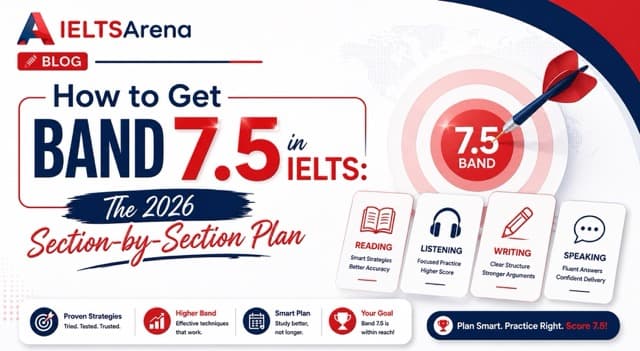
Here are the section targets to aim for. These are the raw-score bands that typically map to a Band 7.5 result.
Listening. Band 7.5 needs roughly 32 to 34 correct out of 40, around 80 to 85 percent. The Listening scale is the same for Academic and General Training, so the target does not change between modules.
Reading (Academic). Aim for about 33 to 34 correct out of 40 for Band 7.5. The Academic passages are denser, which is why the bar sits slightly below General Training in raw terms.
Reading (General Training). Aim for about 35 to 36 correct out of 40, since the passages are more straightforward and the band boundaries are stricter.
Writing. Scored against four equally weighted criteria: Task Response, Coherence and Cohesion, Lexical Resource, and Grammatical Range and Accuracy. A Band 7.5 essay is well-developed, mostly accurate, and uses a flexible range of vocabulary and structures with only occasional slips.
Speaking. Scored on Fluency and Coherence, Lexical Resource, Grammatical Range and Accuracy, and Pronunciation. Band 7.5 speech is fluent, flexible, and largely accurate, with natural use of less common vocabulary and few noticeable errors.
If someone asks how do I get Band 7.5 in IELTS in each section, the short answer is: about 32 to 34 out of 40 in Listening, 33 or more in Academic Reading, and consistent good performance against all four criteria in Writing and Speaking.
Why Most Candidates Stall at Band 7 and Cannot Reach Band 7.5
Several familiar approaches fail to close the half-band gap.
The first is studying breadth instead of fixing errors. At Band 7 your vocabulary is already strong; the problem is a handful of repeated grammar and coherence slips appearing in every essay.
The second is treating Writing like a vocabulary contest. Many strong candidates lose 7.5 in Writing by chasing rare words and breaking accuracy in the process. Examiners reward precision, not difficulty.
The third is ignoring the raw-score gap in Reading and Listening. A Band 7 reader who reaches 30 out of 40 feels close to 7.5, but the jump from 30 to 33 comes from accuracy on the hardest question types, not from reading faster.
The fourth is no feedback loop. You cannot self-correct Writing and Speaking reliably because the errors capping you at 7 are exactly the ones you cannot see yourself.
Real Student Story: Carlos from Bogota, From 7.0 to 7.5
Carlos, a 28-year-old engineer from Bogota, Colombia, needed Band 7.5 overall for a skilled migration visa. His first result was 7.0: Listening 7.5, Reading 7.5, Writing 6.5, Speaking 7.0.
He had been preparing for months, watching videos and writing essays without feedback. The score barely moved because he was practising everything and fixing nothing.
When he finally analysed his Writing, the pattern was obvious. He lost marks on Grammatical Range and Accuracy from the same article and tense errors, and on Coherence and Cohesion from weak paragraph linking, not from weak ideas.
He switched to error-led practice. He wrote timed essays, received band-level feedback against the four criteria, and rewrote each one until the same errors stopped appearing. For Listening, he drilled the hardest five questions instead of replaying easy sections he already passed.
Eight weeks later he retook the test: Listening 8.0, Reading 7.5, Writing 7.0, Speaking 7.5, for an overall 7.5. The visa cleared.
Band 7.5 is not the reward for studying more. It is the reward for stopping the four mistakes you make in every single essay.
The Data: Where Band 7.5 Sits in 2026
Band 7.5 is a competitive band. IELTS test-taker performance data published by the British Council and IDP (2024 to 2025) shows the global mean overall band sits around 6.0 to 6.3, with Writing the weakest at roughly Band 5.9. A Band 7.5 candidate therefore sits well above the global average, in the top tier of test outcomes.
In 2026 this band carries more weight than ever. The UK raised its Skilled Worker English standard from CEFR B1 to B2 from 8 January 2026 (House of Commons Library, 2026), New Zealand extended English requirements to more roles from 1 June 2026 (Immigration New Zealand, reported by VisasUpdate, 2026), and many Saudi, UAE, and Irish licences ask for 7.0 in each section. A 7.5 with strong per-section profile gives you a cushion under each of these rules.
The realistic timeline is encouraging. Moving from a strong Band 7 to Band 7.5 usually takes about 4 to 6 weeks of focused, error-led practice. The gap is shorter than the jump to Band 8, but it still demands a feedback loop, not generic study.
The lesson from the data is clear. Band 7.5 is a skill gap you can close in weeks, not a talent you either have or do not.
The Right Way to Get Band 7.5 in IELTS
Use this error-led plan instead of broad study.
- Take a full timed mock test first. You cannot fix what you have not measured. Get a current band for all four skills under exam conditions.
- Find your two weakest sections and attack those. For most Band 7 candidates, Writing and one of Reading or Listening are the blockers.
- In Reading and Listening, drill the hardest question types. The jump from 30 to 33 correct comes from True/False/Not Given, matching headings, and multiple choice, not from speed.
- In Writing, fix repeated errors, not vocabulary. Get feedback on Task Response, Coherence and Cohesion, Lexical Resource, and Grammatical Range and Accuracy, then rewrite until the same slips disappear.
- In Speaking, record and review. Band 7.5 needs natural fluency and flexible grammar, so review your recordings for hesitation and repeated structures.
- Practise on a real computer-based interface. Pace, on-screen reading, and the timer all affect accuracy near the top of the scale.
How IELTSArena Helps You Get Band 7.5 in IELTS
Knowing how to get Band 7.5 in IELTS is one thing. Closing the half-band gap needs a precise feedback loop on the errors you cannot see, and that is what IELTSArena provides.
IELTSArena's AI Writing feedback scores your Task 1 and Task 2 against the four criteria and pinpoints the exact sentences losing you marks, so you can stop the repeated errors that cap strong candidates at 7. The AI Speaking feedback does the same for fluency, vocabulary, grammar, and pronunciation.
For the hardest jump, expert tutor feedback gives you band-focused, examiner-style correction on Writing and Speaking, the two sections where Band 7.5 is won or lost. AI alone can flag patterns, but human review explains why a sentence stays at 7.0.
The progress analytics track every mock so you can watch your weakest section climb toward 7.5, and the real CBT interface means you train in the exact conditions of test day. Start free on IELTSArena and see your current band before you build your plan.
Self-Diagnosis: Can You Reach Band 7.5?
Be strict with yourself on each one.
- Can you consistently get 32 or more out of 40 in a timed Listening mock?
- In Academic Reading, do you reach 33 or more correct, including the True/False/Not Given questions?
- Can you write a Task 2 essay in 40 minutes that holds up against all four Writing criteria?
- Do you know the two or three repeated errors that appear in every essay you write?
- Can you speak for two minutes with natural fluency and varied grammar, without long pauses?
If you cannot say yes to most of these, you are not far away, but you are guessing at your gap. One measured mock test turns the guess into a plan.
See Your Real Band Today and Close the Half-Band Gap
Band 7.5 is reachable in weeks once you stop studying everything and start fixing the few errors that cap you at 7.
Take a Free Band 7.5 Diagnostic on IELTSArena →
Frequently Asked Questions
How do I get Band 7.5 in IELTS in each section?
To get Band 7.5 in IELTS you need about 32 to 34 out of 40 correct in Listening, roughly 33 to 34 in Academic Reading or 35 to 36 in General Training Reading, and consistent good performance against all four criteria in Writing and Speaking. Writing and Speaking are scored on Task Response or Fluency, Coherence and Cohesion, Lexical Resource, and Grammatical Range and Accuracy, each weighted equally. The fastest route is error-led: take a timed mock, find your weakest two sections, and fix the repeated mistakes rather than studying broadly. Tools like IELTSArena score your essays against the four criteria so you can target the exact gap.
How many questions do I need right for Band 7.5 in IELTS Listening?
For Band 7.5 in IELTS Listening you need about 32 to 34 out of 40 questions correct, roughly 80 to 85 percent. The Listening scale is the same for Academic and General Training, so the target does not change between modules. The last few marks usually come from the harder question types and from accurate spelling, since a correct answer spelled wrong is marked wrong. Pre-read the questions in the gaps, write answers as you hear them, and use the transfer time to check spelling. Drilling the hardest five questions repeatedly is more effective than replaying sections you already get right.
How long does it take to go from Band 7 to Band 7.5 in IELTS?
Moving from a strong Band 7 to Band 7.5 in IELTS usually takes about 4 to 6 weeks of focused, error-led practice. The timeline depends on which sections are holding you back and how consistent your practice is. Candidates who are already at 7.0 and fix their repeated Writing and grammar errors often improve faster than those who keep studying broadly. The key is a feedback loop: take timed mocks, get band-level corrections on Writing and Speaking, and rewrite until the same mistakes stop appearing. Without targeted feedback, many people stay stuck at 7 for months.
Is Band 7.5 in IELTS hard to get?
Band 7.5 is genuinely competitive, since most candidates score around Band 6.0 to 6.5 overall and Writing globally sits below Band 6.0. That said, it is a skill gap you can close, not a fixed talent. Most people who stall at Band 7 are not short on English ability; they repeat a small set of grammar, coherence, and accuracy errors in every answer. Once those errors are identified and removed, the score moves. With a clear diagnosis and 4 to 6 weeks of error-led practice on a real exam interface, Band 7.5 is realistic for strong Band 7 candidates.
What is the hardest section to score Band 7.5 in IELTS?
For most candidates Writing is the hardest section to score Band 7.5 in IELTS, because it is judged on four criteria at once and small, repeated errors in grammar and coherence quietly cap the score at 7. Unlike Reading and Listening, where you can count your raw marks, Writing offers no obvious feedback, so candidates often do not see what is holding them back. The fix is band-level correction against Task Response, Coherence and Cohesion, Lexical Resource, and Grammatical Range and Accuracy. IELTSArena's AI and expert tutor feedback target exactly these criteria, which is why Writing is where focused feedback pays off the most.