
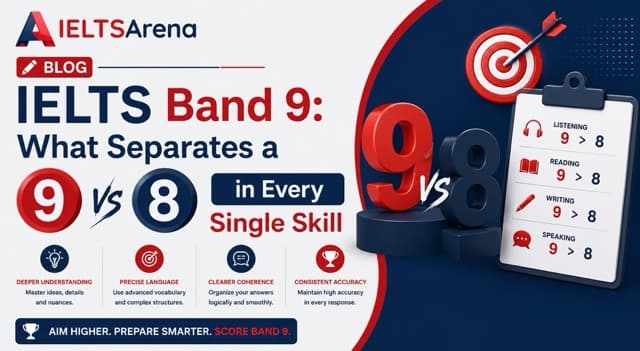
The gap between Band 8 and IELTS Band 9 is not measured in difficult words or complex grammar. Most candidates who reach Band 8 already have those. The real difference is control, precision, and the complete absence of strain.
A Band 9 script does not feel impressive. It feels effortless. The examiner reads it and never once has to pause, reread, or work out what you meant.
That is the secret most guides miss. Band 9 is the level of the "expert user", and an expert is defined by ease, not by showing off. This guide breaks down exactly what separates a 9 from an 8 in Writing, Speaking, Reading, and Listening, with concrete examples for each.
What IELTS Band 9 Officially Means
On the nine band scale, each level has a public descriptor. Band 8 is the "very good user" who handles the language well with only occasional unsystematic inaccuracies. Band 9 is the "expert user" who has full operational command of the language: appropriate, accurate, and fluent with complete understanding.
The wording matters. Band 8 allows occasional errors. Band 9 allows essentially none, and any rare slip must look like a typing error rather than a real gap in ability.
Your overall band is the average of your four skills, rounded to the nearest half band. So you do not need a 9 in every skill to reach an overall IELTS Band 9. A profile of 9, 9, 8.5, and 8.5 averages to 8.75 and rounds up to an overall 9.
This is why understanding each skill separately matters. The path to a 9 looks different in a productive skill like Writing than in a receptive skill like Listening.
Advertisement
Why Most Strong Candidates Stall at 8
The students who get stuck just below Band 9 are rarely weak. They are usually doing one specific thing that quietly caps them at 8.
In Writing, they over-complicate. They add long, dense sentences to look advanced, and those sentences introduce small errors or moments where the meaning is slightly unclear. Top band writing is often simpler on the surface, because clarity is the priority.
In Speaking, they treat the test like a performance and try to insert memorised idioms and big words. The examiner hears the join between natural speech and rehearsed phrases, and fluency drops.
In Reading and Listening, the issue is different. At this level one or two careless errors are the only thing between 8 and 9, and those errors usually come from spelling, plurals, or misreading the question instruction, not from a lack of understanding.
The common thread is that candidates try to add more, when a 9 actually rewards removing strain.
How Daniel Reached an Overall Band 9
Daniel, an engineer from Nigeria applying for a senior role abroad, already had an overall Band 8 across two attempts. He wanted IELTS Band 9 because his target employer treated it as a mark of complete fluency.
"My feedback always said the same thing," he explained. "Great range, but some sentences were doing too much. I was writing to impress instead of writing to be understood."
He changed two habits. In Writing, he shortened his most complex sentences and made sure every single one was completely clear on first reading. In Speaking, he stopped forcing idioms and simply spoke naturally about each topic.
His receptive skills needed only fine tuning. He drilled the exact spelling of answers in Listening and slowed down on the final question instruction in Reading to avoid careless slips.
On his third attempt his profile was 9 in Listening, 9 in Reading, 8.5 in Writing, and 9 in Speaking, giving him an overall 9. Nothing in his English had transformed. He had simply removed the small sources of strain.
The Data: How Rare Is a Band 9?
A 9 is genuinely uncommon, which is why it carries such weight. According to test performance data published by the IELTS partners, the global mean overall score for Academic candidates sits around Band 6 to 6.5, and the proportion of test-takers reaching an overall 9 is a very small single digit percentage.
Receptive skills produce more 9s than productive skills. Across published score distributions, far more candidates hit the top band in Listening and Reading than in Writing, because those sections are marked objectively against a key, while Writing and Speaking are judged against detailed descriptors.
This tells you where the realistic route to an overall IELTS Band 9 usually runs. For most strong candidates it is built on a 9 in Listening and Reading, supported by 8.5 in Writing or Speaking, rather than a clean 9 across all four.
Knowing this changes your strategy. You protect easy marks in the receptive skills and you target the specific 0.5 you need in the productive ones, instead of chasing perfection everywhere.
What Separates 9 From 8 in Each Skill
Here is the precise difference, skill by skill, with what the examiner is looking for.
1. Writing. At Band 8 your ideas are well developed with a wide range of vocabulary and grammar, but you have occasional errors or slightly awkward phrasing. At Band 9, the message is fully extended and supported, the use of language is natural and effortless, and any error is so rare it reads like a slip. Every sentence is clear on the first read.
2. Speaking. Band 8 means you speak fluently with only occasional repetition or self-correction and use a wide range of language. A 9 adds full flexibility and precision in every turn, fully natural pronunciation, and no noticeable effort. You sound like you are simply having a conversation, not sitting a test.
3. Reading. Both bands require strong comprehension, but the score is decided by raw correct answers. To move from 8 to 9, you typically need to convert the final one or two questions you would normally lose, usually by reading the instruction precisely and managing the full 60 minutes across all three passages.
4. Listening. The same logic applies. A 9 usually means losing no more than a single answer across the 40 questions. The difference from 8 is almost always spelling, singular versus plural, and catching answers in the faster final section 4.
Band 9 is not about adding brilliance. It is about removing every last point of friction the examiner could feel.
How IELTSArena Helps You Close the Gap to 9
The problem with chasing IELTS Band 9 alone is that you cannot feel your own strain. The very sentences that cost you the half band look fine to you, because you know what you meant.
This is where IELTSArena makes the difference. The AI writing feedback marks your Task 2 essay against all four criteria and flags the exact sentences that are reaching too far, the rare grammar slips, and the moments where clarity dips below the top band standard.
For Speaking, IELTSArena scores your fluency, pronunciation, vocabulary, and grammar, so you can hear where forced idioms or hesitation pull you down from a 9 to an 8.5.
The expert tutor feedback is the real accelerator at this level. A trained human reviewer can tell you the single difference between your Band 8.5 essay and a Band 9 one, which is a judgement no automatic checker alone can fully make. AI gives you instant pattern detection, and the tutor adds examiner-level nuance.
Because IELTSArena replicates the real CBT interface with its timer, highlighter, and notepad, you also protect your Reading and Listening marks under genuine exam conditions. Start free on IELTSArena.
Self-Diagnosis: How Close Are You to a 9?
These five questions reveal whether IELTS Band 9 is within reach or still some way off.
- Can a reader understand every sentence of your essay on the first read, with no rereading?
- In Speaking, can you talk for two minutes without inserting a single memorised phrase?
- In Listening, do your wrong answers come from spelling and plurals rather than from not understanding?
- In Reading, are you finishing all three passages with time to check the final questions?
- Have you had your Writing and Speaking judged against the Band 9 descriptors by AI or a trained tutor, not just self-assessed?
If you answered "no" to even one or two of these, you have found exactly where your half band is hiding.
Find Out Where Your Band Really Stands
You should not be guessing whether you are an 8 or a 9. One full mock test will tell you precisely, skill by skill.
Take a Free Band 9 Diagnostic on IELTSArena →
Frequently Asked Questions
Is IELTS Band 9 only for native English speakers?
No. IELTS Band 9 is the "expert user" level, and expert command of English is built through use, not by birth. Many non-native speakers reach an overall 9, particularly when they grew up using English academically or professionally, and plenty of native speakers score below 9 because they make careless errors or misread instructions. The descriptor measures accuracy, fluency, and full understanding, not your first language. With precise practice and feedback on your weak points, a non-native candidate can absolutely reach an overall Band 9.
What exactly makes an IELTS Writing essay get Band 9 instead of Band 8?
The Band 8 essay is excellent but has occasional small errors or slightly awkward phrasing, while the Band 9 essay is fully developed, completely natural, and clear on the first read with errors so rare they look like slips. The difference is rarely harder vocabulary. It is total control: every sentence communicates its meaning without making the examiner pause. Often top band writing is simpler and cleaner than ambitious Band 8 writing. Getting AI and expert tutor feedback on IELTSArena shows you which exact sentences are blocking the 9.
Has anyone achieved IELTS Band 9 in all four sections?
Yes, a small number of candidates score a clean 9 in Listening, Reading, Writing, and Speaking, although it is rare and uncommon even among very strong test-takers. It is far more common to reach an overall 9 through a mixed profile, such as 9 in the receptive skills and 8.5 in one productive skill, because the overall band is an average rounded to the nearest half. A clean four-way 9 requires near-flawless performance on the same day across every skill.
What vocabulary and grammar level corresponds to IELTS Band 9?
A Band 9 requires a wide range of vocabulary and grammar used with full flexibility and precision, with errors that are extremely rare and minor. It is not defined by obscure words or the most complex structures. Instead, it is the ability to choose exactly the right word and structure for the meaning, every time, naturally and accurately. A top band writer or speaker can produce a complex idea in a clear, controlled way, which is harder than simply using difficult language, because it demands complete command rather than display.
Should I try to get IELTS Band 9 or is Band 8 enough for all my goals?
For almost every purpose, an overall Band 8 or even 7 already exceeds the requirement. Most universities ask for 6.5 to 7.5, and most immigration routes ask for 6 to 7. You only need to target Band 9 if a specific employer, scholarship, or professional body rewards it, or if you want the personal achievement. Before spending months chasing a 9, confirm your real target. A free diagnostic test on IELTSArena shows your current band so you can decide whether the extra effort is worth it.