You speak English every day. You watch films without subtitles, you chat with colleagues, you think you sound fluent. Then your IELTS result arrives and Speaking says Band 6.5.
It feels personal. How can someone who speaks English comfortably score below Band 7?
The answer is that the IELTS Speaking test does not measure whether you can be understood. It measures four specific things against a fixed set of descriptors. A confident speaker who never uses a complex sentence, or who repeats the same five words, will sit at Band 6 no matter how comfortable they sound.
This guide explains exactly what examiners listen for at IELTS speaking band 7, with real examples for each of the four criteria, so you stop guessing and start targeting the right things.
What Band 7 in IELTS Speaking Actually Means
Your IELTS Speaking score comes from four equally weighted criteria, each worth 25 percent: Fluency and Coherence, Lexical Resource, Grammatical Range and Accuracy, and Pronunciation.
Your final IELTS speaking band 7 result is not an average of vibes. The examiner scores each of the four areas separately using the public band descriptors, then averages them.
This is why a single weak area drags you down. If your fluency is Band 8 but your grammar is Band 6, your overall Speaking band lands around 7. One weak criterion can cost you half a band or more.
Band 7 has a clear profile across the four areas. You speak at length without noticeable effort, you use a range of vocabulary including some less common words, you produce a mix of sentence structures with mostly accurate grammar, and your pronunciation is clear enough to follow without strain.
The test itself runs 11 to 14 minutes across three parts. Part 1 is a short interview, Part 2 is a two-minute long turn from a cue card, and Part 3 is a deeper discussion. The examiner is scoring you continuously across all three.
Why Fluent Speakers Still Miss Band 7
Here is the uncomfortable truth. Everyday fluency and IELTS speaking band 7 are not the same skill.
In daily conversation, you use simple, repeated language because it works. You say "good," "nice," and "a lot" constantly. You speak in short sentences. None of that is wrong in life, but the IELTS descriptors specifically reward range, and range is the thing casual speakers rarely show.
The first reason fluent speakers stall at Band 6.5 is limited vocabulary range. They communicate clearly but use the same common words repeatedly. Lexical Resource at Band 7 requires some less common and idiomatic vocabulary used naturally.
The second reason is a lack of grammatical range. Many comfortable speakers use mostly simple sentences. Band 7 needs a mix of complex structures, used with mostly accurate grammar.
The third reason is memorised answers. Candidates learn scripted Part 2 responses and deliver them word for word. Examiners are trained to spot this, and rehearsed speech often breaks down in Part 3 when the questions become unpredictable.
The fourth reason is overcorrection. Some speakers stop and restart sentences constantly to fix tiny errors, which damages fluency. Band 7 allows some mistakes. Self-correcting yourself into silence costs you more than a small grammar slip would.
A Real Student Story
Daniel, an IT consultant from Manila in the Philippines, used English at work every day. He was certain Speaking would be his strongest section. His first result was Band 6.5, and he was stunned.
"I argue in English in meetings," Daniel said. "I could not understand how I was below Band 7 in Speaking. It made no sense to me at first."
When he recorded his practice answers and reviewed them, the gap became clear. He was fluent, but he leaned on the same small set of words. Everything was "good" or "interesting," and almost every sentence was simple. His grammar was accurate but flat.
Daniel used the AI speaking feedback on IELTSArena to record full answers and get scored on all four criteria. The feedback showed his Lexical Resource and Grammatical Range were both sitting at Band 6 while his fluency was already at Band 7.5.
He focused only on those two weak areas. He practised adding one complex sentence per answer and swapping common words for more precise ones. Six weeks later, Daniel scored Band 7.5 in Speaking. His English had not changed. His range had.
What the Data Tells Us
Speaking and Writing are usually the two productive skills where candidates find it hardest to jump from Band 6 to Band 7. According to official IELTS test-taker performance data published by the IELTS partners, average Speaking scores in many countries cluster around Band 6, which means the Band 7 barrier is exactly where most test-takers get stuck.
The pattern in examiner reports is consistent. Candidates rarely fail Speaking on pronunciation alone. They more often lose marks on Lexical Resource and Grammatical Range, the two criteria that reward variety rather than comfort.
This is encouraging. It means that for most people, reaching IELTS speaking band 7 is not about sounding more native. It is about deliberately widening your vocabulary and varying your sentence structures, both of which are trainable in weeks.
The data also debunks the accent myth. Pronunciation is scored on clarity and features like stress and intonation, not on having a British or American accent. Clear, understandable speech with good rhythm can reach Band 8 with any accent.
What Examiners Listen for in Each Criterion
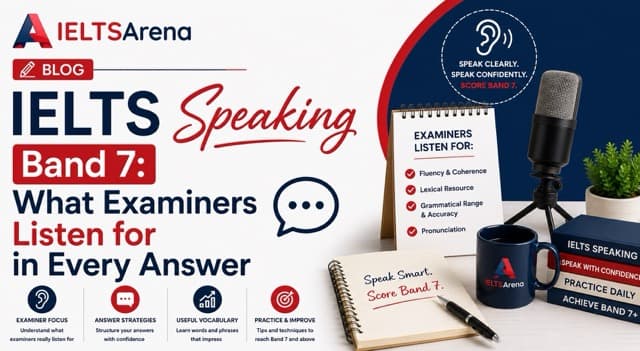
Here is exactly what an examiner is checking for at IELTS speaking band 7, criterion by criterion.
1. Fluency and Coherence. They listen for whether you can speak at length without long pauses or constant self-correction. At Band 7 you can keep going, use a range of connectors naturally, and develop your ideas. A few hesitations are fine. Long silences and frequent restarts are not.
2. Lexical Resource. They listen for range. Can you discuss a variety of topics using flexible vocabulary, including some less common and idiomatic words? Using "delighted" instead of "happy," or "a major drawback" instead of "a bad thing," signals Band 7. Repeating the same basic words signals Band 6.
3. Grammatical Range and Accuracy. They listen for a mix of simple and complex sentences. At Band 7 you produce complex structures, such as conditionals and relative clauses, with mostly accurate grammar. You do not need perfection. You need variety with control.
4. Pronunciation. They listen for clarity and natural features like word stress, sentence stress, and intonation. At Band 7 your speech is easy to follow throughout. Your accent does not matter. Whether the examiner has to strain to understand you does.
A practical target many coaches use is at least two or three well formed complex sentences per longer answer, paired with a few precise vocabulary choices. That is usually enough to lift Lexical Resource and Grammar into Band 7 territory.
How IELTSArena Builds Your Speaking Band
The hardest part of improving IELTS speaking band 7 is hearing yourself the way an examiner does. You cannot score your own range while you are speaking, and most test-takers have no examiner to practise with.
IELTSArena solves this with AI speaking feedback. You record answers to real Part 1, Part 2, and Part 3 questions, and IELTSArena scores your fluency, vocabulary, grammar, and pronunciation separately. You see which of the four criteria is holding you back, just like Daniel did.
Because the feedback is instant, you can practise an answer, see your weak criterion, fix it, and record again in the same session. That tight loop is what moves your band.
For test-takers who want a human perspective, the expert tutor feedback on IELTSArena gives band-focused corrections on your spoken responses, pointing out exactly which vocabulary and structures would lift you from Band 6.5 to Band 7.
IELTSArena also tracks your Speaking practice over time in the progress dashboard, so you can see your Lexical Resource and Grammar scores climbing week by week. More than 10,000 learners have used IELTSArena to target their weak criteria instead of practising blindly.
Record your first Speaking answer on IELTSArena and get scored on all four criteria today.
You do not need a better accent to reach Band 7. You need a wider range, and range is something you can train.
Self-Diagnosis: Are You at Band 7 Yet?
Answer these five questions honestly.
- When you give a two-minute Part 2 answer, do you use a range of vocabulary, or do the same five common words keep returning?
- Can you produce two or three complex sentences in a single answer without freezing?
- Do you keep speaking smoothly, or do you stop and restart constantly to fix tiny errors?
- Are your answers genuine and flexible, or are they memorised scripts that fall apart when the examiner changes the question?
- Do you know which of the four criteria is your weakest right now?
If you cannot answer that last question, that is the first thing to fix. You cannot raise a band you cannot measure.
Start Targeting Band 7 Today
Reaching IELTS speaking band 7 is not about becoming a different speaker. It is about showing range, accuracy, and clarity in the specific ways examiners reward.
Take a Free Speaking Practice on IELTSArena →
Frequently Asked Questions
What is the difference between Band 6 and Band 7 in IELTS Speaking?
The main difference is range and consistency. A Band 6 speaker communicates clearly but uses mostly common vocabulary and simple sentences, with noticeable grammar errors. A Band 7 speaker uses a wider range of vocabulary including some less common words, produces a mix of complex sentence structures with mostly accurate grammar, and speaks at length without much effort. Pronunciation is clear at both levels, so the jump is usually about vocabulary and grammatical range, not accent. The AI speaking feedback on IELTSArena scores each criterion separately so you can see exactly which area is keeping you at Band 6.
Do I need to have a perfect accent to get Band 7 in IELTS Speaking?
No. Pronunciation is scored on clarity and features like word stress, sentence stress, and intonation, not on having a British, American, or any other specific accent. You can keep your natural accent and still reach Band 7 or even Band 8 in pronunciation, as long as your speech is easy to understand throughout and uses natural rhythm. Examiners are trained to assess speakers from every country fairly. Focus on speaking clearly and stressing the right words rather than trying to imitate a native accent.
How many complex sentences do I need to use in IELTS Speaking for Band 7?
There is no fixed number, but a practical target is at least two or three well formed complex sentences in each longer answer, such as your Part 2 long turn and Part 3 responses. Complex sentences include conditionals, relative clauses, and sentences that link ideas with words like although, because, and which. The goal is a natural mix of simple and complex structures with mostly accurate grammar, not complexity in every sentence. Practising on IELTSArena helps you build this habit so it feels natural on test day.
Why do some fluent English speakers still score below Band 7 in IELTS Speaking?
Everyday fluency and IELTS Band 7 are different skills. Fluent speakers often rely on the same common words and simple sentences because that works in daily life. The IELTS descriptors specifically reward a wide vocabulary range and varied grammar, which casual speech rarely shows. Memorised answers and constant self-correction also pull scores down. Many comfortable speakers sit at Band 6.5 because their Lexical Resource and Grammatical Range stay basic. Recording answers and getting scored on IELTSArena reveals these gaps that fluency alone hides.
What vocabulary range do I need to demonstrate for IELTS Speaking Band 7?
For Band 7 you need to show flexible vocabulary across a variety of topics, including some less common and idiomatic words used naturally. This means replacing basic words with more precise ones, such as saying delighted instead of happy, a significant drawback instead of a bad thing, or a thriving city instead of a good city. You do not need rare academic words. You need everyday topics discussed with variety and precision. The AI speaking feedback on IELTSArena highlights where your vocabulary is repeating so you can expand the right areas.