You scored Band 6.0. Your university needs 6.5. Or you got 6.5 and your visa needs 7.0. The gap looks small, but right now it feels impossible, and your retake is in four weeks.
Here is the truth most students never hear. You do not need to fix everything to increase your IELTS band score by one point. You need to fix the one skill that is dragging your overall band down, and you need a plan that targets it directly. Four weeks is enough time to move 0.5 to 1 band if you spend those weeks on the right things.
This guide shows you exactly how to increase your IELTS band score in 28 days, where to focus, and why daily random practice has probably been holding you back.
Why One Band Point Feels So Hard to Gain
Your overall IELTS band score is the average of four skills, rounded to the nearest 0.5. So a person scoring Listening 7, Reading 7, Writing 5.5, and Speaking 6 ends up at 6.5 overall.
In that example, Writing is the anchor pulling everything down. Raising Writing from 5.5 to 7 lifts the overall to 7.0 on its own. The other three skills do not need to change at all.
This is the single most important insight in the whole process. The band score is an average, which means one weak skill costs you the same as three weak skills.
Most test-takers spread their preparation evenly across all four sections. They feel productive because they are always busy. But spreading effort thin is exactly why their score sits still.
To increase your IELTS band score quickly, you stop treating all four skills equally. You find the one that is below the others and you attack it.
Advertisement
Why Common Approaches Fail
The most common mistake is doing more of what you are already good at. If you enjoy Reading, you keep doing Reading practice because it feels rewarding. Meanwhile your Writing stays at 5.5 for months.
The second mistake is practising without feedback. You write ten Task 2 essays, but nobody tells you that you keep losing marks on Coherence and Cohesion. You repeat the same error ten times and call it practice. Repetition without correction simply makes a weak habit permanent.
The third mistake is studying everything and measuring nothing. Students who cannot name their exact band in each skill have no way of knowing where the gap is. You cannot close a gap you have not located.
The fourth mistake is leaving exam familiarity to the last day. People who train on paper and then sit a computer-based test lose easy marks to an unfamiliar interface, not to weak English.
If your IELTS score increase has stalled despite daily effort, one of these four traps is almost always the reason.
A Real Student Who Did It in Four Weeks
Daniel, a nurse from the Philippines, needed Band 7.0 in every section for his registration in Australia. He had taken the test once and scored Listening 7.5, Reading 7, Speaking 7, and Writing 6.0. Writing was the only thing standing between him and his career move.
"I had been writing essays for weeks and getting nowhere," he said. "I assumed I just was not good enough at Writing. The real problem was that nobody was telling me what I kept getting wrong."
Daniel stopped writing random essays. For four weeks he wrote three Task 2 essays a week, submitted each for detailed feedback, and rewrote every essay using the corrections. He discovered his ideas were strong but his paragraphing and linking words were costing him a full band.
On his retake he scored Writing 7.0 and hit his target in every section. He did not become a different writer in 28 days. He fixed one specific weakness that data had hidden in plain sight.
What the Data Says About Improvement Speed
According to data published by the IELTS partners, Writing and Speaking are the two sections where global average scores sit lowest, which means they are where most test-takers have the most room to grow.
Improvement of 0.5 band in a single skill within four weeks is realistic for a focused candidate, and many score reports show exactly that jump on a second attempt. A full 1.0 band gain in your weakest skill is achievable when that skill starts from a clear, specific weakness rather than a general one.
Test-takers who use feedback on their writing and speaking tend to improve faster than those practising alone, because feedback turns invisible errors into fixable ones. Roughly speaking, a corrected essay teaches you more than five uncorrected ones.
The pattern across thousands of score reports is consistent. Targeted effort on the weakest skill beats balanced effort across all four, almost every time.
Your band score does not rise when you practise more. It rises when you practise the right skill with feedback that shows you exactly what to fix.
The Right Approach: A 4-Week Plan to Increase Your IELTS Band Score
Here is the structure that actually moves the number. Follow it in order.
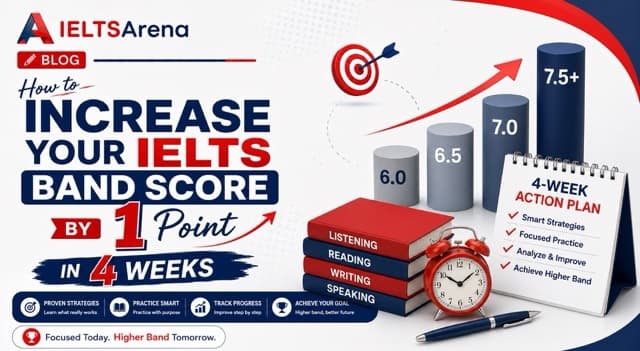
Week 1: Diagnose, do not guess. Take one full timed mock test for all four sections in a single sitting. Record your band in each skill. The lowest one is your target skill for the next three weeks. This single test replaces weeks of guessing.
Week 2: Attack the weakest skill daily. Spend 70 percent of your study time on that one skill. If it is Writing, write and get every essay corrected. If it is Speaking, record answers and check them against the band descriptors for Fluency, Lexical Resource, Grammar, and Pronunciation. Keep the other three skills warm with light practice only.
Week 3: Fix the patterns, not the individual errors. By now your feedback should show repeating mistakes. Maybe you always run out of time in Reading, or your essays lack clear topic sentences. Drill the pattern, not random questions. Fixing one recurring error can lift a whole band.
Week 4: Simulate the real exam. Take two more full mock tests under exact exam conditions, including the computer-based interface if you are sitting a CBT. Compare your scores to Week 1. You should see your weakest skill moving up and your overall band following it.
This plan works because it spends your limited time where the average is most sensitive. That is how to raise your IELTS score without trying to fix everything at once.
How IELTSArena Makes This Plan Work
The hardest parts of this plan are diagnosis and feedback. You cannot fix what you cannot see, and most students have neither an accurate diagnosis nor real correction. This is exactly what IELTSArena is built to solve.
IELTSArena gives you full mock tests on a real computer-based test interface, with the same highlighter, notepad, and navigation panel you will face on exam day. That makes your Week 1 diagnosis accurate, because you are scoring under real conditions.
For your weakest skill, IELTSArena's AI Writing and Speaking feedback identifies your exact errors instantly, scoring Task Achievement, Coherence and Cohesion, Lexical Resource, and Grammatical Range and Accuracy. When you need a human eye, expert tutors on IELTSArena give band-focused corrections that show you precisely why you are losing marks.
The progress analytics dashboard on IELTSArena tracks every mock test, so you can watch your weakest skill climb week by week instead of hoping it is improving. More than 10,000 learners have used IELTSArena to reach their target band, and the platform supports both Academic and General Training.
You can start your four-week plan free on IELTSArena, take a diagnostic mock test, and know your real band in every skill today.
Self-Diagnosis: Are You Ready to Gain a Band?
Answer these honestly before your next attempt.
- Do you know your exact band score in each of the four skills, or are you only guessing from your overall result?
- Can you name the single skill that is dragging your overall band down right now?
- When you practise Writing or Speaking, does anyone tell you specifically what you got wrong?
- Have you practised on the actual computer-based interface, or only on paper and apps?
If you answered no to any of these, you have just found the reason your IELTS band increase has stalled. Each no is a fixable gap, and each one is worth marks.
Start Your Four-Week Climb Today
You do not have four months. You have four weeks, and that is genuinely enough if you spend them on the right skill with real feedback.
Take one free mock test on IELTSArena and you will know exactly where your band score sits in every section today. From there, the plan is simple: attack the weakest skill, fix the repeating patterns, and simulate the real exam before you walk in.
Take a Free Diagnostic Mock on IELTSArena →
Frequently Asked Questions
How long does it take to increase my IELTS band score by one point?
For most focused candidates, a 0.5 band gain in a single skill is realistic within four weeks, and a full 1.0 band gain in your weakest skill is achievable when you start from a specific, identifiable weakness. The key is targeting one skill rather than all four. If you only have a few days, expect smaller gains. With four to six weeks of feedback-driven practice on your weakest section, a one-band overall increase is a reasonable target because your overall band is an average and lifting the lowest skill moves it the most.
Which IELTS section is easiest to improve quickly to raise my overall score?
Listening and Reading often improve fastest because they reward technique and timing, which respond quickly to focused practice. However, the section that will raise your overall score most is simply your lowest one, since the overall band is an average. If Writing is your weakest at 5.5 while everything else is 7, fixing Writing gives you the biggest jump. Diagnose your exact band in each skill first, then target the lowest. A free diagnostic mock test on IELTSArena shows you precisely which section to prioritise.
Why is my IELTS score not improving even though I practise every day?
Daily practice without feedback usually means you are repeating the same mistakes rather than fixing them. If nobody corrects your essays or speaking answers, you reinforce weak habits instead of removing them. Spreading effort evenly across all four skills also stalls progress, because the band is an average and your weakest skill is what holds it down. To improve, narrow your focus to one weak skill and get specific correction. Tools like IELTSArena's AI and expert tutor feedback turn invisible errors into clear, fixable points.
What is the fastest way to raise my IELTS band score from 6 to 7?
Identify which single skill is keeping you at 6, then spend 70 percent of your study time on that skill for four weeks with feedback on every attempt. Take a full diagnostic test first to find your exact band in each section. Fix the repeating patterns your feedback reveals, such as weak paragraphing in Writing or poor time management in Reading. Then simulate the real exam two or three times before your retake. Targeting your weakest skill, rather than practising everything equally, is the fastest reliable route from 6 to 7.
How many hours of preparation does it take to increase IELTS band score by 0.5?
A focused candidate can often gain 0.5 band in a single skill with roughly 25 to 40 hours of targeted, feedback-driven practice over three to four weeks. The exact number depends on how specific your weakness is and how much real correction you get. Quality matters far more than quantity here. Forty hours spread randomly across all four skills may move nothing, while the same hours aimed at your weakest section with feedback can lift it a full half band. Start with a diagnostic mock test on IELTSArena to plan those hours where they count.