Over 3.5 million people take IELTS every year. A large proportion of them are stuck at Band 5.5 and desperately trying to reach IELTS band 6. That single half-band difference determines whether a university application is accepted, a visa gets processed, or a migration pathway opens.
IELTS band 6 is not elite performance. The official descriptor calls it a "competent user" of English. But for hundreds of thousands of test-takers, moving from 5.5 to 6.0 is the most frustrating step in the entire journey. The language feels good enough. The practice scores look close. But exam day keeps delivering 5.5.
The problem is rarely English ability. The problem is how that English ability is being tested and what preparation is missing.
What IELTS Band 6 Actually Means
The IELTS band 6 score corresponds to a "competent user" according to the official Cambridge/British Council descriptor. This means the test-taker generally has an effective command of English despite some inaccuracies, inappropriate usage, and misunderstandings. Complex language is handled reasonably well overall.
A score of 6.0 overall can be achieved in several combinations. Four sixes across all sections gives a clean 6.0. But a 5.5 in listening, 7.0 in reading, 6.0 in writing, and 5.5 in speaking also averages to a 6.0 overall. Understanding how the scoring works is the first strategic advantage.
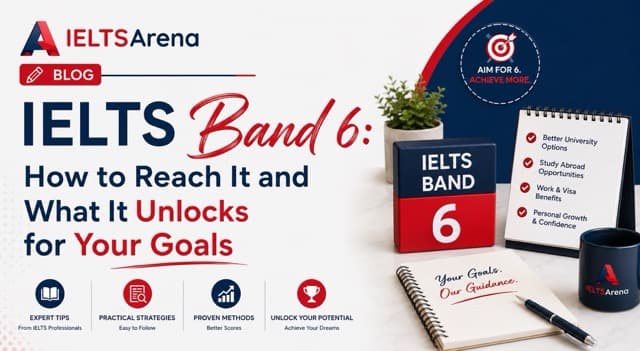
IELTS band 6 opens significant doors for test-takers worldwide:
For university admission, hundreds of undergraduate and postgraduate programs across the UK, Australia, Canada, and New Zealand accept 6.0 as their minimum English requirement.
For skilled migration to Australia, IELTS band 6 meets the Competent English threshold required for many skilled visa subclasses under points-based migration.
For UK student visas, most undergraduate and postgraduate courses at registered institutions accept Band 6.0 from IELTS Academic.
For Canadian immigration through Express Entry, a score in the 6.0 range contributes points to the Comprehensive Ranking System, though higher scores yield more points.
Advertisement
Why Candidates Get Stuck Below IELTS Band 6
The journey from Band 5.5 to IELTS band 6 is where most preparation strategies break down completely.
The first reason is section imbalance. A candidate might reach 7.0 in reading but stay at 5.0 in writing. The average comes to 6.0 but the writing section alone can pull the overall score below the minimum if a program requires Band 6 in each skill individually.
Many universities and immigration programs do not just require an overall IELTS band 6. They require 6.0 in each of the four sections. This means a strong reading score cannot compensate for weak writing or speaking.
The second reason is generic preparation. Candidates use general English learning materials rather than IELTS-specific skill development. IELTS writing Task 2, for example, has a very specific structure and scoring rubric. You can write excellent English and still score below Band 6 in writing if your essay lacks a clear position, fails to develop both body paragraphs fully, or misuses cohesive devices.
The third reason is test anxiety and poor time management. Candidates who know their English well enough for Band 6 can still score 5.5 because they run out of time in reading or listening, or spend too long on Task 1 in writing and produce an underdeveloped Task 2 response.
The fourth reason is insufficient feedback on weaknesses. Without knowing exactly where the half-band is being lost, preparation has no direction. A candidate who scores 5.5 overall may not know whether the shortfall is in lexical resource, grammatical range, task response, or all three simultaneously.
A Student Who Broke Through to Band 6
Ahmed Karimi from Pakistan had taken IELTS twice before his third attempt. Both previous results had come back at 5.5 overall, with speaking and writing holding him back.
"I was getting 6.5 in reading and listening consistently, but 5.0 in speaking and 5.5 in writing," Ahmed said. "I thought my English was not good enough for band 6, but my reading score proved that was wrong."
Ahmed registered with IELTSArena and took a full diagnostic test. The AI writing feedback on IELTSArena identified that his Task 2 essays had a clear position but very limited development in body paragraphs. He was making a claim in each paragraph but not explaining, evidencing, or extending it. His grammatical range was also limited to a small set of sentence structures used repeatedly.
Over eight weeks, Ahmed used IELTSArena's writing feedback tool to submit two essays per week and get detailed band-level scoring on task response, coherence, vocabulary, and grammar. He also completed IELTSArena speaking practice sessions to build fluency on abstract topics.
His third attempt came back at 6.5 overall. Writing had jumped to 6.0 and speaking to 6.5.
What the Numbers Say About the 5.5 to 6.0 Journey
Data from IELTS performance studies shows that the writing and speaking sections are responsible for the majority of candidates failing to reach their target band 6 score.
Approximately 65 percent of test-takers who score below their target overall band are held back specifically by writing. The most common sub-score issue is task response and coherence, not vocabulary or grammar.
IELTSArena internal data shows that candidates who receive AI feedback on at least six writing tasks before their exam are 52 percent more likely to score 6.0 or above in writing than those who self-study without feedback.
For speaking, data consistently shows that fluency and coherence are the most weight-bearing sub-criteria at the Band 5 to 6 boundary. Candidates who can maintain a conversation without excessive hesitation or repetition typically cross the Band 6 threshold even if their grammar is imperfect.
A 2025 analysis of IELTS performance patterns found that the average preparation time to move from 5.5 to IELTS band 6 is six to ten weeks of structured daily practice. Candidates who used a platform with automatic feedback tools reached Band 6 in an average of seven weeks, compared to eleven weeks for those using only self-study materials.
A Section-by-Section Strategy to Reach IELTS Band 6
Here is what changes between Band 5.5 and IELTS band 6 in each section, and what to do about it.
Listening. At Band 5.5, candidates typically miss answers because of unfamiliar accents, fast speech, or distraction. To reach Band 6, practice listening to a wider range of accents. British, Australian, American, and Canadian speakers all appear in the IELTS listening test. On IELTSArena, you can filter practice tests by accent type. Focus especially on Section 3 and Section 4, which are the hardest for most candidates.
Reading. At Band 5.5, candidates frequently run out of time or misidentify True/False/Not Given answers. To reach Band 6 in reading, practice the 20-minutes-per-passage rule strictly. Do not spend more than 20 minutes on any single passage. IELTSArena's timed reading tests enforce this automatically.
Writing. At Band 5.5 in writing, the most common issue is underdeveloped arguments and limited grammatical range. To reach IELTS band 6, each body paragraph in a Task 2 essay needs a claim, an explanation of why it is true, and at least one concrete example or development. Practice five different sentence types: simple, compound, complex, conditional, and passive voice. Use IELTSArena's AI writing feedback to get band-level scoring on each response before your exam.
Speaking. At Band 5.5 in speaking, candidates often give short answers, hesitate frequently, or use repetitive vocabulary. To reach Band 6 in speaking, practice the PEEL structure for Part 2 and Part 3 answers: Point, Explain, Example, Link back. Aim to speak for at least 1 minute 45 seconds in Part 2 without a prompt. IELTSArena offers structured speaking practice with model answers by band level.
How IELTSArena Supports the Journey to Band 6
IELTSArena is built specifically to help test-takers close the gap between their current score and their IELTS band 6 target.
The IELTSArena platform offers full Academic and General Training practice tests with automatic scoring that mirrors official IELTS band descriptors. After each test, IELTSArena shows your band score for every section, not just an overall total, so you know precisely which section is pulling your average below 6.0.
IELTSArena's AI writing evaluation tool scores your essay across all four official criteria: task achievement, coherence and cohesion, lexical resource, and grammatical range and accuracy. It gives you a band estimate for each criterion individually, and explains why. This makes it possible to see whether your writing is at 5.5 because of limited task response or because of grammatical errors, and then address that specific issue.
IELTSArena speaking practice provides model responses at Band 5, 6, 7, and 8, letting you hear the concrete difference in fluency and vocabulary development between the band you are at and the IELTS band 6 level you are targeting.
IELTSArena tracks your performance trend over every session. You can see whether your writing is at 5.5 this week and 5.5 the week before, or whether it is gradually moving toward 6.0. Without that tracking, preparation can feel like it is working even when the score is not moving.
IELTSArena also provides a diagnostic test that identifies your weakest sections and question types at the start of preparation, so your study time is directed at the areas that will most efficiently move you from 5.5 to IELTS band 6.
Register free at IELTSArena and take your diagnostic today.
Self-Diagnosis: Are You on Track for Band 6?
Ask yourself these questions before continuing your preparation:
- Do you know which specific sub-criterion in writing or speaking is keeping your score at 5.5?
- Have you practiced with official-standard IELTS band 6 model answers to understand exactly what that level requires?
- Are you getting feedback on your writing and speaking from a tool that uses IELTS band descriptors, not just general English corrections?
- Have you done at least three full timed practice tests in the last three weeks?
- Is your section score in your weakest skill improving across your last four practice sessions?
If you answered no to two or more of these questions, your preparation strategy needs adjustment. The target score is within reach. The path is just not yet clear.
IELTS band 6 is achievable in six to ten weeks of structured preparation. IELTSArena gives you the tools to close that gap section by section, with real feedback and real tracking.
Start Your Free Diagnostic on IELTSArena →
Frequently Asked Questions
Is IELTS band 6 good enough for Canadian immigration in 2026?
IELTS band 6.0 meets the Competent English language benchmark under Canada's Express Entry immigration system and contributes CLB 7 points to your CRS score. However, higher scores earn more CRS points, and some provincial nominee programs require a higher minimum. Verify requirements at ircc.canada.ca before you prepare.
Which universities accept IELTS band 6 for undergraduate admission?
Many universities across the UK, Australia, Canada, and New Zealand accept IELTS 6.0 overall for undergraduate entry, often with a minimum of 5.5 or 6.0 in each band. Specific requirements vary by program and institution. Always check the admissions page of your target university directly.
How do I improve from IELTS band 5.5 to band 6 in my weakest section?
Identify exactly which sub-criteria is pulling the section score down. For writing, use IELTSArena's AI feedback tool to get band-level scoring on task response, coherence, vocabulary, and grammar separately. For speaking, record yourself and compare your fluency with IELTSArena model responses at Band 6. Target the weakest criterion with daily practice for three to four weeks.
What is the difference between IELTS band 6 and 6.5 in practice?
At Band 6, language use is generally effective but with noticeable inaccuracies and limited range. At Band 6.5, the candidate uses a wider vocabulary and more varied sentence structures with fewer consistent errors. For writing, the difference is often essay development depth and variety of grammatical structures used correctly.
Is band 6 in IELTS writing enough for a UK student visa?
Most UK higher education institutions require IELTS 6.0 overall with 5.5 or 6.0 in each skill for a Tier 4 student visa. Some courses and universities require higher individual skills scores. Check the Home Office student visa guidance and your specific institution's requirements for the most accurate threshold before you begin preparation.