You read every passage carefully. You understand the topic. Yet your IELTS Reading score keeps landing at Band 5 or 5.5, and you cannot work out why.
Here is the uncomfortable truth: in Academic Reading, you need 30 correct answers out of 40 to reach Band 7. At Band 5, you are getting around 15 to 19 right. That is not a small gap in understanding. It is a gap in method.
The good news is that Reading is the most improvable IELTS skill, because it rewards technique over talent. You are not trying to become a faster reader. You are learning to find answers without reading every word.
This guide shows you how to improve IELTS reading score from Band 5 to Band 7 in eight focused weeks, using the exact mistakes that hold most students at Band 5 and the method that fixes them.
The Real Problem With IELTS Reading
The IELTS Academic Reading test gives you three passages, 40 questions, and 60 minutes. That is 20 minutes per passage, including the time to read, find, and write your answers. There is no extra transfer time, so the clock is brutal.
Most Band 5 candidates run out of time on the third passage and guess the final 10 to 13 questions. Even if every other answer is correct, those rushed guesses drag the score down to 5 or 5.5.
The second problem is question type. IELTS Reading uses around eleven question types, and each one needs a different approach. True, False, Not Given works nothing like matching headings, which works nothing like summary completion. Treating them all the same is a guaranteed way to stay at Band 5.
The third problem is the trap of careful reading. Reading every line feels responsible, but it is exactly what runs you out of time. The test does not reward comprehension of the whole passage. It rewards finding specific answers quickly.
Understanding these three problems is the start of any real IELTS reading score improvement. If you want to know how to improve IELTS reading score for good, you fix the cause, not the symptom, and the method that follows is built to attack all three at once.
Advertisement
Why Careful Reading Keeps You Stuck at Band 5
The most common piece of advice, "read more carefully," is the worst advice for IELTS Reading. Careful reading is the habit that keeps people stuck.
When you read every word, you spend your time on sentences that contain no answers. The IELTS passage is long on purpose. Maybe 30 percent of it holds the answers, and the rest is there to slow you down. Careful readers give equal attention to all of it and run out of clock.
The second failed approach is reading the passage fully before looking at the questions. By the time you reach the questions, you have forgotten where the details were, so you read the passage a second time. You have now read 1,500 words twice and answered nothing.
The third failed approach is translating in your head. If you mentally convert each sentence into your first language, your reading speed collapses. There is no time for translation in a 60-minute test.
The fourth is ignoring keywords. Band 5 readers look for the exact words from the question in the passage. But IELTS deliberately paraphrases. The question says "fall," the passage says "decline." If you hunt for matching words instead of matching meaning, you miss the answer that is sitting right in front of you.
To improve IELTS reading, you have to unlearn these habits before you learn new ones. That unlearning is most of the work.
Daniel's Story: From Band 5 to Band 7 in Eight Weeks
Daniel, a 24-year-old graduate from Nigeria, needed Band 7 in Reading for a master's programme. He was a strong reader in daily life and could not understand why he kept scoring 5.5.
"I read the whole passage slowly to make sure I understood it," Daniel said. "Then the questions came and I had eight minutes left for the last 14 questions. I was guessing, and I knew it."
A diagnostic mock test showed his real pattern. He scored well on the first passage and collapsed on the third. His accuracy was fine when he had time, but he never had time for the final third of the test.
Daniel changed one thing first: he read the questions before the passage, then scanned for answers instead of reading line by line. In week one his speed felt uncomfortable, but his last-passage score climbed from 2 correct to 7 correct.
Over the next seven weeks he drilled one question type at a time, reviewed every wrong answer to understand the paraphrase he missed, and sat two timed mock tests a week. His final practice score was 32 out of 40, a clean Band 7.
"The skill was always there," Daniel said. "I just needed a method that respected the clock."
The Data Behind IELTS Reading Score Improvement
The score bands tell you exactly how big your gap is. In Academic Reading, a raw score of 30 out of 40 gives Band 7, 23 gives Band 6, and 15 gives Band 5. So moving from Band 5 to Band 7 means finding roughly 15 extra correct answers.
That sounds enormous until you see where those answers hide. Analysis of test-taker performance consistently shows that most lost marks in Reading come from two places: unfinished final passages and a small set of question types, especially True, False, Not Given and matching headings.
Fix the timing problem and you often recover 8 to 12 answers immediately, simply by attempting questions you used to leave blank. That alone can lift a Band 5 to a Band 6.5.
The remaining gap is accuracy on specific question types. True, False, Not Given is the single biggest source of wrong answers, because students confuse False with Not Given. Drilling that one distinction can add another full band for many candidates.
Industry data on preparation also shows a clear pattern: candidates who take regular timed practice tests improve faster than those who only study tips. Reading is a performance skill, and performance improves with measured repetition, not with reading articles about technique.
This is why the eight-week plan below is built around timed practice and targeted review, not passive study.
How to Improve IELTS Reading Score: Your 8-Week Plan
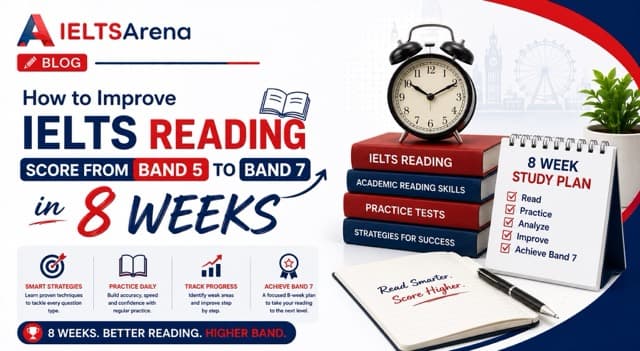
Here is how to improve IELTS reading score in eight weeks, week by week. Each phase fixes one cause of low scores, so follow them in order.
Weeks 1 to 2: Fix your timing and reading order.
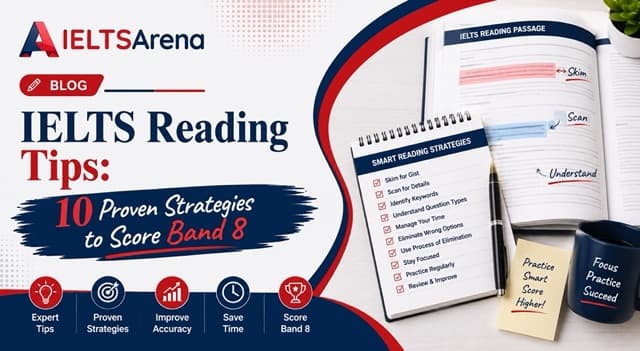
Stop reading the passage first. Read the questions, underline the keywords, then scan the passage for those ideas. Practise skimming each passage in three minutes to grasp its structure, then go straight to the questions. The goal in this phase is to finish all 40 questions within 60 minutes, even if accuracy is rough.
Weeks 3 to 4: Master question types one at a time.
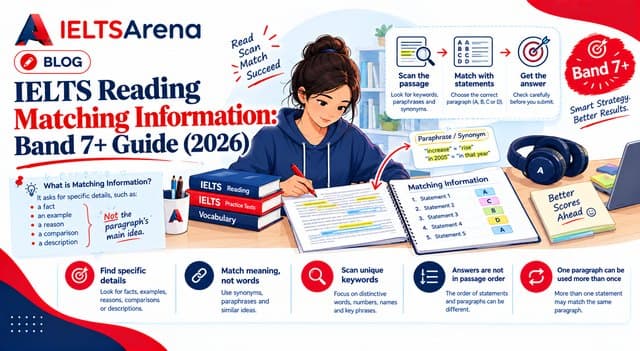
Pick one question type per session. Do ten True, False, Not Given questions, then review every answer until you understand the exact difference between False and Not Given. Repeat for matching headings, then summary completion, then the rest. Depth on one type beats shallow practice across all of them.
Weeks 5 to 6: Build paraphrase recognition.
For every wrong answer, write down the question word and the passage word that meant the same thing. "Increase" and "rise." "Cause" and "lead to." After two weeks of this, your brain starts matching meaning instead of hunting for identical words, which is the core skill of a Band 7 reader.
Weeks 7 to 8: Simulate the real test.
Sit two full, timed, computer-based mock tests each week under exam conditions. No pausing, no dictionary, no extra time. Review each one fully. By now your timing is fixed, your question-type accuracy is high, and the mocks confirm your Band 7.
Follow these phases in order. Skipping the timing fix to chase accuracy is the most common reason plans fail.
How IELTSArena Helps You Improve Your IELTS Reading Score
The plan above only works if your practice mirrors the real exam, and that is exactly what IELTSArena is built to deliver.
IELTSArena replicates the real IELTS computer-based test interface, including the highlighter, notepad, and navigation panel. You practise scanning and marking keywords the same way you will on test day, so your speed transfers directly to the real exam instead of evaporating under pressure.
The progress analytics dashboard is what makes the eight-week plan measurable. After each mock test, IELTSArena shows your accuracy by passage and by question type, so you can see at a glance whether True, False, Not Given is still costing you marks or whether your third passage is still unfinished.
That data turns guesswork into a plan. Instead of practising randomly, you drill the exact question type and the exact passage position where you lose points. This is how you boost IELTS reading without wasting weeks on skills you have already mastered.
IELTSArena gives you a large library of real exam-style Reading tests for both Academic and General Training, so you never run out of fresh material during your eight-week build. Over 10,000 learners have used the platform to lift their bands.
Start free on IELTSArena and take your first timed Reading mock today.
Self-Diagnosis: Why Is Your Reading Score Stuck?
Answer these five questions to find your real bottleneck.
- Do you finish all 40 questions within 60 minutes, or do you guess the last passage?
- Do you read the passage fully before looking at the questions?
- Can you explain the exact difference between a False answer and a Not Given answer?
- When you get a question wrong, do you find the paraphrase you missed, or do you just move on?
- Have you practised on a real computer-based interface, or only on paper?
If your honest answers reveal a timing problem, start with weeks one and two. If timing is fine but accuracy is low, jump to the question-type drilling. One diagnostic mock test will tell you which.
Start Your Free Reading Practice Today
You will never know your real Reading band from reading tips. You only learn it by sitting a full, timed test under exam conditions.
In one free mock test on IELTSArena, you will see your raw score, your band, and the exact question types and passages where you lose marks. That single test tells you whether your problem is speed, accuracy, or both.
Take a Free Reading Mock on IELTSArena →
You do not need to read faster to reach Band 7. You need to read less and find more.
Frequently Asked Questions
What is the fastest way to improve my IELTS reading score?
The fastest single change is to stop reading the full passage first. Read the questions, underline the keywords, then scan the passage to locate the answers. Most Band 5 candidates lose 8 to 12 marks simply by running out of time on the third passage, so fixing your timing recovers those marks almost immediately, often lifting your score by a full band. After timing, drill the high-loss question types, especially True, False, Not Given. Sitting regular timed mock tests on a real computer-based interface, such as the Reading tests on IELTSArena, turns this method into a reliable band improvement within a few weeks.
How do I improve IELTS reading when I already read every passage carefully?
Careful reading is usually the cause of a stuck score, not the cure. The IELTS Reading test is designed so that only part of each passage holds the answers, and reading every line wastes the time you need for the final passage. Switch to scanning: read the questions first, then search for the specific information they ask about. You are not graded on understanding the whole passage, only on answering 40 questions correctly. Most students who read carefully are accurate but slow, so the fix is to read less of the passage and target answers directly, which protects your time for every question.
Should I focus on speed or accuracy when trying to improve IELTS reading?
Fix speed first, then accuracy. If you cannot finish all 40 questions in 60 minutes, your accuracy on the questions you do reach barely matters, because the unanswered ones score zero. Spend the first two weeks training yourself to complete the full test on time, even if your accuracy dips. Once you reliably finish, shift your focus to accuracy by drilling individual question types and reviewing every wrong answer to find the paraphrase you missed. This order matters because accuracy gains are wasted if you never reach the questions. A timed mock test on IELTSArena shows whether speed or accuracy is your current limit.
How many IELTS reading practice tests per week to improve by one band?
To move up one band in about eight weeks, aim for two to three full timed Reading tests per week, paired with detailed review of every test. The review matters more than the volume. Doing five tests a week without analysing your mistakes produces little improvement, while two tests a week with careful review of wrong answers builds real skill. Spend roughly equal time taking the test and studying what went wrong. Track your accuracy by question type so you can target your weak areas. The progress analytics on IELTSArena make this tracking simple by showing where you lose marks across each mock.
What reading habits outside of IELTS practice actually help improve my reading score?
Reading academic-style English daily builds the comprehension speed IELTS rewards. Read quality newspapers, science and current-affairs magazines, and university-level articles for 20 to 30 minutes a day, since these match the complexity of Academic Reading passages. As you read, practise summarising each paragraph in one sentence, which trains the skill of finding the main idea quickly. Note unfamiliar academic vocabulary and how words are paraphrased. These habits build the underlying reading speed and paraphrase recognition that technique alone cannot. Combine them with timed practice on real exam-style tests, such as those on IELTSArena, to convert general reading skill into a higher IELTS band.