The IELTS Reading section gives you 60 minutes to answer 40 questions across three passages. That is 90 seconds per question. For most test-takers, that calculation alone creates the anxiety that derails their performance before they read a single word.
IELTS reading tips are searched online by hundreds of thousands of candidates every month. Yet the majority of what circulates online covers only surface-level advice: "read faster," "skim and scan," "manage your time." These suggestions are not wrong, but they are incomplete. Speed and strategy matter, but they only work when they are built on a precise understanding of how the IELTS Reading test is designed and what it actually rewards.
This guide gives you 10 proven, examiner-aware IELTS reading tips that address the specific traps, question types, and timing challenges that are consistently responsible for pulling scores below Band 7.
The Real Challenge in IELTS Reading
Many candidates approach IELTS Reading the way they approach general comprehension: read the passage, understand it, then answer the questions. This approach fails in the IELTS context for a specific reason. The passages are deliberately complex. They are taken from academic journals, newspapers, and specialist publications and often contain technical vocabulary, dense argument structures, and deliberately misleading adjacent information.
The IELTS Reading test is not assessing whether you understand the passage. It is assessing whether you can locate specific information efficiently and match it accurately to question stems that are almost never phrased in the same language as the passage. Paraphrase recognition is the core skill being tested, not reading comprehension in the conventional sense.
Candidates who do not understand this distinction keep rereading passages for general understanding and run out of time. Candidates who understand it use targeted strategies to locate and verify specific information quickly, leaving enough time for every question.
The IELTS reading tips in this guide are built around this distinction.
Advertisement
Why Standard Preparation Approaches Fall Short
The most common preparation mistake for IELTS Reading is practising with non-IELTS materials. Reading speed exercises, comprehension worksheets, and general vocabulary builders do not prepare you for the specific paraphrase traps and question formats that IELTS uses.
A second common mistake is treating all question types identically. IELTS Reading contains at least nine distinct question types, and each requires a different strategy. Using the same approach for True/False/Not Given questions and for Matching Information questions will cost you marks on one or both types.
A third mistake is not using the 10-minute time rule. If you spend more than 20 minutes on any single passage, you will almost certainly run out of time before completing Passage 3, which typically contains the most difficult questions and the most marks available for Band 7+ candidates.
Without specific IELTS reading tips targeted at these structural problems, you can read for hours every day and still see your score stagnate.
A Real Candidate Who Transformed Their Reading Score
Aisha, a 24-year-old marketing professional from Bangladesh, had been stuck at Band 6.5 in Reading for two exam attempts. She was targeting Band 7.5 for a UK postgraduate programme.
"I was reading so much every day," she recalled. "News articles, academic papers. My vocabulary was good. But I kept getting the same score. When I started training on IELTSArena, I realised I was spending almost 25 minutes on Passage 1 and rushing Passages 2 and 3. And I had no strategy for True/False/Not Given at all."
After following a structured approach using IELTSArena's timed practice tests and question-type breakdowns, Aisha improved her Reading band from 6.5 to 8.0 in her next exam sitting. The key changes were strict per-passage timing and a dedicated approach to the question types she had been tackling incorrectly.
Her result is achievable. The strategies below are the same ones that transformed her performance.
What the Data Shows About IELTS Reading Scores
Published IELTS performance data shows that Reading is the section where Band score improvements are most directly linked to strategy change rather than language ability change.
Analysis of candidates who retook IELTS within six months shows that the largest Reading score gains (0.5 bands or more) were concentrated among candidates who adopted structured question-type strategies, not among those who simply read more between attempts.
Approximately 61% of candidates who score below Band 7 in IELTS Reading run out of time before completing all 40 questions in at least one of their practice sessions. Time management is the most statistically significant predictor of Reading underperformance for candidates whose English language level is otherwise sufficient for Band 7+.
Candidates who use IELTSArena's timed full mock tests for Reading practice and who review their performance using the platform's question-type analysis consistently reduce their per-question response time while maintaining accuracy, the combination that drives Band score improvement.
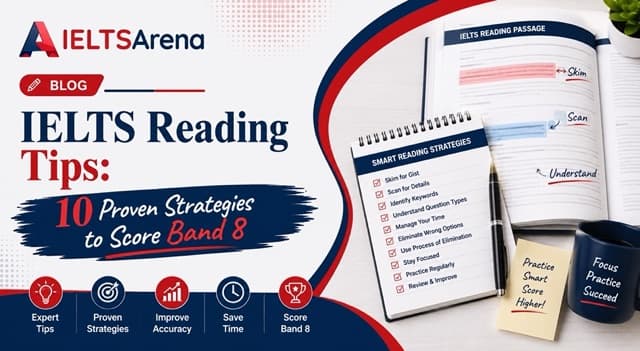
10 Proven IELTS Reading Tips to Score Band 8
These IELTS reading tips are arranged in order of impact, starting with the strategies that produce the largest score gains.
Tip 1: Apply strict per-passage timing from day one. Allocate exactly 20 minutes per passage, regardless of difficulty. Set a timer in every practice session. If you are not finished with a passage when the timer goes off, move on and come back only if you have time. This single habit prevents the most common cause of IELTS Reading underperformance: time collapse on a difficult passage.
Tip 2: Always read the questions before reading the passage. This is the most consistently recommended of all IELTS reading tips, and it remains the most effective. Reading the questions first tells you what to look for. It converts passive reading into targeted search. You are not reading to understand. You are reading to locate.
Tip 3: Use a different strategy for True/False/Not Given questions. True/False/Not Given is the question type that costs the most marks for unprepared candidates. The distinction between False and Not Given is the critical test: if the passage says the opposite of the statement, it is False. If the passage simply does not mention the point at all, it is Not Given. Never mark a statement Not Given just because you cannot find it quickly. Search thoroughly first.
Tip 4: Locate answers in order for most question types. For the majority of IELTS Reading question types, including short answer, sentence completion, and summary completion, answers appear in the passage in the same order as the questions. Use this sequencing to estimate where in the passage to search for each answer rather than scanning the entire text each time.
Tip 5: Master paraphrase recognition as a dedicated skill. The most important IELTS reading tip for Band 7+ performance is training your ability to recognise paraphrase. IELTS questions almost never use the same words as the relevant passage sentence. Practice converting key question words into synonyms before scanning. If the question says "elderly residents," the passage may say "older population" or "senior citizens." Identifying the link is the core skill.
Tip 6: Do not read the passage for general comprehension before looking at questions. This is one of the most counterintuitive IELTS reading tips, but one of the most important. Reading an entire academic passage before knowing the questions wastes time and cognitive energy you need for accurate question matching. Read the title and any subheadings to orient yourself, read the questions, then locate relevant sections.
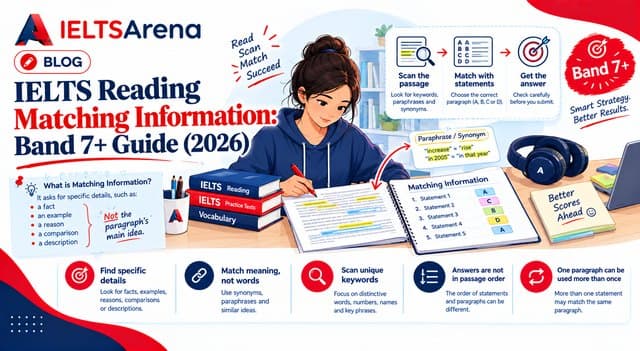
Tip 7: Use paragraph headings as a map for Matching Information and Paragraph Headings questions. For these question types, which require you to match statements or headings to specific paragraphs, read only the first two sentences and last sentence of each paragraph, not the entire paragraph. These sentences contain the topic statement and the concluding point, which is all you need to make an accurate match.
Tip 8: Answer every question, even if you are not certain. There is no negative marking in IELTS Reading. A question left blank is guaranteed to be wrong. An uncertain guess has a chance of being correct. If you are running out of time, make your best guess for remaining questions based on any available context clues and move on. IELTSArena's practice test interface mirrors the actual IELTS CBT format, so you can practise the mechanics of efficient answer selection under timed conditions.
Tip 9: Transfer answers carefully for paper-based IELTS. Unlike Listening, Reading does not have a separate transfer time. You write directly on the answer sheet. For paper-based candidates, practise writing answers on a separate sheet while reading rather than highlighting and transferring later. For CBT candidates, IELTSArena's interface is designed to replicate the exact answer entry format so there are no surprises on exam day.
Tip 10: Review your wrong answers by question type, not by passage. After every practice test on IELTSArena, categorise your errors by question type. If you are getting True/False/Not Given wrong consistently, that is a strategy problem. If you are missing multiple Matching Information questions, that is a different strategy problem. Reviewing by type rather than by passage reveals the targeted practice you actually need, rather than generic re-reading of passages you already completed.
How IELTSArena Builds Your IELTS Reading Performance
IELTSArena provides full-length IELTS Reading practice tests in a CBT interface that replicates the exact format of the real exam. Every practice session on IELTSArena is timed precisely, so the habit of per-passage timing becomes automatic rather than something you need to enforce manually.
After every Reading practice test, the platform breaks down your performance by question type. You can see your accuracy rate for True/False/Not Given questions separately from your rate on Matching Headings, Summary Completion, and other types. This analysis tells you exactly which of the 10 IELTS reading tips above you need to focus on most urgently.
The platform also provides passage-level analysis showing which passages consumed the most time relative to the marks gained, another key diagnostic that most self-study methods cannot replicate.
Candidates preparing on IELTSArena benefit from seeing their progress tracked across multiple sessions, so they can see whether their per-question time is decreasing, whether their True/False/Not Given accuracy is improving, and whether their overall band score trajectory is on track for their target. This data-driven feedback loop is the most efficient way to apply IELTS reading tips in practice rather than just in theory.
Self-Diagnosis: Are These IELTS Reading Tips Working for You?
Before your next practice session, ask yourself these questions.
Do you regularly run out of time before finishing all 40 questions? If yes, implement Tip 1 immediately. Strict 20-minute per-passage timing is non-negotiable for Band 7+ performance.
Do you read the passage before reading the questions? If yes, switch to reading questions first in every practice session from today. This is the most impactful single habit change among all IELTS reading tips.
Do you know the exact difference between False and Not Given in IELTS True/False/Not Given questions? If you are not 100% certain, review Tip 3 and practise exclusively on this question type using IELTSArena's targeted exercises.
After each practice test, do you review errors by question type or by passage? If you review by passage, you are missing the diagnostic information that drives improvement. Switch to question-type review immediately.
Is your Reading band score improving across multiple practice sessions? If not, the problem is almost certainly your review method, not your reading ability. Use IELTSArena's question-type analysis to find the specific type that is costing you the most marks.
Start Applying These IELTS Reading Tips on IELTSArena
Knowing IELTS reading tips is the starting point. Applying them under timed, exam-realistic conditions is what drives actual score improvement. Reading strategies that work in low-pressure study sessions need to be automatised before exam day, and that automatisation only happens through deliberate, timed practice.
IELTSArena provides the test format, the timing, the question-type analytics, and the performance tracking that turn these 10 IELTS reading tips from useful advice into measurable score improvement.
Whether you are aiming for Band 7, 7.5, or 8, the path runs through deliberate strategy practice, not more hours of general reading.
Frequently Asked Questions
Why do I run out of time in IELTS reading and how do I fix it?
Running out of time in IELTS Reading almost always stems from one of two causes: spending too long on a single difficult passage, or not having a targeted search strategy and instead rereading passages for general understanding. Fix this by applying a strict 20-minute limit per passage from your very first practice session. Set a timer. When it goes off, move to the next passage regardless of where you are. Over time, this trains you to be decisive rather than exhaustive. IELTSArena's timed practice tests enforce this discipline automatically.
What is the best strategy for IELTS reading True False Not Given questions?
The key is understanding the difference between False and Not Given. False means the passage states the opposite of the statement. Not Given means the passage does not address the point at all. Never decide on Not Given quickly; always search the passage thoroughly first. For True, locate a direct paraphrase of the statement in the passage. Never rely on general topic familiarity; always find specific textual evidence before marking any answer.
How do I improve my IELTS reading score quickly?
The fastest way to improve your IELTS reading score is to identify your weakest question type and spend one week practising exclusively on that type. Use IELTSArena's question-type performance breakdown to identify it objectively. Candidates who target their weakest question type specifically see faster improvement than those who repeat full practice tests without focused analysis. Apply the relevant strategy from the 10 IELTS reading tips above and measure your improvement over five to seven targeted sessions.
Should I read the passage or the questions first in IELTS reading?
Always read the questions first. This converts your reading from passive comprehension to active search. You know what information to look for before you engage with the text, which dramatically reduces the time spent rereading. Skim the title and subheadings first for orientation, then read the questions, then locate answers in the passage. This sequence is consistently recommended by IELTS examiners and scoring data from IELTSArena confirms it produces faster, more accurate performance.
How can I read faster for IELTS reading without losing comprehension?
Speed in IELTS Reading is less about reading faster and more about reading less. You do not need to read entire passages. You need to read question stems carefully, identify the key concept, and then scan for the relevant passage section. Practise this targeted reading approach rather than general speed reading exercises. Candidates who learn to identify paraphrase quickly and locate relevant sections efficiently will outperform faster readers who scan entire passages without a clear search target.