
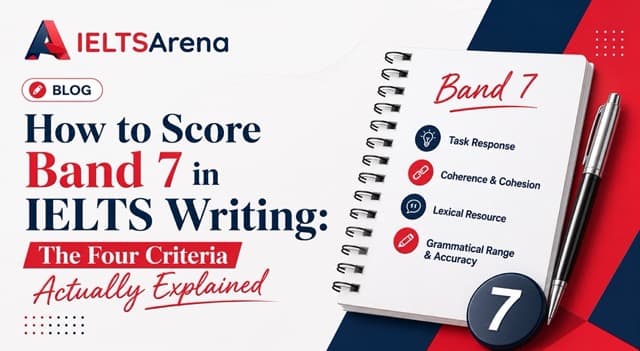
Knowing how to score Band 7 in IELTS writing comes down to hitting at least Band 7 across each of the four official criteria: Task Response, Coherence and Cohesion, Lexical Resource, and Grammatical Range and Accuracy. The gap between Band 6 and Band 7 is specific and measurable in each one, and closing it does not require better English overall. It requires knowing exactly what shifts in each criterion.
Most students who plateau at Band 6.5 fail on one criterion, not all four. Identify which one, fix that specific gap, and Band 7 stops being aspirational. This guide covers the exact descriptor differences and the concrete practice moves that close each one.
Why Learning How to Score Band 7 in IELTS Writing Feels Harder Than It Is
Band 7 is where universities and immigration authorities set most of their requirements, and it is also where most self-study candidates get stuck. The reason is not that Band 7 is objectively difficult. The reason is that generic writing advice teaches you to sound "smart" instead of teaching you what the official band descriptors actually reward.
An examiner does not give you Band 7 because your essay felt sophisticated. They give you Band 7 because your response met the specific descriptors for each of the four criteria. Knowing exactly what changes between Band 6 and Band 7 is the difference between guessing and hitting your target deliberately.
Advertisement
Task Response: The Criterion That Traps Most Band 6.5 Candidates
Task Response measures how well you addressed the specific question asked and how thoroughly you developed your position. It contributes 25% of your Writing score, and it is where most Band 6.5 candidates lose the half-band to Band 7.
The gap in the public descriptors is precise. A Band 6 response "addresses all parts of the task although some parts may be more fully covered than others" and "presents a relevant position although the conclusions may become unclear or repetitive." A Band 7 response "addresses all parts of the task" clearly, "presents a clear position throughout the response," and "presents, extends and supports main ideas."
The Band 6 to Band 7 shift is not about better vocabulary or fancier sentences. It is about whether every part of the prompt got equal, developed treatment, and whether your position stayed clear from introduction to conclusion.
The practical fix: before you write, note every part of the prompt on the notepad. If the prompt has two questions, plan two paragraphs. If it asks for causes and solutions, plan one for each. When you finish, reread and check that every part of the prompt got developed treatment, not just a passing mention. This single planning discipline is the fastest move in learning how to score Band 7 IELTS writing.
Coherence and Cohesion: The Silent Score Killer
Coherence and Cohesion evaluates how logically your paragraphs flow, whether your linking devices work naturally, and whether your ideas progress in a clear order. It contributes 25% of your Writing score.
A Band 6 response uses cohesive devices "effectively, but cohesion within and/or between sentences may be faulty or mechanical." A Band 7 response uses them "flexibly" with only "some inaccuracies or some over/under use." A Band 6 response is "generally organised." A Band 7 response is "logically organised" with clear progression that flows naturally rather than sounding stitched together.
The practical fix: stop overusing "Moreover," "Furthermore," and "In addition." These are the linking-word equivalents of shouting. Band 7 writers use referencing ("this approach," "such measures," "the former") and substitution more than transitional adverbs. Try replacing every third "Moreover" with a reference back to the previous idea, and read the paragraph aloud. If it still flows, you have moved from Band 6 to Band 7 in this criterion.
Lexical Resource: Precision Beats Range
Lexical Resource measures the range and precision of your vocabulary, including collocations and topic-appropriate terms. It contributes 25% of your Writing score.
The Band 6 to Band 7 shift is about precision, not size. A Band 6 response has "an adequate range of vocabulary for the task" and "attempts to use less common vocabulary but with some inaccuracy." A Band 7 response "uses a sufficient range of vocabulary to allow some flexibility and precision" and "uses less common lexical items with some awareness of style and collocation."
The practical fix: after writing, review every noun and verb. Ask whether each is the most precise choice or a generic filler. "Many things affect this issue" becomes "population growth, urban planning failures, and rising transport costs contribute to the housing crisis." That single move can lift Lexical Resource by half a band.
Grammatical Range and Accuracy: What Complex Structures Actually Mean
Grammatical Range and Accuracy measures both the variety of grammatical structures you use and how consistently you get them right. It contributes 25% of your Writing score.
A Band 6 response "uses a mix of simple and complex sentence forms" and "makes some errors in grammar and punctuation but they rarely reduce communication." A Band 7 response "uses a variety of complex structures" and "produces frequent error-free sentences" with "good control of grammar and punctuation."
"Complex structures" does not mean long, difficult sentences. It means grammatical variety: conditionals, relative clauses, participle phrases, and passive constructions used naturally where they suit the meaning. A single conditional used well ("If governments had invested earlier in renewable infrastructure, current energy costs would be lower") demonstrates more grammatical range than a paragraph of long sentences all following the same subject-verb-object pattern.
The practical fix: audit your last three practice essays for structural variety. If more than 60% of your sentences are simple (one clause), that is your Grammatical Range gap. Deliberately practice one new structure per week until it feels natural.
Which Criterion to Fix First
If you know your criterion breakdown, fix the lowest one first. If you do not, the odds strongly favor Task Response as your bottleneck. Coherence and Cohesion is the second most common bottleneck, because most candidates over-rely on transitional adverbs at the expense of natural flow.
Do not try to raise all four at once. Pick one, practice it deliberately for two weeks, then move to the next.
A Realistic Student Story
Aditya, a Delhi-based civil engineer preparing for an Australian skilled worker visa, had scored Band 6.5 on Writing across three attempts, each time with the same criterion breakdown: Task Response 6, Coherence and Cohesion 6.5, Lexical Resource 7, Grammatical Range 7. His overall was 6.5.
His problem was Task Response. Prompts asking for "advantages and disadvantages" got heavy treatment on advantages and a thin paragraph on disadvantages. Prompts asking "to what extent do you agree" got a strong argument for his side but no acknowledgment of the counter-view. His position was there, but not developed.
Two weeks of deliberate practice on prompt-mapping, one paragraph per part of the prompt, no exceptions, moved his Task Response to Band 7 on the next attempt. His overall Writing reached Band 7.5.
His English had always been strong enough for Band 7. The gap was that no one had explained what Task Response actually measured.
If you have been guessing at which criterion is capping your score, run one of your recent essays through IELTSArena's free Writing Task 2 checker and see the criterion-level breakdown before your next practice session.
How to Actually Practice for Band 7 in IELTS Writing
Three habits separate students who reach Band 7 fast from students who plateau at Band 6.5.
Do not write more essays. Rewrite the same essay after receiving criterion-level feedback. If your Task Response was 6.5 on the first attempt, revise until it is 7, then submit the same essay again. That closes the feedback loop, which is how criterion scores actually rise.
Do not chase your strongest criterion. If you are already at Band 7 in Grammatical Range and Band 6 in Task Response, spending more time on grammar practice does nothing for your overall band. Fix the weakest criterion, always.
Do not rely only on AI feedback. Get at least one essay reviewed by a certified IELTS teacher every two to three weeks. The 15-25% of essays where AI is meaningfully wrong tend to be exactly the essays you most need honest feedback on: unusual prompts, high-band attempts, and non-standard argument structures.
The specific work of learning how to score Band 7 IELTS writing is criterion-diagnostic, not general improvement. Diagnose the weakest one, fix it, move on.
Where IELTSArena Fits
IELTSArena's Writing checker gives you a separate band for each of the four official criteria, quotes specific sentences from your essay in the feedback, and explains the reasoning tied to the actual public band descriptors. That criterion-level diagnosis is what tells you which specific fix will move your overall Writing score fastest, which is the whole point of how to score Band 7 IELTS writing strategically rather than by trial and error. Start from the full practice test hub if you want the writing checker alongside the CBT practice tests.
For candidates within half a band of their target, optional expert human tutor review is available on essays flagged by the AI as scoring below target, which closes the accuracy gap that any AI-only tool leaves open.
Check Where You Are Actually Stuck
Do you know your current band for each of the four Writing criteria separately, or only your overall score? Have you diagnosed which specific criterion is your bottleneck? Have you rewritten the same essay after receiving feedback, or moved to a new essay every time? Have you had at least one essay reviewed by a human teacher in the last month?
If any of those answers is no, that is where the path from Band 6.5 to Band 7 is quietly stalling.
Diagnose Your Bottleneck Today
The single most useful thing you can do this week to make real progress on how to score Band 7 IELTS writing is find out which of the four criteria is capping your score. Take a free Writing Task 2 check on IELTSArena and get a criterion-by-criterion band estimate on your next essay. No credit card required.
FAQ
How to score Band 7 IELTS writing when most students plateau at 6.5? Task Response is the criterion Band 6.5 candidates most commonly fail on. Most essays address the prompt but only partially, with some parts developed and others mentioned briefly. Raising Task Response from 6 to 7 requires equal, developed treatment of every part of the prompt, which is a planning discipline more than a language ability.
How do examiners decide between Band 6.5 and Band 7? They score each of the four criteria separately against the public band descriptors, then average. To reach Band 7 overall, you generally need Band 7 in at least three of the four, with no single criterion pulling the average below 7.
Which of the four Writing criteria is easiest to raise? Coherence and Cohesion is usually the fastest, because it responds directly to specific habit changes: reduce transitional adverbs, use referencing and substitution, plan paragraph structure before writing. Lexical Resource takes longer because it requires vocabulary building over weeks. Grammatical Range requires deliberate practice of specific structures.
How long does it take to get IELTS Writing to Band 7? For candidates currently at Band 6.5, focused practice on the weakest criterion typically closes the gap in three to six weeks. For candidates at Band 6, allow eight to twelve weeks. The variable is not English ability but whether you are diagnosing your weakest criterion and practicing it deliberately.
Can I get Band 7 in IELTS Writing without a tutor? Yes, if you use an AI writing checker that gives criterion-level feedback and treat it as diagnostic rather than encouraging. Most self-study candidates who reach Band 7 combine daily AI-checker practice with one human-tutor review every two to three weeks, particularly before their actual test.