
You wrote a clear essay with strong ideas and good vocabulary, yet your Writing band came back at 6.0 and you have no idea why. The answer is almost always the same. One of the four marking criteria quietly pulled your score down, and it was probably the criterion called IELTS coherence and cohesion.
This single criterion controls a full 25 percent of your Writing band. Many test-takers never study it properly because the name sounds vague. They focus on grammar and vocabulary, ignore the way ideas connect, and then wonder why the score will not move.
Here is the truth that changes everything. You can fix coherence and cohesion faster than any other writing skill, and doing so can lift your Writing band by half a point or more without learning a single new word.
What Coherence and Cohesion Actually Means
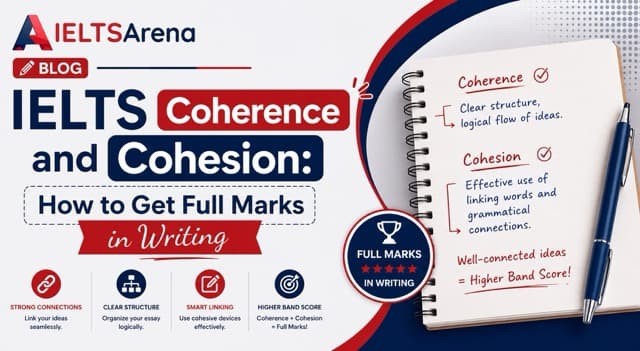
IELTS coherence and cohesion measures how clearly your ideas connect and how easy your essay is to follow from start to finish. It is one of the four equally weighted Writing criteria, sitting alongside Task Response, Lexical Resource, and Grammatical Range and Accuracy.
Coherence is about logic. It asks whether your ideas are organised in a way that makes sense to the reader. Does each paragraph have one clear central idea? Do your points follow a sensible order?
Cohesion is about connection. It asks whether your sentences and paragraphs are linked smoothly using the right tools. These tools include linking words, pronouns, reference words, and clear paragraphing.
Think of it this way. Coherence is the building plan. Cohesion is the cement between the bricks. You need both for the structure to hold.
The examiner reads your essay once, at normal reading speed, just like a real reader. If they have to stop, re-read, or guess what you mean, your IELTS coherence and cohesion score drops immediately. The clearer the path you build, the higher the band.
Advertisement
Why Common Approaches Fail
Most students attack coherence and cohesion with one weapon only: linking words. They memorise a long list of phrases like "moreover", "furthermore", "in addition", and "on the other hand", then scatter them across every sentence.
This backfires badly. The official band descriptors specifically warn against the "mechanical" use of cohesive devices. When every sentence starts with a connector, the writing feels robotic and the examiner notices the pattern instantly.
A second common mistake is paragraphing by feel. Students press enter whenever a paragraph "looks long enough" rather than when a new idea begins. The result is paragraphs with three unrelated points crammed together, which destroys coherence.
A third problem is the missing central idea. Many test-takers list points but never tell the reader what each paragraph is really about. Without a clear topic sentence, the examiner cannot follow the logic, and the IELTS coherence and cohesion band stays stuck at 6.0.
The final trap is overcorrection. After reading advice about linking words, some students add so many that the essay drowns in connectors. The examiner sees a writer who is performing cohesion rather than communicating, and the score suffers.
A Realistic Student Story
Daniel, a nurse from the Philippines, needed Band 7.0 in each section for his registration in Australia. His Reading and Listening were already at 7.5. His Writing kept landing at 6.0, and he could not understand why.
When he looked at his feedback, three of the four criteria were at 7.0. Only one was at 6.0, and it dragged his whole Writing band down. That criterion was coherence and cohesion.
"I genuinely thought my grammar was the problem," Daniel said. "I never realised my paragraphs had no clear topic sentences, and I was starting almost every sentence with a linking word."
Daniel changed two things. He wrote a clear topic sentence for every body paragraph, and he cut his linking words by half. He used reference words like "this trend" and "such measures" instead.
Six weeks later, his Writing band moved from 6.0 to 7.0. Nothing about his vocabulary changed. He simply made his ideas easier to follow, and the IELTS coherence and cohesion score did the rest.
Data and Insight Layer
The British Council and IDP regularly publish global test-taker performance data, and Writing is consistently the lowest-scoring skill of the four. The global average Writing band sits below the average for Reading and Listening year after year.
Within Writing, coherence and cohesion is one of the most common reasons candidates plateau at Band 6.0. According to analysis of official band descriptors, the jump from Band 6 to Band 7 is defined largely by clearer progression and more controlled use of cohesive devices.
The Band 6 descriptor notes that cohesion may be "faulty or mechanical". The Band 7 descriptor requires logical organisation with "clear progression throughout". That single shift in how ideas connect is often the difference between a 6 and a 7.
Here is the encouraging part. Examiner-focused studies suggest that organisation and linking are among the fastest writing features to improve, because they follow learnable rules rather than years of language exposure. A test-taker can often raise the IELTS coherence and cohesion score in weeks, not months.
The Right Approach to Coherence and Cohesion
You can build a high coherence and cohesion score by following a clear method. Use these steps on every Task 2 essay.
- Plan before you write. Spend three to five minutes deciding your position and your two main ideas. A clear plan creates natural coherence because each paragraph already has a purpose.
- Write one idea per paragraph. Each body paragraph should develop a single central point. If you have two big ideas, give them two paragraphs.
- Start every paragraph with a topic sentence. State the main idea of the paragraph in the first sentence. This tells the examiner exactly where the paragraph is going.
- Use a clear four-paragraph structure. Introduction, body paragraph one, body paragraph two, conclusion. This proven IELTS paragraph structure for writing keeps your essay organised under time pressure.
- Use linking words with restraint. Aim for one or two cohesive devices per paragraph, not per sentence. Variety matters more than quantity.
- Use reference and substitution. Instead of repeating "the government", write "it" or "this authority". Words like "this", "these", "such", and "that approach" create smooth cohesion without obvious connectors.
- Build logical progression. Order your sentences so each one follows naturally from the last. Move from a general statement to an example to a result.
- Use IELTS cohesion devices in the right place. Connectors of contrast, addition, cause, and result each have a job. Use "however" for contrast, "as a result" for consequence, and "for instance" for examples.
When you combine clear paragraphing with controlled linking words, your essay reads smoothly on the first pass, and that is exactly what the examiner rewards.
How IELTSArena Helps You Master This
The hardest part of improving coherence and cohesion is that you cannot mark your own essays accurately. You wrote them, so they always make sense to you. You need an outside eye that reads the way an examiner reads.
This is where IELTSArena changes the process. When you submit a Task 2 essay, the AI Writing feedback on IELTSArena gives you an instant band score broken down by all four criteria, including a separate coherence and cohesion score. You see exactly which criterion is holding you back.
The feedback flags weak topic sentences, mechanical linking words, and paragraphs that try to hold too many ideas. Instead of guessing like Daniel did for months, you get specific corrections within minutes.
For deeper support, IELTSArena also offers expert tutor feedback. A human tutor reads your essay and shows you precisely where your logic breaks and how to reorder your ideas for clearer progression. This is the kind of band-focused correction an AI-only tool cannot fully replicate.
IELTSArena also replicates the real IELTS CBT interface, with the highlighter, notepad, and navigation panel. You practise your IELTS coherence and cohesion under exam conditions, so the skill holds up on test day and not just at home.
Because IELTSArena tracks your performance across every mock test, you can watch your IELTS CC score climb essay by essay. More than 10,000 learners have used this loop of writing, feedback, and revision to lift their Writing band. You can start your first essay free on IELTSArena.
Self-Diagnosis: Where Does Your Writing Stand?
Answer these five questions honestly. They expose the gaps that quietly cap your IELTS coherence and cohesion band.
- Does every body paragraph in your essay open with a clear topic sentence that states one main idea?
- Can a stranger read your essay once, at normal speed, and follow your argument without stopping?
- Do you use more than two linking words in a single paragraph, or start most sentences with a connector?
- Do you use reference words like "this", "such", and "these" to connect ideas, or do you repeat the same nouns again and again?
- Do you know your current coherence and cohesion band, or are you only guessing at your overall Writing score?
If any answer made you pause, that gap is costing you band points right now. The good news is that every one of these is fixable within a few weeks of focused practice.
Start Improving Your Writing Today
Coherence and cohesion is the fastest path to a higher Writing band, and you cannot fix what you cannot see. The first step is knowing your real score across all four criteria.
Take one free practice essay on IELTSArena and submit it for AI feedback. In a few minutes, you will know exactly where your IELTS coherence and cohesion score stands today and what is pulling it down.
Start Your Free Writing Practice on IELTSArena →
Frequently Asked Questions
What is the difference between coherence and cohesion in IELTS writing?
Coherence is about the logic and organisation of your ideas, while cohesion is about how you physically connect those ideas. Coherence asks whether your essay is organised clearly, with one central idea per paragraph and a sensible order of points. Cohesion asks whether your sentences and paragraphs flow smoothly using linking words, reference words, and clear paragraphing. They are marked together as a single criterion worth 25 percent of your Writing band. You need strong logic and smooth connection to score well. A clear topic sentence supports coherence, while a well-placed connector supports cohesion.
Which linking words should I use in IELTS writing task 2 to improve coherence?
Use a small range of accurate linking words rather than a long memorised list. For contrast, use "however" or "in contrast". For adding a point, use "in addition" or "moreover". For results, use "as a result" or "therefore". For examples, use "for instance". The key rule is restraint. Aim for one or two connectors per paragraph, not one per sentence. Examiners penalise the mechanical use of cohesive devices, so variety and natural placement matter far more than quantity. Reference words like "this" and "such" often connect ideas more smoothly than another connector.
How do I improve the paragraph structure in my IELTS writing essays?
Use a clear four-paragraph structure for Task 2: an introduction, two body paragraphs, and a conclusion. Give each body paragraph one central idea and open it with a topic sentence that states that idea. Follow the topic sentence with an explanation, then an example, then a result or link back to the question. This logical progression is exactly what raises your coherence and cohesion band. Avoid cramming several unrelated points into one paragraph. On IELTSArena, AI Writing feedback flags weak paragraphing instantly, so you can see and fix the issue before exam day.
Does overusing linking words actually lower my IELTS coherence and cohesion score?
Yes. The official band descriptors specifically warn against the mechanical use of cohesive devices. When you start almost every sentence with a connector, the writing feels forced and unnatural, and the examiner notices the pattern. This can hold you at Band 6 even when your ideas are strong. High-scoring essays use a balanced mix of linking words, reference words, and clear paragraphing. The goal is smooth, natural flow, not a visible display of connectors. Use one or two cohesive devices per paragraph and rely on reference words and logical order to carry the rest of the connection.
How does the IELTS examiner decide my coherence and cohesion band score?
The examiner reads your essay once at normal reading speed and judges how easily they can follow your argument. They check whether your ideas are organised logically, whether each paragraph has a clear central idea, and whether your sentences connect smoothly. At Band 6, cohesion may be faulty or mechanical and paragraphing may be unclear. At Band 7, the examiner expects clear progression throughout and a flexible range of cohesive devices. The difference between bands is how little effort the reader needs to follow you. Practising with feedback on IELTSArena shows you exactly where your logic breaks before the examiner ever sees it.