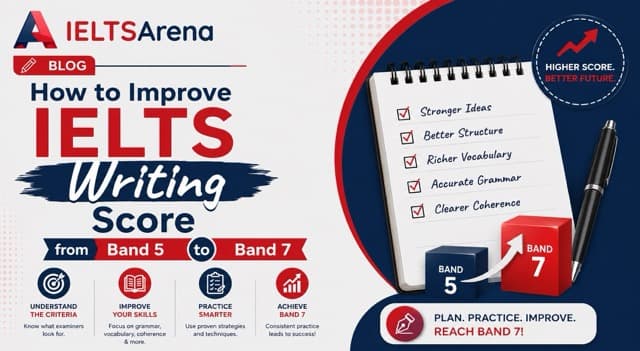
You sat the IELTS exam. You studied, you practised, you felt ready. Then the result came back: Band 5 for Writing. Again.
If that sounds familiar, you are not alone. IELTS Writing is consistently the section that holds test-takers back from their target score. Many candidates get 7+ in Reading and Listening, yet Writing refuses to move past 5.5. The gap between Band 5 and Band 7 is real, it is specific, and it is fixable. This guide explains exactly how to improve your IELTS writing score and close that gap for good.
Why Band 5 Writing Is So Common
At Band 5, your writing communicates meaning. The examiner can understand what you are trying to say. That is the good news.
The problem is that communication alone is not enough. IELTS Writing is assessed on four criteria: Task Achievement (or Task Response for Task 2), Coherence and Cohesion, Lexical Resource, and Grammatical Range and Accuracy. Each criterion carries 25% of the total score.
A Band 5 writer typically makes these errors across all four:
In Task Achievement, the argument is present but underdeveloped. Ideas are listed rather than discussed. Task 2 essays often address only part of the question or mix up discussion and opinion formats.
In Coherence and Cohesion, paragraphs exist but lack clear topic sentences. Cohesive devices are overused or misused. "Furthermore, moreover, in addition, also" appear in every paragraph because the writer learned that linking words are important, not how to use them correctly.
In Lexical Resource, the same words repeat throughout. Academic paraphrasing attempts often produce incorrect collocations. "Do exercise" instead of "exercise regularly," "make a crime" instead of "commit a crime."
In Grammar, sentences are either very short and simple or very long and tangled. Errors appear consistently in the same structures: articles, subject-verb agreement, tense consistency.
Understanding which criterion is dragging your score down is the first step to knowing how to improve your IELTS writing score.
Advertisement
Why Common Approaches Fail to Boost IELTS Writing Band
Most test-takers do one of three things when they want to improve IELTS writing. They write more essays. They memorise vocabulary lists. They study grammar rules from a textbook.
None of these approaches work without feedback.
Writing essay after essay with the same errors only reinforces bad habits. You practise being wrong. After fifty essays, you are a very fast Band 5 writer.
Memorising vocabulary lists does not help unless you know how words are used in context. Knowing that "inevitable" means "unavoidable" tells you nothing about which nouns it collocates with, whether it takes a complement, or how formal it is.
Studying grammar in isolation does not translate to exam writing. You can know every rule about the present perfect and still misuse it under timed conditions.
The single biggest reason IELTS writing score improvement stalls is lack of accurate, specific feedback. Without knowing exactly which examiner criterion is failing and why, you cannot fix it.
One Student Who Broke Through the Band 5 Ceiling
Priya, a 26-year-old nurse from the Philippines, needed Band 7 in Writing for her UK registration application. She had sat the exam twice and scored 5.5 both times.
"I thought my English was good enough," she said. "I could write long essays. But I kept getting the same score."
After a detailed review of her practice essays, Priya discovered her real issue: Task Response. Her essays were long, but they were not answering the question. She was discussing topics broadly rather than addressing the specific instruction. A "discuss both views and give your opinion" question was getting a general essay about the topic instead.
Once she understood the structure required for each task type, and started practising with AI feedback that caught her Task Response errors in real time, her score moved to Band 7 in her third attempt.
The length of her essays was never the issue. The precision of her response was.
What the Data Shows About IELTS Writing Score Improvement
According to Cambridge Assessment data, approximately 35% of IELTS Academic test-takers globally score Band 5.5 or below in Writing. It is the lowest-scoring section for candidates from most test-taking regions.
The criteria where candidates lose the most marks are Task Achievement and Coherence and Cohesion. Research from ETS and Cambridge consistently shows that these two criteria account for the largest score drops in the 5 to 6 band range.
However, Lexical Resource and Grammar become the differentiators between Band 6 and Band 7. Moving from 5.5 to 6.5 is mostly about task precision and coherence. Moving from 6.5 to 7 requires consistent vocabulary accuracy and a wider range of error-free grammar structures.
This means the strategy for how to improve IELTS writing score differs depending on where you currently are. A Band 5 writer and a Band 6.5 writer need to work on different things.
Candidates who receive personalised, criterion-specific feedback improve their writing band score significantly faster than those who practise without it. Studies of test preparation outcomes suggest that structured feedback reduces the time to target band by 40 to 50% compared to self-study alone.
The Right Approach to Improve IELTS Writing Score
Here is the structured approach that actually works for IELTS writing score improvement from Band 5 to Band 7.
Step 1: Diagnose your weakest criterion. Take one of your recent essays and score it against each of the four criteria separately. Which one is consistently below the others? That is where you start. Do not try to fix everything at once.
Step 2: Understand task types deeply before writing. IELTS Academic has five main Task 2 types: opinion essays, discussion essays, problem-solution essays, advantages-disadvantages essays, and two-part questions. Each has a different structure. IELTS General Training Task 1 requires a formal or semi-formal letter structure. Before you write, know exactly what the question is asking you to produce.
Step 3: Write with a clear paragraph plan every time. A Band 7 essay has clear, purposeful paragraphs. Introduction restates the question and states your position. Body paragraph 1 makes one clear point, supports it with an example or explanation. Body paragraph 2 makes a second point. Conclusion summarises without introducing new ideas. This structure is not rigid, but it ensures your response is organised.
Step 4: Practise paraphrasing, not memorising. Instead of memorising phrases, practise paraphrasing the question and your own sentences. Paraphrasing is a skill tested directly in the introduction. Swap nouns for synonyms, change active to passive, restructure the clause. Do this with five sentences daily.
Step 5: Get feedback on every essay, not just correction. You need to know why something is wrong, not just that it is wrong. Feedback should tell you: "This paragraph lacks a clear topic sentence," or "This cohesive device is incorrect here because the second sentence does not contrast with the first." Generic corrections do not produce IELTS writing score improvement.
Step 6: Focus your vocabulary learning on academic collocations. Instead of learning single words, learn them in collocations. "Significant increase," "growing concern," "address the issue," "have a detrimental effect." These natural pairings improve your Lexical Resource score far more than individual vocabulary lists.
Step 7: Timed practice is essential, but only once structure is solid. Many test-takers jump to timed essays too early. Build your structure and vocabulary habits first. Then introduce timed writing. For Task 2, aim to plan for five minutes, write for thirty, review for five.
How IELTSArena Helps You Improve Your IELTS Writing Score Faster
IELTSArena is built specifically for test-takers who want structured, fast improvement in IELTS Writing.
The platform provides AI-powered writing feedback that scores your essays against all four IELTS criteria immediately after submission. You do not wait days for a result. You write, submit, and receive criterion-level feedback within seconds.
IELTSArena tells you specifically which criterion is dragging your score down. If your Task Response is Band 5 but your Lexical Resource is Band 6.5, you see that clearly. You know exactly where to direct your practice.
The IELTSArena essay bank includes questions from all five Task 2 types and General Training Task 1 formats. You can filter by task type and difficulty level. If you are working on discussion essays, you practise discussion essays, not random tasks.
IELTSArena also offers expert tutor feedback for test-takers who want a human review alongside the AI scoring. Tutors provide detailed, line-level annotation on your essays, explaining not just what is wrong but why and how to fix it.
The progress analytics on IELTSArena track your scores across all four criteria over time. You can see whether your Coherence and Cohesion score is improving while your Grammar stays flat. This visibility is what makes systematic IELTS writing score improvement possible.
Thousands of candidates have moved from Band 5 to Band 7 using IELTSArena's structured approach. The platform is designed for the specific challenge of closing that gap, not generic English improvement.
If you are serious about knowing how to improve your IELTS writing score in the shortest time possible, IELTSArena gives you the tools, feedback, and structure to do it.
Self-Diagnosis: Where Are You in Your IELTS Writing Journey?
Before your next practice session, ask yourself these questions honestly:
- Do you know which of the four criteria is your lowest score? If you cannot answer this with confidence, your next step is not writing another essay. It is getting a scored breakdown of a recent essay.
- Do you know the required structure for each Task 2 question type? If you treat all essays the same way regardless of the question, your Task Response score will stay low.
- Can you write a clear topic sentence for every body paragraph? If your paragraphs do not have a single, clear controlling idea, your Coherence and Cohesion score is suffering.
- Do your vocabulary choices feel natural or forced? If you are using words because they sound academic, not because they fit, your Lexical Resource score is at risk.
- Are your grammar errors consistent or varied? Consistent errors (always wrong articles, always wrong prepositions) are fixable with targeted practice. Varied errors suggest your checking process needs work.
Honest answers to these questions will tell you exactly where to focus for your next stage of IELTS writing score improvement.
If you are ready to stop guessing and start improving your IELTS Writing with real feedback, structured practice, and criterion-level analytics, create your free IELTSArena account today.
Start Practising on IELTSArena →
Frequently Asked Questions
How do I improve my IELTS writing score from Band 5 to Band 7 fast?
The fastest route is to identify your weakest criterion first, whether Task Response, Coherence, Vocabulary, or Grammar, and fix it with targeted practice and specific feedback. Generic writing practice without feedback is the slowest method. Platforms like IELTSArena provide criterion-level AI feedback on every essay, which significantly accelerates IELTS writing score improvement.
What are the quickest wins to improve IELTS writing band score?
For most Band 5 writers, the quickest wins are in Task Response. Learn the correct structure for each Task 2 question type and answer the exact question asked, not the topic in general. A precise, well-structured 260-word essay will outscore a vague 350-word essay every time.
Why does my IELTS writing score not improve even though I practise a lot?
Practising without feedback reinforces existing errors. If you are writing essays and reviewing them yourself, you are unlikely to catch your own blind spots. You need external feedback, whether from a tutor or an AI scoring tool like IELTSArena, that can identify patterns in your errors across multiple essays.
How often should I write IELTS essays to improve quickly?
Three to four practise essays per week is a sustainable and effective frequency for most candidates, provided each essay is reviewed with criterion-level feedback. Writing daily without review produces diminishing returns. Quality of feedback matters more than volume of essays.
What is the single most effective thing I can do to improve IELTS writing?
Get accurate, specific feedback on your essays scored against the four IELTS criteria. This single change, moving from self-review to structured external feedback, is the most impactful lever for IELTS writing score improvement. IELTSArena's AI writing feedback tool makes this available instantly for every practice essay you submit.