You speak English every day. At work, with friends, online. People understand you perfectly. So when you scored Band 6 in IELTS Speaking, it made no sense.
Here is the uncomfortable truth. The IELTS Speaking test is not measuring whether people understand you. It is measuring four specific things against a fixed band descriptor, and fluent everyday speakers lose marks on all four without realizing it.
The most damaging IELTS speaking mistakes are silent. They do not sound like errors to you because they are the exact habits that make casual conversation feel natural. In the exam, those same habits pull your band down.
This is the breakdown of the IELTS speaking mistakes that quietly cost you marks, and how to catch them in your own responses before test day.
What The Speaking Test Actually Measures
The IELTS Speaking test runs 11 to 14 minutes across three parts. Part 1 is a short interview. Part 2 is a two-minute long turn from a cue card. Part 3 is a two-way discussion on abstract topics.
Your examiner scores you on four criteria, each weighted equally at 25 percent: Fluency and Coherence, Lexical Resource, Grammatical Range and Accuracy, and Pronunciation.
This is where fluent speakers get caught. You might have strong Fluency and Pronunciation, but weak Lexical Resource and limited Grammatical Range will average your score straight down to Band 6.
The band is the mean of all four criteria. You cannot rely on one strength to carry you. A common pattern is Band 7 fluency dragged to Band 6 overall by simple, repetitive grammar and everyday vocabulary.
Understanding the four criteria is the first step to seeing your own IELTS speaking mistakes clearly. Each mistake below maps directly to one of them.
Advertisement
Why Fluent Speakers Still Score Below Band 7
The core problem is that everyday English and exam English reward different things. In daily conversation, you succeed by being understood quickly. You use simple words, short sentences, and filler to keep the flow going.
The IELTS band descriptors reward the opposite. Band 7 requires a range of complex sentence structures, less common vocabulary used naturally, and flexibility in how you discuss unfamiliar topics.
Fluent speakers rarely stretch themselves. Why reach for a complex structure when a simple one works? That habit is efficient in life and expensive in the exam.
The second reason is self-awareness. You cannot hear your own filler words, your repeated vocabulary, or your grammar slips while you are speaking. Your attention is on the idea, not the language.
Without recording and reviewing yourself, your IELTS speaking mistakes stay invisible. You walk out of the test feeling it went well, then the Band 6 arrives and you have no idea why.
The IELTS Speaking Mistakes That Cost The Most Marks
Here are the errors that most often keep good English speakers below Band 7.
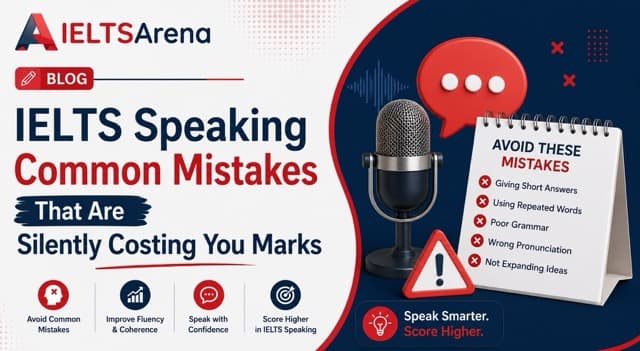
Mistake 1: Overusing filler words. Starting every answer with "actually", "basically", "you know", or a long "ummm" signals hesitation. It lowers your Fluency and Coherence score even when your ideas are clear.
Mistake 2: One-word or memorized answers in Part 1. Answering "Do you like your job?" with "Yes, I like it" gives the examiner nothing to score. Memorized speeches are worse. Examiners are trained to spot them and they cap your fluency mark.
Mistake 3: Simple, repetitive grammar. Speaking only in short present-tense sentences limits your Grammatical Range. Band 7 needs conditionals, relative clauses, and a mix of tenses used naturally.
Mistake 4: Everyday vocabulary only. Using "good", "bad", "nice", and "a lot" throughout the test keeps your Lexical Resource at Band 6. You need less common words and natural collocations.
Mistake 5: Speaking too fast. Rushing to sound fluent creates slurred words and pronunciation errors. Speed is not fluency. Clear, well-paced speech scores higher than fast, messy speech.
Mistake 6: Not developing Part 3 answers. Giving one-line responses to abstract Part 3 questions shows you cannot discuss ideas in depth, which is exactly what this section tests.
Mistake 7: Going off-topic. Long, wandering answers that lose the question hurt your Coherence score. Structure matters as much as content.
Each of these IELTS speaking mistakes is fixable, but only once you can hear yourself making it.
How Miguel Fixed His Band 6 Ceiling
Miguel, an engineer from the Philippines, was stuck at Band 6.5 in Speaking across two attempts. His English at work was strong. He led meetings in English every week.
"I could not understand it," he said. "I speak English all day. How was I only Band 6.5?"
He recorded three of his own practice answers and listened back. The pattern was obvious once he heard it. He started every single answer with "so, basically" and used the word "good" eleven times in four minutes.
His grammar never left the present tense. His Part 2 long turn was a list of simple sentences with no complex structures at all.
He spent four weeks fixing one mistake at a time. First filler words. Then vocabulary range. Then complex sentences. He recorded and reviewed every session.
On his next attempt he scored Band 7.5. Nothing about his actual English had changed. He had simply found and removed the IELTS speaking mistakes that were hiding in plain sight.
What The Data Shows About Speaking Scores
Speaking is one of the two productive skills, alongside Writing, and it is where many candidates plateau. Score reports consistently show that Speaking and Writing sit lower on average than Listening and Reading for most test-takers.
The reason is structural. Listening and Reading test recognition, which improves quickly with practice. Speaking and Writing test production, which requires you to actively change ingrained habits.
According to IELTS band descriptor guidance published by the official test bodies, the jump from Band 6 to Band 7 in Speaking specifically requires a wider range of vocabulary and more flexible grammar, not just clearer pronunciation.
That is why fluency alone stalls at Band 6.5. Roughly speaking, a candidate who is Band 7 on Fluency and Pronunciation but Band 6 on Lexical Resource and Grammar will land at Band 6.5 overall.
The insight is that most speaking improvement comes from raising your two weakest criteria, not polishing your strongest. Identifying which two are holding you back is the entire game.
How IELTSArena Helps You Catch Your Own Mistakes
The single biggest barrier to fixing IELTS speaking mistakes is that you cannot hear them while speaking, and most students have no one to point them out.
IELTSArena solves this directly. The AI Speaking feedback scores your responses on all four criteria: Fluency and Coherence, Lexical Resource, Grammatical Range and Accuracy, and Pronunciation. You see exactly which criterion is dragging your band down.
Instead of guessing why you scored Band 6, you get a criterion-by-criterion breakdown that shows your filler words, your repeated vocabulary, and your grammar patterns. The invisible becomes visible.
You practice on real exam-style Speaking prompts across all three parts, so you build the specific skills each part demands. Part 3 depth is a different skill from Part 1 warmth, and IELTSArena trains both.
For students who want examiner-level insight, expert tutors on IELTSArena give band-focused corrections a human way. An AI can flag that your vocabulary is repetitive. A tutor can show you the exact less common words that would lift you to Band 7 on that topic.
The progress analytics track your Speaking scores over time, so you can confirm your filler words are dropping and your grammar range is widening. More than 10,000 learners have used IELTSArena to move past the Band 6 speaking ceiling.
The combination of instant AI feedback on every attempt and human tutor review is what turns silent IELTS speaking mistakes into a clear, fixable list. You stop guessing and start correcting.
Fluency gets you understood. Range and accuracy get you to Band 7. The gap between them is where most marks are silently lost.
Self-Diagnosis: Are These Mistakes In Your Speaking?
Record yourself answering three practice questions, then listen back and check honestly.
- How many times do you start an answer with "so", "basically", "actually", or "umm"?
- Do you use any complex sentences, or only short present-tense statements?
- Count your vocabulary. How many times do you say "good", "bad", "nice", or "a lot"?
- In Part 3, do your answers develop the idea, or stop after one line?
- Are you speaking clearly, or rushing so fast that words blur together?
If you cannot answer these because you have never recorded yourself, that is the first mistake to fix. You cannot correct what you cannot hear.
See Where Your Speaking Band Really Stands
You do not have a speaking problem. You have a small set of specific, fixable IELTS speaking mistakes that are averaging your band down. The fastest path to Band 7 is finding them and removing them one at a time.
Take a free Speaking practice on IELTSArena and get instant AI feedback on all four criteria. In one session, you will know exactly which mistake is costing you the most marks.
Take a Free Speaking Practice on IELTSArena →
Frequently Asked Questions
What mistakes in IELTS speaking are most likely to keep me below band 7?
The most common band-limiting mistakes are simple, repetitive grammar and everyday vocabulary. If you speak only in short present-tense sentences and rely on words like "good" and "a lot", your Grammatical Range and Lexical Resource stay at Band 6, which averages your overall score down even if your fluency is strong. Overusing filler words, giving one-line Part 3 answers, and speaking too fast also hurt. The path to Band 7 is raising your two weakest criteria. Tools like IELTSArena score each criterion separately so you know which mistake is costing you the most.
Is it a mistake to speak too fast in the IELTS speaking test?
Yes. Speed is often mistaken for fluency, but they are not the same. Speaking too fast causes slurred words, dropped endings, and pronunciation errors that lower your score. Fluency in the IELTS band descriptors means speaking at a natural, steady pace without long hesitation, not rushing. A clear, well-paced answer with occasional natural pauses scores higher than a fast, messy one. Aim for the pace you would use explaining something important to a colleague. Recording yourself and listening back is the quickest way to hear whether you are rushing.
Does correcting yourself in IELTS speaking lower your fluency score?
A quick, natural self-correction does not hurt you and can even show language control. Fluent speakers correct themselves smoothly all the time. The problem is frequent, disruptive self-correction that breaks your flow and creates long hesitation. If you constantly stop, restart, and second-guess your grammar mid-sentence, that lowers your Fluency and Coherence score. The goal is not perfection. It is keeping your speech flowing. Fix a genuine error briefly and move on rather than agonizing over it. Practicing on IELTSArena helps you build the confidence to keep going.
Why do students who speak good English still make mistakes in the IELTS speaking test?
Because everyday English and exam English reward different things. In daily life you succeed by being understood quickly, so you use simple words and short sentences. The IELTS band descriptors reward complex grammar, less common vocabulary, and developed answers, which fluent speakers rarely stretch to use. Good speakers also cannot hear their own filler words, repeated vocabulary, or grammar patterns while talking. These IELTS speaking mistakes stay invisible without recording and review. The fix is not more English exposure but targeted practice that surfaces your specific habits, which is exactly what IELTSArena's AI Speaking feedback provides.
How do I identify my own IELTS speaking mistakes without a teacher?
Record yourself answering real exam questions, then listen back with the four band criteria in mind. Count your filler words, check whether you use any complex sentences, and note how often you repeat basic vocabulary like "good" and "nice". Listen for whether you develop Part 3 answers or stop after one line. This self-review reveals most patterns. For deeper analysis without a private teacher, IELTSArena's AI Speaking feedback scores each criterion automatically and highlights your exact mistakes, and expert tutors can add human, band-focused corrections when you want a second layer of insight.