
You take the Speaking test, get Band 6.0. Your Speaking feedback shows Lexical Resource at Band 7, Grammatical Range at Band 7, Pronunciation at Band 7, Fluency and Coherence at Band 5. Overall Speaking band: 6.0. Three of the four criteria averaged Band 7, but the one Fluency and Coherence cap dragged the whole band down. You spent six weeks studying vocabulary and grammar between attempts, and none of it moved the criterion that was actually holding you back. This is the Fluency and Coherence paradox in IELTS Speaking, and it explains why most Speaking retakes produce the same band as the first attempt.
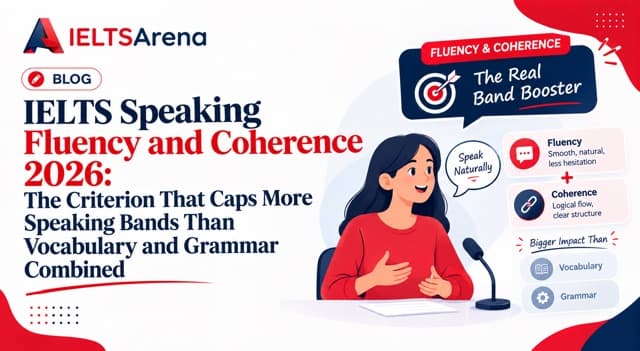
Quick answer: IELTS speaking fluency and coherence is one of the four Speaking assessment criteria, weighted at 25 percent of your overall Speaking band. It measures two things together: whether you speak at a natural pace without noticeable effort (fluency), and whether your ideas connect logically across sentences and paragraphs of speech (coherence). Because the four criteria are averaged, a low Fluency and Coherence score can drag a Band 7 profile on the other three criteria down to Band 6 overall. Fixing Fluency and Coherence produces the fastest visible band movement of any Speaking improvement for candidates at Band 5.5 to 6.5.
In This Guide
- What Fluency and Coherence Actually Measures
- Fluency and Coherence Are Two Sub-Skills, Not One
- The Four Speaking Criteria and Why This One Caps Your Band
- The Band Descriptors from Band 5 to Band 9
- The Four Mistakes That Cap Fluency and Coherence at Band 5 or 6
- A Real Student's Story: Band 5.5 to Band 7.0 in Five Weeks
- The Data Behind This Criterion
- The Right Approach: A Four-Week Fix Plan
- Same Part 2 Answer at Band 5, Band 6, and Band 8 with Hesitation Marked
- Daily Drills That Actually Move the Criterion
- How IELTSArena Helps You Fix Fluency and Coherence Specifically
- Self-Diagnosis: Is Fluency and Coherence Capping Your Band?
- Key Takeaways
- Frequently Asked Questions
Advertisement
What Fluency and Coherence Actually Measures
IELTS speaking fluency and coherence is the criterion that assesses whether your speech flows naturally and connects logically. It applies to all three parts of the Speaking test: Part 1's short question and answer, Part 2's 2-minute long turn, and Part 3's abstract discussion. Each part is scored against the same four criteria, and Fluency and Coherence carries equal 25 percent weight in each.
The criterion covers four specific observable behaviours. First, whether you can speak at a natural rate without noticeable effort or long unfilled pauses. Second, whether hesitations and self-corrections are limited enough not to interrupt understanding. Third, whether you connect ideas across sentences using appropriate linking language (rather than mechanical connectors). Fourth, whether your response develops rather than repeats or restarts.
Because these four checks are what Fluency and Coherence measures, the criterion is uniquely sensitive to speech rate, hesitation patterns, and sentence-to-sentence flow. A candidate with limited vocabulary who speaks smoothly with logical connections can score Band 7 on Fluency and Coherence. A candidate with strong vocabulary who hesitates every second sentence or restarts mid-thought gets capped at Band 5 or 6. This is why studying vocabulary rarely moves this criterion.
Fluency and Coherence Are Two Sub-Skills, Not One
The criterion name combines two related but distinct sub-skills, and understanding the difference is the first step toward fixing it.
Fluency is about delivery. It covers your speech rate, the length and frequency of pauses, and the amount of self-correction. A fluent Band 7 candidate speaks at a comfortable conversational pace, pauses only for natural thought breaks (not to search for words), and does not restart sentences midway.
Coherence is about logical connection. It covers whether your ideas flow one from the next, whether you use appropriate linking language, and whether your response develops rather than repeats. A coherent Band 7 candidate uses phrases like "the main reason for this is", "in contrast", and "this leads to" naturally, and each sentence adds a new idea rather than restating the previous one.
The two sub-skills can fail independently. A candidate can speak smoothly (Band 7 fluency) but with disconnected ideas that jump between topics (Band 5 coherence). Or a candidate can produce logically structured ideas (Band 7 coherence) but with so much hesitation and restarting that delivery breaks down (Band 5 fluency). Because the criterion is scored as a single band, whichever sub-skill is weaker sets the ceiling. Diagnose which of the two is your gap before drilling.
The Four Speaking Criteria and Why This One Caps Your Band
Your IELTS Speaking band is the average of your four criterion scores: Fluency and Coherence, Lexical Resource, Grammatical Range and Accuracy, and Pronunciation. Each criterion is worth 25 percent.
Because the four criteria are averaged rather than voted on, the weakest criterion has a bigger effect on the final band than most candidates realise. Here is what different criterion profiles produce as overall Speaking band scores.
| Fluency and Coherence | Lexical Resource | Grammatical Range | Pronunciation | Overall Speaking band |
|---|---|---|---|---|
| 5 | 7 | 7 | 7 | 6.5 |
| 5 | 8 | 8 | 8 | 7.25, rounded down to 7 |
| 6 | 7 | 7 | 7 | 6.75, rounded to 6.5 |
| 7 | 7 | 7 | 7 | 7 |
| 4 | 8 | 8 | 8 | 7 |
Notice the pattern: even a Band 8 profile on the other three criteria only lifts a Band 5 Fluency and Coherence to Band 7 overall. Fixing Fluency and Coherence is almost always the fastest route to a higher Speaking band, because it is usually the lowest-scoring criterion at Band 5.5 to Band 6.5 level, not because it is intrinsically more important than the other three.
The Band Descriptors from Band 5 to Band 9
Here is what the publicly available Fluency and Coherence descriptors say, expressed in plain language rather than official jargon.
Band 5 Fluency and Coherence. Usually maintains flow of speech but uses repetition, self-correction, and slow speech to keep going. May over-use certain connectives and discourse markers. Produces simple speech fluently, but more complex communication causes problems.
Band 6 Fluency and Coherence. Willing to speak at length, though may lose coherence at times due to occasional repetition, self-correction, or hesitation. Uses a range of connectives and discourse markers but not always appropriately.
Band 7 Fluency and Coherence. Speaks at length without noticeable effort or loss of coherence. May demonstrate language-related hesitation at times, or some repetition or self-correction. Uses a range of connectives and discourse markers with some flexibility.
Band 8 Fluency and Coherence. Speaks fluently with only occasional repetition or self-correction. Hesitation is usually content-related and only rarely to search for language. Develops topics coherently and appropriately.
Band 9 Fluency and Coherence. Speaks fluently with only rare repetition or self-correction. Any hesitation is content-related rather than to find words or grammar. Speaks coherently with fully appropriate cohesive features.
Two patterns emerge. First, hesitation moves through frequent and language-related (5), occasional and language-related (6), sometimes language-related (7), rarely language-related (8), only content-related (9). What matters is not whether you hesitate but why: pausing to think about the topic is Band 8. Pausing to find the English word is Band 6. Second, speech length moves through simple only (5), willing at length (6), at length without noticeable effort (7), fluent throughout (8, 9). Willingness to sustain a Part 2 response for a full 2 minutes and to give Part 3 answers of 30 to 45 seconds is what pushes you from Band 6 to Band 7.
The Four Mistakes That Cap Fluency and Coherence at Band 5 or 6
Four specific mistakes account for most Band 5 and Band 6 Fluency and Coherence scores.
Mistake 1: Language-related hesitation. Long pauses in the middle of sentences to search for a specific word or grammar structure. This is the single most band-limiting fluency mistake because it directly matches the Band 5 to Band 6 descriptor language ("hesitation to find words or grammar"). The fix is not to expand vocabulary but to build the habit of substituting simpler words when the ideal word does not come immediately.
Mistake 2: Over-use of mechanical discourse markers. Repeating "you know", "actually", "basically", "like", and "so" as fillers signals to the examiner that you are using them to buy time rather than to organise ideas. This drops Fluency and Coherence by half a band even when the underlying speech is otherwise fluent. The fix is to record yourself and count the fillers per minute, then consciously replace them with silent pauses.
Mistake 3: Sentence restarting. Beginning a sentence, stopping midway, then restarting with different words. This is the most audible fluency issue on Part 2 and Part 3 responses. The fix is to slow down slightly and finish each sentence you start, even if you would phrase it better on a second attempt.
Mistake 4: Mechanical connectives without logical progression. Saying "firstly", "secondly", and "in conclusion" between paragraphs that do not actually build on each other. This is a coherence issue rather than a fluency issue. The examiner rewards logical progression more than the presence of connectives. The fix is to make sure each new sentence adds something to the previous one, and to use connectives only when they signal a real relationship between ideas.
A Real Student's Story: Band 5.5 to Band 7.0 in Five Weeks
Sana, a software developer from Islamabad applying for an Australian PR, sat the IELTS twice and scored Speaking Band 5.5 both times. Her Lexical Resource and Grammatical Range scores were both Band 7, but Fluency and Coherence was Band 5 on both attempts, dragging her Speaking band down to 5.5.
I was studying more vocabulary and more advanced grammar every week. My third attempt was supposed to be the breakthrough. It scored exactly the same as the first. When my tutor listened to my recorded practice, she counted 14 filler sounds in a 90-second Part 2 response. I had never heard them because I had never listened back to myself. The fix was not to learn more, it was to speak less carelessly.
Her diagnostic named two specific problems: she used "you know" and "actually" as fillers every second sentence, and she restarted about one in five sentences mid-clause. She stopped studying new vocabulary and grammar for four weeks and drilled two things only: filler substitution (replacing "you know" with a silent pause) and sentence commitment (finishing every sentence she started). Her fourth attempt scored Fluency and Coherence Band 7 for the first time. Overall Speaking band lifted from 5.5 to 7.0, and the Australia route cleared. Total time from Band 5.5 to Band 7.0: five weeks, after six months of broad study that produced no movement.
The Data Behind This Criterion
Cambridge Assessment English publicly reports that Fluency and Coherence is the Speaking criterion where candidates most often lose marks in the Band 5 to Band 6.5 range, and the global average Speaking band sits close to Band 6.0 (Cambridge Assessment English, IELTS Test Statistics 2024 to 2025).
British Council examiner reports specifically flag "language-related hesitation" and "repetition of discourse markers as filler" as the two most common patterns that cap Fluency and Coherence at Band 5 to Band 6. IELTS.org confirms the four Speaking assessment criteria for 2026 remain Fluency and Coherence, Lexical Resource, Grammatical Range and Accuracy, and Pronunciation, each weighted equally at 25 percent (IELTS.org, 2026 assessment framework).
Internal tracking on IELTSArena shows that among candidates scoring Speaking Band 5.5 to 6.5, roughly 75 percent have Fluency and Coherence as their lowest-scoring criterion, and that half a band of Fluency and Coherence movement produces roughly half a band of overall Speaking movement on average. The same tracking shows that half a band of Lexical Resource movement produces only a quarter band of overall Speaking movement at this level, because Lexical Resource is rarely the weakest criterion. This is direct evidence that Fluency and Coherence is the criterion to fix first for the majority of Speaking candidates.
The Right Approach: A Four-Week Fix Plan
Fixing IELTS speaking fluency and coherence at scale is a four-step process. Do not skip any step.
Step 1: Diagnose with three recorded responses. Record yourself answering one Part 1 question, one Part 2 cue card, and one Part 3 question. Play each recording back and count three things: filler sounds per minute (target: fewer than 4), sentence restarts (target: fewer than 2 per minute), and pauses longer than 3 seconds (target: 0 mid-sentence, only at natural thought breaks). If any of these three counts is above target, Fluency and Coherence is your fix.
Step 2: Drill filler substitution for two weeks. Every day, record a 60-second monologue on a random topic. Play it back and count the fillers. Consciously replace each "you know", "actually", "basically", or "like" with a short silent pause. Silent pauses do not damage Fluency and Coherence, but fillers do. Within 10 to 14 days, the filler count typically drops from 8 to 12 per minute down to 2 to 3 per minute.
Step 3: Drill sentence commitment for one week. For seven days, record five 30-second responses per day and follow one rule: finish every sentence you start, even if you would phrase it better on a second attempt. Do not restart. Do not rephrase. If you make a grammar mistake mid-sentence, finish the sentence with the mistake, then move on. Restarting damages Fluency and Coherence more than the original mistake would have.
Step 4: Re-test. Record three new responses (one Part 1, one Part 2, one Part 3) and count the same three metrics. If fillers dropped below 4 per minute and restarts below 2 per minute, the fix worked. Retest against the IELTS Speaking band descriptors, or submit for scored feedback, to confirm the criterion moved.
This is the loop that produces Band 5.5 to Band 7 movement on Fluency and Coherence in four weeks. It works because it strips out every other variable: no new vocabulary study, no new grammar rules, just delivery discipline on the specific criterion that was scoring lowest.
Same Part 2 Answer at Band 5, Band 6, and Band 8 with Hesitation Marked
Here is what different Fluency and Coherence levels sound like on the same Part 2 prompt: "Describe a time you helped a friend with a problem." Vocabulary and grammar are held roughly constant across the three versions.
Band 5 Fluency and Coherence (transcribed with hesitation): "So, um, my friend, actually she is, um, she is... my friend was, you know, having a problem with, like, her job. And she was, um... she was... basically she asked me for advice and I, um, I helped her, you know, by listening. And, actually, we talked for, like, two hours. And, um, in the end she felt better, I think."
Notice the pattern: 11 filler sounds in 55 words, one restart, three unfilled pauses. Fluency and Coherence Band 5. The vocabulary and grammar are Band 6 quality, but the delivery caps the criterion.
Band 6 Fluency and Coherence (transcribed): "My friend was having a problem with her job. She asked me for advice and, you know, I helped her by just listening. We talked for about two hours. In the end she felt better, and I think our conversation helped her decide what to do next."
Notice: 1 filler, 0 restarts, 0 long pauses. Fluency Band 7, but coherence is only Band 6 because the ideas are listed rather than connected. No linking language, no development of any single idea. Overall criterion: Band 6.
Band 8 Fluency and Coherence (transcribed): "A close friend of mine was going through a difficult period with her job about six months ago. She had been offered a promotion, but taking it would have meant relocating, and she was genuinely torn about whether to accept. When she asked me for advice, I decided the most useful thing I could do was listen rather than steer her one way or the other, so we spent almost two hours talking through what mattered most to her. By the end of the conversation she had reached her own decision, and I think the space to think out loud was exactly what she needed."
Notice: 0 fillers, 0 restarts, 0 unfilled pauses. Ideas connect logically (about six months ago, but, so, by the end). The response develops the situation, the decision, the intervention, and the outcome in that order. Fluency and Coherence Band 8. Length: 109 words in roughly 45 seconds.
The gap between the Band 5 and Band 8 versions is not vocabulary or grammar. It is filler count, sentence commitment, and logical connection between ideas.
Daily Drills That Actually Move the Criterion
Four short daily drills, done consistently for four weeks, move Fluency and Coherence faster than any other practice.
Drill 1: The 60-second monologue. Pick a random topic from a Part 1 question bank. Record yourself speaking for 60 seconds. Play back, count fillers, note restarts. Do not re-record. Move to the next topic the next day.
Drill 2: The shadow speaking exercise. Play a 30-second clip of a native English speaker on a podcast or news programme. Try to speak the same words at the same pace, half a second behind. This trains your natural speech rhythm and reduces language-related pausing.
Drill 3: The connective-swap exercise. Take a 90-second recording of your own speech and identify every "and", "so", and "but". Rewrite the response using more specific connectives ("as a result", "however", "in particular"). Speak the new version aloud. This trains coherence.
Drill 4: The pause-instead-of-filler exercise. For 5 minutes per day, monologue on any topic with one rule: whenever you feel a "you know" or "actually" coming, pause silently instead. Silence is not penalised. Fillers are.
Consistency matters more than intensity. Twenty minutes a day for four weeks moves the criterion. Two hours a day for one week does not.
How IELTSArena Helps You Fix Fluency and Coherence Specifically
IELTSArena's AI Speaking feedback scores every recorded response against Fluency and Coherence, Lexical Resource, Grammatical Range and Accuracy, and Pronunciation separately, and specifically counts filler sounds, self-corrections, and unnatural pauses in the response. This is the most band-limiting pattern for candidates at Band 5.5 to Band 6.5, and having it counted automatically saves you the manual work of transcribing and counting yourself.
Expert tutors on IELTSArena review Speaking responses with a specific focus on Fluency and Coherence for candidates scoring Band 5.5 to Band 6.5, because Fluency and Coherence is the criterion most likely to be capping the whole Speaking band at that level. The platform also provides model responses at Band 5, Band 6, and Band 8 on the same prompts, so you can hear the specific difference in delivery between the band you are currently at and the band you are targeting. More than 10,000 students have used IELTSArena to move their Speaking band up.
Start your free IELTS practice on IELTSArena and record your first Part 1 response for automated Fluency and Coherence feedback this week.
Self-Diagnosis: Is Fluency and Coherence Capping Your Band?
Work through these questions honestly against a recording of your last practice response.
Did you count more than 4 filler sounds ("you know", "actually", "basically", "like", "so") per minute of speech? Did you restart more than 2 sentences per minute mid-clause? Did you produce any pause longer than 3 seconds in the middle of a sentence, not at a natural thought break? On a Part 2 response, did you speak for the full 2 minutes, or did you stop between 60 and 90 seconds? On a Part 3 response, did each answer reach at least 30 seconds, or did you finish in 15 to 20 seconds? Did your ideas connect logically from one sentence to the next, or did you jump between disconnected points? Did you use varied connectives, or did you rely on "and", "so", and "but" for most links?
If you hesitated on more than two of these, Fluency and Coherence is likely your lowest-scoring criterion. Drill the specific fixes for four weeks and re-test.
Key Takeaways
- IELTS speaking fluency and coherence is one of the four Speaking assessment criteria, weighted at 25 percent of your Speaking band.
- The criterion combines two sub-skills: fluency (delivery, hesitation, pauses) and coherence (logical connection, discourse markers, development). Diagnose which is your gap before drilling.
- Because the four criteria are averaged, a Band 5 Fluency and Coherence drags a Band 7 profile on the other three criteria down to Band 6 overall.
- Roughly 75 percent of candidates scoring Speaking Band 5.5 to 6.5 have Fluency and Coherence as their weakest criterion, making it the fastest fix for most candidates.
- The four mistakes that cap Fluency and Coherence at Band 5-6 are: language-related hesitation, over-use of fillers, sentence restarting, and mechanical connectives without logical progression.
- The fix is delivery discipline, not language study. Four weeks of filler substitution, sentence commitment, and connective-swap drills typically produce half a band to a full band of movement.
Related Guides on IELTSArena
- IELTS Speaking Test Format: What Happens on Exam Day
- IELTS Speaking Part 2 Cue Card Strategy
- IELTS Speaking Part 3 Questions and Sample Answers
- IELTS Cue Card Topics 2026: 30 Most Common Topics
- How to Get Band 7 in IELTS: Section-by-Section Plan
- How to Get Band 7.5 in IELTS
- How to Get Band 8 in IELTS
- IELTS Band Score Chart 2026
- IELTS Speaking Lexical Resource
- IELTS Speaking Grammatical Range and Accuracy
- IELTS Speaking Pronunciation 2026: The Four Sub-Components
- IELTS Speaking Pronunciation: How to Score Full Marks
- IELTS Speaking Mistakes to Avoid
- How to Practise IELTS Speaking Alone
See Where Your Fluency and Coherence Band Stands Today
Try a free mock test at ieltsarena.com and record one timed Speaking response. In one free practice session, you will know exactly which of the four Speaking criteria is capping your Speaking band, and whether Fluency and Coherence is the specific gap holding you back.
Start your free IELTS practice on IELTSArena
Frequently Asked Questions
What is Fluency and Coherence in IELTS Speaking? IELTS speaking fluency and coherence is one of the four Speaking assessment criteria, weighted at 25 percent of your Speaking band. It measures two related sub-skills together: fluency, which covers your speech rate, hesitation frequency, and self-correction, and coherence, which covers how logically your ideas connect from one sentence to the next. A Band 7 candidate speaks at natural conversational pace, hesitates only occasionally to think about content rather than to find words, and connects ideas with appropriate discourse markers. Because fluency and coherence are scored as a single band, whichever sub-skill is weaker sets the ceiling, so diagnose which of the two is your specific gap before choosing what to drill.
How do I improve fluency in IELTS Speaking? Focus on delivery discipline rather than language study. First, count your filler sounds per minute by recording yourself and playing back. Target fewer than 4 fillers per minute. Second, replace fillers ("you know", "actually", "basically", "like") with short silent pauses. Silence is not penalised, fillers are. Third, commit to every sentence you start. Do not restart mid-clause, even if you would phrase it better on a second attempt. Restarting damages Fluency and Coherence more than a small grammar mistake would. Four weeks of daily 20-minute drills on these three habits typically moves Fluency and Coherence from Band 5 to Band 6.5 or Band 7, faster than any vocabulary programme.
How much hesitation is allowed at IELTS Speaking Band 7? Occasional hesitation is allowed at Band 7 as long as it is language-related only occasionally and does not interrupt understanding. The Band 7 descriptor allows "some hesitation, repetition, or self-correction" but requires that speech continues "at length without noticeable effort". In practical terms, this means fewer than 4 filler sounds per minute, no mid-sentence pauses longer than 2 to 3 seconds, and no more than 1 sentence restart per minute. Band 8 tightens this further: hesitation must be content-related (pausing to think about what to say) rather than language-related (pausing to find the English word). If your hesitations happen while searching for a word, the criterion is scored Band 6 or below, not Band 7.
What is the difference between fluency and coherence in IELTS Speaking? Fluency is about delivery, coherence is about logical connection. Fluency covers your speech rate (natural conversational pace), the frequency of pauses (few, and only at natural thought breaks), and how much you self-correct or restart sentences (rare at Band 7+). Coherence covers whether your ideas connect logically from one sentence to the next, whether you use appropriate discourse markers ("as a result", "in contrast", "the main reason for this is"), and whether your response develops rather than repeats. A candidate can be fluent but incoherent (smooth delivery of disconnected ideas) or coherent but disfluent (logically structured ideas delivered with frequent hesitation). Both matter equally within the single band score for this criterion.
Why is my Speaking Fluency scored Band 5 in IELTS? Four specific mistakes cap Fluency and Coherence at Band 5. First, language-related hesitation, where you pause mid-sentence to search for a specific word or grammar structure. Second, over-use of filler sounds like "you know", "actually", "basically", and "like" more than 6 to 8 times per minute. Third, restarting sentences mid-clause more than 3 to 4 times per minute. Fourth, mechanical use of connectives (repeating "firstly", "secondly", "in conclusion") without genuine logical progression between the paragraphs they connect. Any one of these caps Fluency and Coherence at Band 5, and two together typically produce Band 4. All four are delivery habits rather than language gaps, which means they can be fixed without any new vocabulary or grammar study.
Last updated September 2026 by the IELTSArena Editorial Team, a team of IELTS tutors, certified CBT examiners, and Speaking feedback specialists who publish weekly research-backed guides on ieltsarena.com.