Your IELTS result is a number between 1 and 9. But that number means very different things depending on where you are applying, which pathway you are pursuing, and which institutions or immigration authorities are evaluating your application.
Most candidates know their target band. Far fewer understand what the IELTS band score chart actually describes at each level, how the overall band is calculated from four section scores, and why two candidates with the same overall result can have very different outcomes depending on their individual component performance.
This guide covers the full IELTS band score chart from Band 1 to Band 9, explains what each level means for university admissions, immigration, and professional registration in 2026, and shows how IELTSArena helps you close the gap between your current score and your goal.
What the IELTS Band Score Chart Actually Measures
The IELTS band score chart is not a percentage scale. A score of 7.0 does not mean you answered 70% of questions correctly.
Each band level on the IELTS score chart corresponds to a descriptor that defines an overall level of English proficiency. These descriptors were developed by the British Council, IDP, and Cambridge Assessment English and are applied consistently across all IELTS test versions.
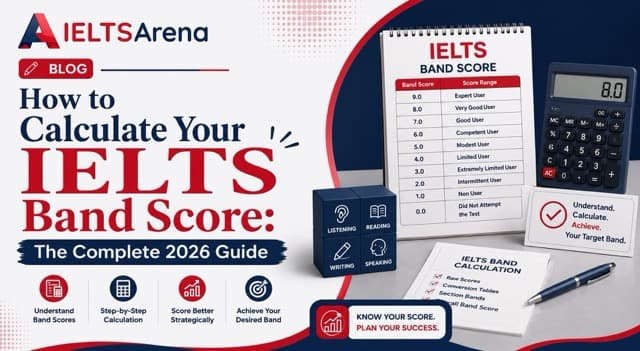
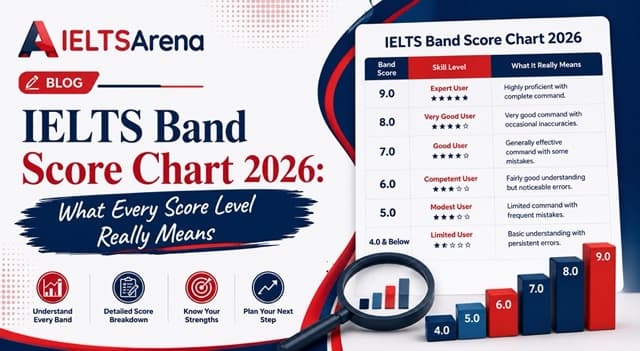
Here is what the IELTS band 1 to 9 scale describes at each level.
- Band 9 – Expert User. Full operational command of the language. Appropriate, accurate, and fluent with complete understanding across all contexts.
- Band 8 – Very Good User. Fully operational command with only occasional unsystematic inaccuracies. Some misunderstandings may occur in unfamiliar situations.
- Band 7 – Good User. Operational command with occasional inaccuracies and misunderstandings. Generally handles complex language well and understands detailed reasoning.
- Band 6 – Competent User. Generally effective command despite some inaccuracies, inappropriate usage, and misunderstandings. Uses and understands fairly complex language, particularly in familiar situations.
- Band 5 – Modest User. Partial command of the language. Copes with overall meaning in most situations, though likely to make many errors. Basic communication in familiar fields.
- Band 4 – Limited User. Basic competence limited to familiar situations. Frequent problems in understanding and expression. Cannot use complex language reliably.
- Band 3 – Extremely Limited User. Conveys and understands only general meaning in very familiar situations. Frequent breakdowns in communication.
- Band 2 – Intermittent User. No real communication possible. Serious difficulties understanding both spoken and written English.
- Band 1 – Non User. Essentially no ability to use the language beyond a few isolated words.
Most candidates preparing for university, immigration, or professional registration require scores between Band 5.5 and Band 8.5, depending on their destination and purpose. IELTSArena is designed specifically to support candidates working within this range.
Advertisement
Why Misunderstanding the Band Score Chart Costs Candidates Exam Attempts
The most damaging misunderstanding candidates have about the IELTS score chart is treating the overall band as the only number that matters.
Many institutions and immigration authorities set minimum requirements for individual sections, not just the overall band score. A candidate who achieves Band 7.0 overall with Band 5.5 in Writing will be disqualified from any programme requiring a minimum of Band 6.5 in each component, even though their overall band meets the stated threshold.
This pattern is extremely common and extremely costly. Candidates who do not understand how their IELTS band descriptor breaks down by skill can pass one overall target and still fail to meet entry requirements entirely.
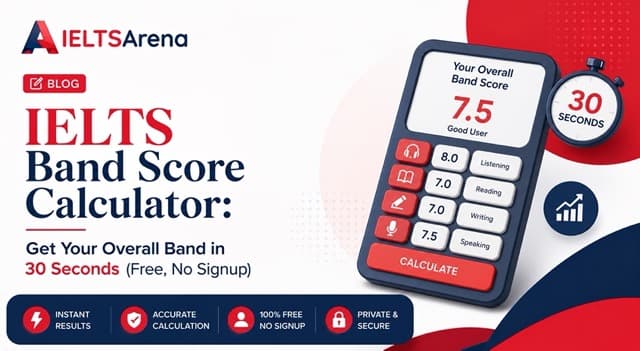
The second major confusion involves the rounding rules on the IELTS score chart. Your four section scores are averaged, and the result is rounded to the nearest 0.5. If your section average is 6.375, your overall band rounds to 6.5. If it is 6.25, it also rounds to 6.5. If it is 6.125, it rounds down to 6.0. Understanding how rounding affects your result is essential when you are close to a threshold. IELTSArena calculates and displays this for you after every full mock test.
One Candidate's Experience Navigating the Band Score Chart
Carlos, a physiotherapist from the Philippines preparing to migrate to Australia, needed Band 7.0 overall with no section below 7.0 for registration with the Australian Health Practitioner Regulation Agency.
"I passed the overall score in my first attempt," he said. "But my Writing came back at 6.5. I had no idea the section minimums were listed separately from the overall requirement."
He used IELTSArena to understand exactly where his IELTS score explained in terms of band descriptors was falling short. IELTSArena's Writing feedback identified precisely which of the four assessment criteria he was underperforming on: specifically Task Achievement and Lexical Resource.
Three months of targeted Writing practice on IELTSArena later, he sat the exam again and achieved Band 7.5 in Writing, clearing all section minimums.
"If I had understood the IELTS band score chart properly from the beginning, I would have targeted Writing specifically from day one. IELTSArena made that specific and actionable."
What the Data Shows About Global Band Score Distribution
According to published IELTS performance data, the global mean overall band score across all test takers is approximately 6.0. The majority of candidates score between Band 5.5 and Band 7.0.
Achieving Band 7.0 places a candidate in approximately the top 35% of all IELTS test takers globally. Band 7.5 and above places them in the top 20%.
The most commonly required scores for university admissions are Band 6.5 and Band 7.0. For skilled migration to Australia, the UK, and Canada, requirements typically range from Band 6.0 to Band 8.0 depending on the visa category and the applicant's specific occupation.
The gap between Band 6.0 and Band 7.0 on the IELTS band score chart represents a significant proficiency increase and typically requires three to six months of structured, targeted preparation. IELTSArena's test environment and feedback tools are specifically designed to support candidates working within this range efficiently.
What Each Score Level on the IELTS Band Score Chart Means for Your Goal
Understanding what each level means for your specific application purpose helps you set a meaningful and accurate target from the beginning of your preparation.
University Admissions
Most undergraduate programmes at mid-tier international universities require Band 6.0 to 6.5. Top-ranked universities typically require Band 7.0 to 7.5. Some competitive programmes in medicine, law, and journalism require Band 7.5 to 8.0 with specific section minimums. Always confirm the exact requirement with the admissions team of your target institution, as requirements vary and are updated regularly.
Migration to Australia
Australia's General Skilled Migration points test assigns points based on IELTS scores. Achieving Band 8 in all four sections (Superior English) earns 20 points in the points test, compared to 10 points for Competent English (Band 6 in all sections). This 10-point difference can determine whether an application receives an invitation to apply in a competitive year. IELTSArena tracks your section scores against these specific thresholds.
Migration to Canada
Canada's Express Entry system converts IELTS scores to the Canadian Language Benchmark (CLB). Band 7.0 in all sections corresponds to CLB 9, which is the threshold for the highest language points tier in the Federal Skilled Worker programme. CLB 10 (Band 8 in Listening, Band 7.5 in Reading, Writing, and Speaking) earns the maximum language points allocation.
Migration to the UK
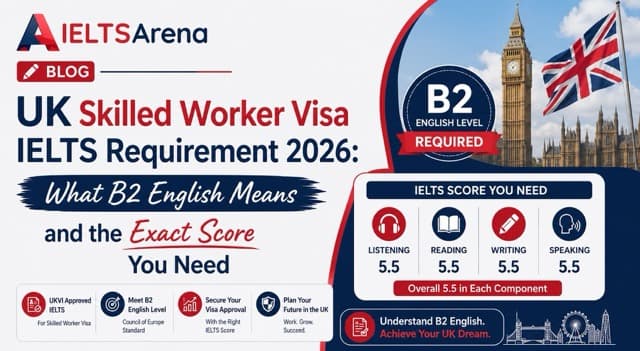
UK Skilled Worker visas require a minimum of CEFR B1 in most categories, which corresponds to approximately Band 4 to 5 on the IELTS score chart. However, specific regulated professions such as nursing and medicine require Band 7.0 across all four sections with no exceptions.
Professional Registration
Healthcare bodies across Australia, the UK, and Canada consistently require Band 7.0 or above with section minimums. Some bodies require Band 7.0 in every individual section. Understanding the section requirements of your specific registration body before you begin preparing is essential.
The Right Approach to Targeting Your Score on the IELTS Band Score Chart
Reaching your target requires a structured five-step process.
Step 1: Know your starting point. Take a full timed IELTS mock test and calculate your estimated band score for each section using the IELTS band descriptor criteria. IELTSArena does this automatically after every test.
Step 2: Know your target score and its section requirements in full. Confirm both the overall band and any individual section minimums required by your university, immigration programme, or professional body. Do not rely only on the overall band stated in programme brochures.
Step 3: Identify your weakest section. Your overall band is constrained by your lowest section score. The most effective preparation prioritises improvement where the gap between your current performance and your target is largest.
Step 4: Set a realistic timeline. Moving from Band 6.0 to Band 7.0 in a single section typically requires 8 to 12 weeks of focused, structured preparation. Building this timeline into your registration and exam booking decisions will prevent wasted attempts.
Step 5: Track your progress with data across multiple mock tests. Regular full mock testing gives you an updated estimate of your current position on the IELTS band score chart and confirms whether your preparation is generating the improvement you need. IELTSArena supports all five of these steps within a single preparation platform.
How IELTSArena Helps You Navigate the IELTS Band Score Chart
IELTSArena generates an estimated band score for every section after each full mock test or skill-specific practice session. This means you always have a current, data-driven picture of exactly where you sit on the IELTS score chart and how far you are from your section and overall targets.
The Writing module on IELTSArena assesses your responses against the four official IELTS Writing band descriptors: Task Achievement, Coherence and Cohesion, Lexical Resource, and Grammatical Range and Accuracy. You receive a specific estimated band for each criterion alongside commentary on what to improve. This level of granularity allows you to see exactly which descriptor is pulling your Writing score below your target.
IELTSArena's Speaking feedback similarly analyses your responses against the fluency, vocabulary, grammatical range, and pronunciation criteria, and maps your estimated performance to the IELTS band score chart at the section level.
The progress dashboard on IELTSArena shows your score trajectory across all four sections over multiple tests. If your Reading score is improving consistently but your Writing score remains static, that pattern is immediately visible. You can adjust your study plan based on what the data shows rather than what you assume.
Candidates who use IELTSArena consistently report that understanding the IELTS score chart at the component level, rather than just focusing on the overall band, fundamentally changes their preparation strategy and produces significantly better results.
Self-Diagnosis: Do You Understand Your Own Score?
Before continuing your preparation, answer these questions honestly.
Do you know your estimated current band score for each of the four sections individually, not just your overall band?
Do you know the specific section minimums required by your target university, visa category, or professional registration body?
Can you identify which of the four IELTS band descriptors is your lowest-scoring criterion in Writing specifically?
Do you understand exactly how your four section scores combine and round to produce your overall band on the IELTS score chart?
Are you tracking your score progress across multiple practice sessions to confirm that your preparation approach is actually generating improvement?
If any of these answers is no, your preparation may be significantly less targeted than it needs to be. IELTSArena provides all of this data automatically after every test and practice session on the platform.
Start Tracking Your Progress Against the IELTS Band Score Chart Today
Understanding the IELTS band score chart is the foundation of effective preparation. Acting on that understanding is what actually moves your score.
Register for free on IELTSArena and take your first full mock test today. See exactly where you sit on the IELTS score chart across all four sections, identify which areas need the most focused work, and build a preparation plan driven by real performance data.
Frequently Asked Questions
What does an IELTS band score of 6.5 actually mean for immigration?
Band 6.5 places a candidate at the upper range of "Competent User" on the IELTS band score chart, indicating generally effective command of the language across familiar and moderately complex situations. For immigration purposes, Band 6.5 overall meets the minimum English requirement for many skilled migration categories in Australia and the UK. However, many occupations and visa subclasses require Band 7.0 or higher, and some impose section minimums that a 6.5 overall does not automatically satisfy. Always confirm the full requirements, including any section minimums, with the relevant immigration authority before booking your exam.
What band score do I need for Canada PR in 2026?
Canada's Express Entry system converts IELTS scores to the Canadian Language Benchmark (CLB). To reach CLB 9, which earns a strong points allocation in the Federal Skilled Worker programme, you need Band 6.0 in Listening, Band 6.0 in Reading, Band 6.0 in Writing, and Band 6.0 in Speaking at minimum. To reach CLB 10 and earn the maximum language points, you need Band 8.0 in Listening, Band 7.0 in Reading, Band 7.0 in Writing, and Band 7.0 in Speaking. IELTSArena helps you track your section scores against these specific CLB thresholds throughout your preparation.
Is band 7 in IELTS hard to achieve for most students?
Band 7 represents Good User proficiency and places a candidate in the top third of all IELTS test takers globally. It is achievable with structured preparation but does require consistent, targeted effort over several weeks or months depending on your starting point. The most common barrier is uneven section scores, where strong performance in Listening is offset by weaker Writing, pulling the overall band below 7.0. IELTSArena's section-level feedback helps candidates identify and address exactly these imbalances efficiently rather than studying all sections equally regardless of need.
How is the overall IELTS band score calculated from four sections?
Your four section scores (Listening, Reading, Writing, and Speaking) are averaged to produce your overall band. The result is then rounded to the nearest 0.5. For example, section scores of 7.5, 7.0, 6.5, and 6.5 average to 6.875, which rounds to 7.0 on the IELTS band score chart. Section scores of 7.0, 6.5, 6.0, and 6.0 average to 6.375, which also rounds to 6.5. Understanding this rounding behaviour is important when you are close to a target threshold. IELTSArena displays your calculated overall band alongside your individual section scores after every full mock test.
What is the difference between IELTS band 6 and band 7?
Band 6 (Competent User) on the IELTS score chart indicates generally effective command of the language with some inaccuracies, inappropriate usage, and misunderstandings, particularly in unfamiliar or complex situations. Band 7 (Good User) indicates operational command with only occasional inaccuracies and the consistent ability to handle complex language and detailed reasoning. In practical preparation terms, reaching Band 7 from Band 6 typically requires stronger vocabulary range and precision, more complex grammatical structures used accurately, and faster, more confident comprehension in Listening and Reading. The gap between these two levels is one of the most significant on the IELTS band score chart and is where the majority of serious preparation effort is focused for candidates targeting Band 7.0 or above.