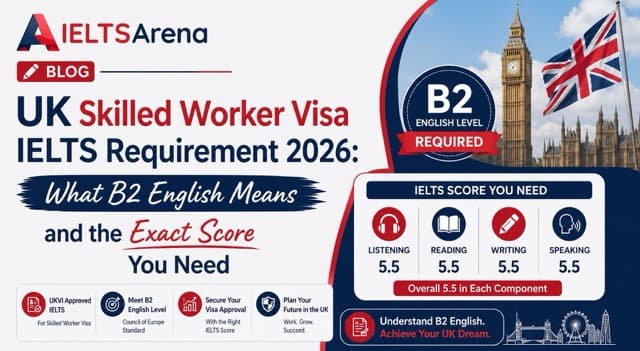
If you are applying for a UK work visa this year, the English bar has moved, and many applicants do not realise by how much. From 8 January 2026, the UK skilled worker visa English requirement rose from CEFR Level B1 to Level B2. That is a full level higher, and it applies across all four skills.
In plain terms, the English score that would have passed a friend last year may not pass you now. The good news is the new threshold is clear, measurable, and entirely achievable with the right preparation.
This guide explains exactly what B2 means in IELTS band terms, who the change applies to, and how to clear it on your first attempt.
What the UK skilled worker visa English requirement is now
From 8 January 2026, first-time main applicants on the Skilled Worker, Scale-Up and High Potential Individual routes must prove English proficiency at CEFR Level B2 across reading, writing, speaking and listening. Previously the bar was Level B1.
You prove this through an approved Secure English Language Test, known as a SELT, such as IELTS for UKVI. The change applies to new applicants. According to UK government guidance reported in early 2026, those already holding permission under these routes can extend without evidencing the higher level.
So if you are entering one of these routes for the first time in 2026, the UK skilled worker visa English requirement you must meet is B2, not B1.
Advertisement
What is CEFR B2, and what IELTS band equals it?
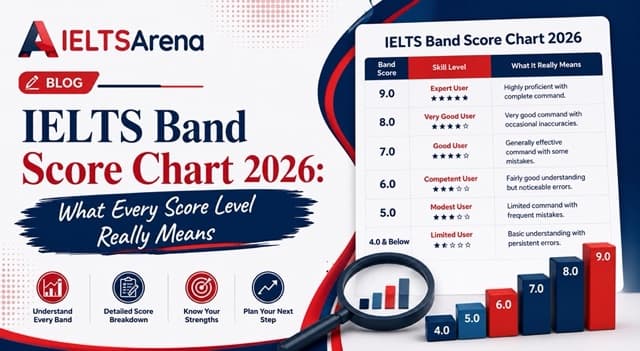
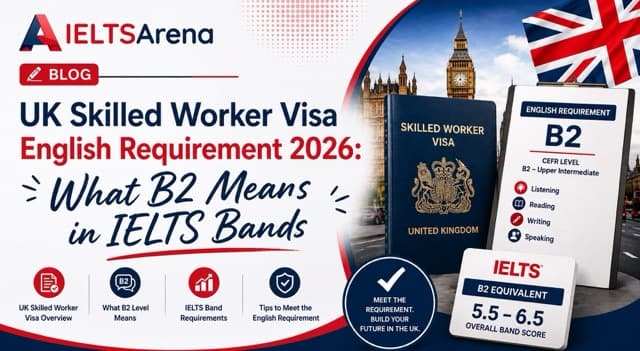
CEFR is the Common European Framework of Reference for Languages, a scale from A1 (beginner) to C2 (mastery). B2 is the "upper intermediate" level, where you can understand complex text, interact fluently, and produce clear, detailed writing.
In IELTS terms, CEFR B2 corresponds to roughly an IELTS band 5.5 to 6.5, with the commonly cited equivalent for the B2 threshold being around band 5.5 and above on each skill, depending on how the requirement is set. Because the UK rule applies to all four skills, you cannot rely on a strong Listening score to rescue a weak Writing score. Every skill must clear the bar.
This is the detail most applicants miss. B1 was forgiving. B2 across all four skills is not.
Why applicants underestimate the jump from B1 to B2
The move from B1 to B2 sounds small. One level. In practice it is the difference between "can communicate the basics" and "can handle complex, abstract topics with accuracy."
Many applicants prepared for the old B1 bar, scored just enough, and assumed the same effort would carry them through. It will not. The most common failure pattern is an applicant who is comfortable in conversation but loses marks in Writing because of grammatical range and accuracy, or in Speaking because of limited lexical resource.
The other trap is the "all four skills" rule. An applicant who scores well overall but dips below the threshold in one skill fails the requirement entirely. Under B2, a single weak skill sinks the whole application.
A realistic applicant story
Consider Maria, a 29-year-old nurse from Manila, Philippines, applying for a Skilled Worker visa in 2026. She had passed an English test two years earlier at the old B1 level and assumed she was safe.
Her first 2026 attempt landed her at band 6.0 overall, but her Writing came in at 5.0, below the B2 threshold she needed across all skills. The strong overall score meant nothing. The single weak skill failed her.
"I genuinely thought I was already good enough," Maria said. "Nobody told me the rule had changed to B2 on every skill, or that my Writing was the weak link."
She focused her preparation entirely on Writing, worked on task response and grammatical accuracy, and retested six weeks later at 6.5 overall with Writing at 6.0. She cleared the requirement on every skill.
Data and insight: the skill that fails most applicants
Across global IELTS results, Writing remains the lowest-scoring section for most candidates, often half a band below Speaking and a full band below Listening. For a requirement that demands B2 on every skill, that makes Writing the single biggest risk to a UK work visa application.
Under the new rule, your weakest skill is your real score. Everything else is irrelevant if one skill falls short.
The takeaway is simple. Do not prepare for your average. Prepare for your weakest skill, because that is the one the UK skilled worker visa English requirement will judge you on.
The right approach: prove B2 on every skill, first time
Follow this sequence.
- Confirm you need the IELTS for UKVI version, not the standard academic or general test, since visa routes require an approved SELT.
- Take a full timed mock test to find your real score on each of the four skills.
- Identify any skill sitting below your B2 target, most often Writing or Speaking.
- Get targeted feedback on that skill, focused on the exact assessment criteria you are missing.
- Re-test under timed conditions until every skill clears the threshold with margin.
- Only then book your official IELTS for UKVI test.
The goal is not a good overall score. The goal is no skill below the line.
How IELTSArena helps you clear B2 on every skill
The reason applicants fail one skill is that they practice their strengths and avoid their weaknesses. IELTSArena is built to expose and fix the weak skill before test day.
IELTSArena's AI Writing feedback pinpoints exactly why you lose marks on Task 1 and Task 2, mapped to the four assessment criteria of task response, coherence and cohesion, lexical resource, and grammatical range and accuracy. Its AI Speaking feedback scores fluency, pronunciation, vocabulary and grammar so you know if Speaking is your risk. Expert tutors then give human, band-focused corrections that AI alone cannot fully replicate.
Progress analytics show all four skill scores side by side, so you can see at a glance which skill is below B2 and track it upward. More than 10,000 learners have used IELTSArena to hit their target band. Start free and take a full mock to find your weakest skill today.
Are you ready for B2? A quick self-check
Be honest with each one:
- Do you know the exact IELTS band that equals B2 for your specific visa route?
- Have you scored at or above that band on all four skills, not just overall?
- Do you know which IELTS version, IELTS for UKVI, your visa requires?
- Is your Writing band at or above the threshold, or are you guessing?
- Have you practiced under timed conditions, or only studied casually?
Any "no" is a gap worth closing before you pay for the official test.
See where you stand today
The UK skilled worker visa English requirement is now B2 on every skill, and a single weak section can stop your application. The smart move is to find that weak skill now, while fixing it is free.
Take one free mock test on IELTSArena and you will know exactly where each of your four bands stands today.
Take Your First Free Mock Test on IELTSArena →
Frequently Asked Questions
What IELTS band is CEFR B2?
CEFR B2 is the upper-intermediate level on the Common European Framework, and it corresponds to roughly an IELTS band of 5.5 to 6.5. For UK visa purposes, the B2 threshold is commonly set around band 5.5 and above on each skill, though exact requirements can vary by route. The crucial point for the 2026 UK skilled worker visa is that B2 must be met across all four skills, reading, writing, speaking and listening. A strong overall score does not help if one individual skill falls below the B2 band, so every skill must clear the line.
What English level do I need for a UK skilled worker visa in 2026?
From 8 January 2026, first-time main applicants on the Skilled Worker, Scale-Up and High Potential Individual routes must prove English at CEFR Level B2 across all four skills, up from the previous B1 level. You demonstrate this through an approved Secure English Language Test such as IELTS for UKVI. In IELTS terms, B2 sits at roughly band 5.5 and above on each skill. Because the requirement applies to every skill, you should prepare so that your weakest section, often Writing, clears the threshold comfortably rather than relying on a strong overall average.
Is B1 enough for a UK work visa now?
No, not for first-time applicants entering the Skilled Worker, Scale-Up or High Potential Individual routes from 8 January 2026. The requirement rose from B1 to B2, a full CEFR level higher, and it applies across all four skills. Applicants who already hold permission under these routes may be able to extend without evidencing the higher level, but new applicants must meet B2. If you prepared for or previously passed at the old B1 bar, you should retest and confirm that every skill now reaches the higher B2 threshold before applying.
Which IELTS test do I need for a UK visa?
For UK visa and immigration purposes you generally need IELTS for UKVI, which is an approved Secure English Language Test, rather than the standard IELTS Academic or General Training test. IELTS for UKVI follows the same format and difficulty but is taken at approved test centres under specific conditions required by the Home Office. Always confirm the exact test and version on the official UK government list before booking. Practicing the format in advance helps, and platforms like IELTSArena let you rehearse the computer-based experience so the test format never costs you marks.
How do I prove B2 English for a UK skilled worker visa?
You prove B2 by sitting an approved Secure English Language Test, such as IELTS for UKVI, and scoring at the required level across all four skills. Book the correct version, prepare so your weakest skill clears the B2 threshold, and keep the certificate, since SELT results have a validity period. The most reliable approach is to take a full timed mock first, identify any skill below the line, and fix it before the official test. IELTSArena offers real computer-based mock tests with AI and expert feedback so you can confirm all four skills meet B2 before you pay.