
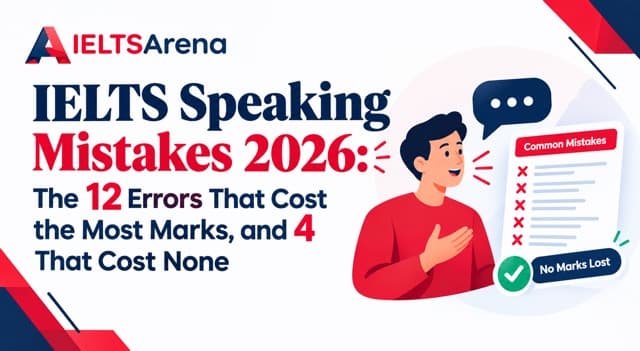
Most IELTS Speaking retake attempts produce the same band as the first attempt. Not because candidates did not work hard between attempts, but because they worked on the wrong mistakes. They spent six weeks eliminating small grammar slips (which barely affected the band) while ignoring flat intonation (which was capping their whole Speaking band at Band 5.5). This is what happens when candidates learn "common IELTS speaking mistakes" from generic tip lists that do not rank the mistakes by band impact. This guide ranks 12 real mistakes by which criterion they hurt and how much they cost, and it names 4 more mistakes that candidates worry about but that do not actually affect the band at all.
Quick answer: The 12 IELTS speaking mistakes that cost the most marks fall across the four assessment criteria. Fluency and Coherence: freezing on Part 2 before 90 seconds, over-using filler sounds, mechanical connectives. Lexical Resource: misused "advanced" vocabulary, repeating the same key words, memorised phrases that do not fit the question. Grammatical Range: sticking to simple sentences, tense inconsistency, dropped articles on every sentence. Pronunciation: flat intonation, misplaced word stress, mumbling. The 4 mistakes that do not cost marks are: having an accent, asking the examiner to repeat a question, disagreeing with the examiner's premise, and making the occasional small grammar slip. Fixing the wrong mistakes is the single biggest reason retakes produce the same band.
In This Guide
- Why Ranking Mistakes by Band Impact Matters
- The 4 Speaking Criteria and How Mistakes Map to Them
- Fluency and Coherence Mistakes (Highest Band Impact)
- Lexical Resource Mistakes
- Grammatical Range and Accuracy Mistakes
- Pronunciation Mistakes
- 4 "Mistakes" That Do Not Actually Cost Marks
- A Real Student's Story: Band 5.5 to Band 7.0 by Fixing the Top 3 Mistakes Only
- The Data Behind This
- The Right Approach: Fix in Rank Order, Not All at Once
- Sample Response with 6 Mistakes Highlighted and Rewritten
- How IELTSArena Helps You Diagnose Which Mistakes Are Yours
- Self-Diagnosis: Which of the 12 Mistakes Are Yours?
- Key Takeaways
- Frequently Asked Questions
Advertisement
Why Ranking Mistakes by Band Impact Matters
Most IELTS Speaking mistakes lists give you 10 or 20 items in random order, and you end up spending equal time on each. This is inefficient because the mistakes do not have equal band impact. Freezing at 45 seconds into Part 2 caps Fluency and Coherence at Band 5, which drags your whole Speaking band down by half a band or more. Using a slightly informal contraction ("gonna" instead of "going to") costs almost nothing at Band 6 to 7 level.
If you have four weeks to prepare and you spread that time equally across 12 mistakes, you fix none of them well. If you rank them by band impact and drill the top three, you move your Speaking band by half a band. This is why ranking matters, and why the mistakes in this guide are grouped by criterion (so you know which criterion each one hurts) rather than as a flat list.
The 4 Speaking Criteria and How Mistakes Map to Them
Your IELTS Speaking band is the average of four criterion scores, each weighted at 25 percent: Fluency and Coherence, Lexical Resource, Grammatical Range and Accuracy, and Pronunciation. Every mistake damages one specific criterion primarily. Knowing which criterion a mistake targets lets you predict how much it will cost you and which criterion score will move when you fix it.
| Criterion | Weight | Common lowest score at Band 5.5 to 6.5 level | Mistakes that damage it |
|---|---|---|---|
| Fluency and Coherence | 25 percent | Yes, roughly 75 percent of candidates | 3 mistakes (see below) |
| Lexical Resource | 25 percent | Rarely lowest at this level | 3 mistakes |
| Grammatical Range and Accuracy | 25 percent | Sometimes lowest | 3 mistakes |
| Pronunciation | 25 percent | Second most common lowest, roughly 40 percent | 3 mistakes |
The pattern from the criterion breakdown: Fluency and Coherence mistakes cost the most bands overall, because Fluency and Coherence is the lowest-scoring criterion for the majority of candidates. Pronunciation mistakes are the second most costly. Lexical Resource and Grammatical Range mistakes cost the least on average at Band 5.5 to 6.5 level, because those criteria are rarely the lowest ones. Which means: fix your Fluency and Coherence mistakes first.
Fluency and Coherence Mistakes (Highest Band Impact)
Mistake 1: Freezing on Part 2 before 90 seconds. Ending the 2-minute long turn at 45 to 65 seconds is the single most damaging Speaking mistake. It drops Fluency and Coherence sharply because the section is designed to test sustained speech, and stopping short signals you cannot sustain it. Fix: plan for expansion beyond the visible bullet points during the 1-minute preparation, and drill to a consistent 105 to 120 seconds in practice. See the Speaking Part 2 cue card strategy for the four-section structure that fills 2 minutes on any topic.
Mistake 2: Over-using filler sounds. Repeating "you know", "actually", "basically", "like", and "so" as fillers signals that you are using them to buy time rather than to organise ideas. More than 4 fillers per minute drops Fluency and Coherence by half a band even when the underlying speech is otherwise fluent. Fix: record yourself, count fillers, then consciously replace each filler with a short silent pause. Silent pauses are not penalised, fillers are.
Mistake 3: Mechanical connectives without logical progression. Saying "firstly", "secondly", and "in conclusion" between paragraphs that do not actually build on each other is a coherence issue that drops the criterion by half a band. The examiner rewards logical progression more than the presence of connectives. Fix: make sure each new sentence adds something to the previous one, and use connectives only when they signal a real relationship between ideas. See the dedicated Fluency and Coherence guide for the full criterion breakdown and drill plan.
Lexical Resource Mistakes
Mistake 4: Misused "advanced" vocabulary. Using a word you learned recently but do not fully understand ("plethora" when you mean "many", "ubiquitous" when you mean "common", "myriad" when you mean "several") is a Lexical Resource issue that examiners are trained to spot. A misused advanced word scores lower than a correctly used common one. Fix: use only vocabulary you are 100 percent sure of in meaning, connotation, and grammatical form. A precise "many" beats a misused "plethora".
Mistake 5: Repeating the same key words throughout the response. Using "important" five times in a 60-second answer, or "people" ten times in a Part 3 response, caps Lexical Resource at Band 6. The criterion specifically rewards range and paraphrasing. Fix: build a small stock of synonyms for the 20 most common IELTS content words (important, people, problem, thing, good, bad, big, small, more, and so on) and rotate them naturally.
Mistake 6: Memorised phrases that do not fit the question. Learning 30 idioms and inserting them regardless of context drops Lexical Resource because forced idioms sound unnatural. Examiners are trained to recognise memorised phrases within seconds. Fix: learn topical vocabulary rather than fixed phrases. A precise vocabulary of 50 topic-specific words for education, environment, technology, health, and family will do more for Lexical Resource than 30 memorised idioms.
Grammatical Range and Accuracy Mistakes
Mistake 7: Sticking to simple sentences throughout. Using only simple sentence patterns (subject plus verb plus object) caps Grammatical Range at Band 6 regardless of accuracy. The criterion specifically rewards range: complex sentences with subordinate clauses ("although", "because", "which"), conditionals ("if I had", "if I could"), and passive structures where appropriate. Fix: deliberately include at least one complex sentence in every Part 3 answer and one in the middle of every Part 2 response.
Mistake 8: Tense inconsistency within a response. Switching between past and present tense within the same answer without a reason ("Yesterday I go to the market, and I bought some fruit") is a Grammatical Accuracy issue that drops the criterion by half a band. Fix: pick a tense for the answer based on the question (past for narrative questions, present for opinion or habit questions) and stay consistent throughout the response.
Mistake 9: Dropping articles on every sentence. Systematically omitting "a", "an", and "the" ("I went to shop", "I read book last week") is a Grammatical Accuracy issue that caps Grammatical Range at Band 5.5 to Band 6. Candidates from L1 backgrounds without articles (Russian, Chinese, Japanese, Korean, most Indian languages) are particularly prone to this. Fix: drill the three article rules explicitly and consciously insert articles in every noun phrase during practice.
Pronunciation Mistakes
Mistake 10: Flat intonation. Speaking every sentence with the same pitch pattern, with no rise for questions or fall for statements, is the single most audible Pronunciation issue at Band 5 to Band 6. The examiner cannot easily distinguish your questions from your statements or your emphasis from your neutral delivery. Fix: shadow-speak BBC News or TED clips daily to internalise natural intonation patterns.
Mistake 11: Misplaced word stress on common multi-syllable words. Saying "econOMic" instead of "ecoNOMic", "deVElopment" instead of "deVELopment", or "phoTOgraphy" instead of "phoTOgraphy" is instantly noticed by the examiner. Multiple stress errors on high-frequency words cap Pronunciation at Band 5.5. Fix: check stress patterns for the 50 most common multi-syllable words in general English and drill them daily.
Mistake 12: Mumbling and unclear consonants. Not opening the mouth enough, dropping final consonants, or slurring consonant clusters reduces intelligibility across all L1 accents. Unlike accent, mumbling is a physical delivery habit that examiners penalise directly. Fix: deliberate over-articulation practice for two weeks until clear consonant production becomes automatic. See the Speaking Pronunciation guide for the four-sub-component breakdown.
4 "Mistakes" That Do Not Actually Cost Marks
Four mistakes appear in almost every "common IELTS speaking mistakes" list, and none of them actually damage your Speaking band. Stop worrying about these.
Myth-mistake 1: Having an accent. Your L1 accent is not scored. Nigerian, Filipino, Indian, Chinese, Arabic, and every other L1 accent regularly scores Band 7, Band 8, and Band 9. The Band 7 Pronunciation descriptor explicitly states that L1 accent has minimal effect on intelligibility. Trying to change your accent is the wrong fix and produces no band movement.
Myth-mistake 2: Asking the examiner to repeat a question. In Part 1 and Part 3, you are allowed to say "Sorry, could you repeat that?" without any Fluency and Coherence penalty. Examiners are explicitly trained to accept this. What is penalised is answering the wrong question because you did not ask, or making up an answer to a question you did not understand. Ask, do not guess.
Myth-mistake 3: Disagreeing with the examiner's premise. IELTS Speaking is not scored on what you say, only on how you say it. If the examiner asks "Why do you think young people prefer social media?" and you disagree with the premise ("Actually, I think older people use social media more than young people do"), that is fine, provided you defend the alternative view. Examiners are trained to accept any view as long as it is expressed clearly and coherently.
Myth-mistake 4: Making the occasional small grammar slip. Occasional small errors are permitted at Band 7 and Band 8. The Band 7 descriptor explicitly allows "some grammatical errors that do not affect meaning". Fixating on eliminating every small slip is a waste of preparation time that would be better spent on higher-impact mistakes. What matters is that most of your grammar is accurate and that errors do not consistently interfere with meaning.
A Real Student's Story: Band 5.5 to Band 7.0 by Fixing the Top 3 Mistakes Only
Berkan, a software developer from Istanbul applying for a German employer's Blue Card, sat the IELTS three times and scored Speaking Band 5.5 each time. He spent six months studying advanced vocabulary and complex grammar between attempts, and none of it moved the score.
I had a list of 22 common IELTS speaking mistakes taped to my desk. I was trying to fix all of them at once. My tutor listened to my recording for 10 minutes and said, "You freeze on Part 2 at 55 seconds, you say 'you know' 14 times a minute, and your word stress is wrong on eight common words. Fix those three and stop worrying about the other 19." I felt insulted at first. Then I did what she said, and it worked.
His diagnostic identified three specific mistakes from the 12 above: Mistake 1 (freezing on Part 2), Mistake 2 (filler overuse), and Mistake 11 (misplaced word stress). He stopped studying vocabulary and grammar entirely for four weeks and drilled only those three. His fourth attempt scored Speaking Band 7.0. Overall band lifted from 6.0 to 7.0, and the Blue Card route cleared. Total time from Band 5.5 to Band 7.0: four weeks focused on three mistakes, after six months of broad practice that produced no movement.
The Data Behind This
Cambridge Assessment English publicly reports that Fluency and Coherence and Pronunciation are the two Speaking criteria where candidates most often lose marks in the Band 5 to Band 6.5 range, and that the global average Speaking band sits close to Band 6.0 (Cambridge Assessment English, IELTS Test Statistics 2024 to 2025).
British Council examiner reports specifically flag four patterns as the most common Speaking mistakes across all Band 5.5 to Band 6.5 candidates: premature termination of Part 2, filler overuse, flat intonation, and misplaced word stress on high-frequency words. IELTS.org confirms the four Speaking assessment criteria for 2026 remain Fluency and Coherence, Lexical Resource, Grammatical Range and Accuracy, and Pronunciation, each weighted equally at 25 percent (IELTS.org, 2026 assessment framework).
Internal tracking on IELTSArena shows that among candidates scoring Speaking Band 5.5 to 6.5, more than 80 percent have at least one of the three Fluency and Coherence mistakes above, and roughly 60 percent have at least one of the three Pronunciation mistakes. Fewer than 30 percent have Lexical Resource or Grammatical Range as their lowest-scoring criterion. This is direct evidence that the mistakes in the Fluency and Pronunciation categories should be tackled first for most candidates.
The Right Approach: Fix in Rank Order, Not All at Once
Fixing IELTS speaking mistakes at scale is a four-step process. Do not skip Step 1, because it decides which mistakes are actually yours.
Step 1: Diagnose which of the 12 mistakes apply to you. Record yourself answering one Part 1 question, one Part 2 cue card, and one Part 3 question. Play each recording back with the checklist from the Self-Diagnosis section below. Identify which specific mistakes you make consistently. Most candidates make between 3 and 6 of the 12.
Step 2: Rank your mistakes by criterion impact. Fluency and Coherence mistakes go first (they cap the most bands). Pronunciation mistakes go second. Lexical Resource and Grammatical Range mistakes go third. Within each criterion, the mistakes listed above are already in rough order of band impact.
Step 3: Drill your top 3 mistakes for four weeks. Choose only the three highest-ranked mistakes from your list and drill them daily with focused practice. Do not try to fix more than three at once. Fixing three well moves your Speaking band by half a band. Trying to fix ten poorly moves it not at all.
Step 4: Re-test and re-rank. After four weeks, record three new responses and rescore against the 12-mistake checklist. If your top three have moved, add the next three in rank order and drill for another four weeks.
This is the loop that produces Band 5.5 to Band 7 movement in four to eight weeks. It works because it fixes the mistakes that are actually damaging your band, in the order that produces the fastest visible movement.
Sample Response with 6 Mistakes Highlighted and Rewritten
Here is a Band 5.5 Part 1 response to "What do you like about your hometown?" with 6 of the 12 mistakes present, followed by a Band 7 rewrite that removes them.
Band 5.5 response (with mistakes marked in bold): "Um, I live in Istanbul which is very important city in Turkey. You know, it is important because it is old city with many history. Actually, I love Istanbul because there is many restaurant and cafe. Basically the food is important for me and Istanbul have very good food. Like, I go to restaurant every weekend with friend."
Mistakes present: Mistake 2 (filler overuse: "um", "you know", "actually", "basically", "like" all in 45 words), Mistake 5 (repeating "important" three times), Mistake 9 (dropped articles: "very important city", "every weekend with friend"), Mistake 8 (tense inconsistency: "Istanbul have" instead of "Istanbul has"), plus underlying Fluency and Coherence issues from the mechanical connectives.
Band 7 rewrite (same content, mistakes removed): "I live in Istanbul, which is one of the largest cities in Turkey and has a really rich history stretching back several thousand years. What I love most about it is the food scene. There are countless restaurants and cafes across every neighbourhood, from traditional Turkish places to Levantine and modern fusion, and I usually spend most of my weekends exploring new ones with my friends."
The rewrite is the same underlying idea, delivered without the six mistakes. Length: 65 words versus 45 words, but delivered at natural pace. Fluency and Coherence, Lexical Resource, Grammatical Range, and Pronunciation all move up because the six mistakes have been removed without adding any new vocabulary or grammar features.
How IELTSArena Helps You Diagnose Which Mistakes Are Yours
IELTSArena's AI Speaking feedback scores every recorded response against Fluency and Coherence, Lexical Resource, Grammatical Range and Accuracy, and Pronunciation separately, and specifically flags the individual mistakes from the 12 above. Filler counts, word stress errors, dropped articles, and mechanical connectives are all flagged in the feedback, so you can rank your mistakes by criterion impact automatically without transcribing and diagnosing manually.
Expert tutors on IELTSArena review Speaking responses with a specific focus on the highest-impact mistakes for candidates scoring Band 5.5 to Band 6.5, which is where the criterion-ranking approach in this guide is most valuable. The platform also provides model responses at Band 5, Band 6, and Band 8 on the same prompts, so you can hear exactly what removing the top three mistakes sounds like. More than 10,000 students have used IELTSArena to reach their target Speaking band.
Start your free IELTS practice on IELTSArena and record your first response to see which of the 12 mistakes are yours.
Self-Diagnosis: Which of the 12 Mistakes Are Yours?
Work through this checklist honestly against a recording of your last practice response.
Fluency and Coherence checks: Did your Part 2 response end before 90 seconds? Did you produce more than 4 filler sounds ("you know", "actually", "basically", "like") per minute? Did you use "firstly", "secondly", "in conclusion" between paragraphs that did not build on each other? Lexical Resource checks: Did you use any vocabulary word you would struggle to define precisely? Did you repeat the same content word (important, people, thing, good) more than three times in one answer? Did you insert any memorised idiom or phrase that felt forced in context? Grammatical Range checks: Did you use only simple sentence patterns throughout? Did you switch between past and present tense without a reason? Did you drop articles ("a", "an", "the") in more than half of your noun phrases? Pronunciation checks: Did your intonation stay flat throughout, or did it rise and fall meaningfully? Did you stress the wrong syllable on any multi-syllable word? Did you mumble or drop final consonants?
Count how many boxes you ticked. Fixing your top three in rank order produces half a band of movement in four weeks.
Key Takeaways
- The 12 IELTS speaking mistakes that cost the most marks fall across the four assessment criteria, 3 per criterion, and they have different band impacts.
- Fluency and Coherence mistakes cost the most bands overall because Fluency and Coherence is the lowest-scoring criterion for roughly 75 percent of Band 5.5 to 6.5 candidates.
- Pronunciation mistakes cost the second most bands, because Pronunciation is the second most commonly lowest-scoring criterion.
- Lexical Resource and Grammatical Range mistakes cost the least on average at Band 5.5 to 6.5 level, so fix them last.
- Having an accent, asking the examiner to repeat a question, disagreeing with a question's premise, and making the occasional small grammar slip do not cost marks. Stop worrying about them.
- Fix three mistakes well rather than 12 poorly. Four weeks of focused drilling on your top three ranked mistakes moves your Speaking band by half a band.
Related Guides on IELTSArena
- IELTS Speaking Test Format: What Happens on Exam Day
- IELTS Speaking Part 2 Cue Card Strategy
- IELTS Speaking Fluency and Coherence
- IELTS Speaking Pronunciation
- IELTS Speaking Part 3 Questions and Sample Answers
- IELTS Cue Card Topics 2026: 30 Most Common Topics
- How to Get Band 7 in IELTS: Section-by-Section Plan
- IELTS Band Score Chart 2026
- IELTS Speaking Lexical Resource
- IELTS Speaking Grammatical Range and Accuracy
- IELTS Speaking Pronunciation 2026: The Four Sub-Components
- How to Practise IELTS Speaking Alone
See Which Mistakes Are Capping Your Band Today
Try a free mock test at ieltsarena.com and record one timed Speaking response. In one free practice session, you will know which of the 12 mistakes above are actually yours, ranked by criterion impact, so you can drill the three that will move your band fastest rather than spreading effort across all 12.
Start your free IELTS practice on IELTSArena
Frequently Asked Questions
What are the most common mistakes in IELTS speaking? The 12 most common IELTS speaking mistakes group into the four assessment criteria. Fluency and Coherence: freezing on Part 2 before 90 seconds, over-using filler sounds like "you know" and "actually", and using mechanical connectives without logical progression. Lexical Resource: misused "advanced" vocabulary, repetition of key words like "important" and "people", and memorised phrases that do not fit the question. Grammatical Range: sticking to simple sentences, tense inconsistency within one response, and dropping articles on every sentence. Pronunciation: flat intonation, misplaced word stress on multi-syllable words, and mumbling. Fluency and Coherence mistakes and Pronunciation mistakes cost the most marks overall, because those two criteria are the most commonly lowest-scoring for candidates in the Band 5.5 to 6.5 range.
What mistakes cost the most marks in IELTS speaking? The three Fluency and Coherence mistakes cost the most bands overall, because Fluency and Coherence is the lowest-scoring criterion for roughly 75 percent of candidates at Band 5.5 to 6.5 level. In order of impact: freezing on Part 2 before 90 seconds (drops the criterion sharply because the section is designed to test sustained speech), over-using filler sounds more than 4 times per minute (drops the criterion by half a band even when the underlying speech is fluent), and using mechanical connectives without genuine logical progression between paragraphs. After Fluency and Coherence, Pronunciation mistakes are the second most costly. Fixing the top three Fluency and Coherence mistakes produces the fastest visible band movement for most candidates.
What should I do if I make a grammar mistake in IELTS speaking? Finish the sentence and move on. Restarting a sentence to correct a small grammar mistake damages your Fluency and Coherence score more than the original mistake would have damaged Grammatical Range. The Band 7 descriptor explicitly allows "some grammatical errors that do not affect meaning", which means occasional small slips are permitted at Band 7 and Band 8. What matters is that most of your grammar is accurate and that errors do not consistently interfere with meaning. Fixating on eliminating every small slip is a waste of preparation time that would be better spent on higher-impact mistakes like flat intonation or filler overuse. If the mistake genuinely obscures meaning, you can briefly correct it and move on without restarting.
Does my accent count as a mistake in IELTS speaking? No. Your L1 accent is not scored as a mistake. The Band 7 Pronunciation descriptor explicitly states that "L1 accent has minimal effect on intelligibility", which means examiners are trained to accept any accent as long as the speaker can be understood without effort. Nigerian, Filipino, Indian, Chinese, Arabic, and every other L1 accent regularly scores Band 7, Band 8, and Band 9 on Pronunciation. What is scored is whether individual sounds are produced clearly, whether word stress is placed correctly, whether rhythm follows English stress-timing patterns, and whether intonation carries meaning. A strong accent that is clearly understood scores higher than a mild accent with misplaced word stress. Trying to sound "more native" is the wrong fix and produces no band movement.
Can I ask the examiner to repeat a question in IELTS speaking? Yes, in Part 1 and Part 3, you can ask the examiner to repeat the question without any Fluency and Coherence penalty. A polite "Sorry, could you repeat that?" or "Could you please say that again?" is explicitly acceptable and examiners are trained to accept it. What is penalised is answering the wrong question because you did not ask for clarification, or making up an answer to a question you did not understand. In Part 2, the examiner cannot re-read the cue card once you have received it, but you can ask for clarification of unfamiliar words on the card during your 1-minute preparation time. Ask when you need to, never guess.
Last updated September 2026 by the IELTSArena Editorial Team, a team of IELTS tutors, certified CBT examiners, and Speaking feedback specialists who publish weekly research-backed guides on ieltsarena.com.