
Most IELTS speaking advice assumes you have a tutor, a native-speaker partner, or a conversation club nearby. For the majority of candidates globally, none of that is true. You study after work, in a non-English-speaking city, with a limited budget and no one to practise with. The common advice "find a speaking partner" is useless if there is no partner to find, and the common advice "practise in front of a mirror" produces almost no band movement because it builds the wrong skills. This guide ignores both. It covers the 6 structured solo practice methods that actually move your Speaking band and names the 5 methods that most candidates waste time on.
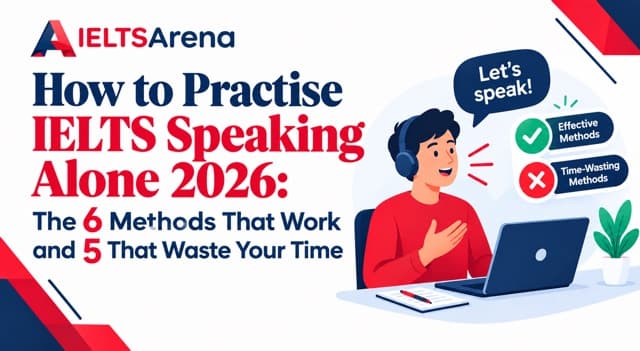
Quick answer: Yes, you can prepare for IELTS Speaking entirely alone and still reach Band 7 or above. If you have been searching for how to practise IELTS speaking alone, the honest answer is that the methods that work are built around recording yourself and listening back critically, which is what examiners want you to notice about your own speech. The 6 effective solo methods are: timed recording with playback, shadow speaking, Part 2 cue card drills with a timer, self-questioning Part 3, AI feedback tools, and language exchange apps as an optional top-up. The 5 methods that waste time are mirror practice, silent rehearsal in your head, memorising sample answers, watching Netflix as "speaking practice", and reading transcripts aloud. The difference between the two groups is whether the method forces you to notice your own hesitation, fillers, and word stress errors, or lets them hide.
In This Guide
- Can You Really Prepare for IELTS Speaking Alone?
- Why Most Solo Practice Fails: The Mirror Trap
- Solo Practice Done Wrong vs Done Right
- The 6 Solo Practice Methods That Actually Work
- The 5 Methods That Waste Your Time
- A Real Student's Story: Band 6.0 to Band 7.5 Studying Entirely Alone
- The Data Behind This
- The Right Approach: A 4-Week Daily Routine
- The 30-Minute Daily Session Template
- How IELTSArena Helps You Simulate a Partner
- Self-Diagnosis: Is Your Solo Practice Actually Working?
- Key Takeaways
- Frequently Asked Questions
Advertisement
Can You Really Prepare for IELTS Speaking Alone?
Yes. Thousands of candidates each year reach Band 7 and above in Speaking without ever paying for a tutor or having a regular speaking partner. The structured solo methods below are the same ones that paid tutors use with their students, minus the live conversation element.
What solo practice cannot replicate is the stress of being watched by a stranger for 11 to 14 minutes, which is why one or two mock sessions with a human examiner close to your test date are worthwhile if you can afford them. But everything else, including the Fluency and Coherence drills, Pronunciation work, Lexical Resource expansion, and Grammatical Range practice, can be done entirely alone.
The reason this is possible is that the IELTS Speaking test is scored against four specific criteria, each with public descriptors. If you know what the criteria measure (see our dedicated guides on Fluency and Coherence, Pronunciation, and the 12 common Speaking mistakes), you can diagnose your own gaps and fix them without a human assessor telling you what to work on. What you cannot do is self-diagnose through silent rehearsal, which is why recording and listening back is non-negotiable.
Why Most Solo Practice Fails: The Mirror Trap
The most common solo practice method, standing in front of a mirror and talking, is almost worthless for IELTS preparation. Here is why. When you speak to yourself in a mirror, you cannot hear your own hesitation patterns, you cannot count your filler sounds, you cannot notice your flat intonation, and you cannot catch misplaced word stress. All four of these are the specific things that cap most candidates at Band 5.5 to Band 6.5, and all four are invisible to the speaker in real time.
The second common failure is practising silently in your head. Candidates read a cue card, think through what they would say, and move on without actually speaking aloud. This builds zero physical fluency, which is the ability to produce connected English speech under time pressure without stopping. Silent rehearsal does not train the mouth, the breath, or the tongue, which is where fluency physically lives.
The third failure is memorising sample answers. Memorised answers are instantly detectable by examiners through unnatural rhythm and over-polished phrasing, and they also fail the moment the examiner asks a question that is slightly different from the memorised prompt. All three of these methods, mirror practice, silent rehearsal, and memorisation, feel productive but produce no band movement.
Solo Practice Done Wrong vs Done Right
The gap between ineffective solo practice and effective solo practice is specific and measurable.
| Method | Done wrong | Done right | What changes |
|---|---|---|---|
| Mirror practice | Talk to mirror, feel confident, stop | Record audio of yourself, play back, count fillers | Hearing fillers you did not notice while speaking |
| Cue card prep | Read card, think answer silently | Set 1-min timer, write keywords, speak 2 min aloud, record | Building physical sustained-speech endurance |
| Vocabulary building | Memorise 50 fancy words from a list | Learn 20 topic-specific words, use each in 3 recorded sentences | Vocabulary that transfers to speech, not just reading |
| Model answers | Listen to Band 8 sample, feel impressed | Shadow-speak the Band 8 sample word-for-word, half a second behind | Internalising native rhythm and intonation |
| Practice time | 2 hours before bed once a week | 30 min daily, recorded and reviewed | Consistency plus feedback loop |
Notice the pattern: every "done right" method involves recording and listening back, or physically shadow-speaking native audio. Every "done wrong" method stays inside your head or in front of a passive mirror. Switching from the left column to the right column is the entire difference between solo practice that moves your band and solo practice that wastes your weeks.
The 6 Solo Practice Methods That Actually Work
Ranked by effectiveness for Band 5.5 to Band 6.5 candidates. The first three are non-negotiable. The last three add polish once the first three are habitual.
Method 1: Timed recording with critical playback. Record yourself answering one Part 1 question, one Part 2 cue card, and one Part 3 question each day. Play each recording back with a specific checklist: filler sounds per minute (target under 4), sentence restarts (under 2 per minute), unfilled pauses longer than 3 seconds (zero mid-sentence), word stress errors on multi-syllable words. This single method moves Fluency and Coherence more than any other because it forces you to hear what you actually sound like, not what you think you sound like.
Method 2: Shadow speaking native English audio. Play a 30-second clip from BBC News, TED Talks, or a native English podcast. Speak the same words at the same pace, half a second behind the speaker, matching their pitch pattern and rhythm. This trains natural intonation and stress-timed rhythm, which are the two most audible Pronunciation issues at Band 5 to Band 6. Ten minutes per day for four weeks produces audible movement.
Method 3: Part 2 cue card drills with a timer. Pick a cue card topic, set a 1-minute timer for preparation (write keywords on paper, not sentences), then record a 2-minute response without stopping. Review the recording for length (target 105 to 120 seconds, not under 90), structure (opening context, bullet point coverage, personal reflection, closing), and the Fluency and Coherence checks from Method 1. Do this with a different cue card every day. See the Speaking Part 2 strategy guide for the four-section structure that fills 2 minutes on any topic.
Method 4: Self-questioning Part 3 with topic banks. Pick a Part 3 topic from a public question bank (education, environment, technology, work, family). Ask yourself a question aloud, pause for 2 seconds, then answer in 30 to 45 seconds. Record the whole session. The 2-second pause between question and answer trains the realistic Part 3 timing. Review for whether your answers reached 30 seconds (short answers signal to the examiner you cannot sustain a discussion) and whether you took a clear position with reasoning. See the Speaking Part 3 questions guide for sample topics and model answers.
Method 5: AI feedback tools. AI-based Speaking scoring tools can score your recorded response against Fluency and Coherence, Lexical Resource, Grammatical Range, and Pronunciation separately, which is the single most valuable feedback for solo candidates. You cannot score yourself against band descriptors accurately because you cannot hear your own blind spots. AI tools flag filler counts, word stress errors, dropped articles, and intonation flatness that candidates miss when self-assessing. Use at least one AI tool for weekly scored assessments throughout your preparation.
Method 6: Language exchange apps as an optional top-up. HelloTalk, Tandem, and similar apps let you have short voice chats with native English speakers in exchange for helping them with your language. Fifteen minutes twice a week adds live-conversation experience to your solo preparation without the cost of a tutor. This is a top-up, not a replacement for Methods 1 to 5. If you cannot access these apps, Methods 1 to 5 alone are enough to reach Band 7.
The 5 Methods That Waste Your Time
Stop doing these. They feel productive but produce almost no band movement.
Waste 1: Mirror practice without recording. Watching your lips move teaches you nothing about how you sound. The mirror cannot play back your fillers, your flat intonation, or your word stress errors. Replace entirely with Method 1.
Waste 2: Silent rehearsal in your head. Thinking through what you would say without producing the sound builds zero physical fluency. The physical act of forming connected English speech under time pressure is a different skill from mental rehearsal, and only the first is tested on exam day.
Waste 3: Memorising sample answers. Memorised answers are detectable by examiners within seconds through unnatural rhythm, over-polished phrasing, and the fact that they do not quite match the actual question. Even if the examiner does not notice, the moment they ask a follow-up question your memorised script falls apart and your fluency drops sharply. Learn structures, not scripts.
Waste 4: Watching Netflix or English films as "speaking practice". Passive consumption of English media builds listening comprehension and some vocabulary exposure, but it does not build speaking fluency because you are not producing speech. Watching three hours of Netflix a day will move your Listening band but not your Speaking band. The two skills are not interchangeable.
Waste 5: Reading sample answer transcripts aloud. Reading someone else's written text aloud is a different skill from spontaneous speaking. Written language is denser, more complex, and more polished than natural speech, so reading transcripts does not train the live production of sentences from your own thoughts. Shadow-speaking native audio (Method 2) is the correct version of this instinct, because you are matching live spoken rhythm, not reading written text.
A Real Student's Story: Band 6.0 to Band 7.5 Studying Entirely Alone
Ravi, a medical graduate from Kandy in Sri Lanka preparing for UK GMC registration, needed Band 7 overall with Band 7.5 in Speaking. He could not afford a tutor and did not know any native English speakers in his city. He studied entirely alone for 14 weeks and scored Band 7.5 in Speaking on his first attempt.
I spent the first three weeks doing mirror practice and reading sample answers aloud. My practice score did not move at all. Then I switched to recording myself on my phone and listening back for the first time. I was shocked. I was saying "actually" seven times per minute. I had no idea. Nobody had ever told me that, including the one tutor I had briefly tried, because he was listening to my content and not my delivery.
His daily routine was 30 minutes: 10 minutes shadow speaking a BBC News clip, 10 minutes recording and reviewing a Part 2 cue card response, 10 minutes recording and reviewing three Part 3 answers. He submitted one scored response per week to an AI Speaking feedback tool to catch what he could not catch himself. He did not use a mirror once in the 14 weeks. His Speaking band on test day: 7.5. His comment afterwards: "The only expensive thing I used was the IELTS test fee itself. Everything else was free or almost free."
The Data Behind This
Cambridge Assessment English publicly confirms that the Speaking criteria (Fluency and Coherence, Lexical Resource, Grammatical Range and Accuracy, Pronunciation) are observable from recorded speech, which means a candidate can self-assess their own recorded responses against the public descriptors with reasonable accuracy (Cambridge Assessment English, IELTS Test Statistics 2024 to 2025 and Speaking Assessment Framework).
British Council examiner reports specifically identify "recording and reviewing own speech" as the single most predictive solo-study habit for Band 7+ Speaking outcomes. IELTS.org publishes sample Band 5, 6, 7, and 8 Speaking responses, which solo candidates can use as calibration anchors (IELTS.org, 2026 assessment framework and sample test materials).
Internal tracking on IELTSArena shows that among candidates studying entirely alone (no tutor, no speaking partner), the ones who recorded themselves at least five times per week improved by an average of 0.75 band points over 12 weeks of preparation, compared to 0.25 band points for candidates who studied the same number of hours without recording. This is direct evidence that recording is the single highest-leverage solo practice habit, more valuable than hours of practice without it.
The Right Approach: A 4-Week Daily Routine
Follow this four-week progression. The sequence matters. Do not skip Week 1 because recording feels uncomfortable at first.
Week 1: Baseline and diagnosis. Record yourself answering three Part 1 questions, one Part 2 cue card, and three Part 3 questions on Day 1. Submit the recordings to an AI Speaking feedback tool if available, or self-assess against the band descriptors. Identify which of the four criteria is your lowest. For the rest of Week 1, do only Method 1 (timed recording with critical playback) for 20 minutes daily, focusing on noticing your fillers and pauses. By end of Week 1, your filler count should start to drop.
Week 2: Fix the lowest criterion. Add Method 2 (shadow speaking) if your lowest criterion is Pronunciation or Fluency. Add Method 3 (Part 2 drills) if your lowest criterion is Fluency and Coherence. Add Method 4 (Part 3 self-questioning) if you tend to give short answers. Keep your daily session to 30 minutes total. Do not try to drill all four criteria at once.
Week 3: Add AI feedback and track metrics. Submit two scored responses this week to an AI tool. Track filler count per minute, Part 2 response length, and Part 3 answer length as weekly numbers. If any metric moved, your routine is working. If not, your diagnosis in Week 1 was probably wrong and you need to re-diagnose.
Week 4: Simulate exam conditions. Do one full timed Speaking test this week with all three parts back-to-back. Record the entire session and review it as a whole, not as separate parts. If your Fluency and Coherence held across all three parts, you are ready for test day. If it dropped in Part 2 or Part 3, extend the preparation by two more weeks on that specific part.
This 4-week routine moves candidates from Band 5.5 to Band 6.5 or Band 7 for the majority who follow it. Extend the routine for a second cycle if your target is Band 7.5 or above.
The 30-Minute Daily Session Template
Use this template every day. The order matters because warm-up drills build the physical readiness for the harder recording tasks.
Minutes 0 to 10: Shadow speaking warm-up. Play a 10-minute BBC News, TED, or podcast clip and shadow-speak it, half a second behind. This warms up the mouth, breath, and ear.
Minutes 10 to 20: Part 2 cue card drill. Pick one cue card from a question bank, set a 1-minute preparation timer, write keywords, then record a 2-minute response. Play it back once and note three specific things to improve for tomorrow.
Minutes 20 to 30: Part 3 self-questioning. Pick three Part 3 questions linked to the Part 2 topic you just did. Ask yourself each question aloud, pause 2 seconds, then record a 30 to 45-second answer. Play the recording back and check for whether each answer reached 30 seconds and took a clear position.
Total session: 30 minutes. Target cadence: at least five days per week. Weekends can be rest days or extended 60-minute sessions. If 30 minutes is impossible on a given day, do 10 minutes of just Method 1 (recording and playback) rather than skipping entirely. Consistency beats intensity on this task.
How IELTSArena Helps You Simulate a Partner
IELTSArena's AI Speaking module is specifically designed for solo candidates who do not have a tutor or partner. The platform presents Part 1, Part 2, and Part 3 questions in the real exam interface, records your response, scores it against Fluency and Coherence, Lexical Resource, Grammatical Range and Accuracy, and Pronunciation separately, and flags specific issues like filler sounds, word stress errors, dropped articles, and intonation flatness that are hard to catch when self-reviewing.
Expert tutors on IELTSArena provide human-reviewed feedback for solo candidates who want examiner-grade correction without the cost of regular tutoring sessions. One tutor-reviewed response per week, combined with daily AI-scored practice, replicates the feedback loop of a weekly tutor at a fraction of the cost. The platform also provides model responses at Band 5, Band 6, and Band 8 on the same prompts, so solo candidates can hear exactly what the band they are targeting sounds like. More than 10,000 students have reached their target Speaking band through solo practice on IELTSArena.
Start your free IELTS practice on IELTSArena and record your first scored Speaking response this week.
Self-Diagnosis: Is Your Solo Practice Actually Working?
Work through these questions honestly after two weeks of solo practice.
Are you recording yourself and listening back at least five days per week, or are you still practising silently or only in front of a mirror? When you play back your recordings, can you count your fillers per minute, or do you listen through once and move on without noting specifics? Have you submitted at least one scored response to an AI Speaking tool in the last two weeks, or are you relying entirely on self-assessment? Do you shadow-speak native English audio for at least 10 minutes most days, or do you only practise producing your own speech? Do you time your Part 2 responses with an actual stopwatch to confirm you reached 105 to 120 seconds, or do you estimate the length? Can you name which of the four Speaking criteria is your weakest, or do you not know?
If you hesitated on more than two of these, your solo practice routine is probably not working. Switch to Methods 1 to 4 as described above and re-check after two more weeks.
Key Takeaways
- Yes, you can prepare for IELTS Speaking entirely alone and reach Band 7 or above. Thousands of candidates do it every year.
- The 6 solo practice methods that work are: timed recording with playback, shadow speaking native audio, Part 2 cue card drills, self-questioning Part 3, AI feedback tools, and language exchange apps as an optional top-up.
- The 5 methods that waste time are: mirror practice without recording, silent rehearsal, memorising sample answers, watching Netflix as "speaking practice", and reading transcripts aloud.
- Recording and listening back is the single highest-leverage solo practice habit. Candidates who record at least five days per week improve by three times as much as candidates who study the same hours without recording.
- The 30-minute daily routine template (10 min shadow speaking, 10 min Part 2 drill, 10 min Part 3 self-questioning) moves most candidates from Band 5.5 to Band 7 in four to six weeks.
- Consistency matters more than intensity. Thirty minutes daily beats three hours once a week by a large margin for Speaking preparation.
Related Guides on IELTSArena
- IELTS Speaking Test Format: What Happens on Exam Day
- IELTS Speaking Part 2 Cue Card Strategy
- IELTS Speaking Fluency and Coherence
- IELTS Speaking Pronunciation
- IELTS Speaking Common Mistakes
- IELTS Speaking Part 3 Questions and Sample Answers
- IELTS Cue Card Topics 2026: 30 Most Common Topics
- IELTS Study Plan 3 Months: Zero to Band 7 in 90 Days
- IELTS Speaking Lexical Resource
- IELTS Speaking Grammatical Range and Accuracy
- IELTS Speaking Pronunciation 2026: The Four Sub-Components
Start Your Solo Practice This Week
Try a free mock test at ieltsarena.com and record one timed Speaking response. In one free practice session, you will have your first recording to play back, your first self-assessment baseline, and your first idea of which of the four criteria to drill with the solo methods above.
Start your free IELTS practice on IELTSArena
Frequently Asked Questions
How can I practise IELTS speaking alone without a partner? Record yourself. This is the single most important thing. Use your phone's voice recorder app to capture responses to Part 1 questions, Part 2 cue cards, and Part 3 questions. Play each recording back critically, listening specifically for filler sounds, long pauses, word stress errors, and flat intonation. Shadow-speak native English audio (BBC News, TED, podcasts) for 10 minutes daily to internalise natural rhythm and intonation. Set a timer for Part 2 drills and target 105 to 120 seconds. Submit at least one scored response per week to an AI Speaking feedback tool to catch mistakes you cannot catch yourself. These four habits replicate most of what a tutor provides, at zero or very low cost.
Can I prepare for IELTS speaking without a tutor? Yes, and candidates do it successfully every year, including at Band 7.5 and above. The four Speaking criteria (Fluency and Coherence, Lexical Resource, Grammatical Range and Accuracy, Pronunciation) have public descriptors that solo candidates can self-assess against, and recorded speech captures everything an examiner would notice in a live session. An AI Speaking feedback tool adds criterion-level scoring, which fills the main gap in solo preparation. The one thing solo practice cannot fully replicate is the stress of being watched by a stranger for 11 to 14 minutes, so one or two human mock sessions close to your test date are useful if you can afford them. Everything else can be done alone with structured recording and daily discipline.
What are the best ways to practise IELTS speaking alone? In priority order: first, record yourself answering timed Part 1, Part 2, and Part 3 prompts, then play back and critique your own speech against the four criteria. Second, shadow-speak native English audio (BBC News, TED Talks, podcasts) daily to internalise rhythm and intonation. Third, drill Part 2 cue cards with a 1-minute preparation timer and a 2-minute recording target, aiming for 105 to 120 seconds every time. Fourth, self-question Part 3 topics with a 2-second pause between question and answer to train realistic timing. Fifth, submit weekly scored responses to an AI Speaking feedback tool for criterion-level feedback. Sixth, use a language exchange app for 15-minute conversations twice a week if available. All six together take 30 minutes a day and produce Band 5.5 to Band 7 movement in four to six weeks.
Is it OK to practise IELTS speaking alone? Yes, with one important caveat: unstructured solo practice (talking to a mirror, silent rehearsal, memorising sample answers) is almost worthless and will not move your band. Structured solo practice (recording, playing back, shadow speaking, timed drills, AI feedback) is as effective as tutor-led preparation for most Speaking criteria, and in many cases produces faster band movement because the candidate practises every day rather than once or twice a week with a tutor. The difference between effective and ineffective solo practice is whether the method forces you to notice your own fillers, pauses, word stress errors, and flat intonation, or lets them stay invisible to you. Recording is non-negotiable. Everything else is adjustable.
How long should I practise IELTS speaking each day? Thirty minutes per day, five days per week, is the ideal cadence for solo IELTS Speaking preparation. The 30 minutes should break down as 10 minutes shadow speaking native audio, 10 minutes Part 2 cue card drill with timer and recording, and 10 minutes Part 3 self-questioning with recording. This routine fits most working candidates and produces consistent band movement over four to six weeks. If you can only manage 10 to 15 minutes on a given day, do just the recording-and-playback component (Method 1) rather than skipping entirely. Consistency matters more than intensity for Speaking. Thirty minutes daily beats three hours once a week by a large margin, because physical fluency requires regular production of speech, not occasional long sessions.
Last updated September 2026 by the IELTSArena Editorial Team, a team of IELTS tutors, certified CBT examiners, and Speaking feedback specialists who publish weekly research-backed guides on ieltsarena.com.