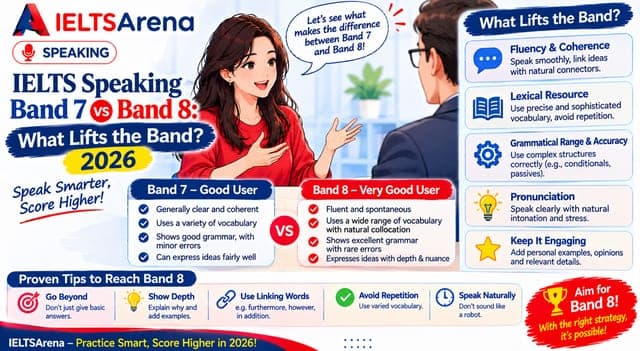
Going from Band 7 to Band 8 on Speaking is harder than going from Band 5 to Band 7. The gap between Band 7 and Band 8 is not about speaking more or extending answers further. Both are already at length. It is about compression, precision, and the kind of natural phrasing that only comes with controlled sophistication. Which is why most Band 7 candidates sit at Band 7 for months even with heavy practice.
Band 8 is required for a specific set of test-takers. Oxford Clarendon and Cambridge Trust scholars, UK medical consultant specialist registration, top tier Canadian immigration categories, academic faculty positions at research universities, and a handful of competitive professional licensing paths. For everyone else, Band 7 is enough and the extra effort of pushing to Band 8 is not worth the gain.
This guide is for the Band 7 candidate who needs Band 8. It breaks down the specific differences across all four marking criteria, side-by-side Band 7 vs Band 8 answers on three different question types, the vocabulary and grammar lifts that actually move the band, and the two-month practice plan that works. Practise at IELTSArena with AI Speaking Feedback that scores every answer against the four criteria so you can see which one is still at Band 7.
Quick Answer: Band 8 IELTS Speaking means fluent, natural speech with a wide range of vocabulary used flexibly and precisely, a wide range of grammar structures with full flexibility, and pronunciation that is clear throughout with varied intonation and only occasional mistakes that do not affect understanding. The jump from Band 7 to Band 8 is driven by three specific lifts: tighter, more precise vocabulary (replacing a two-word phrase with one well-chosen word), more sophisticated grammar structures used naturally (concessive clauses, cleft sentences, hypothetical past), and intonation that signals meaning (not just clarity). Band 8 is not Band 7 with more words. It is Band 7 with better words.
Who this is for: Test-takers already scoring Band 7 on Speaking who need Band 8 for a specific requirement (academic scholarship, medical registration, immigration points, top-tier faculty position). Not relevant for most immigration or visa applications, which require Band 7 or lower.
Why Band 7 to Band 8 Is Harder Than Any Other Half-Band Jump
The jumps from Band 5 to 5.5, 5.5 to 6, 6 to 6.5, and 6.5 to 7 are all driven by the same two things: speaking at length and reducing errors. Longer answers plus fewer mistakes equals a higher band. Both are visible, countable, and improvable with practice.
The jump from Band 7 to Band 8 is driven by something harder to see and harder to practise. The Band 8 descriptor across all four criteria includes words like "wide range", "flexibly", "a variety of", and "natural". These are not countable improvements. You cannot write a drill that says "add three concessive clauses to each answer". You have to make the concessive clauses sound like something you would say naturally, in the moment, under pressure.
The second reason the jump is harder is diminishing returns on practice volume. A Band 5 candidate doing 40 Speaking practice sessions typically moves to Band 6.5. A Band 7 candidate doing the same 40 sessions typically moves to Band 7.5 at best. The practice has to be more targeted, more criterion-specific, and more focused on quality rather than quantity.
The third reason is that Band 8 demands all four criteria at Band 8. Your Speaking band is the average of Fluency and Coherence, Lexical Resource, Grammatical Range and Accuracy, and Pronunciation. Band 7.5 is possible with three criteria at 7 and one at 8. Band 8 overall requires at least three of the four at Band 8. One Band 7 criterion drags the whole average back.
The Four Criteria at Band 7 vs Band 8
The official Cambridge band descriptors differ in specific ways at each criterion. Understanding these is the first step to building a practice plan that actually targets the gap.
Fluency and Coherence. Band 7: "speaks at length without noticeable effort or loss of coherence", "uses a range of connectives and discourse markers with some flexibility". Band 8: "speaks fluently with only occasional repetition or self-correction", "develops topics coherently and appropriately". The lift: at Band 7 you speak at length comfortably. At Band 8 you also develop topics appropriately, which means the content organisation is natural, not formulaic. The PPEEL framework that produces Band 7 Part 3 answers has to become invisible by Band 8.
Lexical Resource. Band 7: "uses vocabulary resource flexibly to discuss a variety of topics", "uses some less common and idiomatic vocabulary". Band 8: "uses a wide vocabulary resource readily and flexibly to convey precise meaning", "uses less common and idiomatic vocabulary skilfully, with occasional inaccuracies". The lift: at Band 7 you use some less common words. At Band 8 you use them "skilfully" and "to convey precise meaning". The difference is between knowing a word and using it in the exact right context, which is harder to drill.
Grammatical Range and Accuracy. Band 7: "uses a range of complex structures with some flexibility", "frequently produces error-free sentences, though some grammatical mistakes persist". Band 8: "uses a wide range of structures flexibly", "produces a majority of error-free sentences with only very occasional inappropriacies or basic/non-systematic errors". The lift: at Band 7 you use a range of structures. At Band 8 you use a wide range with full flexibility, and your error rate drops significantly. The sentence-level accuracy matters as much as the structural range.
Pronunciation. Band 7: "shows all the positive features of Band 6 and some, but not all, of the positive features of Band 8". Band 8: "uses a wide range of pronunciation features", "sustains flexible use of features, with only occasional lapses", "is easy to understand throughout; L1 accent has minimal effect on intelligibility". The lift: at Band 8, intonation and stress carry meaning, not just clarity. A regional accent is still fine, but it should not require any effort from the examiner to understand.
The Three Common Band 7 Ceilings
Most Band 7 candidates stuck at Band 7 have one of three specific problems. Identifying which one is yours tells you where to focus your Band 8 preparation.
Ceiling one: vocabulary breadth without precision. You know enough words to discuss any topic, including less common ones, but you often use them in slightly the wrong register or context. "Reduce" when you mean "mitigate". "Important" when you mean "pivotal". The precision gap caps Lexical Resource at Band 7.
Ceiling two: grammar range without flexibility. You use complex structures when you have time to plan them (Part 2 cue card), but your Part 1 and Part 3 answers default to simpler structures under time pressure. The flexibility gap caps Grammatical Range at Band 7.
Ceiling three: fluent delivery without natural intonation. You speak smoothly and clearly, but your intonation stays flat across answers. You do not use stress to signal emphasis, you do not use intonation changes to signal attitude or uncertainty. The pronunciation gap caps overall Pronunciation at Band 7.
Most Band 7 candidates have one or two of these ceilings, not all three. Spotting yours cuts your preparation time in half because you can skip the criteria that are already at Band 8.
Chen's Story: Band 7 to Band 8 in Eight Weeks
Chen is a 29-year-old quantitative researcher at a Shanghai hedge fund applying for a position at a London quant firm. The role required IELTS 8.0 overall for the firm's internal threshold on international hires. Her previous test came back at Band 7.5 Speaking, with Band 7 on Lexical Resource and Pronunciation holding her back. The other two criteria were already at Band 8.
Chen's Lexical Resource issue was precision, not range. She knew the less common words but used them in slightly the wrong context. "Significant" when "substantial" was more precise. "Problem" when "issue" was more appropriate. The AI Speaking Feedback on IELTSArena flagged these specific substitutions on 60 percent of her Part 2 and Part 3 answers.
Her Pronunciation issue was intonation flatness. Her clarity was already at Band 8, but her sentences had no stress patterns to carry meaning. Every sentence sounded the same. The feedback flagged the lack of pitch variation on content words and the lack of stress on comparative structures.
For eight weeks, Chen worked on both specific gaps. She kept a running vocabulary refinement list of 20 word pairs where she used the less precise option: significant/substantial, problem/issue, think/suspect, important/pivotal, bad/detrimental. She drilled her intonation by reading short passages out loud with explicit stress markers and recording herself.
"Band 7 to Band 8 was not about learning new words. I already had the words. It was about learning to use the words I had with more precision, and about letting my voice actually carry meaning instead of staying flat."
Her next test came back at Band 8 on Speaking. Lexical Resource and Pronunciation both moved to Band 8. The other two criteria stayed where they were. Overall band crossed the threshold with no vocabulary expansion at all.
The Data Behind Band 7 to Band 8 Movement
Cambridge Assessment English does not publish specific statistics on how many Band 7 candidates reach Band 8 in a given year. IDP and British Council trainer notes suggest that only around 15 to 20 percent of test-takers who start at Band 7 and prepare for 8 to 12 weeks reach Band 8 on their next official test. The remaining 80 percent either stay at Band 7, move to Band 7.5, or drop slightly on a different criterion while improving on another.
The successful 15 to 20 percent have one thing in common: they target specific criteria rather than practising generally. General Speaking practice at Band 7 produces marginal improvement because you are already using the techniques that produced Band 7. New techniques, specific to the criterion still at Band 7, are what moves the final half-band.
In the 2026 marking approach, examiners have been given more detailed descriptors for what distinguishes Band 7.5 from Band 8 on each criterion. For Lexical Resource specifically, the distinction has moved further toward "precise meaning" rather than "range of vocabulary". A candidate using 30 less common words imprecisely scores lower than a candidate using 15 less common words precisely. This marking shift favours candidates who refine the words they already know rather than those who try to memorise more.
For Pronunciation, the 2026 descriptors have added explicit mention of "sentence stress" and "intonation to convey meaning" at Band 8. This is a shift away from pure clarity marking toward functional pronunciation, which means a strong but clear regional accent is more compatible with Band 8 than it was five years ago, as long as the stress and intonation patterns work.
Fluency and Coherence: What Band 8 Sounds Like
Band 8 Fluency is not faster speech. It is more natural speech. The three specific lifts.
Natural development without framework seams. At Band 7, the PPEEL framework is visible: you can hear the Point, Prove, Example, Explore, Link moves in sequence. At Band 8, the five moves blend together. The example emerges naturally from the explanation. The alternative view is woven into the main argument. The structure is still there, but the examiner cannot hear the joins.
Discourse markers that signal attitude. At Band 7, you use connectives: "and", "but", "because", "so", "however". At Band 8, you add markers that signal your attitude to what you are saying: "arguably", "to be fair", "I suppose", "what strikes me is", "where I would push back on my own argument". These are not just transitions. They tell the examiner how you feel about the content.
Repair and self-correction that sound deliberate. At Band 7, self-correction is a hesitation that drops the band. At Band 8, repair is a tool: you catch yourself mid-sentence and reword because the first version was not quite right. This is a Band 8 feature in the descriptors ("only occasional repetition or self-correction") when it signals precision rather than struggle.
Lexical Resource: Specific Vocabulary Lifts
Band 8 Lexical Resource is driven by precision, not range. Twenty specific word-pair lifts that move most Band 7 candidates to Band 8.
| Band 7 word | Band 8 lift | Context |
|---|---|---|
| important | pivotal, crucial, central | emphasising critical status |
| problem | issue, challenge, concern | less emotional, more precise |
| big | substantial, considerable | describing scale |
| think | suspect, suppose, imagine | signalling tentativeness |
| very | remarkably, strikingly, notably | intensifier |
| good | compelling, effective, valuable | positive judgement |
| bad | detrimental, counterproductive | negative judgement |
| get | obtain, acquire, secure | formal register |
| make | produce, generate, create | formal register |
| start | initiate, launch, embark on | formal register |
| end | conclude, terminate, wind down | formal register |
| show | demonstrate, illustrate, highlight | evidence-based claim |
| help | facilitate, enable, support | enabling action |
| change | shift, transform, evolve | directional change |
| different | distinct, divergent, separate | precise comparison |
| same | identical, equivalent, comparable | precise comparison |
| about | concerning, regarding, in terms of | formal preposition |
| because | given that, in light of | formal causal |
| but | although, whereas, that said | formal contrast |
| so | consequently, as a result, thus | formal result |
The point of the table is not to memorise 20 word pairs. It is to notice which four or five pairs you use most often in the wrong direction. A targeted drill on those four or five lifts your Lexical Resource criterion by half a band in three to four weeks.
Grammatical Range: Structures Band 8 Uses
Band 8 grammar is driven by flexibility across structures, not use of complex structures in isolation. Five specific grammar lifts that most Band 7 candidates miss under time pressure.
Concessive clauses. "Although", "even though", "despite the fact that". These let you acknowledge an alternative view in one subordinate clause, which is a core Band 8 move. "Although remote work has given some workers more flexibility, the always-on culture is the stronger force." One sentence, two positions, Band 8 grammar.
Cleft sentences. "What strikes me is X". "The thing that surprised me most was X". "Where I would push back is X". These structures emphasise one part of the sentence and signal attention, which is a Band 8 Fluency and Coherence marker as well as a grammar lift.
Hypothetical past. "If you had asked me five years ago, I would have said X, but...". "Had the system been designed differently, the outcome might have been more successful." These show flexibility with time and conditional structures and are consistently rated at Band 8.
Participle clauses. "Having spent two years in finance, I think...". "Looking at the data, the pattern becomes clearer". These compress what Band 7 candidates would say in two sentences into one tighter sentence.
Noun phrase complexity. "The increasingly porous boundary between work and home life" instead of "the boundary between work and home that is becoming more porous". Compressing a relative clause into a modified noun phrase is a Band 8 move that lifts Grammatical Range without changing content.
Drill one of these five structures per week over five weeks and your Grammatical Range criterion moves from Band 7 to Band 8 for most candidates.
Pronunciation: The One Thing Most Band 7 Candidates Miss
Band 8 Pronunciation is not about clarity. Most Band 7 candidates are already clear enough. The thing that moves the band is sentence stress and intonation that carries meaning.
Content word stress. In English, content words (nouns, verbs, adjectives, adverbs) carry stress. Function words (articles, prepositions, pronouns) do not. Band 7 speakers often flatten this pattern, pronouncing every word with similar emphasis. Band 8 speakers automatically stress content words and reduce function words, which is both a clarity marker and a meaning marker.
Intonation on comparison and contrast. When you say "I think X, but on the other hand Y", the intonation on X and Y should rise and fall in different patterns to signal the contrast. Band 7 speakers often say both halves of a contrast with the same intonation, which flattens the meaning. Band 8 speakers use pitch changes to make the contrast audible.
Pause for emphasis. Band 8 speakers pause briefly before the most important word in a sentence to signal "listen to this one". "The main reason work-life balance has got worse is [pause] the always-on culture." The pause is deliberate. It is a Band 8 pronunciation feature.
These three features are the most common pronunciation gap between Band 7 and Band 8 candidates. All three can be drilled with recorded self-correction over three to four weeks.
Where IELTSArena Fits Into Your Band 8 Preparation
For Band 7 candidates aiming at Band 8, the AI Speaking Feedback on IELTSArena identifies which specific criterion is still at Band 7. The feedback is per-criterion and per-answer, so after three or four practice sessions you will see a clear pattern: your Lexical Resource is already at Band 8, your Grammatical Range is at Band 7, your Pronunciation is split (clarity at Band 8, intonation at Band 7).
The pattern lets you target. If Lexical Resource is already at Band 8, you can stop drilling vocabulary. If Pronunciation intonation is the issue, you drill intonation specifically for three weeks. This is the targeted preparation that works for the final half-band jump.
For the two or three mock tests closest to your official exam, Expert Tutor Review by a trained IELTS examiner adds band-level accuracy on borderline cases. The tutor can tell you whether your Band 7.5 is actually a 7.75 (which rounds up on test day) or a 7.5 (which does not). More than 1,200 learners have used IELTSArena to lift their Speaking band, with the Real CBT Interface giving you the same timer and prompt structure as the official computer-based test.
Record your first Part 2 cue card answer today at IELTSArena and the AI feedback will tell you within seconds which of your four criteria is still at Band 7.
The Two-Month Band 8 Practice Plan
A focused eight-week plan for a Band 7 candidate aiming at Band 8.
Weeks 1 to 2: criterion diagnosis. Submit six to eight full Part 1, Part 2, and Part 3 answers to AI Speaking Feedback. Identify which of the four criteria are already at Band 8 and which are still at Band 7. Most candidates will find one or two criteria at Band 8 and two or three still at 7. Confirm the pattern across at least six sessions before moving on.
Weeks 3 to 5: criterion-specific drills. Pick the two weakest criteria. Drill them specifically. If Lexical Resource is weak, build a 20-pair precision word list and work it into Part 2 and Part 3 answers daily. If Grammatical Range is weak, drill one new complex structure per week. If Pronunciation is weak, record and self-correct intonation on three answers per day.
Weeks 6 to 7: integration. Full mock tests three times a week. Each one with per-criterion AI feedback. The goal is to make the Band 8 moves automatic under test-day pressure, not drilled under preparation conditions. By end of week 7, your target criteria should be averaging Band 8 across most answers.
Week 8: pre-test polish. Two full mock tests, both with Expert Tutor Review. Focus on any criterion still showing Band 7 in isolated answers. Rest the day before the official test.
Eight weeks, roughly 50 practice sessions, Band 7 to Band 8 for the 15 to 20 percent of candidates who complete the plan with target discipline.
Self-Diagnosis: Which Criterion Is Holding You Back
Answer honestly based on your recent AI feedback or self-recorded Speaking practice.
- When you use less common words (e.g. "pivotal", "detrimental", "substantial"), are you using them precisely or just inserting them because you know them?
- In Part 1 and Part 3 under time pressure, do you still produce complex grammar structures, or do you default to simpler sentences?
- Does your intonation vary within sentences (rise on questions, fall on statements, stress on content words), or does your voice stay relatively flat?
- Can you hear the PPEEL framework in your own Part 3 answers, or does the structure sound invisible and natural?
- Do your Part 2 cue card answers include at least one concessive clause, cleft sentence, or participle clause naturally in the middle of the long turn?
A yes to question 1 and no to any of questions 2, 3, or 4 means Lexical Resource is probably already at Band 8 and your gap is somewhere else. A no to questions 2 and 5 means Grammatical Range is your gap. A no to question 3 means Pronunciation intonation is your gap. Target the specific gap rather than practising generally.
Record Your First Answer Today
Submit three Part 2 or Part 3 answers to AI Speaking Feedback on IELTSArena, and you will see per-criterion scores within seconds. Identify which of the four criteria is still at Band 7 and target that one for the next three weeks. Start free at IELTSArena. No credit card and no commitment.
Related Guides
These sit inside the Speaking cluster on IELTSArena. Use them to drill the specific criterion holding your band at 7.
- IELTS Speaking: The Complete Guide
- AI IELTS Speaking Practice
- Speaking Part 3: How to Extend Your Answers to 40-60 Seconds
- Speaking Mock Test With Band Score
- Speaking Part 2 Cue Card Strategy
- IELTS Speaking Fluency and Coherence
- IELTS Speaking Pronunciation
- IELTS Speaking Lexical Resource
- IELTS Speaking Grammatical Range and Accuracy
- IELTS Speaking Mistakes to Avoid
- How to Practise IELTS Speaking Alone
FAQ
What is the difference between Band 7 and Band 8 in IELTS Speaking? Band 7 Speaking means you speak at length without noticeable effort, use a range of connectives, use some less common vocabulary, and use a range of complex grammar structures. Band 8 Speaking means you speak fluently with only occasional repetition, develop topics coherently, use a wide vocabulary resource flexibly and precisely, use a wide range of grammar structures with full flexibility, and have intonation that carries meaning. The jump is driven by three specific lifts: tighter vocabulary precision (not range), more sophisticated grammar used naturally under pressure, and intonation that signals attitude and emphasis. Only around 15 to 20 percent of candidates who start at Band 7 and prepare for 8 to 12 weeks actually reach Band 8 on their next test.
How do I score Band 8 in IELTS Speaking? Identify which of the four criteria is still at Band 7 and target that one specifically. For Lexical Resource, drill 20 word pairs where you default to the less precise option (important vs pivotal, big vs substantial). For Grammatical Range, drill one new complex structure per week over five weeks (concessive clauses, cleft sentences, hypothetical past, participle clauses, complex noun phrases). For Pronunciation, drill content word stress, intonation on contrast, and pause for emphasis. For Fluency and Coherence, make the PPEEL framework invisible in Part 3 so the structure sounds natural. Use AI Speaking Feedback on IELTSArena to confirm which criterion moved to Band 8 and which still needs work.
What vocabulary do I need for Band 8 Speaking? Band 8 Lexical Resource is driven by precision, not range. You do not need more words. You need to use the words you already know with more precision. Twenty specific word-pair lifts move most Band 7 candidates to Band 8: important to pivotal, problem to issue, big to substantial, think to suspect, very to remarkably, good to compelling, bad to detrimental, get to obtain, make to produce, start to initiate, end to conclude, show to demonstrate, help to facilitate, change to shift, different to distinct, same to equivalent, about to concerning, because to given that, but to although, so to consequently. You do not need all twenty. The four or five you use most often in the wrong direction are enough.
What grammar structures do I need for Band 8 Speaking? Band 8 Grammatical Range is driven by flexibility across structures under time pressure. Five structures that move most Band 7 candidates to Band 8: concessive clauses (although, even though, despite), cleft sentences (what strikes me is, the thing that surprised me most was), hypothetical past (had the system been designed differently, I would have), participle clauses (having spent two years in, looking at the data), and complex noun phrases (the increasingly porous boundary between work and home). You do not need to use all five in every answer. You need to use any two or three of them naturally and flexibly across your Speaking test. Drill one new structure per week over five weeks.
Is Band 8 Speaking harder than Band 7? Yes, significantly. The jump from Band 7 to Band 8 is harder than the jumps from Band 5 to 7 combined for most candidates. The reason is that Band 7 is reached by speaking at length and reducing errors, both of which are countable improvements. Band 8 requires compression, precision, and natural phrasing, which cannot be drilled as directly. Only 15 to 20 percent of candidates who start at Band 7 and prepare for 8 to 12 weeks reach Band 8 on their next official test. For most immigration, academic admission, and professional purposes, Band 7 is enough. Band 8 is only required for specific academic scholarships (Oxford Clarendon, Cambridge Trust), UK medical specialist registration, top-tier Canadian immigration points, and some competitive faculty positions.