The IELTS Speaking test is 11 to 14 minutes long. In that time, a trained examiner asks you about 25 to 30 questions and makes four separate band judgements that average into your Speaking band. There is no essay to hide behind, no reading comprehension to buy you thinking time, and no listening transcript to re-read. You either speak clearly, in extended answers, with a reasonable range of vocabulary and grammar, in the moment, or your band stops at 6.
Most test-takers walk into Speaking under-prepared because the test looks small. 14 minutes. One examiner. A conversation. How hard can it be. The answer, measured against 2026 Band 7 criteria, is harder than any other skill, because every weakness in your English is visible in real time with no second attempt.
This is the complete guide to IELTS Speaking in 2026. It covers the full test format, all three parts in detail, the four marking criteria the examiner uses, side-by-side Band 6 vs 7 vs 8 answers, and a preparation plan that lifts your band in four to six weeks. Practise every part of the test at IELTSArena with AI Speaking Feedback that scores your answers against the four official criteria within seconds.
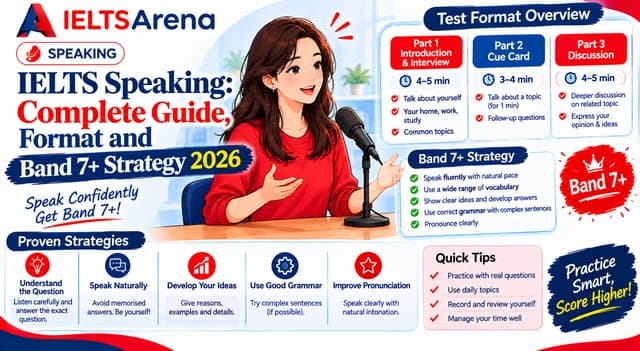
Quick Answer: The IELTS Speaking test is an 11 to 14 minute face-to-face interview with a trained examiner, split into three parts. Part 1 is a 4 to 5 minute introduction with questions about familiar topics. Part 2 is a 3 to 4 minute long turn where you speak for up to two minutes on a cue card. Part 3 is a 4 to 5 minute two-way discussion of abstract ideas linked to the Part 2 topic. The test is marked on four criteria of equal weight: Fluency and Coherence, Lexical Resource, Grammatical Range and Accuracy, and Pronunciation. From June 2026 the test is only available in computer-delivered format (either face-to-face at the test centre or by video call), paper IELTS having been discontinued globally. Band 7 means confident, extended answers with a wide vocabulary range and only occasional errors.
Who this is for: Anyone preparing for IELTS Speaking, from first-time test-takers wanting to understand the format to repeat test-takers trying to break out of Band 6.5 and reach Band 7 or above. Applies equally to Academic, General Training, UKVI, and Life Skills variants where Speaking is a one-to-one interview.
What IELTS Speaking Actually Tests
IELTS Speaking is not a test of your opinions. It is not a test of how well you prepared memorised answers. It is a test of your ability to use English in real-time spoken communication on a range of topics you cannot predict in advance.
The examiner is listening for four separate things, each marked independently and averaged for your final band. The content of your answers barely matters. A Band 8 answer with a controversial opinion scores higher than a Band 6 answer with a popular opinion. The examiner marks how you speak, not what you say.
This is why memorised answers do not work. Every examiner is trained to spot them within one or two sentences, and once spotted, your Fluency and Coherence mark drops to Band 5 for that answer. The grammar range and the pronunciation markers that come from genuine spoken English disappear the moment you start reciting. Speaking is the only one of the four IELTS skills where preparation strategy that works for Writing (memorise templates and apply them) actively hurts your band.
Band 7 Speaking is a specific thing. It means you can speak at length, develop ideas naturally, use a reasonable range of vocabulary including some less common items, show flexibility in grammar structures, and be understood without strain by a listener who is used to the accents in your region. Band 7 is the English of a confident international professional, not a fluent native speaker.
Test Format: 11 to 14 Minutes, Three Parts, One Examiner
The IELTS Speaking test runs for 11 to 14 minutes depending on how your answers go. A short-answering candidate finishes closer to 11. A fluent, extended-answering candidate finishes closer to 14. The time is not a mark in itself, but short answers almost always correlate with lower bands because they signal reluctance or inability to speak at length.
From June 2026, paper IELTS was discontinued globally. All Speaking tests are now part of the computer-delivered format and are offered in one of two modes:
IELTS on Computer (Face-to-Face Speaking). You travel to a test centre and sit in a quiet room with a trained examiner across the desk. The examiner records the session. This is still the format most test-takers use because it feels like a familiar interview.
IELTS Online (Video Call Speaking). You take the Speaking test by video call with a trained examiner, often from home or from a test centre booth. The content, timing, and marking are identical. The only differences are logistical, including a mandatory pre-test ID verification and a stable camera and microphone requirement.
Across both modes, the test is divided into three parts in a fixed order. The examiner follows a scripted framework but can ask natural follow-up questions, so no two Speaking tests are identical. The examiner cannot see your Writing, Reading, or Listening performance and does not know what band they are aiming for. Their only job is to score what they hear in the room.
Part 1: Introduction and Interview (4 to 5 Minutes)
Part 1 opens the test. The examiner introduces themselves, checks your ID, and begins with a short set of personal introduction questions. Then they ask you questions on two or three familiar topics drawn from a published question bank. Common Part 1 topics include your hometown, your work or study, hobbies, food, music, sport, travel, family, weather, and holidays.
The examiner asks around 12 to 15 questions in Part 1. Each answer should run 2 to 4 sentences, roughly 20 to 40 seconds. Short one-sentence answers drop your Fluency and Coherence mark because they signal unwillingness to extend. Over-long answers of 60 seconds or more irritate the examiner and often drift off-topic, which also drops the mark.
The questions in Part 1 are deliberately familiar. "Do you work or study?" "What do you enjoy about your job?" "How often do you listen to music?" "What kind of weather do you prefer?" The examiner is not trying to catch you out. They are checking that you can speak comfortably about everyday topics without hesitation.
Band 7 in Part 1 means you extend every answer with at least one supporting detail, you use a range of vocabulary beyond the most basic words, and you speak without long pauses or repeated self-correction. The common Band 6 pattern is short answers with the examiner's words repeated back, which signals you understand the question but cannot develop beyond the obvious response.
Part 2: Long Turn (3 to 4 Minutes)
Part 2 is the hardest part of the test for most candidates. The examiner hands you a cue card with a topic and three or four bullet points. You get 60 seconds of silent preparation time with a pencil and paper to make notes, then you speak for 1 to 2 minutes without interruption.
A typical cue card reads something like this. "Describe a memorable journey you have taken. You should say: where you went, who you went with, what you did there, and explain why the journey was memorable."
The 60 seconds of preparation is the most valuable minute of the whole test. The strongest candidates use it to write a short structure, three or four one-word notes for each bullet point. Weaker candidates write full sentences they then try to read out loud, which the examiner spots immediately as rehearsed delivery.
The long turn runs for up to 2 minutes. The examiner will stop you at 2 minutes exactly, so aiming for 90 to 110 seconds is safer than aiming for the maximum. Finishing at 45 seconds, which is a common Band 5.5 pattern, signals you ran out of ideas and drops Fluency and Coherence.
After your long turn, the examiner asks one or two brief rounding-off questions linked to the topic. These are short Yes-and-brief-explanation answers, 10 to 20 seconds each, that bridge into Part 3.
Band 7 in Part 2 means you cover all four bullet points on the cue card, you speak for at least 90 seconds without major pauses, and your answer has a clear structure. The common Band 6 pattern is to answer only two or three of the bullet points because of time, or to repeat the same information in different words to fill the time.
Part 3: Two-Way Discussion (4 to 5 Minutes)
Part 3 is a discussion of abstract ideas linked to the Part 2 topic. If Part 2 was about a memorable journey, Part 3 might cover why people travel, how travel has changed in the last 20 years, the impact of tourism on local communities, and whether space tourism will become normal.
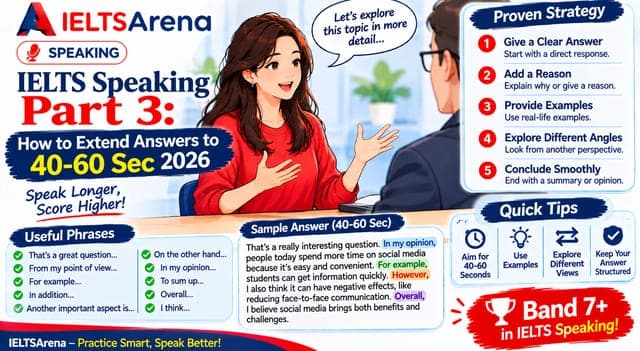
The examiner asks around 5 to 7 questions in Part 3. Each answer should run 40 to 60 seconds, roughly four to six sentences, with developed reasoning and at least one example. Short one-sentence answers in Part 3 almost always cap your band at 6 because the examiner cannot assess your range of ideas or vocabulary from a 10-second response.
Part 3 is where the examiner tests your ability to speculate, hypothesise, compare, and defend an opinion. The questions move from concrete to abstract across the 5-minute conversation. The examiner follows your answers with natural follow-ups like "Why do you think that?" or "Can you give me an example?" or "Do you think that will change in the future?" The follow-ups are testing whether you can extend an idea beyond its first expression.
Band 7 in Part 3 means you give extended, developed answers with at least one specific example or reason, you use linking phrases to signal your reasoning (such as "the main reason is", "what people often forget is", "another way of looking at this"), and you can hold a two-way conversation without the examiner carrying it. The common Band 6 pattern is to answer the question but add no reasoning, example, or counterpoint.
The Four Marking Criteria
Every IELTS Speaking band is the average of four criterion-level marks. Each criterion is weighted equally at 25 percent. The examiner makes four separate judgements across the 14 minutes and the four marks are then averaged, which is why you cannot score a 7 overall unless at least three of your four criteria are at Band 7.
Fluency and Coherence (25 percent). How smoothly you speak, how well you connect ideas, how little you hesitate or self-correct. Band 7 means you speak at length without noticeable effort or loss of coherence, and you use a range of connectives and discourse markers with some flexibility. The common Band 6 pattern is repeated hesitation on content words and over-reliance on simple connectives like "and" and "but".
Lexical Resource (25 percent). The range and accuracy of your vocabulary. Band 7 means you use vocabulary flexibly to discuss a variety of topics, you use less common lexical items, and you can paraphrase when you do not know the exact word. The common Band 6 pattern is repetition of the same words throughout the test and avoidance of less common vocabulary.
Grammatical Range and Accuracy (25 percent). The variety of sentence structures and the accuracy of your grammar. Band 7 means you use a range of complex structures with some flexibility, with most sentences error-free and no errors preventing understanding. The common Band 6 pattern is heavy use of simple sentences, occasional errors in complex structures, and tense inconsistency.
Pronunciation (25 percent). Clarity, control of individual sounds, use of stress and intonation. Band 7 means you can be understood throughout, you use a range of pronunciation features, and only occasional words or sounds reduce clarity. The common Band 6 pattern is heavy accent influence that occasionally reduces clarity, flat intonation, and misplaced word stress.
Pronunciation is the most misunderstood criterion. A regional accent is not a problem at any band. The examiner is marking clarity, not nativeness. A test-taker from Lagos, Jakarta, or Lima can reach Band 8 or 9 on pronunciation while retaining a clear regional accent as long as the examiner never has to work hard to understand them.
Band 6 vs Band 7 vs Band 8 Answers: Side by Side
Same Part 1 question, three different executions. The question: "How often do you travel in your free time, and where do you usually go?"
Band 6 answer: "I travel sometimes. I usually go to the beach with my family. I like it because it is relaxing. The beach is nice."
Four short sentences, 23 words, 10 seconds. The content answers the question but no idea is extended, no vocabulary range is shown, and the sentences are all simple. Fluency and Coherence at Band 6, Lexical Resource at Band 5.5, Grammatical Range at Band 5.5.
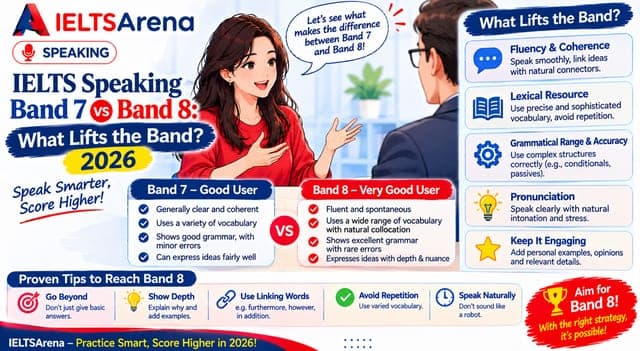
Band 7 answer: "I try to travel at least two or three times a year, usually during the long weekends when I can get away without taking too much time off work. My go-to destination is a small coastal town about three hours from where I live, because it is quiet, uncrowded, and has incredible seafood. I find that even a short break by the sea really helps me reset for the next few weeks at work."
Three sentences, 76 words, around 35 seconds. The answer extends with specifics (two or three times a year, long weekends, three hours away), uses a range of vocabulary (go-to destination, uncrowded, reset), and uses complex sentence structures (relative clauses, conjunctions, result clauses). Fluency and Coherence at Band 7, Lexical Resource at Band 7, Grammatical Range at Band 7.
Band 8 answer: "I try to get away roughly every couple of months, nothing elaborate, usually a long weekend somewhere within driving distance. My default is a stretch of coast about three hours from the city, mainly because it has stayed off the mainstream tourist radar, so even in peak season you can find a quiet beach and reasonably priced seafood. Beyond the obvious appeal of the scenery, there is something about being away from screens for 48 hours that properly resets me, far more than any staycation ever manages."
Three sentences, 92 words, around 40 seconds. Same essential answer but with tighter vocabulary (default, off the mainstream tourist radar, reasonably priced, properly resets), more complex grammar (participle clause, conjunction with contrast, comparative structure with intensifier), and natural intonation markers (nothing elaborate, mainly because, far more than). Lexical Resource at Band 8, Grammatical Range at Band 8.
Notice that all three answers address the same question with the same essential content. The jump from Band 6 to Band 7 is about length and development. The jump from Band 7 to Band 8 is about tighter vocabulary and more natural phrasing.
Nurlan's Story: Band 5.5 to Band 7 in Six Weeks
Nurlan is a 31-year-old petroleum engineer from Astana applying for Canadian PR through Express Entry. He needed CLB 7 on each skill, which maps to Speaking Band 6. His first mock test came back at Band 5.5 on Speaking, with the feedback: "answers too short, no extension, Part 2 ended at 52 seconds."
He realised his preparation had been wrong. He had been memorising Part 2 cue card answers from YouTube videos. The examiner had spotted the memorisation in the first 20 seconds and marked his Fluency and Coherence down accordingly.
For six weeks, Nurlan stopped memorising anything. He practised one Part 1 answer, one Part 2 cue card, and one Part 3 question every day on IELTSArena's AI Speaking Practice. The feedback flagged every answer that was under 20 seconds in Part 1, under 90 seconds in Part 2, or under 40 seconds in Part 3. He forced himself to extend every answer by one supporting detail and one specific example.
"I kept thinking I just needed better vocabulary. The vocabulary I had was already Band 7. I just kept stopping before I used it. Once I stayed on each answer long enough, the examiner could see what I actually knew."
His next official test came back at Band 7 on Speaking. His vocabulary, grammar, and pronunciation did not change. His answers got longer, more structured, and less rehearsed. Half a band higher than his target.
The Data Behind IELTS Speaking Marks
Cambridge Assessment English publishes the IELTS Speaking band descriptors publicly. Band 7 Fluency and Coherence reads "speaks at length without noticeable effort or loss of coherence". Band 6 reads "willingness to speak at length, though may lose coherence". The word "effort" in the Band 7 descriptor is what the examiner is listening for, which translates in practice to steady pace, controlled pauses, and no visible struggle for words.
British Council and IDP IELTS report that Speaking is the skill where test-takers are most likely to receive a band equal to or lower than their self-prediction. On a global average basis, test-takers typically self-predict Speaking a full band higher than they actually score, which is the largest gap of any of the four skills. The gap closes when test-takers hear their own answers scored against the four criteria, which is why structured feedback is more important for Speaking than for any other IELTS skill.
In the 2026 marking approach, examiners have been given clearer guidance on three specific patterns that cap bands: memorised cue card answers (automatically marked at Band 5 regardless of language quality), one-word Part 1 answers followed by silence (capped at Band 5.5 for Fluency and Coherence), and heavy pronunciation of filler phrases like "you know", "I think so", and "kind of" more than once every 20 seconds (capped at Band 6 for Fluency and Coherence).
The computer-delivered Speaking test (both face-to-face and video call) uses the exact same marking criteria as the previous paper-based version. The format change from June 2026 does not affect scoring.
How to Prepare for IELTS Speaking in Six Weeks
A realistic six-week plan for a test-taker currently at Band 5.5 to 6 aiming for Band 7. This assumes 45 minutes of focused practice per day, five days per week.
Week 1: baseline and format. Learn the three-part structure. Watch two or three official sample Speaking tests end-to-end to internalise the pace and format. Record yourself answering five Part 1 questions, five Part 2 cue cards, and five Part 3 questions. Submit them for AI Speaking Feedback and read the paragraph-level scores. The point of week 1 is not improvement, it is diagnosis.
Week 2: Part 1 extension. Spend five days answering Part 1 questions only. Rule: no answer shorter than two sentences, every answer must have one supporting detail. Record every answer. By end of week 2, your Part 1 answers should be averaging 25 to 35 seconds with no one-word responses.
Week 3: Part 2 structure. Spend five days on cue cards. Rule: no memorised answers, strictly 60 seconds of planning with written notes, aim for 90 to 110 second long turns. The 60-second planning is the critical skill. By end of week 3, you should be hitting 90-second-plus Part 2 answers consistently.
Week 4: Part 3 development. Spend five days answering Part 3 abstract questions. Rule: every answer must include at least one example and at least one piece of reasoning. Target 40 to 60 seconds per answer. Part 3 is where most Band 6 test-takers plateau, because the questions require you to think and speak at the same time, which Parts 1 and 2 do not fully demand.
Week 5: full mock tests. Three full 14-minute mock tests this week, spaced two days apart. Each one with full feedback on all four criteria for all three parts. Rewrite your two weakest answers between each mock test. By end of week 5, your overall band should be at 6.5 or 7 depending on starting point.
Week 6: pre-test polish. Two full mock tests, both with Expert Tutor Review from a trained IELTS examiner. Focus on filler phrases, pronunciation, and any criterion still below your target. Rest two days before your official test.
30 days of structured practice with feedback outperforms 90 days of unstructured conversation practice because the feedback tells you which of your four criteria is actually holding the band back.
Common Mistakes That Cap Speaking at Band 6
Six habits that consistently stop otherwise strong candidates from breaking Band 6.5.
Memorising cue card answers. The examiner spots this within 20 seconds and drops your Fluency and Coherence to Band 5. Memorise topic ideas and vocabulary, never full answers.
Giving one-word Part 1 answers. "Yes." "Sometimes." "No, I don't." These signal unwillingness to extend. Every Part 1 answer needs at least two sentences.
Overusing filler phrases. "You know", "I think so", "kind of", "like" more than once every 20 seconds caps you at Band 6 for Fluency.
Avoiding opinions in Part 3. "I don't know, maybe." The examiner is specifically testing your ability to speculate and defend. No opinion means no mark on half the Part 3 criteria.
Speaking too fast under nerves. Pronunciation suffers, filler words multiply, and the examiner mishears. Match the examiner's natural interview pace.
Not using any less common vocabulary. Band 7 Lexical Resource specifically requires some less common words. If every answer uses only the most basic vocabulary, your ceiling is Band 6 even if everything else is right.
Where IELTSArena Fits Into Your Speaking Preparation
Speaking is the skill where feedback matters most, because you cannot hear your own band while you are speaking. You know when a Writing sentence is clunky because you can read it back. You cannot know when your Speaking answer sounded Band 6 or Band 7, because by the time you have finished the sentence, you are already in the next one.
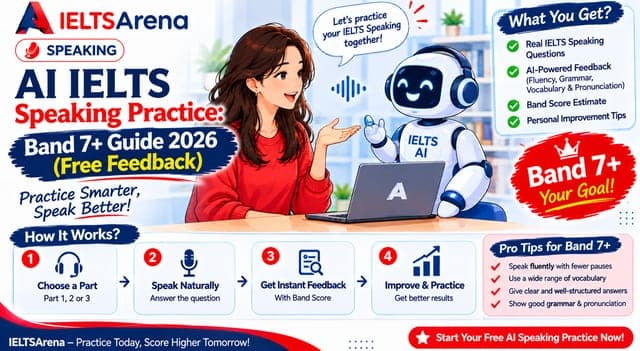
IELTSArena's AI Speaking Practice records every answer you give across Parts 1, 2, and 3, scores it against the four official criteria within seconds, and flags the specific words, pauses, or filler phrases that dropped the band. You can submit unlimited answers for feedback, which is why six weeks of IELTSArena practice typically outperforms three months of conversation partner practice without structured feedback.
For band-level accuracy in the two or three weeks before your official test, IELTSArena's Expert Tutor Review by trained IELTS examiners gives you detailed per-criterion feedback and specific rewrites of your weakest answers at the band above yours. More than 1,200 learners have used IELTSArena to lift their Speaking band this way, with the Real CBT Interface giving you the same test environment you will face on test day.
Start free, record one Part 1 answer, and get your first Fluency and Coherence read in seconds at IELTSArena.
Self-Diagnosis: Where Is Your Speaking Right Now
Record yourself answering these questions and listen back honestly.
- Can you speak for 90 seconds on a cue card topic without pausing for more than three seconds at a time?
- Can you answer a Part 1 question with at least two sentences and one supporting detail?
- Can you give a Part 3 answer with at least one specific example and one piece of reasoning in 40 to 60 seconds?
- Do you use any linking phrases beyond "and", "but", "because", and "so"?
- Do you use filler phrases like "you know", "kind of", "like" more than once every 20 seconds?
If you answered no to two or more of the first four, or yes to the fifth, your current ceiling is Band 6 or 6.5. Four to six weeks of structured practice with feedback usually lifts this to Band 7.
See Your Speaking Band Today
Record one Part 1 answer, one Part 2 cue card, and one Part 3 question on IELTSArena, and get a four-criteria breakdown of each within seconds. Start free at IELTSArena. No credit card and no commitment.
Related Guides
These sit inside the Speaking cluster on IELTSArena. Work through them in the order below as you build up each part of the test.
- Speaking Part 1 Format and Topics (the opening 4 to 5 minutes)
- Speaking Part 2 Cue Card Strategy (the 60-second plan plus long turn)
- Speaking Part 3: How to Extend Your Answers to 40-60 Seconds
- Speaking Band 7 vs Band 8: What Lifts the Band
- AI IELTS Speaking Practice
- Speaking Mock Test With Band Score
- IELTS Speaking Fluency and Coherence
- IELTS Speaking Pronunciation
- IELTS Speaking Lexical Resource
- IELTS Speaking Grammatical Range and Accuracy
- IELTS Speaking Mistakes to Avoid
- How to Practise IELTS Speaking Alone
FAQ
What is the IELTS Speaking test? IELTS Speaking is an 11 to 14 minute face-to-face interview with a trained IELTS examiner, split into three parts: a 4 to 5 minute introduction and interview on familiar topics, a 3 to 4 minute long turn where you speak on a cue card topic for up to two minutes, and a 4 to 5 minute two-way discussion of abstract ideas linked to the Part 2 topic. The examiner marks you on four criteria of equal weight: Fluency and Coherence, Lexical Resource, Grammatical Range and Accuracy, and Pronunciation. From June 2026 the Speaking test is only available in computer-delivered format, either face-to-face at the test centre or by video call. The content, timing, and marking are identical across both modes.
How long is the IELTS Speaking test? The IELTS Speaking test is 11 to 14 minutes long. Part 1 runs 4 to 5 minutes, Part 2 runs 3 to 4 minutes (including the 60 second preparation plus up to 2 minutes of long turn plus brief rounding-off questions), and Part 3 runs 4 to 5 minutes. Short-answering candidates finish closer to 11 minutes, which usually correlates with lower bands. Fluent, extended-answering candidates finish closer to 14 minutes. The time is not a mark in itself but short answers almost always cap Fluency and Coherence at Band 6 because the examiner cannot assess range and development from a response of 10 or 15 seconds.
What are the three parts of IELTS Speaking? IELTS Speaking has three parts in a fixed order. Part 1 is a 4 to 5 minute introduction and interview covering two or three familiar topics from a published question bank, such as hometown, work or study, hobbies, food, or weather. Part 2 is a 3 to 4 minute long turn where the examiner gives you a cue card with a topic and four bullet points, you plan silently for 60 seconds, then speak for up to 2 minutes. Part 3 is a 4 to 5 minute two-way discussion of abstract ideas linked to the Part 2 topic, with 5 to 7 questions that test speculation, comparison, and defending an opinion.
How is IELTS Speaking marked? IELTS Speaking is marked on four criteria of equal weight at 25 percent each: Fluency and Coherence (how smoothly you speak and connect ideas), Lexical Resource (the range and accuracy of your vocabulary), Grammatical Range and Accuracy (the variety and accuracy of your sentence structures), and Pronunciation (clarity, control of sounds, use of stress and intonation). The examiner makes four separate band judgements across the full 14 minutes and the four marks are averaged for your overall Speaking band. You cannot score Band 7 overall unless at least three of your four criteria are at Band 7. A regional accent is not a problem at any band. The examiner marks clarity, not nativeness.
How do I prepare for IELTS Speaking in one month? Spend 30 to 45 minutes a day, five days a week, on structured practice with feedback. Week 1 diagnose your current band with recorded answers submitted for AI Speaking Feedback. Week 2 drill Part 1 extensions, no answer shorter than two sentences. Week 3 drill Part 2 cue cards with 60-second planning and 90-second plus long turns, never memorised. Week 4 drill Part 3 abstract questions with one example and one piece of reasoning per answer. In the final two weeks run three full 14-minute mock tests with four-criteria feedback and rewrite your two weakest answers between each one. 20 practice sessions with structured feedback outperform 60 sessions of unstructured conversation practice because the feedback tells you which specific criterion is holding your band back.