The single most common reason Band 7-ready candidates finish Speaking at Band 6.5 is that their Part 3 answers are too short. 15 seconds. 20 seconds. The examiner asks a thoughtful abstract question about how work has changed in the last 20 years and gets back one sentence that answers the question but develops nothing. The band drops not because the ideas are weak, but because the examiner has nothing to mark.
Part 3 is a 4 to 5 minute discussion of abstract ideas linked to your Part 2 cue card topic. The examiner is specifically testing your ability to speculate, hypothesise, compare, and defend an opinion. None of that can happen in 15 seconds. A Band 7 Part 3 answer runs 40 to 60 seconds. A Band 8 answer runs 50 to 70 seconds. If you finish in 20, the ceiling is Band 6, no matter how good your vocabulary.
This guide gives you the framework that extends Part 3 answers from 15 seconds to 50 seconds without padding or filler, side-by-side Band 6 vs 7 vs 8 answers on the same question, and the practice routine that fixes short-answer habit in two to three weeks. Record your first Part 3 answer at IELTSArena and the AI Speaking Feedback will tell you exactly how long each answer ran and which Band your pace matches.
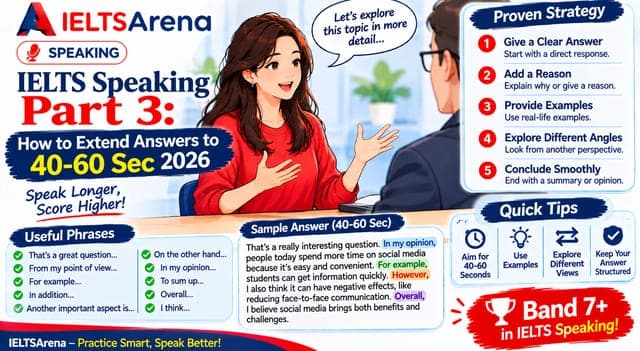
Quick Answer: Band 7 IELTS Speaking Part 3 answers run 40 to 60 seconds each, roughly four to six sentences, with one specific example and one piece of reasoning. The PPEEL framework extends every answer: Point (your position in one sentence), Prove (why you think it, one or two sentences), Example (one specific case), Explore (acknowledge an alternative view or complication), Link (tie back to the question or extend into speculation). Band 6 Part 3 answers typically run 15 to 25 seconds with no example and no reasoning, which is the single most common cap on Speaking at Band 6.5. The fix is a framework, not more ideas.
Who this is for: Test-takers at Band 5.5 to Band 7.5 whose Part 1 and Part 2 are solid but whose Part 3 answers end too quickly for the examiner to assess range. Equally useful across all three Part 3 question types: comparison, speculation, abstract opinion.
Why Part 3 Is Where Most Band 7 Candidates Lose Half a Band
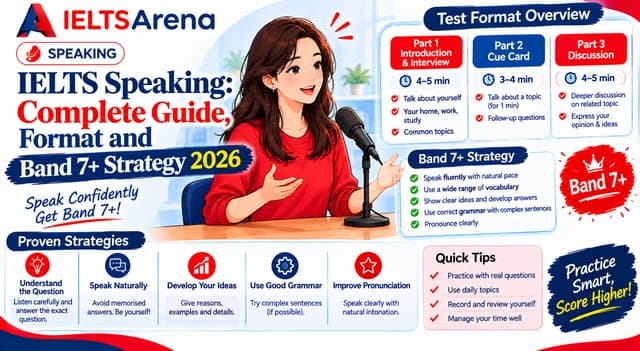
Parts 1 and 2 reward specific types of language. Part 1 rewards comfortable extended answers on familiar topics. Part 2 rewards structured delivery on a cue card. Both have a visible shape, which makes them easier to practise and improve.
Part 3 is different. It is a free-form discussion where the examiner is listening for abstract reasoning, speculation, and defence of opinion. The question is open, the answer is open, and the candidate has to generate structure in real time. Most Band 6 candidates generate no structure at all. They answer the question in one sentence, confirm their position in a second sentence, and stop. 15 to 20 seconds. The examiner has nothing to mark.
The specific problem is that Part 3 answers must be developed to be marked at Band 7. Band 7 Fluency and Coherence specifically requires "develops topics coherently and appropriately". A 15-second answer does not develop a topic. A 50-second answer with a framework does. The gap between Band 6.5 and Band 7 on Speaking is almost always closed in Part 3, not in Part 1 or Part 2.
The second problem is that Part 3 is where Lexical Resource and Grammatical Range are most visible. A longer, more complex answer gives the examiner more surface area to see your vocabulary range and your sentence variety. A 15-second answer gives them one chance. A 50-second answer gives them four or five chances. The band difference is almost mechanical.
Why Most Part 3 Answers End Too Quickly
Six habits sink Part 3 length across every target band. If your Part 3 answers have been averaging under 30 seconds, at least one of these is in play.
Treating the question as a Part 1 question. Part 1 answers are 20 to 40 seconds. Part 3 answers are 40 to 60 seconds. Many candidates do not consciously adjust the length, so Part 3 answers default to Part 1 length even when the question demands development.
Running out of ideas after the first thought. You answer the question, then realise you have nothing more to say, so you stop. The fix is a framework that forces you to extend regardless of how much "idea" you have.
Fear of going off-topic. You think if you keep talking, you will drift and lose coherence. So you stop early. The fix is a framework that keeps every extension tied to the original question.
Being too clear in sentence one. Your topic sentence answers the question so completely that you have nothing left to say. The fix is to open with a position rather than a complete answer, which leaves room for the development.
Lack of examples. Band 6 Part 3 answers are often opinions without evidence. The fix is to make every Part 3 answer carry at least one specific example or illustration.
No concept of alternative views. You give your opinion and move on. The examiner is looking for speculation and comparison, which require you to acknowledge the other side at least briefly.
Marwa's Story: Band 6.5 to Band 7.5 in Five Weeks
Marwa is a 33-year-old architect from Tunis applying for Canadian PR through Express Entry. She needed CLB 7 Speaking, which maps to Band 6. Her first mock test came back at Band 6.5 on Speaking, with the specific feedback: "Part 3 answers consistently under 25 seconds, no examples given, position stated but not defended."
Marwa's problem was not language. Her Part 1 and Part 2 had both scored at Band 7. Her Part 3 kept pulling the overall band down to 6.5. She timed her Part 3 answers after that mock test and realised she was finishing them in 15 to 20 seconds on average. The examiner was giving her the second question before she had even extended the first.
For five weeks, Marwa practised Part 3 only. One abstract question per day on IELTSArena, with a strict rule: every answer must reach 45 seconds before stopping. She used the PPEEL framework for every answer: Point in sentence one, Prove in sentence two, Example in sentence three, Explore an alternative in sentence four, Link back in sentence five.
"I thought a short answer was safer than a long one that might drift. The opposite was true. The examiner needed to hear me reason, and I was not giving her anything to score. Once I committed to 45 seconds, my whole Speaking band moved."
Her next official test came back at Band 7.5 on Speaking. The vocabulary and grammar had not changed. Her Part 3 answers extended from 20 seconds to 50 seconds on average, and the Band 6.5 ceiling disappeared with them.
The Data Behind Part 3 Answer Length
Cambridge Assessment English band descriptors for Speaking Fluency and Coherence are publicly available. Band 7 reads "speaks at length without noticeable effort or loss of coherence" and "develops topics coherently and appropriately". The word "develops" is what Part 3 is specifically testing, and development requires time.
British Council and IDP IELTS trainer notes consistently report that Part 3 answer length is the single strongest predictor of Band 7 vs Band 6.5 on Speaking. Candidates whose Part 3 answers average under 25 seconds score Band 6.5 or lower 85 percent of the time, regardless of vocabulary or grammar quality. Candidates whose Part 3 answers average 40 to 60 seconds score Band 7 or higher 70 percent of the time.
In the 2026 marking approach, examiners have been given explicit guidance that Part 3 answers under 20 seconds are "insufficient for development" and automatically cap Fluency and Coherence at Band 6. Part 3 answers over 90 seconds are also flagged, usually for drift or repetition, which caps at Band 6.5. The target zone of 40 to 60 seconds per answer, with five to seven answers across the four to five minutes of Part 3, is what the examiner is listening for.
The practical implication for your preparation is simple. Hitting 40 to 60 seconds on every Part 3 answer is more important than any vocabulary or grammar improvement you can make in the same four weeks.
The PPEEL Framework for Band 7+ Part 3 Answers
Every Band 7 Part 3 answer does five moves. Learn the five, practise them on three different question types, and the framework will carry you through every Part 3 answer you will ever give.
Point. State your position in one sentence. Direct, not hedged. 10 to 15 words. Example: "I think the main reason people travel more now than 20 years ago is that it has simply become much cheaper."
Prove. Why that position is true, in one or two sentences. The reasoning that supports the point. 15 to 25 words. Example: "Budget airlines and online booking platforms have cut the cost of international travel by maybe 50 to 70 percent in real terms, which has opened up trips that would have been out of reach a generation ago."
Example. One specific case that illustrates the point. Real places, real events, real figures if you can remember them. 15 to 25 words. Example: "A return flight from Tunis to Rome in the 1990s would have been a month's salary for most middle-class families, and today the same flight is often less than a week's wages."
Explore. Acknowledge a complication, an alternative view, or a counter-example in one short sentence. This is where speculation and comparison happen, which the examiner is specifically listening for. 10 to 20 words. Example: "That said, the environmental cost of all this cheap travel is something people are only now starting to take seriously."
Link. Tie back to the question or extend into a brief speculation about the future. 10 to 15 words. Example: "So affordability has driven the change, and that question of cost versus environmental impact will probably define the next 20 years."
Five sentences, around 80 to 110 words, 45 to 55 seconds at Band 7 pace. All five moves tied directly to the question, no drift, no filler. The framework does the work of generating structure so your brain only has to generate ideas.
PPEEL Applied: Band 6 vs Band 7 vs Band 8 on the Same Question
The question: "Do you think work-life balance is better now than it was 20 years ago?"
Band 6 answer (18 seconds): "I think work-life balance is worse now, because people are always on their phones and work emails. It is hard to switch off from work. So yes, I think it is worse."
30 words, three sentences, no example, no reasoning beyond "phones and emails", no acknowledgement of any alternative view. The content answers the question but the examiner has nothing to assess range on. Fluency and Coherence at Band 6, Lexical Resource at Band 6.
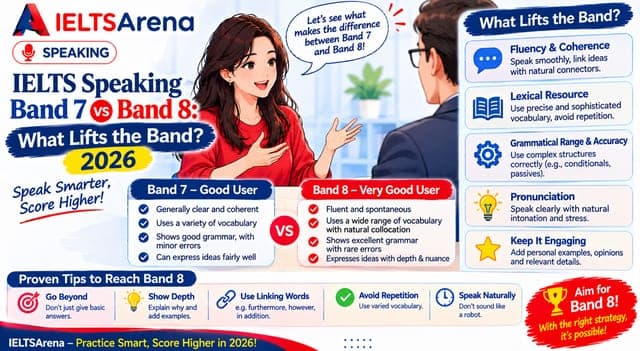
Band 7 answer (48 seconds): "I think work-life balance has actually got worse for most office workers, mainly because the boundary between work and home has disappeared. 20 years ago, when you left the office at six, you were genuinely off work until the next morning. Now, with smartphones and work chat apps, you are reachable at 10pm on a Sunday, and the social expectation is that you will respond. A friend of mine who works in finance says she has not had an unbroken weekend in two years. That said, remote work has given some people more flexibility over when and where they work, so it is not purely a negative change. Overall, though, I think the always-on culture is the stronger force."
115 words, six sentences, specific example (friend in finance), reasoning (boundary disappeared, social expectation), alternative view acknowledged (remote work flexibility), link back to position. Fluency and Coherence at Band 7, Lexical Resource at Band 7, Grammatical Range at Band 7.
Band 8 answer (52 seconds): "Work-life balance has arguably got worse for most knowledge workers, though not for all. The core reason is that the boundary between office and home has essentially evaporated, so what used to be a clear end-of-day cut-off is now a diffuse state of always-reachable. Smartphones and workplace chat tools mean that a Sunday evening message from a manager is considered normal, and refusing to respond carries real social cost. A friend in investment banking has not taken a genuinely unbroken weekend in two years, which 20 years ago would have been unimaginable. Where I would push back on my own argument is that remote work has given some workers much more flexibility, so for parents especially, the picture is more mixed. On balance, though, the always-on culture seems to be the dominant force."
140 words, six sentences, same essential answer but with tighter vocabulary (evaporated, diffuse state, dominant force), more sophisticated grammar (concessive clauses, participle structures, hypothetical past), and intonation markers (arguably, essentially, where I would push back). Lexical Resource at Band 8, Grammatical Range at Band 8.
Notice the Band 7 and Band 8 answers follow the exact same five-move PPEEL shape. The difference between them is vocabulary density and sentence complexity, not structure. The jump from Band 6 to Band 7 is almost entirely structural: adding development, example, and alternative view where the Band 6 answer stopped.
Three Types of Part 3 Question and How PPEEL Adapts
Part 3 questions come in three broad types. PPEEL works for all three with small adjustments.
Comparison questions. "How is X different today compared to 20 years ago?" or "What is the difference between X in your country and X in other countries?" PPEEL adaptation: Point is your overall observation. Prove is why the difference exists. Example is one concrete illustration. Explore is a nuance (not every aspect has changed, or the difference is less in some areas). Link ties back to the comparison.
Speculation questions. "How do you think X will change in the future?" or "What might happen if X continues to grow?" PPEEL adaptation: Point is your prediction. Prove is the reasoning that supports it. Example is a current trend that signals the future. Explore is uncertainty or a counter-trend. Link projects forward.
Abstract opinion questions. "Do you agree that X is good for society?" or "Why do you think people X?" PPEEL adaptation: Point is your position. Prove is the main reason. Example is a specific case. Explore is the counter-argument. Link reaffirms your position.
In every case, the structure is identical. Only the content of each move changes depending on the question type. This is why the framework works even when the question is unexpected. You do not need to know the answer. You need to know the shape of the answer.
Where IELTSArena Fits Into Your Part 3 Practice
Part 3 is the part of the test where self-timing matters most. You cannot judge whether your answer ran 20 seconds or 45 seconds while you are speaking. The AI Speaking Feedback on IELTSArena measures your answer length to the second and tells you immediately whether your pace was Part 1 pace or Part 3 pace.
The feedback also flags structural issues specific to Part 3. If your answer had no example sentence, it says so. If your answer never acknowledged an alternative view, it says so. If your Lexical Resource dropped specifically because you repeated the same two words across four Part 3 answers in a row, it tracks that pattern and flags it.
For the two or three practice tests closest to your official exam, Expert Tutor Review by a trained IELTS examiner marks your full 14-minute mock test with specific per-answer feedback on Part 3. The tutor rewrites your weakest Part 3 answer at the next band so you can see what a Band 7 extension sounds like when yours is still at Band 6.
More than 1,200 learners have used IELTSArena to lift their Speaking band, with the Real CBT Interface giving you the same timer, interface, and prompt structure as the official computer-based test. Record your first Part 3 answer today at IELTSArena and the feedback will tell you within seconds whether your pace is already at Band 7 or still at Band 6.
The Three-Week Part 3 Practice Routine
A focused routine that fixes short-answer habit in two to three weeks.
Week 1: timing diagnosis. Answer five Part 3 questions a day for five days. No preparation. Record every answer. Submit for AI Speaking Feedback and read the length and pace reports. Target: identify your current average Part 3 answer length. Most Band 6 candidates come in at 15 to 25 seconds. Awareness of the gap is the first fix.
Week 2: PPEEL drilling. Answer three Part 3 questions a day for five days. Use PPEEL explicitly for every answer. Write the five move labels on a piece of paper in front of you if needed. Target: every answer at 40 seconds minimum. Do not worry about naturalness in week 2. Structure first, polish later.
Week 3: PPEEL polish and alternative views. Answer three Part 3 questions a day for five days. Hide the PPEEL labels. Focus on making the five moves flow naturally into each other without visible seams. Target: 45 to 55 second answers that sound unrehearsed, with at least one specific example and one acknowledged alternative view.
Three weeks, 55 Part 3 answers, half a band of improvement on Speaking for most Band 6 to 6.5 candidates. The improvement comes almost entirely from the length and structure change, not from any vocabulary work.
Self-Diagnosis: Are Your Part 3 Answers at Band 7 Yet?
Record yourself answering three Part 3 questions, time each answer, and listen back honestly.
- Did any of your three answers run under 30 seconds?
- Did any of your three answers include a specific example (real place, real event, real figure)?
- Did any of your three answers acknowledge an alternative view or counter-argument?
- Did any of your three answers tie back to the original question in the final sentence?
- If you listened to only your Part 3 answers with no other context, could the examiner tell what band you were aiming for?
If you answered yes to question 1 and no to any of questions 2, 3, or 4, your Part 3 is almost certainly capping your Speaking at Band 6.5. The PPEEL framework fixes all three gaps in three weeks of focused practice.
See Your Part 3 Band Today
Record three Part 3 answers on IELTSArena, submit for AI Speaking Feedback, and get a per-answer length and criterion breakdown within seconds. You will know your current Part 3 band today and which of the five PPEEL moves to drill first. Start free at IELTSArena. No credit card and no commitment.
Related Guides
These sit inside the Speaking cluster on IELTSArena. Work through them in the order below.
- IELTS Speaking: The Complete Guide
- AI IELTS Speaking Practice
- Speaking Band 7 vs Band 8: What Lifts the Band
- Speaking Mock Test With Band Score
- Speaking Part 1 Format and Topics
- Speaking Part 2 Cue Card Strategy
- IELTS Speaking Fluency and Coherence
- IELTS Speaking Lexical Resource
- IELTS Speaking Grammatical Range and Accuracy
- IELTS Speaking Mistakes to Avoid
- IELTS Speaking Part 3 Questions (sample questions by topic)
FAQ
How long should my IELTS Speaking Part 3 answers be? Band 7 Part 3 answers run 40 to 60 seconds each, roughly four to six sentences, with one specific example and one piece of reasoning. Band 8 answers run 50 to 70 seconds with tighter vocabulary and more complex grammar. Band 6 answers typically run 15 to 25 seconds and are the single most common reason otherwise strong candidates get capped at Band 6.5 Speaking. In the 2026 marking approach, Part 3 answers under 20 seconds are flagged as "insufficient for development" and automatically cap Fluency and Coherence at Band 6. The target zone is 40 to 60 seconds per answer across the five to seven questions the examiner asks in the four to five minutes of Part 3.
How do I extend my IELTS Speaking Part 3 answers? Use the PPEEL framework. Every answer gets five moves. Point: state your position in one sentence (10 to 15 words). Prove: give the reasoning that supports it in one or two sentences (15 to 25 words). Example: one specific case, real places or events (15 to 25 words). Explore: acknowledge an alternative view or complication in one sentence (10 to 20 words). Link: tie back to the question or extend into a brief speculation (10 to 15 words). Five sentences, 80 to 110 words, 45 to 55 seconds at Band 7 pace. The framework works for all three Part 3 question types: comparison, speculation, and abstract opinion. Practise it on IELTSArena with AI Speaking Feedback that tracks your answer length and structure.
What makes a Band 7 Part 3 answer? A Band 7 Part 3 answer runs 40 to 60 seconds, contains one specific example and one piece of reasoning, acknowledges at least one alternative view or complication, and ties back to the original question in its final sentence. The Band 7 Fluency and Coherence descriptor specifically requires "develops topics coherently and appropriately", which means the answer must extend beyond the initial position with reasoning, example, and some comparison or speculation. Band 6 answers typically miss the example and the alternative view, which drops both Task Response and Lexical Resource. Band 8 answers follow the same shape as Band 7 but with tighter vocabulary and more sophisticated grammar.
How do I avoid short answers in IELTS Speaking Part 3? Three fixes. First, consciously reset your pace between Part 1 and Part 3. Part 1 answers are 20 to 40 seconds. Part 3 answers are 40 to 60 seconds. The length difference is deliberate. Second, use the PPEEL framework for every Part 3 answer so you have a shape to extend into even when you have run out of fresh ideas. Third, make every Part 3 answer carry at least one specific example and at least one acknowledgement of an alternative view, which both naturally extend the answer by 10 to 15 seconds each. Practise with timed AI Speaking Feedback that shows your answer length to the second, which quickly builds the sense of what a 45-second answer feels like in real time.
What is the PPEEL technique in IELTS Speaking Part 3? PPEEL stands for Point, Prove, Example, Explore, Link. It is a five-move framework for extending Part 3 answers to Band 7+ length and structure. Point states your position in one sentence. Prove gives the reasoning behind it. Example gives one specific case. Explore acknowledges an alternative view or complication. Link ties back to the question or extends into a brief speculation. Together the five moves produce a four to six sentence answer of 80 to 110 words running 45 to 55 seconds at Band 7 pace. PPEEL works across all three Part 3 question types: comparison, speculation, and abstract opinion. The framework exists so your brain only has to generate ideas, not structure, while speaking in real time.