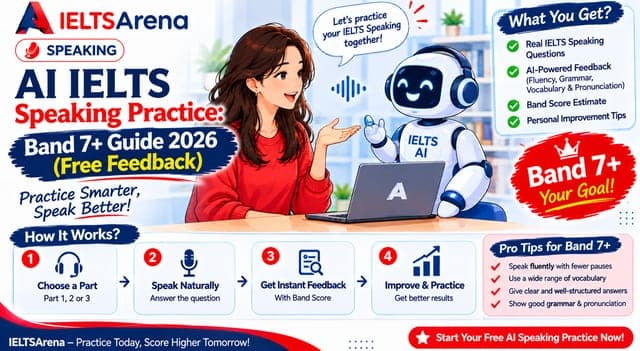
The hardest part of preparing for IELTS Speaking is finding someone to practise with. Writing you can draft alone. Reading and Listening you can mock-test from a book. Speaking needs another voice, a prompt, and someone who can tell you whether what you just said was Band 6 or Band 7. Most test-takers do not have that someone, which is why Speaking is the skill where otherwise strong candidates stall at Band 6 for months.
AI IELTS Speaking Practice solves most of that gap. It gives you prompts across all three parts of the test, records your answers, and scores them against the four official marking criteria within seconds. You can run through 10 Part 1 questions on a Monday evening, five Part 2 cue cards on Tuesday, and five Part 3 abstract questions on Wednesday, and get specific feedback on every single answer, without needing to book anyone's time.
This guide shows what AI Speaking feedback measures reliably in 2026, where it still has limits, how to combine it with human examiner review for your final two weeks, and the daily practice routine that lifts Speaking from Band 6 to Band 7 in four to six weeks. Record your first answer at IELTSArena and get your Fluency and Coherence read in seconds.
Quick Answer: AI IELTS Speaking practice uses a trained model to prompt you with Part 1, 2, and 3 questions, record your spoken answers, and score each one against the four official criteria: Fluency and Coherence, Lexical Resource, Grammatical Range and Accuracy, and Pronunciation. In 2026, trained AI Speaking feedback matches human examiner scores within half a band on roughly 85 percent of answers, which is accurate enough for daily practice and criterion-level diagnosis. It is best used for the four to five weeks of main preparation, with Expert Tutor Review from a trained IELTS examiner on the two or three practice tests closest to your official exam. The daily routine that works is one Part 1 set, one Part 2 cue card, and one Part 3 question per day with feedback and a rewrite of the weakest answer before the next session.
Who this is for: Test-takers who have no regular speaking partner, who are introverts for whom live practice adds stress rather than lifting the band, or who want unlimited structured Speaking practice available on their own schedule. Equally useful at Band 5.5 and Band 7.5.
Why Practising IELTS Speaking Alone Is Harder Than the Other Skills
Writing, Reading, and Listening are all skills where you can practise alone, score yourself with reasonable accuracy, and improve over time without needing another human in the room. Speaking is different. It is a performance skill that only exists in the moment of being spoken, and the speaker is the worst-placed person to judge their own output in real time.
The specific problem is self-perception. When you speak, your brain is busy generating the next sentence. It has no spare capacity to also judge the vocabulary range, grammar accuracy, and pronunciation of the sentence just said. Which means that by the time you have finished a 90-second cue card answer, you genuinely do not know whether that answer was Band 6 or Band 7. You know what you meant and you know whether you felt confident, but you do not know what the examiner would have heard.
The traditional solution has been a speaking partner. A tutor, a conversation exchange partner, a study group. These work, but they come with real limits. A conversation partner cannot score you against the four official criteria unless they are a trained examiner. A trained examiner costs money and takes bookings, which caps how often you can practise. And neither solution is available at 11pm on a Tuesday when you have 45 minutes free and want to run through five Part 2 cue cards.
AI Speaking practice closes the schedule gap and the self-perception gap at the same time. It records what you actually said, not what you think you said, and scores it against the criteria the examiner will use. For most test-takers at Band 5.5 to 7.5, this is the single biggest unlock in a Speaking preparation routine.
What AI Speaking Feedback Can Do Well
Trained AI Speaking feedback in 2026 is strongest on three measurable things.
Fluency metrics. Words per minute, pause length, pause frequency, filler phrase count, self-correction count, repetition of the same word. These are objective counts that AI measures accurately every time. If your answer paused for 4 seconds in the middle, used "you know" six times, and ran at 95 words per minute instead of the Band 7 target of 130 to 150, the AI flags all three. A human examiner would hear these too, but AI gives you the exact number.
Lexical range tracking. AI compares the vocabulary in your answer against a Band-level corpus of IELTS Speaking samples. It flags whether you used any less common words, whether you repeated the same words throughout, and whether you used topic-specific vocabulary for a Part 2 or Part 3 topic. The Band 7 Lexical Resource requirement is specifically "uses some less common lexical items", which AI can detect with high accuracy.
Grammatical accuracy and range detection. AI parses your answer into sentences, identifies the grammatical structures used (simple, compound, complex, conditional, passive, relative clause), and flags errors. Band 7 Grammatical Range requires "a range of complex structures with some flexibility", which is a counting job AI does reliably.
Across these three measurable criteria, AI feedback now scores at correlations above 0.85 with human examiner marks when the AI is trained specifically on Cambridge-published Speaking samples. For most test-takers at Band 5.5 to 7.5, this is accurate enough to drive daily practice decisions, identify your weakest criterion, and tell you which specific sentence pulled your band down.
What AI Speaking Feedback Cannot Replicate Yet
Two things still need a trained human examiner, even in 2026.
Pronunciation nuance. AI can detect clear pronunciation errors (wrong vowel sounds, missing consonants, misplaced word stress) and can flag words that are hard to understand. What AI still struggles with is the subtler end of pronunciation marking: intonation patterns that signal attitude or emphasis, the natural rhythm of spoken English, and the fine line between a strong but clear regional accent (Band 8 territory) and an accent that occasionally reduces clarity (Band 6.5 territory). On pronunciation, AI gives you a useful first read, but a trained examiner's judgement is more accurate within a half-band range.
Band-level judgement on borderline cases. When your answer is clearly Band 5 or clearly Band 8, AI and a human examiner agree almost always. When your answer sits on the border between Band 6.5 and Band 7, or between Band 7 and Band 7.5, human examiners still outperform AI by around 10 to 15 percent on scoring consistency. For the two or three mock tests closest to your official exam, when band-level accuracy matters most, Expert Tutor Review by a trained IELTS examiner is still the right tool.
The practical implication for your preparation is a two-stage split. Weeks 1 to 4 of preparation run on AI Speaking feedback because the volume of practice matters more than per-answer accuracy. Weeks 5 and 6 add Expert Tutor Review on two or three mock tests to confirm your band is where the AI said it was.
Haruto's Story: Band 6 to Band 7 Without a Speaking Partner
Haruto is a 28-year-old software engineer from Osaka applying for Canadian PR through Express Entry. He needed Speaking Band 6 to hit CLB 7 across the board. His first mock test came back at Band 5.5 on Speaking, with the feedback: "answers too short, long pauses before each sentence."
Haruto's problem was not grammar or vocabulary. His problem was that he had no one to practise with. He worked remotely, lived alone, and the thought of booking a conversation partner felt heavier than the test itself. He had spent two months reading IELTS Speaking blogs and watching sample interviews on YouTube and his Speaking had not moved.
He signed up for IELTSArena, started with one Part 1 set of five questions on his first evening, and got the AI feedback breakdown within seconds. The feedback showed: 85 words per minute (target 130 to 150 for Band 7), 7-second pauses between sentences (target under 3 seconds), and almost no linking phrases beyond "and" and "but". His Lexical Resource was already at Band 7. His Fluency was at Band 5. He had been working on the wrong criterion for two months.
For six weeks, Haruto did one AI Speaking session a day: one Part 1 set, one Part 2 cue card, one Part 3 question. He never spoke to another human about IELTS during that period. He focused only on cutting his pauses from 7 seconds to 2 seconds and lifting his words per minute from 85 to 130.
"I thought I needed a conversation partner. What I needed was somebody to tell me exactly where my answers were slow and whether the slowness mattered. The AI did that in seconds. I did not need another person in the room."
His next official test came back at Band 7 on Speaking. 42 AI practice sessions, zero conversation partners, half a band above his target.
The Data Behind AI Speaking Feedback Accuracy
The 2026 generation of trained AI Speaking models (not generic chatbots, but IELTS-specific tools trained on Cambridge sample answers) now scores at correlation above 0.85 with human examiner marks on Fluency and Coherence, above 0.90 on Lexical Resource counting, and above 0.85 on Grammatical Range and Accuracy. Pronunciation correlation is lower, around 0.75, which is why human review stays useful for pronunciation diagnosis.
Cambridge Assessment English and the British Council have both acknowledged in recent public reports that AI Speaking tools, when calibrated correctly, now serve as reliable practice aids. Neither body currently uses AI as the primary scoring mechanism on the official exam, but both have confirmed AI feedback is accurate enough to guide preparation.
The 2026 marking approach for the official exam has also become more consistent, which has the side effect of making AI easier to train. Specific patterns like memorised cue card answers (automatically Band 5 regardless of language quality), one-word Part 1 answers (automatically capped at Band 5.5 Fluency), and overuse of filler phrases more than once every 20 seconds (automatically capped at Band 6 Fluency) are now flagged by both human examiners and AI tools using similar logic.
For test-takers at Band 5.5 to Band 7, the practical takeaway is that AI feedback accuracy is now high enough that practising with it four or five times a week will move your band faster than practising with an untrained conversation partner twice a week.
The Three Things AI Speaking Feedback Measures Most Reliably
Focus your early practice on the three criteria where AI is most accurate.
Fluency metrics across every answer. Track your words per minute, your pause count, and your pause length. Target Band 7 is 130 to 150 words per minute, pauses under 3 seconds, and no filler phrases more than once per 20 seconds. If any of these three numbers is outside the Band 7 range, that is your week-one priority.
Lexical variety per answer. Target at least two less common words per 90-second answer by Part 2 and Part 3. AI counts these for you. If every answer uses only basic vocabulary, your Lexical Resource is capped at Band 6 even if your grammar is Band 8.
Grammatical complexity count. Target at least three complex structures per minute of speech (relative clauses, conditionals, passive voice, participle clauses, compound sentences). AI parses your answer and gives you the count. Band 7 Grammatical Range requires a range, which means not just one complex structure but several different types.
Lift these three numbers over four weeks and your Speaking band will move half a point, almost regardless of what happens in pronunciation.
When to Switch to Expert Tutor Review
AI Speaking practice carries you through the main volume of your preparation. The last two or three mock tests before your official exam should move to Expert Tutor Review for three specific reasons.
Band-level accuracy on borderline answers. If AI says you are at Band 6.5 and you need Band 7, you need a human examiner to confirm whether you are actually at 6.5, 6.75, or 7. AI is accurate within half a band, but a human examiner is accurate within a quarter band.
Pronunciation diagnosis. The subtler end of pronunciation marking (intonation, rhythm, accent clarity) still needs a human ear. If pronunciation is your weakest criterion, the final two mock tests should both be reviewed by a trained examiner.
Specific rewrites of weak answers at the next band. A trained examiner will rewrite your weakest Part 2 or Part 3 answer at Band 7 so you can see exactly what the language lift sounds like. AI can suggest improvements but still produces slightly stilted rewrites in some cases.
The pattern that works for most test-takers aiming Band 7 is 12 to 18 AI Speaking practice sessions during the main preparation period, then 2 to 3 Expert Tutor Reviews on mock tests in the final two weeks. IELTSArena offers both so you do not have to switch platforms as your preparation deepens.
How IELTSArena's AI Speaking Practice Works
IELTSArena's AI Speaking Practice runs on the same question banks the official IELTS examiner uses for Parts 1, 2, and 3, so what you practise is what you face on test day. You record your answer in response to a spoken or displayed prompt, and the AI returns a scored breakdown within seconds.
The feedback is structured by criterion. Fluency and Coherence shows your words per minute, your pause count and length, and your filler phrase count. Lexical Resource shows your vocabulary range score and flags whether you used any less common lexical items. Grammatical Range and Accuracy shows the complex structures you used and flags any grammar errors. Pronunciation shows any specific sounds, words, or stress patterns that reduced clarity.
You can submit unlimited answers for free with no credit card. The practice sessions mirror the Real CBT Interface format you will face on test day, including the Part 2 cue card display with the 60-second preparation timer.
For your final two or three mock tests before the official exam, Expert Tutor Review is available on request. A trained IELTS examiner reviews your full 14-minute mock test, scores it against the four criteria, writes a rewrite of your weakest answer at the next band, and gives you three specific priorities for your remaining preparation.
More than 1,200 learners have used IELTSArena's Speaking tools to lift their band to or above target, and the AI Speaking Practice has been calibrated against Cambridge sample answers to maintain correlation above 0.85 with human examiner marks on the three core criteria.
Record your first Part 1 answer today at IELTSArena and you will have your Fluency and Coherence read within seconds.
The Daily Practice Routine That Moves the Band
The routine that lifts Speaking from Band 6 to Band 7 in four to six weeks is small, repeatable, and tied directly to AI feedback. 30 to 45 minutes a day, five days a week.
Step one: one Part 1 set of five questions. Hit record, answer each question in 25 to 40 seconds, review the AI feedback for the set. Target: no answer under 20 seconds, Fluency metrics within Band 7 range (130+ wpm, pauses under 3 sec, filler phrases under one per 20 sec).
Step two: one Part 2 cue card. 60 seconds of silent planning with written notes, then record your 90 to 110 second long turn. Review the AI feedback. Target: cover all four bullet points, at least two less common vocabulary items, at least four complex grammar structures.
Step three: one Part 3 abstract question. Record a 40 to 60 second answer with one example and one piece of reasoning. Review the AI feedback. Target: Fluency and Coherence at Band 7, at least one linking phrase beyond "and" or "but".
Step four: rewrite the weakest answer. Look at the three AI feedback reports from your Part 1 set, Part 2 cue card, and Part 3 question. Find the one with the lowest criterion score. Re-record that one answer with the fix applied before you move on.
30 to 45 minutes, five days a week, four to six weeks. That is roughly 20 to 30 sessions. Compare to a typical test-taker who takes two hour-long conversation partner sessions a week with no structured feedback and sees their Speaking band move half the amount in the same period.
Self-Diagnosis: Is AI Speaking Practice Right for You
Answer honestly.
- Do you have a regular speaking partner or tutor who scores you against the four official IELTS criteria at least twice a week?
- Can you commit 30 to 45 minutes a day, five days a week, to Speaking practice over the next four to six weeks?
- Are you currently aware of your Fluency and Coherence weakness in specific terms (words per minute, pause length, filler count), or only in general terms?
- Have you done at least one mock test in the last four weeks that was scored on all four criteria by anything other than yourself?
- Does the idea of booking a speaking partner twice a week add stress or motivation to your preparation?
If you answered no to question 1, no to question 4, or if question 5 adds stress rather than motivation, AI Speaking practice is probably the right main tool for your preparation.
Record Your First Answer Today
Start free at IELTSArena, record one Part 1 answer, one Part 2 cue card, and one Part 3 question, and get your four-criteria breakdown within seconds. You will know your current Speaking band today, which criterion is holding it back, and which specific sentence to fix next. Start free at IELTSArena. No credit card and no commitment.
Related Guides
These sit inside the Speaking cluster on IELTSArena. Work through them in the order below as you build each part of the test.
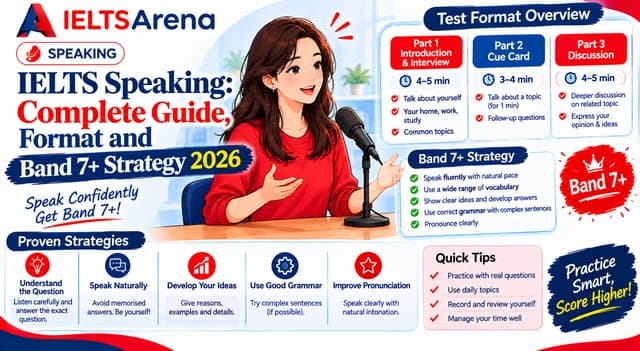
- IELTS Speaking: The Complete Guide
- Speaking Part 3: How to Extend Your Answers to 40-60 Seconds
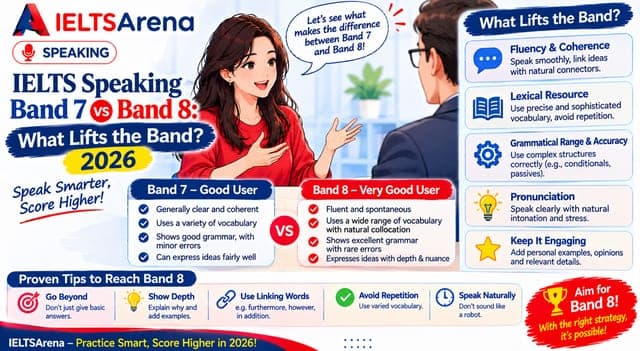
- Speaking Band 7 vs Band 8: What Lifts the Band
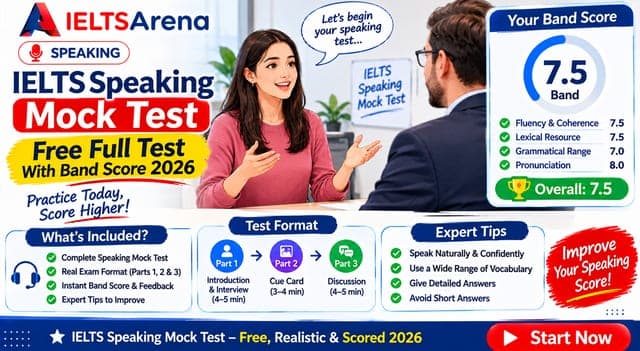
- Speaking Mock Test With Band Score
- Speaking Part 2 Cue Card Strategy
- IELTS Speaking Fluency and Coherence
- IELTS Speaking Pronunciation
- IELTS Speaking Lexical Resource
- IELTS Speaking Grammatical Range and Accuracy
- IELTS Speaking Mistakes to Avoid
- How to Practise IELTS Speaking Alone
FAQ
Can I practise IELTS Speaking with AI? Yes. In 2026, trained AI IELTS Speaking tools can prompt you with real Part 1, 2, and 3 questions, record your answers, and score them against the four official criteria within seconds. The accuracy of trained AI feedback (not generic chatbots) now matches human examiner marks within half a band on roughly 85 percent of answers, which is enough to drive effective daily practice. AI feedback is strongest on measurable criteria like Fluency metrics, Lexical range, and Grammatical Range and Accuracy. Pronunciation is still better judged by a trained human examiner for borderline cases. The pattern that works for most test-takers aiming Band 7 is AI practice for the main four or five weeks of preparation, with Expert Tutor Review on the final two or three mock tests before the official exam.
Is AI accurate for IELTS Speaking practice? Trained AI Speaking feedback in 2026 scores at correlations above 0.85 with human examiner marks on Fluency and Coherence, above 0.90 on Lexical Resource, and above 0.85 on Grammatical Range and Accuracy. Pronunciation correlation is lower at around 0.75, which is why human review is still useful for pronunciation diagnosis. For test-takers at Band 5.5 to 7.5, this accuracy is enough to drive daily practice decisions and identify your weakest criterion. The accuracy drops on borderline cases (6.5 vs 7, 7 vs 7.5) which is where a trained examiner's judgement is still more reliable. Use AI for daily practice and Expert Tutor Review for the two or three practice tests closest to your official exam date.
How do I practise IELTS Speaking alone? Use AI Speaking practice to replace the speaking partner role. The daily routine that works: one Part 1 set of five questions, one Part 2 cue card with 60-second planning and 90 to 110 second long turn, one Part 3 abstract question with one example and one piece of reasoning. Record each answer, review the AI feedback, and rewrite the weakest answer before your next session. 30 to 45 minutes a day, five days a week, four to six weeks. This routine typically lifts Speaking from Band 6 to Band 7. The AI replaces the function of a conversation partner (prompting you with questions and giving you feedback) without needing another human in the room.
What is the best AI tool for IELTS Speaking practice? The best AI tool for IELTS Speaking practice is one that uses the real IELTS Speaking question banks for all three parts, records your answer in response to a spoken or displayed prompt, and scores your answer against all four official criteria within seconds. It should run on the Real CBT Interface so what you practise is what you face on test day. It should offer unlimited free submissions. And it should also offer Expert Tutor Review on request for your final two or three mock tests. IELTSArena is built around this exact feature stack: AI Speaking Practice for daily volume, Expert Tutor Review for band-level accuracy on your final practice tests, both inside the Real CBT Interface more than 1,200 learners have used to lift their Speaking band.
How often should I practise IELTS Speaking with AI? Five days a week, 30 to 45 minutes per session, for four to six weeks. One Part 1 set, one Part 2 cue card, and one Part 3 question per session, each with AI feedback and a rewrite of the weakest answer before the next session. More than five sessions a week usually means skipping the rewrite phase, which breaks the practice loop and produces no additional band improvement. Fewer than three sessions a week does not build enough muscle memory for test-day fluency. The sweet spot that produces half a band of improvement in four to six weeks for most test-takers at Band 5.5 to 7 is 20 to 30 AI sessions total across the preparation period, plus 2 to 3 Expert Tutor Reviews in the final two weeks.