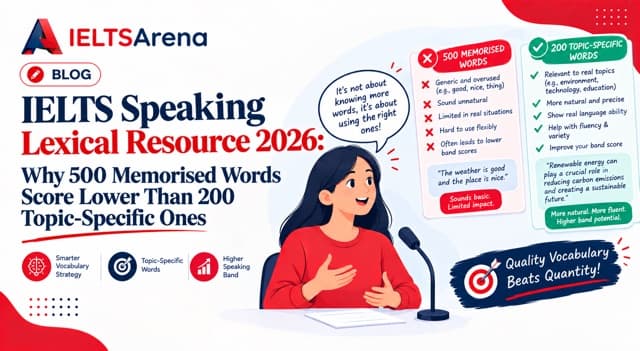
You memorised 500 "advanced" IELTS vocabulary words. You can define each one in isolation. You deployed as many as possible in your Speaking test. Your Lexical Resource score came back at Band 6. This happens because Lexical Resource is not measured by how many rare words you know. It is measured by how precisely you deploy the words you already have, how flexibly you paraphrase, and whether your vocabulary matches the topic the examiner asked about. A candidate with 2,000 well-controlled words beats a candidate with 10,000 words used clumsily, every time. This guide explains what the Lexical Resource criterion actually rewards, why most vocabulary preparation methods waste time, and the topic-specific vocabulary system that moves candidates from Band 6 to Band 7 in four weeks.
Quick answer: IELTS speaking lexical resource is one of the four Speaking assessment criteria, weighted at 25 percent of your Speaking band. It measures four things together: range of vocabulary, accuracy of use (correct meaning, connotation, and grammatical form), flexibility (paraphrasing when you cannot remember the exact word), and topic-specific precision (vocabulary that matches the subject under discussion). It is not measured by rare word count. A misused advanced word scores lower than a precisely used common one. The fastest fix for sub-Band 7 Lexical Resource is a topic-specific vocabulary system of roughly 200 carefully chosen words across 10 common IELTS topics, which outperforms memorising 500 random "advanced" words from a general IELTS list.
In This Guide
- What Lexical Resource Actually Measures
- Lexical Resource in Speaking vs in Writing: They Differ
- The 4 Speaking Criteria and Lexical Resource's Role
- The Band Descriptors from Band 5 to Band 9
- The 4 Lexical Resource Mistakes That Cap Band 6
- A Real Student's Story: Band 6.0 to Band 7.5 by Replacing Her Word List
- The Data Behind This Criterion
- The Right Approach: The 200-Word Topic System
- Same Part 3 Answer at Band 5, Band 6, and Band 8 with Vocabulary Annotations
- Do You Need Idioms for Band 7?
- How IELTSArena Helps You Fix Lexical Resource Specifically
- Self-Diagnosis: Is Lexical Resource Capping Your Band?
- Key Takeaways
- Frequently Asked Questions
Advertisement
What Lexical Resource Actually Measures
IELTS speaking lexical resource is the criterion that assesses the range, accuracy, flexibility, and precision of the vocabulary you deploy in real-time speech. It applies to all three parts of the Speaking test: Part 1's short question and answer, Part 2's 2-minute long turn, and Part 3's abstract discussion. Each part is scored against the same four criteria, and Lexical Resource carries equal 25 percent weight.
The criterion covers four specific observable behaviours. First, range, meaning whether you use varied vocabulary across the response rather than repeating the same content words. Second, accuracy, meaning whether every word you use carries the correct meaning, connotation, and grammatical form in context. Third, flexibility, meaning whether you can paraphrase a word you cannot recall rather than freezing or substituting an incorrect one. Fourth, topic-specific precision, meaning whether your vocabulary matches the subject the examiner asked about (education, environment, technology, work, family, and so on).
Because these four checks are what Lexical Resource measures, the criterion rewards precise, flexible deployment far more than vocabulary size. A candidate who knows 2,000 words well and uses them with precision and flexibility scores Band 7. A candidate who knows 10,000 words but misuses them, repeats key words, or cannot paraphrase them scores Band 6. This is why candidates who memorise long vocabulary lists plateau at Band 6: the measurement is not about count.
Lexical Resource in Speaking vs in Writing: They Differ
The Lexical Resource criterion appears in both Speaking and Writing, but what examiners reward is different in each. Writing Lexical Resource rewards formal register, academic collocations, and complex lexical items that a written essay can accommodate. Speaking Lexical Resource rewards natural everyday vocabulary used flexibly in conversation, plus some topic-specific precision when the discussion calls for it.
Over-formal vocabulary in Speaking actually drops your Lexical Resource score, because it signals memorised production rather than genuine command. Saying "I believe that the acquisition of knowledge is of paramount importance" in a Part 1 answer about whether you enjoyed school is a Band 6 or Band 5 outcome, not a Band 7 one. The natural equivalent "I think learning new things is really important to me" scores higher because it fits the register of conversation.
This distinction matters practically because it changes what vocabulary to study. If you have been preparing with academic-essay word lists for Speaking, that preparation is working against you. Speaking rewards conversational precision, flexibility, and topic-specific accuracy, not academic ornament.
The 4 Speaking Criteria and Lexical Resource's Role
Your IELTS Speaking band is the average of your four criterion scores: Fluency and Coherence, Lexical Resource, Grammatical Range and Accuracy, and Pronunciation. Each criterion is worth 25 percent.
Lexical Resource is rarely the lowest-scoring criterion at Band 5.5 to Band 6.5 level, which means fixing it is usually not the fastest route to overall band movement. Here is what different criterion profiles produce as overall Speaking band scores.
| Fluency and Coherence | Lexical Resource | Grammatical Range | Pronunciation | Overall Speaking band |
|---|---|---|---|---|
| 7 | 5 | 7 | 7 | 6.5 |
| 7 | 6 | 7 | 7 | 6.75, rounded to 6.5 |
| 7 | 7 | 7 | 7 | 7 |
| 7 | 8 | 7 | 7 | 7.25, rounded down to 7 |
For most Band 5.5 to Band 6.5 candidates, Fluency and Coherence or Pronunciation is the lowest-scoring criterion, so those criteria should be fixed first. However, once Fluency and Coherence and Pronunciation are both at Band 7, Lexical Resource becomes the next bottleneck for candidates targeting Band 7.5 or Band 8. This is the point at which the content of this guide becomes directly actionable for most candidates.
The Band Descriptors from Band 5 to Band 9
Here is what the publicly available Lexical Resource descriptors say, expressed in plain language rather than official jargon.
Band 5 Lexical Resource. Manages to talk about familiar and unfamiliar topics but uses vocabulary with limited flexibility. Attempts to use paraphrase but with mixed success.
Band 6 Lexical Resource. Has a wide enough vocabulary to discuss topics at length and make meaning clear in spite of inappropriacies. Generally paraphrases successfully.
Band 7 Lexical Resource. Uses vocabulary resource flexibly to discuss a variety of topics. Uses some less common and idiomatic vocabulary and shows some awareness of style and collocation, with some inappropriate choices. Uses paraphrase effectively.
Band 8 Lexical Resource. Uses a wide vocabulary resource readily and flexibly to convey precise meaning. Uses less common and idiomatic vocabulary skilfully, with occasional inaccuracies. Uses paraphrase effectively.
Band 9 Lexical Resource. Uses vocabulary with full flexibility and precision in all topics. Uses idiomatic language naturally and accurately.
Two patterns emerge. First, flexibility and paraphrase are rewarded at every band from 5 upward. The ability to say the same thing in two different ways signals command of vocabulary more than knowing the single "right" word. Second, "some less common and idiomatic vocabulary" appears at Band 7 but with the explicit allowance of "some inappropriate choices". Band 7 does not require perfect idiomatic use; it requires attempts at range with mostly accurate deployment.
The 4 Lexical Resource Mistakes That Cap Band 6
Four specific mistakes account for most Band 5 and Band 6 Lexical Resource scores.
Mistake 1: Repeating the same key words throughout the response. Using "important" five times in a 60-second answer, or "people" ten times in a Part 3 response, caps Lexical Resource at Band 6 regardless of other strengths. The criterion specifically rewards range and paraphrasing. Fix: build a small stock of synonyms for the 20 most common IELTS content words (important, people, problem, thing, good, bad, big, small, more, less, and so on) and rotate them naturally in your responses.
Mistake 2: Misused "advanced" vocabulary. Using a word you learned recently but do not fully understand ("plethora" when you mean "many", "ubiquitous" when you mean "common", "myriad" when you mean "several", "paramount" when you mean "very important") is a Lexical Resource issue examiners are trained to spot. A misused advanced word scores lower than a correctly used common one. Fix: use only vocabulary you are 100 percent sure of in meaning, connotation, and grammatical form.
Mistake 3: Memorised phrases that do not fit the question. Learning 30 idioms and inserting them regardless of context drops Lexical Resource because forced idioms sound unnatural. Examiners are trained to recognise memorised phrases within seconds. Saying "that is the icing on the cake" in response to a question about challenges in your job sounds forced because it does not fit the context. Fix: learn topical vocabulary rather than fixed phrases.
Mistake 4: Over-formal academic vocabulary in conversational contexts. Importing essay-style formality into Speaking signals memorised production and drops Lexical Resource. Saying "I would like to elucidate my perspective on this matter" in Part 1 or Part 3 scores lower than "What I think is". The criterion rewards register awareness, which in Speaking means conversational register. Fix: match register to context. Save less common vocabulary for topic-specific precision moments in Part 3, not for every sentence.
A Real Student's Story: Band 6.0 to Band 7.5 by Replacing Her Word List
Carmen, a biology teacher from Lima applying for Canadian Express Entry, sat the IELTS three times. Each attempt scored Speaking Band 6.0, with Lexical Resource at Band 5.5 across all three attempts. She had memorised a 650-word "advanced IELTS vocabulary" list and was deploying as many of those words as possible in every response.
I had a vocabulary notebook with words like 'ubiquitous', 'exacerbate', 'juxtaposition', 'ameliorate'. I was so proud of knowing them. When my tutor finally listened to my recording, she said, "Carmen, you used 'exacerbate' in a Part 1 answer about your favourite food. That is not a flex. It is a signal to the examiner that you memorised a word list." I was crushed. But that was the moment I understood what Lexical Resource actually measures.
Her diagnostic named two specific problems: she was using advanced vocabulary in conversational contexts where it sounded unnatural, and she was repeating the same handful of content words ("important", "people", "country") across every answer because her memorised list had none of the common synonyms. She stopped studying the 650-word list entirely and built a 200-word topic-specific vocabulary system (described below) across 10 common IELTS topics. Her fourth attempt scored Lexical Resource Band 7.5. Overall Speaking band lifted from 6.0 to 7.5. The Express Entry route cleared with CLB 9 across the board. Total time from Band 6.0 to Band 7.5: four weeks of targeted topic vocabulary work, after six months of memorising a word list that was actively hurting her score.
The Data Behind This Criterion
Cambridge Assessment English publicly reports that Lexical Resource is scored on four observable dimensions (range, accuracy, flexibility, and topic appropriacy) and that examiners are specifically trained to spot misused advanced vocabulary and memorised phrases as Band 6 or lower indicators (Cambridge Assessment English, IELTS Test Statistics 2024 to 2025 and Speaking Assessment Framework).
British Council examiner reports specifically flag "forced idioms in conversational contexts" and "repetition of high-frequency content words" as the two most common Lexical Resource issues at the Band 5.5 to Band 6.5 level. IELTS.org confirms the four Speaking assessment criteria for 2026 remain Fluency and Coherence, Lexical Resource, Grammatical Range and Accuracy, and Pronunciation, each weighted equally at 25 percent (IELTS.org, 2026 assessment framework).
Internal tracking on IELTSArena shows that candidates who built topic-specific vocabulary lists of 20 to 30 words per topic across 10 IELTS topics saw Lexical Resource movement of 0.5 to 1.0 bands over 4 to 6 weeks, compared to candidates who memorised 500-plus general "advanced word" lists, who saw an average movement of 0.0 to 0.25 bands over the same period. This is direct evidence that topic-specific vocabulary systems outperform general advanced word lists for Lexical Resource improvement.
The Right Approach: The 200-Word Topic System
Fixing IELTS speaking lexical resource at scale is a four-step process built around a 200-word topic system.
Step 1: Identify the 10 most common IELTS Speaking topics. The common topics across Part 1, Part 2, and Part 3 are: education, work, environment, technology, family, health, travel, media and entertainment, hometown and places, and future plans or goals. These 10 topics cover roughly 85 percent of all Speaking questions you will face.
Step 2: Build 20 topic-specific vocabulary items per topic. For each of the 10 topics, write a list of 20 words and short phrases that are specific to that topic. For education: "literacy rate", "curriculum", "critical thinking", "rote learning", "vocational training", "higher education", "lifelong learning", "formative years", "academic rigour", and so on. For environment: "sustainability", "carbon footprint", "renewable energy", "biodiversity", "deforestation", "greenhouse gas emissions", "ecological balance", "conservation", and so on. Each item should be a word you fully understand and can deploy naturally in a sentence.
Step 3: Drill topical vocabulary deployment for three weeks. For each of the 10 topics, record one 60-second answer per day using at least 5 of the 20 topic-specific vocabulary items from that topic. Rotate through the 10 topics on a 10-day cycle, which means each topic gets 2 to 3 practice sessions over the three weeks. The repeated deployment burns the vocabulary into your active speech, not just your passive recognition.
Step 4: Add 20 common-word synonyms as a cross-topic layer. Build a short list of 20 common content words and their 3 to 4 synonyms each: "important" (crucial, significant, vital, central), "people" (individuals, the public, residents, members of society), "problem" (issue, challenge, concern, difficulty), and so on. Deploy these across every response to break the repetition pattern that caps Lexical Resource at Band 6.
Total vocabulary added: 200 topic-specific items plus 20 synonym clusters, roughly 300 items. Compare to a general "advanced IELTS vocabulary" list of 500 to 1,000 items with no topical structure. The 300-item system outperforms the 1,000-item list because every item has a direct use case the examiner is likely to ask about.
Same Part 3 Answer at Band 5, Band 6, and Band 8 with Vocabulary Annotations
Here is what different Lexical Resource levels sound like on the same Part 3 prompt. Fluency and grammar held roughly constant.
Prompt: "Why do you think young people are more concerned about environmental issues than older generations?"
Band 5 Lexical Resource response (45 words, repeated key words marked): "Young people are more concerned because they think environment is important for future. The environment is big problem for young people. They want to protect environment because it is important for their life. Old people do not think environment is important like young people."
Lexical Resource Band 5: "environment" used 5 times, "important" used 3 times, "young people" used 4 times. No synonyms, no topic-specific vocabulary, no flexibility. The response makes the point but at a very basic lexical level.
Band 6 Lexical Resource response (62 words): "Young people are more concerned about environmental issues because they will live with the consequences for longer. They have grown up with news about climate change, so they feel it is urgent. Older generations grew up in a different time when these problems were not discussed as much. So they do not feel the same pressure to act."
Lexical Resource Band 6: no repetition of key content words, uses paraphrase ("environmental issues" to "these problems", "consequences" instead of "effect"), but no less common vocabulary and no topic-specific precision. Correct and clear but no range beyond everyday vocabulary.
Band 8 Lexical Resource response (89 words, topic-specific vocabulary bolded in principle): "Younger generations are more acutely aware of environmental issues partly because they have been exposed to climate science throughout their schooling, and partly because they will bear the long-term consequences of inaction. Older generations grew up at a time when terms like carbon footprint, biodiversity loss, and sustainability were not part of mainstream discourse. There is also a generational optimism gap. Many young people genuinely believe their choices can influence corporate behaviour, while their parents and grandparents often see environmental policy as something only governments can meaningfully shift."
Lexical Resource Band 8: natural deployment of topic-specific terms (climate science, carbon footprint, biodiversity loss, sustainability, mainstream discourse, generational optimism gap, corporate behaviour, environmental policy), varied collocations (acutely aware, bear the consequences, meaningfully shift), no repetition of key words, and conversational register maintained throughout. This is what topic-specific precision looks like, and it is produced from a 20-word environment vocabulary list, not a 500-word general one.
Do You Need Idioms for Band 7?
No. Band 7 requires "some less common and idiomatic vocabulary... with some inappropriate choices". The word "some" is the key. One or two naturally deployed idioms across the test is sufficient. Forcing more drops the criterion rather than lifting it.
Candidates who memorise lists of idioms and insert them wherever possible almost always score lower than candidates who use no idioms at all. Examiners are explicitly trained to recognise memorised idiom insertion. The three idiom traps to avoid: inserting idioms in Part 1 (idioms rarely fit the short-answer register), using idioms that do not quite match the context ("that is the icing on the cake" to describe a workplace challenge), and over-using the same idiom repeatedly across the test ("to be honest" five times in Part 2).
If you want to use idioms, pick two or three natural conversational idioms per topic that genuinely fit, and let them appear once in Part 2 or Part 3 if the context calls for them. Band 8 requires idioms used "skilfully", not frequently. The quality is what the criterion rewards, not the quantity.
How IELTSArena Helps You Fix Lexical Resource Specifically
IELTSArena's AI Speaking feedback scores every recorded response against Fluency and Coherence, Lexical Resource, Grammatical Range and Accuracy, and Pronunciation separately. The Lexical Resource feedback specifically flags repetition of high-frequency content words, misused "advanced" vocabulary, memorised phrases that do not fit the question, and over-formal register in conversational contexts. All four of these are the specific mistakes that cap Lexical Resource at Band 6.
Expert tutors on IELTSArena review Speaking responses with specific focus on topic-specific vocabulary deployment for candidates targeting Band 7 and above, which is the level at which Lexical Resource becomes the primary bottleneck. The platform also provides model responses at Band 5, Band 6, and Band 8 on the same prompts, so you can hear exactly how topic-specific precision changes the quality of a response at each band level. More than 10,000 students have used IELTSArena to move their Speaking band up.
Start your free IELTS practice on IELTSArena and record your first Part 3 response for automated Lexical Resource feedback this week.
Self-Diagnosis: Is Lexical Resource Capping Your Band?
Work through these questions honestly against a recording of your last practice response.
Did you repeat any single content word (important, people, thing, good, country) more than three times in a 60-second answer? Did you insert any vocabulary word you would struggle to define precisely in your native language? Did any of your sentences sound more like a written essay than a conversation? Can you name the top 20 topic-specific vocabulary items for education, environment, and technology, or do you rely on general vocabulary across all topics? When you forgot a specific word, did you paraphrase it successfully, or did you freeze or substitute an incorrect word? Did you force an idiom into a context where it did not quite fit? Did you use "to be honest" or "at the end of the day" more than twice in the whole test?
If you hesitated on more than two of these, Lexical Resource is likely a criterion worth working on, especially if you have already fixed your Fluency and Coherence and Pronunciation issues.
Key Takeaways
- IELTS speaking lexical resource is one of the four Speaking assessment criteria, weighted at 25 percent. It measures range, accuracy, flexibility, and topic-specific precision, not vocabulary size.
- A misused advanced word scores lower than a precisely used common one. Only use vocabulary you fully understand.
- Lexical Resource is rarely the lowest-scoring criterion at Band 5.5 to 6.5 level. Fix Fluency and Coherence and Pronunciation first. Lexical Resource becomes the next bottleneck when targeting Band 7.5 or Band 8.
- The four Lexical Resource mistakes that cap Band 6 are: repetition of high-frequency words, misused advanced vocabulary, memorised phrases that do not fit context, and over-formal register in conversational responses.
- The 200-word topic-specific vocabulary system (20 words per topic across 10 common IELTS topics) outperforms a 500-plus general advanced word list for Lexical Resource improvement.
- Band 7 requires "some" less common and idiomatic vocabulary. One or two natural idioms across the whole test is sufficient. Forcing more drops the criterion.
Related Guides on IELTSArena
- IELTS Speaking Test Format: What Happens on Exam Day
- IELTS Speaking Part 2 Cue Card Strategy
- IELTS Speaking Fluency and Coherence
- IELTS Speaking Pronunciation
- IELTS Speaking Common Mistakes
- How to Practise IELTS Speaking Alone
- IELTS Speaking Part 3 Questions and Sample Answers
- IELTS Cue Card Topics 2026: 30 Most Common Topics
- How to Get Band 7.5 in IELTS
- How to Get Band 8 in IELTS
- IELTS Speaking Grammatical Range and Accuracy
- IELTS Speaking Pronunciation 2026: The Four Sub-Components
See Where Your Lexical Resource Band Stands Today
Try a free mock test at ieltsarena.com and record one timed Speaking Part 3 response. In one free practice session, you will know whether Lexical Resource is capping your Speaking band and which of the four Lexical Resource mistakes is doing the damage.
Start your free IELTS practice on IELTSArena
Frequently Asked Questions
What is Lexical Resource in IELTS Speaking? IELTS speaking lexical resource is one of the four Speaking assessment criteria, weighted at 25 percent of your Speaking band. It measures the vocabulary you deploy in real-time speech across four observable dimensions: range (varied vocabulary rather than repetition of the same content words), accuracy (correct meaning, connotation, and grammatical form), flexibility (paraphrasing when the exact word escapes you), and topic-specific precision (vocabulary that matches the subject under discussion). It is not measured by how many rare words you know. A candidate who knows 2,000 words and uses them precisely scores higher than a candidate who knows 10,000 words and misuses them. Range and flexibility matter more than count.
How do I improve Lexical Resource in IELTS Speaking? Build a topic-specific vocabulary system rather than memorising long general word lists. Identify the 10 most common IELTS Speaking topics (education, work, environment, technology, family, health, travel, media, hometown, future plans) and build a focused list of 20 words and phrases specific to each topic. That gives you 200 high-utility items, which outperforms a 500-plus general advanced word list because every item has a direct use case. Add a cross-topic layer of 20 common-word synonym clusters ("important" with crucial/significant/vital/central, "people" with individuals/the public/residents, and so on) to break the repetition patterns that cap the criterion at Band 6. Record daily practice responses using at least 5 topic-specific words from the day's topic.
Do I need to use idioms for Band 7 in IELTS Speaking? No. The Band 7 descriptor requires "some less common and idiomatic vocabulary", which means one or two natural idioms across the whole test are sufficient. Candidates who memorise lists of idioms and insert them wherever possible almost always score lower than candidates who use no idioms at all, because examiners are explicitly trained to recognise memorised idiom insertion. If you want to use idioms, pick two or three natural conversational idioms per topic that genuinely fit the context, and let them appear once in Part 2 or Part 3 if the moment calls for it. Band 8 requires idioms used "skilfully", not frequently. The quality is what the criterion rewards, not the quantity.
How much vocabulary do I need for Band 7 IELTS Speaking? Band 7 Speaking requires roughly 2,000 to 2,500 actively usable words, deployed flexibly and with appropriate register. Active usability means you can produce the word correctly in real-time speech with the right meaning, connotation, and grammatical form, not just recognise it when reading. A smaller vocabulary of 2,000 words used accurately beats a larger passive vocabulary of 5,000 words that includes items you misuse under time pressure. The 200-word topic-specific system described in this guide is additive on top of your existing general vocabulary, not a replacement for it. If your general everyday English vocabulary is weak, build it first before adding topic-specific layers.
What is the difference between Lexical Resource in Speaking and in Writing? Writing Lexical Resource rewards formal register, academic collocations, and complex lexical items that fit a 250-word essay. Speaking Lexical Resource rewards natural everyday vocabulary used flexibly in conversation, plus some topic-specific precision when the discussion calls for it. Over-formal vocabulary in Speaking actually drops your Lexical Resource score because it signals memorised production rather than genuine command, so phrases that work in Writing ("I would like to elucidate my perspective on this matter") drop Speaking Lexical Resource rather than raising it. The two criteria share a name but reward different vocabulary profiles. If you have been preparing with academic-essay word lists for Speaking, that preparation is working against you.
Last updated September 2026 by the IELTSArena Editorial Team, a team of IELTS tutors, certified CBT examiners, and Speaking feedback specialists who publish weekly research-backed guides on ieltsarena.com.