
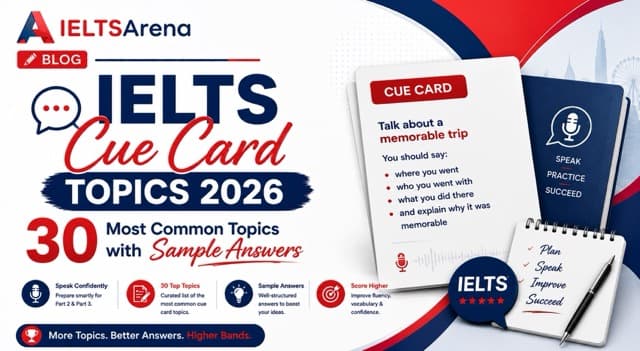
You sit down, the examiner hands you a card, and you have 60 seconds to plan two full minutes of speech on a topic you have never seen. For most test-takers, that single minute is the most nerve-wracking part of the entire IELTS exam. This guide is also the most complete free bank of IELTS speaking topics with answers you will find, organised across the six themes examiners rotate through.
The good news is that the IELTS cue card topics 2026 examiners use are not random. They rotate through a predictable set of themes: a person, a place, an object, an event, an experience, and an abstract idea. Prepare across those themes and almost nothing on test day can surprise you.
This guide gives you the 30 most common IELTS cue card topics 2026 candidates are likely to face, a Band 7 framework for answering any of them, and examiner tips on exactly what to include in your two-minute response.
What the Cue Card Task Actually Tests
IELTS Speaking Part 2 is the long turn. The examiner gives you a card with a topic and three or four bullet prompts. You get one minute to prepare with paper and pencil, then you speak for one to two minutes without interruption.
The examiner is not testing your knowledge of the topic. You will never be marked on whether your story is true or impressive. You are scored on four criteria, each weighted equally: Fluency and Coherence, Lexical Resource, Grammatical Range and Accuracy, and Pronunciation.
That changes everything about how you prepare. A "boring" topic answered with smooth fluency and varied vocabulary beats an exciting topic delivered in broken, hesitant sentences.
The bullet points on the card are your structure, not a checklist you must complete. They exist to give you something to talk about. Once you understand that the IELTS cue card topics 2026 throws at you are really tests of sustained, organised speech, the whole task becomes less frightening.
Advertisement
Why Most Candidates Struggle With Cue Cards
The most common failure is running out of words after 40 seconds. The candidate answers the bullet points literally, finishes them quickly, then freezes in silence.
The second failure is memorisation. Students learn scripted answers for popular topics, then deliver them word for word. Examiners are trained to spot this instantly. Memorised speech sounds flat, ignores the actual prompt, and often gets the candidate stopped and redirected, which lowers the fluency score.
The third failure is poor time awareness. Some candidates speak for 40 seconds and stop. Others ramble past two minutes and get cut off mid-sentence. Both signal weak control of the long turn.
The fourth is topic panic. A candidate who has only prepared a handful of subjects freezes when the card shows something unfamiliar. They have prepared topics, not a method. Preparing for the IELTS cue card topics 2026 means building a framework that works for any card, not collecting scripts for specific ones.
A Student Story: Mariam From Pakistan
Mariam, a graduate from Lahore, Pakistan, was applying to study in Australia. She needed Band 7 in Speaking but kept scoring 6.0. Her grammar and vocabulary were strong, yet cue cards undid her every time.
"I memorised about twenty answers," Mariam said. "Then I got a card about a piece of technology I depend on, which I had never rehearsed, and my mind went completely blank. I spoke for maybe 30 seconds."
Her score of 6.0 reflected that breakdown in fluency, not a lack of English. She was preparing topics instead of a repeatable method.
She switched her strategy. Instead of scripts, she learned one flexible structure she could apply to any of the IELTS cue card topics 2026 might present. She practised expanding any prompt with reasons, examples, feelings, and a short reflection. She rehearsed speaking for the full two minutes, timed.
Six weeks later Mariam scored Band 7.5 in Speaking. "The difference was that I stopped fearing the topic," she said. "I knew I could fill two minutes on anything, because I had a method, not a memorised paragraph."
What the Data Tells Us About Speaking Scores
Speaking is one of the harder bands to lift, and the data shows why preparation method matters.
According to performance data published by the British Council and IDP, Speaking is one of the lower-scoring sections globally, with the worldwide average sitting close to 6.0 in many test-taker groups. Fluency and Coherence is the criterion where Part 2 most often costs candidates marks.
Cambridge assessment guidance notes that examiners reward candidates who can speak at length without noticeable effort and who organise ideas logically. In other words, the long turn rewards sustained, structured talk, which is exactly what cue cards test.
Examiner reports referenced by IELTS partners consistently flag memorised answers and short, underdeveloped responses as the two behaviours that hold candidates at Band 6. Both are fixable with the right method.
The lesson from the data is clear. To move from Band 6 to Band 7 on the IELTS cue card topics 2026 examiners use, you train a flexible structure and full two-minute delivery, not a stack of pre-written answers.
You do not need to know the topic. You need a structure that lets you speak fluently about anything for two minutes.
The 30 Most Common IELTS Cue Card Topics for 2026
These topics group into the six themes examiners rotate through. Prepare two or three from each theme and you cover the full range.
People (describe a person):
- Describe a person you admire.
- Describe a friend who is a good leader.
- Describe a family member you spend a lot of time with.
- Describe a person who helped you in a difficult situation.
- Describe an older person you respect.
Places (describe a place):
- Describe a place you visited that left a strong impression.
- Describe a city you would like to live in.
- Describe a quiet place where you like to relax.
- Describe a building you find interesting.
- Describe a natural place such as a park or beach.
Objects (describe a thing):
- Describe a piece of technology you depend on.
- Describe a gift you received that was meaningful.
- Describe something you bought recently that you are happy with.
- Describe a possession you would not want to lose.
- Describe a piece of clothing you wear often.
Events (describe an occasion):
- Describe a celebration or festival you enjoyed.
- Describe an important decision you made.
- Describe a time you helped someone.
- Describe a memorable journey you took.
- Describe an achievement you are proud of.
Experiences (describe an activity):
- Describe a skill you would like to learn.
- Describe a hobby you have practised for a long time.
- Describe a book or film that influenced you.
- Describe a time you tried something for the first time.
- Describe a meal you enjoyed with others.
Abstract ideas (describe a concept):
- Describe a goal you want to achieve in the future.
- Describe a change you would like to see in your community.
- Describe a piece of advice that helped you.
- Describe a habit you would like to develop.
- Describe a time you were very busy.
Notice the pattern. Almost every card asks who, where, what, when, why, and how you felt. That pattern is your answer framework for all of the IELTS cue card topics 2026 can throw at you.
A Band 7 Framework for Any Cue Card
Here is a method you can apply to all 30 topics above and any new one.
- Use your 60 seconds to note keywords, not sentences. Jot four or five words: the subject, two details, one feeling, and one reflection. Writing full sentences wastes preparation time.
- Open with a direct statement. Name the person, place, or thing in your first sentence. "The piece of technology I depend on most is my laptop." This anchors your answer immediately.
- Expand with reasons and examples. This is where most marks are won. For each bullet, add a why and a specific example. Detail creates the two minutes naturally.
- Add feelings and senses. Describe how something made you feel and what you noticed. Emotional and sensory detail demonstrates range and keeps you talking.
- Finish with a short reflection. End with what the experience taught you or why it still matters. This signals control and a natural conclusion.
This structure, subject, reasons, examples, feelings, reflection, fills two minutes on any topic. A sample Band 7 opening for topic 11 might be: "The piece of technology I rely on most is my laptop, because it connects my work, my studies, and my contact with family abroad. I bought it two years ago, and honestly I would struggle to manage a single day without it."
From that single opening you can branch into when you use it, a specific recent example, how you would feel without it, and a closing reflection on dependence on technology. That is two minutes, built from a framework rather than a script.
Why This Is the Best IELTS Speaking Topics With Answers Bank
Every IELTS speaking topics with answers bank on the web falls into one of two patterns: too many sample answers memorised word for word (which examiners now interrupt under the 2026 anti-memorization rules), or too few topics to give real coverage. This bank covers all six theme families with one full sample per theme and a personalization line telling you exactly which phrases to change so the answer sounds like yours rather than a script.
How IELTSArena Helps You Master the Long Turn
Reading sample answers is useful. Speaking them under timed pressure and getting scored is what actually moves your band. That is the gap IELTSArena closes.
IELTSArena's AI Speaking feedback scores your spoken answers on fluency, pronunciation, vocabulary, and grammar, which are the exact four criteria examiners use in Part 2. You record a full two-minute response to a cue card and see instantly where you lose marks.
That feedback solves Mariam's original problem. Instead of guessing why she scored 6.0, she could see whether the issue was hesitation, limited vocabulary, or grammar slips, then target it directly.
IELTSArena also lets you practise across many of the IELTS cue card topics 2026 themes in real exam conditions, with the timing and structure of the actual Speaking test. You build the habit of speaking for the full two minutes rather than freezing at 40 seconds.
When you want a human judgement, expert tutors on IELTSArena give band-focused corrections on your speaking, which AI-only tools cannot fully replicate. IELTSArena also tracks your speaking practice over time, so you can watch your fluency improve across sessions. More than 10,000 learners have used IELTSArena to prepare, and you can start free on IELTSArena.
Self-Diagnosis: Are You Ready for Part 2?
Test your cue card readiness with these questions.
- Can you speak for a full two minutes on an unfamiliar topic without long pauses?
- Do you have one flexible structure you can apply to any card, or only memorised answers?
- When you finish a cue card, do you know your likely fluency and vocabulary band?
- Have you practised recording and timing yourself, not just reading sample answers?
- Can you keep talking when the bullet points run out, by adding reasons, examples, and reflection?
If you answered no to two or more, you are preparing topics instead of a method. Fixing that is the fastest route from Band 6 to Band 7 in Speaking.
Find Out Where Your Speaking Band Stands
You can keep memorising answers and hope the right topic appears, or you can build a method and test it under real conditions this week.
Record a Cue Card Response on IELTSArena →
Frequently Asked Questions
What are the most common IELTS cue card topics expected in 2026?
Cue card topics rotate through six predictable themes: a person, a place, an object, an event, an experience, and an abstract idea. Common 2026 examples include describing a person you admire, a place that left an impression, a piece of technology you depend on, a memorable journey, a skill you want to learn, and a future goal. Examiners reuse these themes because they let any candidate respond regardless of background. Rather than memorising specific cards, prepare two or three answers per theme and learn one flexible structure. IELTSArena lets you practise across these themes in real exam conditions with AI feedback, so you build a method that works for any card you receive on test day.
How do I organise my cue card answer to speak for exactly 2 minutes?
Use a five-part structure: state the subject directly, give reasons, add specific examples, include feelings or sensory detail, then finish with a short reflection. In your 60-second preparation, note four or five keywords rather than full sentences. The examples and feelings sections are where you naturally fill time, because each one can be expanded with a why and a what-happened. Practise with a timer so you learn the feel of two minutes. Speaking too briefly signals underdevelopment, and going far past two minutes gets you cut off. IELTSArena's timed speaking practice and AI feedback help you calibrate your length and keep your delivery fluent for the full long turn.
Should I memorise model cue card answers for the IELTS speaking test?
No. Examiners are trained to detect memorised answers, and reciting one usually lowers your fluency score because it sounds unnatural and often ignores the actual prompt. If the examiner suspects memorisation, they may stop and redirect you, which disrupts your flow. Instead of scripts, learn a flexible framework you can apply to any topic, and prepare ideas and vocabulary around the six common themes. This keeps your speech natural and responsive to the exact card. IELTSArena's AI Speaking feedback helps you practise spontaneous, structured responses and shows you where your fluency and vocabulary actually stand, which is far more valuable than rehearsing fixed paragraphs that may not match your card.
What happens if I run out of things to say in an IELTS cue card task?
If you finish the bullet points early, do not stop. Expand by adding reasons, specific examples, feelings, and a reflection on why the topic matters to you. For instance, if describing an object, talk about when you got it, how you use it, how you would feel without it, and what it says about your habits. Long silences hurt your Fluency and Coherence score more than a slightly imperfect sentence. The goal is sustained, organised speech. Practising this expansion habit is essential. IELTSArena lets you rehearse full two-minute responses with feedback, so you train the instinct to keep talking smoothly until the examiner signals time.
How many different cue card topics should I prepare before the IELTS speaking test?
You do not need to prepare hundreds of individual cards. Prepare two or three answers within each of the six themes, which gives you roughly fifteen to eighteen flexible answers, plus one structure you can apply to anything new. This covers the full range of likely topics while keeping your preparation efficient. The aim is breadth of method, not memorised volume, because the exam will always include some variation you have not rehearsed exactly. IELTSArena offers practice across many cue card themes in real exam conditions with AI feedback, so you can confirm that your framework holds up on unfamiliar topics before you sit the actual Speaking test.
Where can I find IELTS speaking topics with answers?
The most useful IELTS speaking topics with answers banks cover all three parts of the Speaking test. For Part 1 personal questions, use the IELTSArena Part 1 questions and answers guide. For Part 2 cue cards, use the 30 most common cue card topics on this page. For Part 3 discussion questions, use the Part 3 strategies and sample answers guide. Together the three cover every theme family in the current 4-month cycle.
![IELTS Speaking Part 1 Questions and Answers [2026]: 40+ Real Questions From the Current Cycle](/_next/image?url=%2Fblog%2Fcover-ielts-speaking-part-1-questions-and-answers.jpeg&w=3840&q=75&dpl=dpl_DXyM63YUHjigMzg2B75HT6s5tc1D)