
You speak English every day. You watch films, you chat with friends, you handle work calls. Yet your IELTS Speaking score is stuck at Band 6.0, and the feedback always says the same thing: limited vocabulary.
It feels unfair. You are fluent, so why does the examiner want more words?
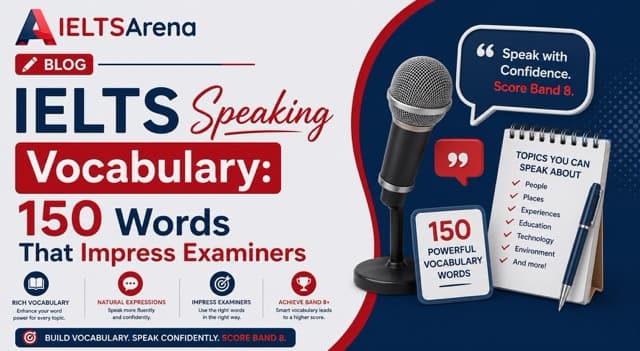
The truth is that Lexical Resource counts for 25 percent of your Speaking band, and everyday fluency is not the same as the range examiners reward. Strong IELTS speaking vocabulary means using precise, varied, and topic-appropriate language naturally. This guide gives you 150 high-scoring words and phrases, organised by topic, and shows you how to use them without sounding rehearsed.
What Lexical Resource Actually Measures
In the IELTS Speaking test, the examiner scores you on four criteria, each worth 25 percent: Fluency and Coherence, Lexical Resource, Grammatical Range and Accuracy, and Pronunciation.
Lexical Resource is your IELTS speaking vocabulary in action. It is not about using rare, complicated words. It is about choosing the right word for the situation and showing range across different topics.
A Band 6 speaker uses common words and sometimes the wrong one. A Band 7 speaker uses less common vocabulary, some idiomatic language, and shows awareness of collocation. A Band 8 speaker uses a wide range fluently and precisely, with natural idiomatic expressions.
The test has three parts. Part 1 covers familiar topics like home, work, and hobbies. Part 2 is a two-minute talk from a cue card. Part 3 is an abstract discussion linked to the Part 2 topic. Each part demands a slightly different level of vocabulary for IELTS speaking, and the examiner listens for variety across all three.
Advertisement
Why Memorising Word Lists Usually Fails
Most students download a long IELTS speaking word list, try to memorise it, then force the words into answers. The examiner hears this immediately. A memorised word dropped into the wrong context actually lowers your score because it shows you do not understand usage.
The second problem is collocation. Words live in natural partnerships. You say "heavy rain," not "strong rain." You "make a decision," you do not "do a decision." Learning single words without their partners produces awkward, unnatural speech.
A third mistake is reaching for the most complex word possible. Students think "utilise" beats "use" and "endeavour" beats "try." Examiners are not impressed by long words used clumsily. They reward precise words used correctly.
Many test-takers also overuse the same few words. They say "good," "nice," and "very" in every answer. Repeating basic words signals a limited range and pulls Lexical Resource down toward Band 5 or 6.
The fix is not more memorising. It is learning useful IELTS speaking vocabulary in context, with collocations, and practising it until it feels natural in your own mouth.
How Daniel Moved From Band 6 to Band 7.5
Daniel, an engineer from Nigeria applying for skilled migration to Australia, was confident speaking English at work. His first IELTS attempt gave him Band 6.0 in Speaking, half a band below what he needed.
"I talked fluently for two minutes without pausing," he said. "But the examiner wrote that my vocabulary was repetitive. I kept saying 'good' and 'a lot' and 'important' over and over."
Daniel realised fluency alone was not enough. He needed range. He stopped trying to memorise random lists and instead learned 15 topic groups of IELTS speaking phrases, each with collocations and example sentences.
He practised describing the same Part 2 topics using the new vocabulary until the words came out without thinking. He recorded himself and replaced every "good" with a precise alternative like "remarkable," "worthwhile," or "rewarding."
On his second attempt, Daniel scored Band 7.5 in Speaking. "The difference was not speaking more," he said. "It was choosing better words for what I was already saying."
What the Data Says About Vocabulary and Band Scores
Speaking and Writing are the two productive skills, and they consistently produce lower scores than Listening and Reading. Across global IELTS results published by the official test partners, the average Speaking band sits near 6.0 to 6.2 for many candidate groups.
Lexical Resource is one of the most common reasons candidates stall at Band 6.5. Examiner training materials from major preparation providers note that vocabulary range, not fluency, is often the deciding factor between Band 6.5 and Band 7.0.
Research on vocabulary acquisition suggests that knowing around 3,000 to 5,000 word families covers most everyday and academic speech. You do not need tens of thousands of words. You need the right few hundred for common IELTS topics, used accurately.
This is encouraging. Estimates from teaching data suggest that mastering 150 to 200 well-chosen words and phrases, with their collocations, can lift a borderline candidate by half a band in Lexical Resource within a few weeks of focused practice.
Examiners do not reward big words. They reward the right word, used naturally, across a range of topics.
The 150 Words and Phrases, Organised by Topic
Learn these in groups. Practise each group in full sentences, not in isolation.
1. Describing opinions (instead of "I think"): I reckon, I would argue, from my perspective, as far as I am concerned, it seems to me, I am inclined to believe, my personal view is, I firmly believe, I am convinced that, I tend to think.
2. Strong positive adjectives (instead of "good"): remarkable, outstanding, impressive, worthwhile, rewarding, beneficial, invaluable, exceptional, fascinating, enjoyable.
3. Strong negative adjectives (instead of "bad"): disappointing, frustrating, tedious, dreadful, overwhelming, unpleasant, troubling, problematic, exhausting, off-putting.
4. Talking about frequency: on a daily basis, every now and then, from time to time, occasionally, hardly ever, more often than not, the vast majority of the time, rarely, repeatedly, sporadically.
5. Work and study topic: demanding, rewarding career, work-life balance, deadline, multitask, hands-on experience, professional development, steep learning curve, fulfilling, time-consuming.
6. Technology topic: cutting-edge, user-friendly, indispensable, time-saving, addictive, screen time, digital detox, keep up with, revolutionise, overreliant.
7. Environment topic: sustainable, carbon footprint, eco-friendly, renewable energy, pollution levels, conservation, single-use plastic, climate change, raise awareness, dispose of.
8. Hometown and city topic: bustling, vibrant, picturesque, residential area, well-connected, cost of living, green spaces, infrastructure, densely populated, laid-back.
9. Hobbies and free time: unwind, recharge, take my mind off things, a great way to relax, get hooked on, pastime, leisurely, fully immersed, blow off steam, pick up a new skill.
10. People and personality: approachable, easy-going, hard-working, reliable, outgoing, considerate, ambitious, down-to-earth, supportive, self-motivated.
11. Describing change: gradually, dramatically, significantly, a noticeable shift, on the rise, in decline, transform, a turning point, steadily, considerably.
12. Linking ideas: as a result, on top of that, having said that, more importantly, in other words, for instance, to put it simply, that being said, what is more, on the other hand.
13. Useful idiomatic phrases: a piece of cake, see eye to eye, the best of both worlds, get the hang of it, food for thought, once in a blue moon, hit the nail on the head, a blessing in disguise, off the top of my head, at the end of the day.
14. Talking about the past (Part 2): as a child, looking back, back in the day, it brings back memories, I distinctly remember, at the time, growing up, in those days, a defining moment, nostalgic.
15. Speculating (Part 3): it is highly likely, there is a good chance, it could well be, presumably, in all probability, I would imagine, conceivably, the odds are, it stands to reason, all things considered.
That is 150 pieces of IELTS speaking vocabulary. Do not learn all of them in one day. Take two or three groups a week and use them until they feel like your own.
How IELTSArena Helps You Use This Vocabulary Naturally
Knowing the words is only half the task. The examiner scores how naturally you use them under pressure. This is where practice with feedback matters, and where IELTSArena helps directly.
On IELTSArena, the AI speaking feedback scores your fluency, pronunciation, vocabulary, and grammar after every practice answer. It flags when your vocabulary for IELTS speaking is too repetitive and shows you where stronger word choices would lift your band.
You can record Part 1, Part 2, and Part 3 responses on IELTSArena and immediately see whether your Lexical Resource is reaching Band 7 territory. The platform highlights overused words so you can replace them with the precise alternatives from this list.
For real examiner-style judgement, expert tutors on IELTSArena review your Speaking and tell you which IELTS speaking phrases sound natural and which sound forced. This human feedback is something AI-only tools cannot fully replicate.
IELTSArena also tracks your progress across every practice session, so you can watch your vocabulary range improve week by week. Start free on IELTSArena.
Self-Diagnosis: Is Your Speaking Vocabulary Ready?
Ask yourself these questions before your test.
- Can you give an opinion five different ways without repeating "I think"?
- Do you know at least three precise adjectives to replace "good" and "bad" each?
- Can you use two idiomatic phrases naturally in a two-minute Part 2 answer?
- When you speak, do you notice yourself repeating "very," "a lot," and "nice"?
- Can you discuss an abstract Part 3 topic using speculation language like "in all probability" or "it stands to reason"?
If any of these made you pause, your Lexical Resource has room to grow. The solution is targeted practice with feedback, not silent memorising.
Start Building Your Speaking Vocabulary Today
You will not know your real Speaking band until you record yourself and get it scored against the official criteria. Guessing wastes the weeks you have before the exam.
Record a Part 2 Answer on IELTSArena →
Frequently Asked Questions
What vocabulary level do I need for Band 7 in IELTS Speaking?
For Band 7 in Speaking, you need to use a range of less common vocabulary and some idiomatic language with awareness of style and collocation. You do not need rare academic words. You need precise, topic-appropriate vocabulary used flexibly across all three parts of the test, with only occasional inaccuracy. Roughly 3,000 to 5,000 active word families cover most topics. The key is range and accuracy, not difficulty. Practising topic-based vocabulary with AI speaking feedback on IELTSArena helps you confirm whether your word choices are reaching the Band 7 standard before exam day.
How do I use advanced vocabulary naturally without sounding forced in IELTS Speaking?
Learn words in context with their natural collocations, not as isolated items on a list. Practise each new word in full sentences about real topics until it feels automatic. Avoid forcing a complex word where a simpler precise one fits better, because examiners reward accuracy over difficulty. Record yourself and listen for any phrase that sounds memorised or out of place. Replace it with language you would genuinely use. On IELTSArena, AI and expert tutor feedback flags forced or unnatural vocabulary, so you can refine your IELTS speaking vocabulary until it sounds like your own voice.
Which vocabulary topics come up most in the IELTS Speaking test?
The most common topics include work and study, hometown and accommodation, hobbies and free time, technology, the environment, travel, family and friends, and daily routines. Part 3 often moves into more abstract areas such as society, education, change over time, and the future. Building topic-based vocabulary for these high-frequency areas gives you the best return on study time. Prepare collocations and example sentences for each topic rather than random words. Practising these common topics repeatedly on IELTSArena helps you respond quickly with strong, varied language instead of hesitating.
Does repeating words in IELTS Speaking reduce my band score?
Yes, frequent repetition of the same basic words lowers your Lexical Resource score, which counts for 25 percent of your Speaking band. Saying "good," "nice," "very," and "a lot" in every answer signals a limited range and tends to cap candidates around Band 6. The fix is to build a bank of precise alternatives and practise using them. Some natural repetition is fine, but the examiner is listening for variety and the ability to paraphrase. Recording answers on IELTSArena and reviewing the AI feedback helps you spot overused words and replace them with stronger choices.
How many new words do I need to learn to improve IELTS Speaking Lexical Resource?
You do not need thousands. Most borderline candidates can lift their Lexical Resource by mastering 150 to 200 well-chosen words and phrases, complete with collocations and example uses, across the most common IELTS topics. Quality and natural usage matter far more than quantity. Learning two or three topic groups a week and practising them in full answers is more effective than cramming long lists. Focus on words you can deploy confidently under pressure. With consistent practice and feedback on IELTSArena, this focused approach can raise your Speaking band by half a point within a few weeks.
![IELTS Speaking Part 1 Questions and Answers [2026]: 40+ Real Questions From the Current Cycle](/_next/image?url=%2Fblog%2Fcover-ielts-speaking-part-1-questions-and-answers.jpeg&w=3840&q=75&dpl=dpl_DXyM63YUHjigMzg2B75HT6s5tc1D)