
You sit the Speaking test, get Band 6.0. Feedback shows Pronunciation at Band 5.5. You conclude that you need to sound more British, hire an accent coach, and spend six months trying to erase the sound of your first language from your English. You retake the exam and score Band 6.0 again. This is what happens when candidates confuse accent with pronunciation. The IELTS Pronunciation criterion does not penalise accents. Candidates from Manila, Lagos, Seoul, Delhi, and São Paulo score Band 8 and Band 9 on Pronunciation every year with their first-language accents fully intact. What actually gets scored is four specific things, and fixing them takes four weeks, not four years.
Quick answer: IELTS speaking pronunciation is one of the four Speaking assessment criteria, weighted at 25 percent of your Speaking band. It measures four things together: individual sound production, word stress, sentence stress and rhythm, and intonation. Accent is not scored. What is scored is whether the examiner can understand you without effort and whether you use pronunciation features like stress and intonation to convey meaning. A strong accent that is understood clearly scores higher than a mild accent that mumbles or misplaces word stress. Fixing Pronunciation takes four weeks of targeted drills on the specific sub-component that is scoring lowest, not months of accent training.
In This Guide
- What Pronunciation Actually Measures
- The Accent Myth: Why You Do Not Need to Sound British or American
- The Four Sub-Components of Pronunciation
- The Four Speaking Criteria and Why This One Is Underestimated
- The Band Descriptors from Band 5 to Band 9
- The Four Pronunciation Mistakes That Cap Your Band
- A Real Student's Story: Band 5.5 to Band 7.5 Without Changing Her Accent
- The Data Behind This Criterion
- The Right Approach: A Four-Week Fix Plan
- Daily Drills That Actually Move the Criterion
- How IELTSArena Helps You Fix Pronunciation Specifically
- Self-Diagnosis: Is Pronunciation Capping Your Band?
- Key Takeaways
- Frequently Asked Questions
Advertisement
What Pronunciation Actually Measures
IELTS speaking pronunciation is the criterion that assesses whether the examiner can understand what you say without conscious effort, and whether you use pronunciation features like stress and intonation to convey meaning naturally. It applies to all three parts of the Speaking test: Part 1's short question and answer, Part 2's 2-minute long turn, and Part 3's abstract discussion. Each part is scored against the same four criteria, and Pronunciation carries equal 25 percent weight.
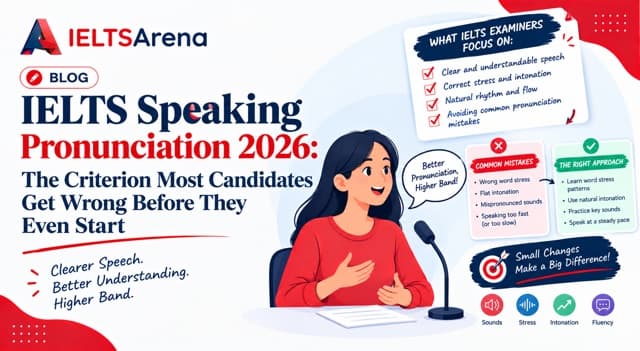
The criterion covers four specific observable behaviours. First, individual sound production, which means whether the sounds of English (vowels, consonants, consonant clusters) are formed clearly enough to be understood, even if they are not native-standard. Second, word stress, which means whether you place the emphasis on the correct syllable of multi-syllable words. Third, sentence stress and rhythm, which means whether you emphasise the content words and reduce the function words the way English naturally does. Fourth, intonation, which means whether your pitch rises and falls in ways that signal meaning (questions, contrast, importance) rather than staying flat.
Because these four checks are what Pronunciation measures, the criterion is about being clearly understood and about using rhythm and pitch as meaningful signals. Accent, meaning the recognisable regional or national sound of your English, is not scored. This is the most misunderstood aspect of the criterion and the reason many candidates spend months on the wrong fix.
The Accent Myth: Why You Do Not Need to Sound British or American
The IELTS Pronunciation criterion has been designed since its inception to accept all clear varieties of English. Cambridge Assessment English, the British Council, and IDP have publicly confirmed that examiners are trained not to reward or penalise any particular accent. A Nigerian, Filipino, Indian, or Chinese-accented English speaker can and does score Band 8 and Band 9 on Pronunciation every year.
What the criterion does penalise is unclear sound production, misplaced word stress, flat delivery, and mumbling, regardless of accent. A candidate with a strong Punjabi-accented English who speaks clearly, stresses words correctly, and uses natural intonation will score higher than a candidate with a milder accent who mumbles or places stress on the wrong syllables. The listener's understanding is the test, not the accent's regional origin.
This distinction matters practically because it changes what you should work on. If you have been told or have assumed that you need to "sound more native" for Band 7, that advice is wrong and it is why so many candidates plateau. The correct advice is: keep your accent, work on the four sub-components below, and the criterion will move.
The Four Sub-Components of Pronunciation
The Pronunciation criterion combines four related sub-skills. Understanding which of the four is your specific gap is the first step toward fixing it.
Sub-component 1: Individual sound production. Are the vowels and consonants of English formed clearly? Certain sounds are commonly difficult for specific first languages: the "th" sound for many Slavic and Romance speakers, the "r" and "l" distinction for some East Asian speakers, "b" and "v" for Spanish speakers, "p" and "f" for Arabic speakers. These are fixable with targeted practice, but only if you know which sounds are actually causing miscommunication in your English.
Sub-component 2: Word stress. Every English word of two or more syllables has one stressed syllable that carries the main emphasis. "PHOtograph" versus "phoTOgraphy" versus "photoGRAPHic" carry stress on different syllables, and misplaced word stress is one of the most common causes of miscommunication. A Band 7 candidate places word stress correctly in almost all cases.
Sub-component 3: Sentence stress and rhythm. English is a stress-timed language, meaning content words (nouns, main verbs, adjectives, adverbs) are emphasised while function words (articles, prepositions, auxiliary verbs) are reduced. Candidates from syllable-timed language backgrounds (Japanese, French, Spanish) often deliver every word with equal weight, which produces a flat, robotic rhythm even when individual sounds are correct.
Sub-component 4: Intonation. English uses pitch to signal meaning: rising intonation for genuine questions, falling intonation for statements, contrastive stress for corrections, and changes in pitch range to signal importance or contrast. Flat intonation is one of the most audible Band 5 to Band 6 pronunciation issues.
The four sub-components can fail independently. A candidate can produce individual sounds perfectly (Band 8 sub-component 1) but with flat intonation throughout (Band 5 sub-component 4). Or a candidate can have varied intonation (Band 7 sub-component 4) but consistently misplace word stress (Band 5 sub-component 2). Because Pronunciation is scored as a single band, whichever sub-component is weakest sets the ceiling.
The Four Speaking Criteria and Why This One Is Underestimated
Your IELTS Speaking band is the average of your four criterion scores: Fluency and Coherence, Lexical Resource, Grammatical Range and Accuracy, and Pronunciation. Each criterion is worth 25 percent.
Pronunciation is often underestimated because it feels less "language-based" than vocabulary and grammar. Candidates spend hours studying vocabulary lists, then complete their preparation without ever recording themselves to hear how they sound. But at Band 6 to Band 7 level, Pronunciation is often the criterion where the widest gap exists between how candidates think they sound and how they actually sound.
| Fluency and Coherence | Lexical Resource | Grammatical Range | Pronunciation | Overall Speaking band |
|---|---|---|---|---|
| 7 | 7 | 7 | 5 | 6.5 |
| 8 | 8 | 8 | 5 | 7.25, rounded down to 7 |
| 7 | 7 | 7 | 6 | 6.75, rounded to 6.5 |
| 7 | 7 | 7 | 7 | 7 |
| 8 | 8 | 8 | 4 | 7 |
Notice the pattern: even a Band 8 profile on the other three criteria only lifts a Band 5 Pronunciation to Band 7 overall. And unlike Fluency and Coherence, which most candidates recognise as a problem, Pronunciation gaps are often invisible to the candidate themselves. Fixing this criterion requires recording, listening, and diagnosing, which most preparation routines skip entirely.
The Band Descriptors from Band 5 to Band 9
Here is what the publicly available Pronunciation descriptors say, expressed in plain language rather than official jargon.
Band 5 Pronunciation. Shows all the positive features of Band 4 and some of the positive features of Band 6. The listener has to concentrate to understand some parts of the response. Uses a limited range of pronunciation features. Mispronunciations frequently cause difficulty for the listener.
Band 6 Pronunciation. Uses a range of pronunciation features with mixed control. Shows some effective use of features but this is not sustained. Can generally be understood throughout, though mispronunciation of individual words or sounds reduces clarity at times.
Band 7 Pronunciation. Shows all the positive features of Band 6 and some of the positive features of Band 8. Uses a range of pronunciation features with flexibility. Sustains flexible use of features, with only occasional lapses. Is easy to understand throughout, and L1 accent has minimal effect on intelligibility.
Band 8 Pronunciation. Uses a wide range of pronunciation features. Sustains flexible use of features, with only occasional lapses. Is easy to understand throughout. L1 accent has minimal effect on intelligibility.
Band 9 Pronunciation. Uses a full range of pronunciation features with precision and subtlety. Sustains flexible use of features throughout. Is effortless to understand.
Two patterns emerge. First, the words "L1 accent has minimal effect on intelligibility" appear explicitly at Band 7 and Band 8. This is the criterion telling you directly that having an accent is not the problem. The problem is whether that accent affects understanding. Second, "range of pronunciation features" moves through limited (5), mixed control (6), flexible (7), wide flexible (8), full and precise (9). The criterion rewards using pronunciation features (stress, rhythm, intonation) as tools for meaning, not just producing sounds correctly.
The Four Pronunciation Mistakes That Cap Your Band
Four specific mistakes account for most Band 5 and Band 6 Pronunciation scores.
Mistake 1: Flat intonation. Speaking every sentence with the same pitch pattern, with no rise for questions or fall for statements. This is the single most audible Band 5 to Band 6 pronunciation issue. The examiner cannot easily distinguish your questions from your statements, or your emphasis from your neutral delivery. The fix is targeted intonation practice using recorded native speech as a model.
Mistake 2: Misplaced word stress. Placing the primary stress on the wrong syllable of common multi-syllable words. Saying "econOMic" instead of "ecoNOMic", "deVElopment" instead of "deVELopment", or "phoTOgraphy" instead of "phoTOgraphy" is instantly noticed by the examiner and drops Pronunciation by half a band per repeated occurrence. The fix is to check stress patterns for high-frequency multi-syllable words in a dictionary and drill the correct pattern.
Mistake 3: Syllable-timed rhythm. Delivering every syllable with equal weight instead of stressing content words and reducing function words. This produces the "robotic" or "flat" rhythm that examiners cite most often as a Band 5 to Band 6 issue. Candidates from French, Spanish, Japanese, and Cantonese first-language backgrounds are particularly prone to this. The fix is shadow-speaking with English native speakers to internalise the stress-timed rhythm.
Mistake 4: Mumbling and unclear consonants. Not opening the mouth enough, dropping final consonants, or slurring consonant clusters. Unlike accent, mumbling is a physical delivery habit that reduces intelligibility across all L1 accents. The fix is deliberate over-articulation practice for two weeks until clear consonant production becomes automatic.
Notice what is not on this list: having an Indian, Filipino, Nigerian, or Chinese accent. None of these is a Pronunciation mistake. What matters is whether the four sub-components are functioning, not what your L1-influenced sound base is.
A Real Student's Story: Band 5.5 to Band 7.5 Without Changing Her Accent
Yuki, a research scientist from Tokyo applying for a UK Global Talent visa, sat the IELTS three times and scored Speaking Band 5.5 each time. She had spent four months with an accent coach trying to sound "more British" and had made no progress. Her Pronunciation criterion score was Band 5 on all three attempts, dragging her overall Speaking band down.
My accent coach kept telling me to change my vowel sounds and drop my Japanese rhythm. Nothing worked, and I hated the practice sessions because they felt like I was denying who I was. Then a new tutor listened to my recording and said, "Your accent is fine. You are misplacing word stress on twelve common words and your intonation is completely flat. Fix those two things and keep the accent." I could not believe how simple it was.
Her diagnostic named two specific problems: she stressed the wrong syllable on 12 high-frequency words she used constantly (economic, development, industry, technology, community, among others), and her intonation was flat throughout her responses with almost no pitch variation. She stopped the accent lessons entirely and spent four weeks on two drills: a word-stress list of the 12 mispronounced words plus 40 additional high-frequency words, and daily 10-minute shadow-speaking of BBC news clips to internalise natural intonation. Her fourth attempt scored Pronunciation Band 7. Overall Speaking band lifted from 5.5 to 7.5 with her Japanese accent fully intact, and the UK visa route cleared.
The Data Behind This Criterion
Cambridge Assessment English publicly confirms that Pronunciation is scored on four sub-components (sound production, word stress, sentence stress and rhythm, intonation) and that L1 accent is explicitly not penalised at any band level (Cambridge Assessment English, IELTS Test Statistics 2024 to 2025 and Speaking Assessment Framework).
British Council examiner reports specifically flag "flat intonation" and "consistent word stress errors" as the two most common patterns that cap Pronunciation at Band 5 to Band 6. IELTS.org confirms the four Speaking assessment criteria for 2026 remain Fluency and Coherence, Lexical Resource, Grammatical Range and Accuracy, and Pronunciation, each weighted equally at 25 percent, and the Pronunciation criterion continues to accept all clear varieties of English (IELTS.org, 2026 assessment framework).
Internal tracking on IELTSArena shows that among candidates scoring Speaking Band 5.5 to 6.5, roughly 60 percent have significant word stress errors on high-frequency multi-syllable words, and roughly 45 percent produce flat intonation across their entire response. The same tracking shows that half a band of Pronunciation movement produces roughly half a band of overall Speaking movement on average, comparable to Fluency and Coherence. This is direct evidence that Pronunciation is a high-leverage fix, particularly for candidates who have wrongly attributed their score to accent.
The Right Approach: A Four-Week Fix Plan
Fixing IELTS speaking pronunciation is a four-step process. Do not skip the first step, because it decides which of the four sub-components to drill.
Step 1: Diagnose which sub-component is your gap. Record yourself answering one Part 1 question, one Part 2 cue card, and one Part 3 question. Play back with a specific checklist: Are any individual sounds unclear or causing miscommunication? Are you stressing the correct syllable on multi-syllable words? Does your rhythm feel flat or robotic, or does it emphasise content words? Does your pitch rise and fall to signal questions, statements, and importance, or does it stay level? Whichever sub-component fails the check is your priority.
Step 2: Drill the identified sub-component for three weeks. If word stress is your gap, work through a stress list of the 50 most common multi-syllable words in general English and drill them daily. If intonation is your gap, shadow-speak BBC News, TED Talks, or CNN clips for 10 minutes daily, matching the pitch pattern half a second behind the speaker. If rhythm is your gap, practice stress-timed reading (reading paragraphs aloud with content words stressed and function words reduced). If sound production is your gap, identify the specific 3 to 5 sounds that cause miscommunication in your English and drill minimal pairs (ship-sheep, live-leave, wet-wait) for those sounds only.
Step 3: Re-record and compare. After three weeks, record the same three prompts you diagnosed with in Step 1. Compare the two recordings side by side. If the specific sub-component you drilled has visibly improved, the fix worked. If not, your diagnosis was probably wrong, and the gap is a different sub-component.
Step 4: Extend to a second sub-component if time allows. Once one sub-component moves from Band 5 to Band 6.5 or Band 7, if you have time before the exam, move to the second-weakest sub-component and drill for another three weeks.
This is the loop that produces Band 5.5 to Band 7 movement on Pronunciation in four to six weeks. It works because it strips out accent training entirely and focuses on the specific sub-component that is actually reducing intelligibility.
Daily Drills That Actually Move the Criterion
Four short daily drills, done consistently for four weeks, move Pronunciation faster than any other practice.
Drill 1: Word stress list. Take a list of 50 high-frequency multi-syllable words (economic, development, industry, technology, community, employment, environment, government, international, opportunity, and so on). Look up the stress pattern in a dictionary. Say each word aloud 10 times, exaggerating the stressed syllable. Ten minutes per day.
Drill 2: Shadow speaking for intonation. Play a 30-second clip of BBC News, TED, or a native English podcast. Speak the same words at the same pace, half a second behind, matching the pitch pattern. This trains natural intonation without translating rules into practice. Ten minutes per day.
Drill 3: Stress-timed reading. Take a paragraph of English text. Read it aloud with deliberate stress on content words (nouns, main verbs, adjectives, adverbs) and reduction of function words (articles, prepositions, auxiliary verbs). This retrains syllable-timed speakers to the English rhythm. Five minutes per day.
Drill 4: Minimal pair practice. If specific sounds are your gap, drill minimal pairs (ship-sheep, live-leave, wet-wait, thin-tin, right-light) for two minutes per sound per day, focusing only on the 3 to 5 sounds that actually reduce your intelligibility.
Consistency matters more than intensity. Twenty-five minutes a day for four weeks moves Pronunciation. Two hours a day for one week does not.
How IELTSArena Helps You Fix Pronunciation Specifically
IELTSArena's AI Speaking feedback scores every recorded response against Fluency and Coherence, Lexical Resource, Grammatical Range and Accuracy, and Pronunciation separately. The Pronunciation feedback specifically flags word stress errors on individual words, identifies intonation patterns that are too flat, and highlights sounds that reduce intelligibility, so you can see immediately which of the four sub-components is your gap.
Expert tutors on IELTSArena review Speaking responses with a specific focus on Pronunciation for candidates scoring Band 5.5 to Band 6.5, because the accent-versus-pronunciation confusion is one of the most common misdiagnoses at this level. The platform also provides model responses at Band 5, Band 6, and Band 8 on the same prompts, so you can hear exactly what the difference between the band you are at and the band you are targeting sounds like. More than 10,000 students have used IELTSArena to move their Speaking band up.
Start your free IELTS practice on IELTSArena and record your first Part 1 response for automated Pronunciation feedback this week.
Self-Diagnosis: Is Pronunciation Capping Your Band?
Work through these questions honestly against a recording of your last practice response.
Play back the recording and listen specifically for whether your intonation rises for questions and falls for statements, or whether it stays flat throughout. Does the recording sound robotic or naturally rhythmic when you compare it to a native English podcast played immediately after? Are you stressing multi-syllable words on the correct syllable (economic, development, technology), or are you shifting the stress? Are there specific sounds in the recording where a listener would have to concentrate to understand you? Would a stranger listening to your recording need to ask you to repeat any word? Do you open your mouth enough to produce clear vowel sounds, or are you mumbling with reduced jaw movement? Do you produce final consonants clearly, or do you drop them at the ends of words?
If you hesitated on more than two of these, Pronunciation is likely your lowest-scoring criterion. Diagnose which of the four sub-components is the specific gap and drill only that sub-component for three to four weeks.
Key Takeaways
- IELTS speaking pronunciation is one of the four Speaking assessment criteria, weighted at 25 percent of your Speaking band. It measures sound production, word stress, sentence stress and rhythm, and intonation.
- Accent is not scored. A strong L1 accent that is clearly understood scores higher than a mild accent with poor stress or mumbling. Cambridge, British Council, and IDP explicitly confirm this in the Band 7 and Band 8 descriptors.
- Trying to sound British or American is the wrong fix. Keep your accent, work on the four sub-components, and the criterion moves.
- Roughly 60 percent of candidates scoring Speaking Band 5.5 to 6.5 have significant word stress errors on high-frequency words, and roughly 45 percent produce flat intonation across their entire response.
- The four Pronunciation mistakes that cap Band 5-6 are: flat intonation, misplaced word stress, syllable-timed rhythm, and mumbling. All four are fixable in four weeks with targeted drills.
- Diagnose which of the four sub-components is your gap before drilling. Drilling the wrong sub-component wastes weeks and produces no visible band movement.
Related Guides on IELTSArena
- IELTS Speaking Test Format: What Happens on Exam Day
- IELTS Speaking Part 2 Cue Card Strategy
- IELTS Speaking Fluency and Coherence
- IELTS Speaking Part 3 Questions and Sample Answers
- IELTS Cue Card Topics 2026: 30 Most Common Topics
- How to Get Band 7 in IELTS: Section-by-Section Plan
- How to Get Band 7.5 in IELTS
- IELTS Band Score Chart 2026
- IELTS Speaking Lexical Resource
- IELTS Speaking Grammatical Range and Accuracy
- IELTS Speaking Pronunciation: How to Score Full Marks
- IELTS Speaking Mistakes to Avoid
- How to Practise IELTS Speaking Alone
See Where Your Pronunciation Band Stands Today
Try a free mock test at ieltsarena.com and record one timed Speaking response. In one free practice session, you will know which of the four Speaking criteria is capping your Speaking band, and whether Pronunciation is the specific gap holding you back, or whether the gap you thought was pronunciation is actually a different criterion entirely.
Start your free IELTS practice on IELTSArena
Frequently Asked Questions
Do I need a native accent for Band 7 in IELTS Speaking? No. The Band 7 Pronunciation descriptor explicitly states that "L1 accent has minimal effect on intelligibility", which means examiners are trained to accept any accent as long as the speaker can be understood without effort. Nigerian, Filipino, Indian, Chinese, Arabic, and every other L1 accent regularly scores Band 7, Band 8, and Band 9. What is scored is whether individual sounds are produced clearly, whether word stress is placed correctly, whether rhythm follows English stress-timing patterns, and whether intonation carries meaning. A strong accent that is clearly understood scores higher than a mild accent with misplaced word stress or flat intonation. Trying to sound "more native" is the wrong fix and typically produces no band movement.
How do I improve pronunciation for IELTS Speaking? Focus on the specific sub-component that is your gap rather than trying to change your overall accent. Record yourself and listen critically for four things: individual sound clarity, word stress placement, rhythm (are content words stressed and function words reduced?), and intonation (does pitch rise and fall meaningfully?). Whichever sub-component fails the check is your priority. Drill that one sub-component for three weeks with daily 10 to 25 minute practice sessions (word stress lists, shadow speaking, stress-timed reading, or minimal pairs depending on your gap). Re-record after three weeks and compare. This targeted approach produces Band 5.5 to Band 7 movement in four to six weeks, faster than any accent programme.
Does my accent affect my IELTS Pronunciation score? Your accent does not directly affect your IELTS speaking pronunciation score. What affects the score is whether your accent produces sounds clearly enough for the examiner to understand without effort. Some accents make certain English sounds harder to produce clearly (the "th" sound for Slavic and Romance speakers, the "l" and "r" distinction for some East Asian speakers, "b" and "v" for Spanish speakers), and those specific sounds may need targeted practice. But the overall accent, meaning the recognisable regional or national character of your English, is not scored. Cambridge Assessment English, the British Council, and IDP all confirm this in their published assessor training materials.
What is Pronunciation scored on in IELTS Speaking? IELTS speaking pronunciation is scored on four sub-components combined into one band. First, individual sound production, meaning whether the vowels, consonants, and consonant clusters of English are formed clearly enough to be understood. Second, word stress, meaning whether you place the emphasis on the correct syllable of multi-syllable words. Third, sentence stress and rhythm, meaning whether you emphasise content words and reduce function words in a stress-timed rhythm. Fourth, intonation, meaning whether your pitch rises and falls to signal meaning like questions, statements, contrast, and importance. Because Pronunciation is scored as a single band, whichever of the four sub-components is weakest sets the ceiling for the whole criterion.
Why is my Pronunciation scored Band 5 in IELTS Speaking? Four specific mistakes cap Pronunciation at Band 5. First, flat intonation, where every sentence is delivered with the same pitch pattern regardless of whether it is a question, a statement, or an emphasis. Second, misplaced word stress on common multi-syllable words, especially on frequently-used academic and everyday vocabulary. Third, syllable-timed rhythm, where every syllable is given equal weight instead of English's natural stress-timed pattern that emphasises content words. Fourth, mumbling or unclear consonants, particularly dropped final consonants and slurred consonant clusters. None of these is related to accent. All four are physical delivery habits that can be fixed with four weeks of targeted daily drills of 20 to 25 minutes.
Last updated September 2026 by the IELTSArena Editorial Team, a team of IELTS tutors, certified CBT examiners, and Speaking feedback specialists who publish weekly research-backed guides on ieltsarena.com.