

Most people who lose marks in IELTS Speaking do not lose them because of weak English. They lose them because the exam started before they were ready, and the surprise threw them off in the first two minutes. Walking in without knowing the IELTS speaking test format is like walking onto a stage without knowing the script.
The speaking test is only 11 to 14 minutes long. That is a very short window to prove your level, and every second of confusion costs you. A candidate who knows exactly what is coming sounds calm, fluent, and in control.
This guide walks you through the IELTS speaking test format step by step, from the moment you enter the room to the final question of Part 3. By the end, nothing on exam day will surprise you.
The Problem: Fear of the Unknown
The IELTS Speaking test is the only part of the exam where you sit face to face with a real examiner. There is no screen to hide behind and no time to delete and rewrite. This human element is exactly what makes test-takers nervous.
Many candidates have never spoken English with a stranger under timed pressure. They imagine an interrogation. In reality, the IELTS speaking test format is a structured, predictable conversation with three clear parts.
The fear comes from not knowing the sequence. When you do not know whether a question is the warm-up or the main event, you cannot pace yourself. You might give a one-word answer where a long answer was needed, or ramble where a short answer was expected.
Understanding the IELTS speaking test format removes that fear. Once you know the structure, your brain can stop worrying about what comes next and focus entirely on speaking well.
Advertisement
Why Common Preparation Fails
The biggest mistake is preparing only the answers and ignoring the IELTS speaking exam structure. Students memorise model answers to popular topics, then freeze when the examiner asks a slightly different question.
Memorised answers are easy for examiners to spot. They sound rehearsed, the rhythm is unnatural, and they often do not match the exact question. Examiners are trained to notice this, and it pulls down your Fluency and Coherence score.
A second failure is practising alone, in your head or in front of a mirror. This builds zero tolerance for the pressure of a real conversation. On exam day, the presence of a real examiner feels completely different from silent practice.
A third mistake is ignoring timing. Each part of the IELTS speaking test format has a purpose and a length. Students who do not know how long Part 2 lasts either run out of things to say or stop far too early. Knowing the IELTS speaking process lets you fill each part with confidence.
A Realistic Student Story
Amara, a graduate from Nigeria, was applying to a university in the United Kingdom. Her spoken English was strong, and her friends often told her she sounded fluent. She expected an easy Band 8 in Speaking.
She scored 6.5. The reason was simple. She had no idea what the IELTS speaking test format looked like, so when the examiner handed her the cue card in Part 2, she panicked and spoke for only forty seconds.
"I thought Part 2 was a quick question," Amara said. "I did not know I had two full minutes to talk, so I stopped early and just sat there in silence. It felt like the longest minute of my life."
Before her retake, Amara studied the full IELTS speaking exam structure and practised the two-minute long turn with a timer. She learned to use the one-minute preparation time and to keep talking until the examiner stopped her.
On her second attempt, her Speaking band rose to 7.5. Her English had not changed. She simply understood the IELTS speaking process and used every part of it the way it was designed.
Data and Insight Layer
Speaking is often the section where test-takers underperform relative to their actual ability, and exam anxiety is a major reason. Research published in language testing journals consistently links test anxiety to lower oral performance, even among confident speakers.
The official structure is fixed worldwide. The British Council, IDP, and Cambridge all use the same three-part IELTS speaking test format, lasting 11 to 14 minutes. This consistency is good news, because it means you can prepare for an exact, known sequence.
Examiner reports frequently note that candidates lose marks in Part 2 by speaking too briefly. The long turn is designed for up to two minutes of continuous speech, yet many candidates stop after one minute or less, leaving Fluency and Coherence marks on the table.
Part 3 is where higher bands are won or lost. Analysis of band descriptors shows that the discussion in Part 3 is where examiners test the ability to develop ideas, speculate, and justify opinions, which separates a Band 6 from a Band 7 or 8.
The IELTS Speaking Test Format Step by Step
Here is exactly what happens on the day, from start to finish.
Step 1: Check-in and identity verification. You arrive, show your passport or identity document, and may have a photo taken. You wait until your name is called.
Step 2: Entering the room. You enter a quiet room with one examiner. The examiner greets you, confirms your name and where you are from, and turns on the recorder. The whole test is recorded for quality and re-marking purposes.
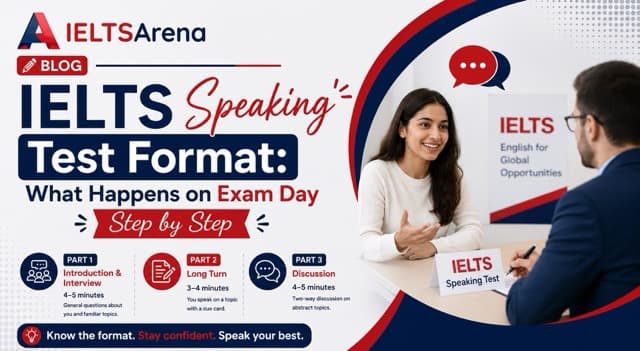
Step 3: Part 1, Introduction and interview (4 to 5 minutes). The examiner asks simple questions about familiar topics such as your home, work, studies, hobbies, and daily routine. Give answers of two or three sentences. Do not give one-word answers, and do not give a speech.
Step 4: Part 2, the long turn (3 to 4 minutes total). The examiner hands you a cue card with a topic and points to cover. You get one minute to prepare and may make notes. You then speak for up to two minutes without interruption. The examiner may ask one or two short follow-up questions at the end.
Step 5: Part 3, the discussion (4 to 5 minutes). The examiner asks deeper, more abstract questions linked to the Part 2 topic. Here you explain opinions, compare ideas, and speculate about the future. Answers should be longer and more developed than in Part 1.
Step 6: The end. The examiner says the test is over and turns off the recorder. You leave. The result is reported as part of your overall band a few days later.
That is the entire IELTS speaking test format. Three parts, one examiner, a fixed sequence you can rehearse until it feels routine.
How IELTSArena Prepares You for Speaking Day
Knowing the IELTS speaking test format is the first step. Performing well inside it is the next, and that requires realistic practice with feedback.
IELTSArena provides AI Speaking feedback that scores you on the four official criteria: Fluency and Coherence, Lexical Resource, Grammatical Range and Accuracy, and Pronunciation. You speak your answers, and the system tells you where you lost marks, just as an examiner would.
You can practise each part of the IELTS speaking process separately. Drill Part 1 introductions, rehearse the two-minute Part 2 long turn with a timer, and develop your Part 3 discussion answers until they sound natural rather than memorised.
For candidates who want a human ear, IELTSArena also offers expert tutor feedback. A tutor reviews your speaking and shows you the specific habits costing you marks, such as stopping too early in Part 2 or giving thin answers in Part 3. This is the kind of correction Amara needed and never received the first time.
Because IELTSArena tracks your progress across every practice session, you can see your fluency and pronunciation scores improve over time. More than 10,000 learners have used IELTSArena to walk into the speaking room knowing exactly what to expect. You can start practising free on IELTSArena.
The goal is simple. By exam day, the IELTS speaking test format should feel familiar, not frightening. When you have rehearsed the sequence many times, the real test feels like one more practice session.
Self-Diagnosis: Are You Ready for the Speaking Test?
Answer these five questions honestly to find out if the IELTS speaking exam structure still holds any surprises for you.
- Can you speak continuously for the full two minutes in Part 2 without running out of things to say?
- Do you know the difference in expected answer length between Part 1 and Part 3?
- Can you use the one-minute preparation time in Part 2 to plan notes quickly and clearly?
- Have you ever practised speaking out loud and received feedback on your fluency and pronunciation?
- Do you know what to do if you do not understand a question during the test?
If any of these made you uncertain, that gap could cost you half a band or more. Each one is easy to close with focused, realistic practice before exam day.
Walk In Knowing Exactly What Comes Next
The candidates who score highest in Speaking are not always the best speakers. They are the ones who walked in calm because they knew the IELTS speaking test format inside out.
You can be one of them. Practise the three parts, rehearse the two-minute long turn, and get feedback on how you actually sound under pressure.
Take a Free Speaking Practice on IELTSArena →
Frequently Asked Questions
What happens on the day of the IELTS speaking test?
On test day you arrive, show your passport or identity document, and may have a photo taken before your name is called. You then enter a quiet room with one examiner who greets you and turns on a recorder. The test follows three parts: a short interview about familiar topics, a two-minute long turn based on a cue card, and a deeper discussion linked to that topic. The whole session lasts 11 to 14 minutes. After the final question, the examiner ends the test and you leave. The IELTS speaking test format is the same worldwide, so you can rehearse the exact sequence in advance.
How long does the IELTS speaking test take from start to finish?
The IELTS speaking test lasts 11 to 14 minutes in total, not counting check-in and waiting time. It is divided into three parts. Part 1 is the introduction and interview, lasting 4 to 5 minutes. Part 2 is the long turn, which includes one minute of preparation and up to two minutes of speaking, taking 3 to 4 minutes overall. Part 3 is the discussion, lasting 4 to 5 minutes. The timing is fixed and the same in every country and test centre. Knowing these lengths helps you pace each part correctly, especially the two-minute long turn where many candidates stop far too early.
Is the IELTS speaking test recorded and does that affect my score?
Yes, every IELTS speaking test is recorded. This is standard practice and does not lower your score in any way. The recording exists for quality control and in case your test needs to be re-marked, for example if you request a remark. The examiner in the room is the one who assesses you in real time using the four official criteria. The recording simply protects the fairness of the process. You should treat the test as a normal conversation and not worry about the recorder. Practising with AI Speaking feedback on IELTSArena helps you feel comfortable being recorded before exam day.
Can I ask the IELTS examiner to repeat the question in the speaking test?
Yes, you can ask the examiner to repeat a question in Part 1 and Part 3, and this does not cost you marks. Simply say something like "Could you repeat that, please?" It is far better to ask than to answer the wrong question. However, in Part 2 the examiner cannot change or re-explain the cue card once your preparation time starts, so read it carefully during your one minute. Asking for repetition naturally is part of normal communication and examiners expect it. What does lower your score is staying silent or guessing, so always ask if you are unsure.
How do I calm my nerves before the IELTS speaking test on exam day?
The most effective way to calm nerves is preparation that removes surprise. When you know the IELTS speaking test format and have rehearsed all three parts many times, the real test feels familiar. Practise speaking out loud, record yourself, and get feedback so the experience of being assessed feels normal. On the day, arrive early, breathe slowly, and remember the test is a structured conversation, not an interrogation. Treat the examiner as a friendly listener. Candidates who practise realistically, such as with AI Speaking feedback on IELTSArena, report far lower anxiety because exam day feels like one more practice session rather than a leap into the unknown.
![Will IELTS Examiners Know You Memorised Your Answers? [2026]: The 4 Signals, the Penalty, and the Recovery Script](/_next/image?url=%2Fblog%2Fcover-ielts-memorised-answers-penalty.jpeg&w=3840&q=75&dpl=dpl_DXyM63YUHjigMzg2B75HT6s5tc1D)
![IELTS Speaking Part 1 Questions and Answers [2026]: 40+ Real Questions From the Current Cycle](/_next/image?url=%2Fblog%2Fcover-ielts-speaking-part-1-questions-and-answers.jpeg&w=3840&q=75&dpl=dpl_DXyM63YUHjigMzg2B75HT6s5tc1D)
![IELTS Test Day Rules [2026]: The Complete Checklist, 8 Confirmed Changes, and 5 Disqualifying Mistakes](/_next/image?url=%2Fblog%2Fcover-ielts-test-day-rules-2026.jpeg&w=3840&q=75&dpl=dpl_DXyM63YUHjigMzg2B75HT6s5tc1D)