Over 3.5 million people took IELTS globally in 2024, with the average Speaking score of 6.3. The gap between that average and Band 7 is surprisingly small, and the right IELTS speaking tips close it faster than most people expect.
Speaking is where raw language ability matters less than how candidates apply it. Limited vocabulary combined with excellent delivery habits can outscore fluent speakers making wrong choices under exam pressure. This guide gives you seven specific habits that consistently move candidates from Band 6.5 to Band 7 and above.
Why the Speaking Test Is Harder Than It Looks
The IELTS Speaking test runs 11 to 14 minutes across three parts. Part 1 covers familiar topics like home, work, and hobbies. Part 2 involves a cue card with one minute of preparation for a two-minute monologue. Part 3 discusses abstract ideas connected to the Part 2 topic.
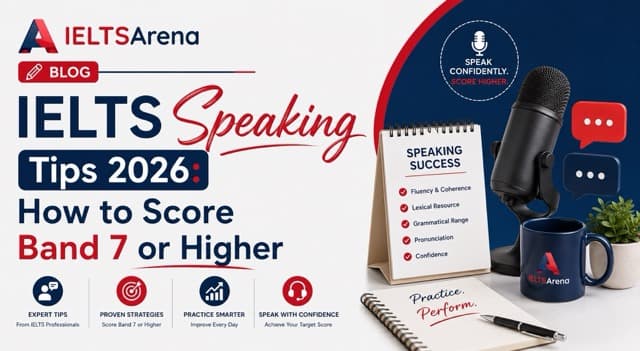
Scoring uses four criteria worth 25% each: Fluency and Coherence, Lexical Resource, Grammatical Range and Accuracy, and Pronunciation.
The difficulty stems from the test feeling conversational while undergoing forensic evaluation. Every long pause, repeated filler word, vocabulary repetition, and mispronounced sound is noted. The examiner is friendly. The scoring is not.
Advertisement
Why Common Preparation Methods Fail
The most common mistakes involve practising alone before mirrors or reading English aloud. Neither replicates actual test conditions with examiners and time pressure.
A second major mistake involves memorising model answers. Examiners detect rehearsed responses and ask follow-up questions outside prepared content. Candidates either freeze or produce noticeably lower-quality responses, resulting in Fluency and Coherence scores that do not reflect their true potential.
A third failure involves focusing exclusively on vocabulary while ignoring Fluency and Coherence. Candidates learn advanced words but cannot string sentences together without pausing to search for the next phrase.
The best IELTS speaking tips target delivery habits, not language acquisition.
A Real Candidate Story: Fatima From Nigeria
Fatima, a 27-year-old nursing graduate from Nigeria, took IELTS twice with consistent Band 6.5 in Speaking. She needed Band 7 for UK nursing registration.
"I always prepared lists of good vocabulary. I knew all the words. But in the test I kept pausing because I was trying to remember which word to use. My fluency was breaking down right when I needed it most."
Fatima started using IELTSArena's Speaking practice module three weeks before her third attempt, completing timed mock Speaking tests with AI feedback on Fluency and Coherence patterns and practising Part 2 responses.
"The feedback showed me exactly how many times I was saying 'um' and 'like' and how long my pauses were. I had no idea it was that bad. Once I saw the numbers, I trained myself to keep speaking even when I was not sure about the next word."
On her third attempt, Fatima scored Band 7.5 in Speaking, half a band above her target.
Research on High-Scoring Speakers
Cambridge Assessment English examiner reports identify consistent patterns in Band 7 candidates: smooth speech flow with only occasional hesitation, vocabulary range for both familiar and abstract topics, accurate complex sentences at least 60% of the time, and clear pronunciation despite non-native accents.
IELTSArena data shows candidates completing ten timed speaking practice sessions improve Fluency and Coherence ratings by an average of 0.7 sub-bands within six weeks.
Most candidates plateauing at Band 6 or 6.5 lose marks in Fluency and Coherence, not Vocabulary or Grammar. This suggests the common advice to "learn more advanced words" addresses the wrong problem entirely.
Seven IELTS Speaking Tips for Band 7+
Tip 1: Keep talking, even when unsure. Fluency means speaking continuously, not perfectly. Use natural filler strategies like "That is an interesting question, let me think about that for a moment" or "I have not thought about this before, but I would say..." These phrases buy thinking time without creating damaging silence.
Tip 2: Develop answers with a three-part structure. Answer plus Reason plus Example. "I prefer the mountains to the beach. I find the quieter environment much more refreshing, especially after a stressful week at work. Last summer I spent five days hiking in the highlands and came back feeling genuinely renewed." This structure maintains speaking flow, adds coherence, and demonstrates grammatical range.
Tip 3: Use vocabulary naturally, not performatively. Band 7 requires precise, topic-appropriate vocabulary without repetition — not rare words. Instead of saying "good" repeatedly, use "beneficial," "valuable," "rewarding," or "constructive." IELTSArena's speaking feedback highlights vocabulary repetition patterns automatically.
Tip 4: Self-correct grammar without stopping. Band 7 speakers make grammatical errors but self-correct smoothly. "I have been living... I mean I lived there for about ten years" shows awareness without hurting Fluency. Stopping completely to correct yourself does harm Fluency ratings.
Tip 5: Prepare flexible content, not scripted answers. Build adaptable stories, opinions, and examples applicable to many topics rather than memorising answers. A professional challenge story suits questions about work, success, failure, learning, leadership, and teamwork. Five or six versatile examples enable natural response rather than hunting for memorised scripts.
Tip 6: Manage Part 2 time effectively. Use the entire one-minute preparation period. Write bullet points, not sentences. Focus on what you will say for each of the four cue card prompts. Spend the final ten seconds deciding your opening sentence for an immediate fluent start. Candidates running out of content at the 90-second mark almost always failed to use the preparation minute effectively.
Tip 7: Record yourself before every practice session. Listening back reveals filler words, pauses, and vocabulary repetition invisible during speaking. Identifying specific patterns is the fastest improvement method. IELTSArena's AI analysis does this automatically, tracking error patterns across sessions.
How IELTSArena Supports Band 7 Speaking
IELTSArena's Speaking module replicates real IELTS Speaking test conditions outside formal test centres.
The platform offers timed speaking simulations for all three parts with cue cards matching official IELTS format and difficulty. After each session, AI analysis generates detailed score reports broken down by Fluency, Vocabulary, Grammar, and Pronunciation with specific improvement feedback.
For Band 7+ candidates, IELTSArena offers human expert feedback from qualified IELTS trainers, combining instant AI scoring with personalised coaching.
Progress tracking shows score trends across sessions, confirming that preparation moves in the right direction before exam day. Many candidates use IELTSArena for the final two to three weeks of targeted speaking preparation.
The question bank covers the full range of Part 1, Part 2, and Part 3 topics in current IELTS exams. Every simulation is timed and scored in exam format, directly building the habits and reflexes the real test rewards.
Start Your Free Speaking Simulation on IELTSArena →
Self-Diagnosis: Where Is Your Speaking Holding You Back?
Before your next practice session, answer these honestly:
- When unsure what to say next, do you stay silent over three seconds or use natural bridging phrases?
- In Part 1 answers, do you give single-sentence responses or extend with reason and example?
- Do you use the same vocabulary words repeatedly or vary word choices across answers?
- Do you self-correct grammar mid-sentence without stopping or pause entirely?
- After the Part 2 preparation minute, can you speak continuously for the full two minutes or run out after 60-90 seconds?
If you hesitate on any of these, the right IELTS speaking tips applied to that specific habit will move your band faster than additional vocabulary or grammar study.
Frequently Asked Questions
What are the most important IELTS speaking test priorities?
Four priorities matter most: maintain smooth speech flow with only occasional hesitation to protect your Fluency score, vary vocabulary to avoid repetition, produce mixed simple and complex grammatical structures, and speak clearly enough for understanding despite your accent. Fluency and Coherence is commonly where candidates lose marks, making smooth delivery the top priority. Vocabulary expansion alone rarely moves a band score if fluency is weak.
How do I avoid long pauses in the IELTS Speaking test?
Use natural bridging phrases: "That is an interesting question," "I have not considered this before, but," or "Let me think about this for a moment." These phrases are used by native speakers and are not penalised. Additionally, practise extending every answer with reason and personal example so more material always follows the initial response. Regular timed practice on IELTSArena builds this habit until it becomes automatic under exam pressure.
Does accent matter in the IELTS Speaking test?
No. IELTS examiners understand a wide range of accents globally. Your accent does not affect your Pronunciation score. What matters is understandable speech. Assessment focuses on clarity, word stress, sentence stress, intonation, and the absence of phonological features that cause misunderstanding. Strong regional accents are not penalised. Poor word stress or intonation that makes meaning difficult to follow are penalised.
How do I use advanced vocabulary naturally in IELTS Speaking?
Build vocabulary in topic-related clusters rather than learning isolated words. For technology, learn together: "transformative," "indispensable," "ubiquitous," "privacy implications," and "digital literacy." When technology topics appear, you have a mental cluster to draw from. Practise using each word in sentences during regular speaking sessions until the words feel natural rather than retrieved. Words that feel forced lower your Lexical Resource score rather than raising it.
What mistakes prevent Band 7 in IELTS Speaking?
Five common barriers exist: one-word or one-sentence answers that fail to demonstrate extended discourse; rehearsed-sounding memorised responses that prompt examiner follow-up; excessive filler words that fragment fluency; vocabulary repetition that signals limited lexical range; and overly cautious speaking where candidates slow down to avoid grammar errors and damage Fluency scores. Targeted practice with detailed AI feedback directly addresses all five.
![IELTS Speaking Part 1 Questions and Answers [2026]: 40+ Real Questions From the Current Cycle](/_next/image?url=%2Fblog%2Fcover-ielts-speaking-part-1-questions-and-answers.jpeg&w=3840&q=75&dpl=dpl_2sNYisMeFMxzdZaDp7gTaeytuEus)