The audio is playing. You are looking for the answer to question 4, and suddenly you hear the answer to question 6. Your brain scrambles. By the time you decide what to write, the speaker has moved on, and now you have lost questions 4, 5, and 6 in one panic.
This is the exact trap of IELTS listening note completion. The audio plays only once. There is no pause, no rewind, no second chance. If you fall behind, the gap widens fast.
Note completion questions test something specific: can you follow a live conversation, predict what is coming, and capture the right word at the right moment. Get the method right and these become some of the easiest marks in the whole Listening test.
What IELTS Listening Note Completion Actually Tests
The IELTS Listening test has four sections, 40 questions, and 30 minutes of audio, followed by transfer time on paper-based tests. Note completion appears most often in Sections 1 and 2.
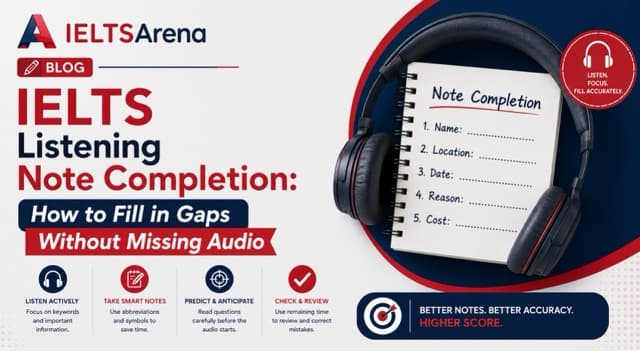
In IELTS listening note completion, you see a set of notes, a form, or a summary with blanks. You listen to the audio and write the missing word or words in each blank as you hear them.
Section 1 is usually a conversation about an everyday situation, such as booking accommodation or joining a club. Section 2 is a single speaker giving information, like a tour guide or an announcement.
The answers are almost always concrete details: names, dates, times, prices, phone numbers, addresses, and simple nouns. The audio gives you these details in order, which is the key advantage you must use.
The challenge is not vocabulary. The challenge is timing. You have to listen, locate, decide, and write, all while the audio keeps moving forward.
Advertisement
Why Most Students Lose Marks on Note Completion
Most test-takers make the same avoidable errors on IELTS listening gap fill questions.
The first mistake is not reading the notes before the audio starts. Every section gives you time to preview the questions. Students who skip this preview have no idea what is coming, so they are always reacting late.
The second mistake is writing full sentences. Note completion needs one to three words only. Students who try to write everything they hear fall behind instantly and miss the next answer.
The third mistake is freezing after a missed answer. One missed blank turns into three because the student keeps looking backward instead of moving forward with the audio.
The fourth mistake is ignoring the word limit. If the instruction says "no more than two words," writing three words scores zero, even if the meaning is correct.
There is also a spelling problem. In IELTS note taking listening, a correctly heard but misspelled answer is marked wrong. Students who capture the right word but spell it incorrectly still lose the mark.
The audio never waits for you. Success in note completion is not about hearing everything, it is about staying with the speaker and letting go of what you missed.
A Realistic Student Story
Amara, a nurse from Nigeria preparing for registration abroad, needed Band 7.0 in Listening. Her first attempt gave her Band 6.0, and note completion was where she bled marks.
"I would hear an answer, start writing it neatly, and while I was writing I missed the next two," she said. "By the end of Section 2 I had three blank spaces and no idea what went in them."
Amara changed two habits. First, she used every second of preview time to read the notes and predict what kind of word each blank needed, a number, a name, or a place. Second, she trained herself to write in shorthand and fix spelling later, so writing never pulled her attention off the audio.
She practised full Section 1 and Section 2 audios repeatedly under real timing until predicting and writing became automatic. On her next attempt she scored Band 7.5 in Listening.
"Once I stopped trying to write perfectly in the moment, I stopped missing answers," Amara said. "Preview time was the thing that changed everything."
Data and Insight: Where the Easy Marks Live
The IELTS Listening test gets progressively harder. Section 1 and Section 2, where note completion is most common, are the most accessible parts of the test.
This matters for your band. On the IELTS Listening test, roughly 30 correct answers out of 40 typically maps to around Band 7.0, and about 23 correct maps to around Band 6.0, according to published IELTS band conversion guidance. The earlier sections are where strong candidates secure the marks that protect their overall band.
Note completion answers follow the audio in order, which removes a major source of confusion. Unlike matching or multiple choice, you always know that the next answer comes after the last one you heard. This predictability is why note completion should be a strength, not a weakness.
British Council and IDP guidance confirms that spelling and word limits are strictly enforced in IELTS listening fill in blanks questions. This means accuracy under pressure, not just comprehension, is what separates a Band 6.0 from a Band 7.5 in these sections.
The takeaway is simple. Note completion offers some of the most reliable marks in the test, but only for candidates who preview, predict, and write efficiently.
The Right Approach to IELTS Note Completion
Here is a step-by-step method that keeps you with the audio instead of chasing it.
- Use preview time fully. Before each section, read every blank. Underline the words around each gap. This tells you what you are listening for and when it is coming.
- Predict the answer type. For each blank, decide what kind of word fits. Is it a number, a date, a name, a place, or a plural noun. Predicting narrows your focus so you catch the answer instantly.
- Follow the signposts. Speakers signal answers with phrases like "the address is," "it costs," and "you will need to bring." These IELTS note completion tips train your ear to know exactly when an answer is arriving.
- Respect the word limit. Read the instruction carefully. "No more than two words and a number" is a rule, not a suggestion. Count your words before you finalise each answer.
- Write in shorthand, then fix later. Capture the sound of the word quickly and correct the spelling during transfer time. Never let writing pull your ears off the audio.
- If you miss one, let it go. Immediately move to the next blank. A missed answer costs one mark. Chasing it costs three. Staying with the speaker is always the right choice.
- Check spelling and grammar at the end. Make sure your answer fits the sentence grammatically and is spelled correctly. A plural that should be singular, or a small spelling slip, will cost the mark.
How IELTSArena Trains Note Completion Under Real Conditions
You cannot fix timing problems by listening slowly at home. You fix them by practising IELTS listening note completion under exact exam conditions, again and again, until previewing and writing become automatic. This is where IELTSArena works.
IELTSArena replicates the real IELTS CBT interface, including the on-screen timer, the notepad, and the single-play audio. You practise note completion exactly as it appears on test day, which trains the timing instinct that decides your Listening band.
The platform gives you a large library of Section 1 and Section 2 audios with note completion, form completion, and gap-fill tasks. You meet the same signposting language and answer patterns repeatedly, so predicting answers becomes second nature.
After each test, IELTSArena shows you the correct answers and highlights exactly which blanks you missed and why. Its progress analytics track your Listening performance over time, so you can see whether your weakness is preview, prediction, spelling, or word limits. More than 10,000 learners have used IELTSArena to turn note completion from a weak spot into a reliable source of marks.
Because IELTSArena is free to start, you can take a full timed Listening test today and see how many note completion marks you are leaving on the table. Begin on IELTSArena and practise with real single-play audio in minutes.
Self-Diagnosis: Are You Ready for Note Completion?
Answer these honestly to see whether your note completion technique needs work.
- Do you read and understand every blank during the preview time before the audio starts?
- Can you predict what type of word each blank needs, such as a number, a name, or a place?
- When you miss one answer, do you move on immediately instead of freezing?
- Do you always check the word limit before finalising an answer?
- Are your answers spelled correctly and grammatically consistent with the sentence?
If you hesitated on two or more, note completion is likely costing you marks that are among the easiest to recover in the whole Listening test.
Turn Note Completion Into Your Strongest Section
Note completion rewards preparation more than raw ability. Preview, predict, write efficiently, and let go of what you miss, and these questions become dependable marks.
Take one free timed Listening test on IELTSArena and see exactly where you stand. In a single test you will know how many note completion answers you are catching and how close you are to your target band.
Take a Free Listening Test on IELTSArena →
Frequently Asked Questions
How do I keep up with the audio when filling in blanks in IELTS listening?
Stay ahead of the audio instead of chasing it. Use the preview time before each section to read every blank and predict what type of word you are listening for. Follow the notes in order, because note completion answers always come in the same sequence as the audio. Write in quick shorthand and fix spelling later, so writing never distracts your ears. If you miss one answer, move on instantly rather than looking backward. Practising full single-play tests on IELTSArena trains this timing instinct, which is the real skill that decides your note completion score.
How many words can I write for each blank in IELTS listening note completion?
You must follow the exact word limit in the instruction, which is usually "no more than two words" or "no more than three words and a number." Writing even one word over the limit scores zero, even if your answer is correct. Numbers written as figures usually count as one item, and hyphenated words are typically counted as one word. Always read the instruction for each set of questions, because the limit can change between sections. Count your words before finalising each answer. On IELTSArena you practise these exact word-limit rules under real timing, so the habit becomes automatic before test day.
How do I know where the answer is coming when listening in IELTS?
Speakers give you signals just before the answer. Listen for phrases like "the address is," "it costs," "you should bring," and "the next meeting is on." These signposts tell you an answer is arriving. During preview time, look at the words printed around each blank, because you will hear those same words or their synonyms in the audio moments before the answer. This is why previewing matters so much. Note completion answers also follow the audio in order, so you always know the next answer comes after the last one. IELTSArena drills these signposting patterns across many real Section 1 and Section 2 tasks.
What happens if I miss the audio for one question in IELTS note completion?
You lose only that single mark, so do not let one miss become three. The most common and damaging mistake is freezing and trying to recall a missed answer while the audio keeps playing. That backward focus makes you miss the next two answers as well. The correct response is to accept the miss, move your eyes to the next blank, and stay with the speaker. You can make an educated guess later during checking time, because a blank scores zero anyway. Practising under real single-play conditions on IELTSArena trains you to recover instantly instead of panicking.
How do I practise IELTS listening note completion before the exam?
Practise with full, timed, single-play audio that matches the real exam, not by pausing and replaying. Focus first on Section 1 and Section 2 tasks, where note completion is most common. After each test, review which blanks you missed and why, whether it was preview, prediction, spelling, or the word limit. Repeat until previewing and shorthand writing become automatic. IELTSArena is built for this, because it replicates the real CBT interface with single-play audio and a timer, gives you a large library of note completion tasks, and tracks your progress so you can see your Listening band improve test by test.