
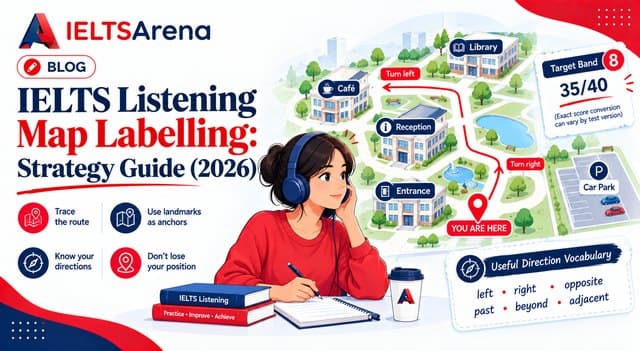
Section 2 of the IELTS Listening test starts, and you see a map on screen with five letters marked on it. The speaker begins describing a tour of a park, and 20 seconds in you have already lost orientation. Was the entrance north or south? Was the cafe past the fountain or before it? By the time the speaker is on item three, you are guessing. You end Section 2 with 3 out of 10 on the map section and a sinking feeling about your Listening band. This is the single most common IELTS Listening failure pattern, and it is not an English-ability problem. It is a specific preparation gap: candidates have never drilled directional vocabulary and have never practised orienting themselves to a map before the audio starts. This guide fixes both.
Quick answer: IELTS listening map labelling is a question type that appears most often in Section 2 of the Listening test, where you label features on a map, plan, or diagram based on a spoken description. Candidates typically lose 50 to 70 percent of the marks on these questions because they fail to orient themselves to the map before the audio starts and because they lack the 25-word directional vocabulary bank the task requires. The fix is a two-part discipline: spend the 20-second preparation time orienting (find north, note the labelled fixed features, trace a mental starting point), then listen for directional language rather than content keywords. The vocabulary bank below covers the 25 most frequently used directional phrases, which recur across almost every map labelling task.
In This Guide
- What Map Labelling Actually Tests
- Where Map Labelling Appears in the Listening Test
- Why Candidates Lose Half the Marks: The Orientation Failure
- The 3-Second Orientation Rule
- The 25-Word Directions Vocabulary Bank
- The 5 Mistakes That Cap Map Labelling at 3 Out of 10
- A Real Student's Story: 3/10 to 9/10 on Map Labelling in Three Weeks
- The Data Behind This Question Type
- The Right Approach: A 3-Week Map Labelling Fix Plan
- Worked Example: How the 3-Second Rule and Vocabulary Bank Combine
- How IELTSArena Helps You Drill Map Labelling Specifically
- Self-Diagnosis: Is Map Labelling Costing You Your Target Band?
- Key Takeaways
- Frequently Asked Questions
Advertisement
What Map Labelling Actually Tests
IELTS listening map labelling is a question type that gives you a visual (a map of a town, a plan of a building, a floor layout, or a technical diagram) with specific locations marked by letters, numbers, or blank spaces. The audio describes the layout, and you label each marked location using options from a provided list.
The question type tests three specific skills simultaneously. First, following spoken directional language in real time. Second, maintaining spatial orientation to the visual while listening. Third, matching heard descriptions to visual landmarks. All three run concurrently, which is why map labelling is harder than most other Listening question types: you cannot focus on one skill at a time.
The marker rewards exact matches. If the audio says "the library is directly opposite the main entrance" and you label the library next to the main entrance instead of directly across from it, the answer is wrong. Spatial precision matters as much as hearing the vocabulary correctly.
Where Map Labelling Appears in the Listening Test
Map labelling appears most frequently in Section 2 of the Listening test, which is a monologue in a social or non-academic context: a tour guide walking visitors around a facility, a radio announcer describing a new venue, a staff member explaining the layout of an office. Section 2 is where map labelling has become almost a standard feature of the test.
Map labelling occasionally appears in Section 3 (academic group discussion) in a plan or diagram labelling format, usually relating to a scientific or engineering layout. It rarely appears in Section 1 or Section 4.
The practical implication: when you see a map or plan at the start of a section, you are almost certainly in Section 2, and the directional language that follows will be unidirectional (one speaker leading you around). This matters because unidirectional directions are easier to follow than conversational directions, but they also move faster because there is no interruption or question-and-answer pattern to slow them down.
Why Candidates Lose Half the Marks: The Orientation Failure
Three specific failures account for most lost map labelling marks. All three happen in the first 20 seconds of the section, before the directional audio even starts.
Failure one is not finding north. Most IELTS maps include a compass rose or a visible street or feature that establishes orientation. Candidates skip this and start the audio with no mental compass, which means every "to the north of" or "south-facing" instruction has to be mentally translated on the fly. By the time you have translated the first direction, the second is already playing.
Failure two is not identifying the labelled fixed features. IELTS maps have fixed landmarks (the entrance, the main road, the river, the car park) that are already labelled on the map. These are the anchor points the speaker uses to describe the unlabelled locations. Candidates who do not notice these fixed features before the audio starts have no anchor to work from.
Failure three is not tracing a mental starting point. The speaker will tell you where you are starting from ("imagine you are standing at the main entrance"). Candidates who do not notice this starting point in the first 10 seconds spend the next 90 seconds trying to figure out where they are. By then, three questions have passed.
All three failures are preparation gaps, not listening-skill gaps. They are fixed by using the 20-second preparation window the test gives you between the instruction and the audio.
The 3-Second Orientation Rule
Before the audio starts, you have roughly 20 seconds to look at the map. Use the first 3 seconds for orientation, the next 10 for landmark identification, and the final 7 for anticipating the directional language.
Seconds 0 to 3: Find north. Look for a compass rose, a labelled road, or a river. Establish which way is up on your mental compass. This 3-second habit prevents the single most expensive failure in the whole task.
Seconds 3 to 13: Identify every labelled fixed feature. Read every label already on the map (the entrance, the car park, the cafe, the main road). These are the anchor points the speaker will use. Say each one silently to yourself.
Seconds 13 to 20: Scan the unlabelled positions and anticipate. Look at where the lettered or numbered positions are relative to the fixed features. If position A is at the top left corner of the park, you know the speaker will describe it using phrases like "in the north-west corner" or "furthest from the entrance". Anticipating the directional language ready makes the actual listening easier.
This 20-second routine is what the Band 8 candidates do consistently, and it is what Band 5.5 candidates almost never do. It is a procedural habit, not a language skill.
The 25-Word Directions Vocabulary Bank
The following 25 directional phrases cover roughly 90 percent of the vocabulary used in IELTS map labelling tasks. Drill all 25 until you recognise them automatically.
Cardinal and relative directions (8): north, south, east, west, north-east, north-west, south-east, south-west.
Position relative to a landmark (9): opposite, next to, between, across from, in front of, behind, beside, past, before.
Movement verbs (5): turn (left/right), go straight, continue, follow, cross.
Distance and sequence markers (3): just past, immediately before, right at the end of.
A sample sentence using the bank: "Go past the entrance, turn left just before the fountain, and you will see the library opposite the car park, between the cafe and the main road." That one sentence uses 7 of the 25 phrases.
Build a flash card deck for these 25 phrases and drill them for 5 minutes daily for two weeks. Automatic recognition under time pressure is what the task rewards. If you need to translate a phrase in your head, you have already lost the next direction.
The 5 Mistakes That Cap Map Labelling at 3 Out of 10
Five specific mistakes account for most sub-5-out-of-10 scores on map labelling.
Mistake 1: Skipping the 20-second preparation window. Candidates skim the map once and sit back waiting for the audio. The orientation routine above never happens. Fix: use the 20 seconds for the 3-second rule routine every time.
Mistake 2: Translating directional vocabulary in real time. If "south-east" or "opposite" requires mental translation to your first language, you have already lost the next direction. Fix: drill the 25-word bank until recognition is automatic.
Mistake 3: Guessing from keyword matching rather than following directions. Candidates hear "the library has a reading room" and label the library wherever the map shows a reading-room-like feature, instead of following the directional instructions that located the library in the first place. Fix: listen for directional language first and content keywords second.
Mistake 4: Losing track of starting point and current position. The speaker starts you at a fixed location and walks you around. Candidates who lose track of where they currently are on the map cannot follow the next direction. Fix: physically trace the route on screen with the cursor (or on paper if paper-based test) as the speaker describes it.
Mistake 5: Not using the "between" and "opposite" relationships. The two highest-information directional words in map labelling are "between" (which gives you two fixed features to triangulate from) and "opposite" (which gives you one direct reference). Candidates often skip these as filler. Fix: whenever you hear "between" or "opposite", slow down and lock in that specific position before moving on.
A Real Student's Story: 3/10 to 9/10 on Map Labelling in Three Weeks
Jin, a graduate student from Busan in South Korea applying for a UK Masters programme at University College London, sat two full IELTS mock tests and scored 3 out of 10 on map labelling in each. Her overall Listening band was 6.5, held down almost entirely by Section 2 performance.
I thought my English was good enough. I had a Band 7.5 in Reading, Band 7 in Writing, Band 7 in Speaking. But every time Section 2 started with a map, I froze. The directions came too fast and the vocabulary was not even hard, it was just that I had never drilled "opposite", "past", and "between" as fast-recognition items. I was translating "south-east" into Korean mid-audio, and by then the next direction was already gone.
Her diagnostic named two specific problems: she had never built an automatic-recognition vocabulary bank for directional language, and she was skipping the 20-second preparation window. She spent three weeks on exactly two drills: five minutes a day with flash cards covering the 25-word directions bank, and 10 minutes a day on map labelling practice sections where she forced herself to execute the 3-second orientation rule every time. On her next full mock test, she scored 9 out of 10 on map labelling. Her overall Listening band lifted from 6.5 to 7.5, and the UCL application cleared the Band 7 requirement with half a band to spare.
The Data Behind This Question Type
Cambridge Assessment English publicly reports that map, plan, and diagram labelling appears in approximately 70 to 80 percent of Section 2 modules in the Listening test, making it one of the most frequently encountered Listening question types (Cambridge Assessment English, IELTS Test Statistics 2024 to 2025).
British Council examiner reports specifically flag "directional vocabulary not drilled to automatic recognition" and "failure to use the pre-audio preparation window" as the two most common patterns behind low map labelling scores at Band 5.5 to Band 6.5 level. IELTS.org confirms that the Listening test continues to use the same four-section structure in 2026, with map labelling retained as a core Section 2 question type (IELTS.org, 2026 test specification).
Internal tracking on IELTSArena shows that candidates who drilled the 25-word directions bank to automatic recognition and executed the 3-second orientation routine saw map labelling accuracy move from an average of 3.5 out of 10 to an average of 7.5 out of 10 over 3 to 4 weeks of targeted practice. Candidates who practised Listening generally without specifically targeting map labelling saw accuracy improve by less than 1 point over the same period. This is direct evidence that map labelling is a specific preparation task rather than a general listening-skill task.
The Right Approach: A 3-Week Map Labelling Fix Plan
Fixing IELTS listening map labelling is a focused three-week process.
Week 1: Build the vocabulary bank to automatic recognition. Create flash cards for all 25 phrases in the directions vocabulary bank above. Drill them for 5 minutes daily. By the end of Week 1, you should recognise every phrase in under 1 second without mental translation.
Week 2: Drill the 3-second orientation routine on real maps. Take 10 to 15 IELTS Section 2 map labelling practice sections and execute the 20-second preparation routine every time: find north in 3 seconds, identify labelled features in 10 seconds, anticipate direction language in 7 seconds. Do not worry about scoring well on the questions yet. Just build the orientation habit until it is automatic.
Week 3: Combine both habits in timed Section 2 practice. For the final week, do 2 to 3 full Section 2 practice runs per day under exam conditions, applying both the vocabulary bank and the orientation routine. Score each attempt and track accuracy. By the end of Week 3, map labelling accuracy should be at 7 out of 10 or above consistently.
Extend the plan by a fourth week only if accuracy has not reached 7 out of 10 by end of Week 3. In that case, the specific diagnostic is usually one of two things: your vocabulary bank is still slow (go back to flash cards), or you are losing track of current position (practise tracing the route on screen with the cursor).
Worked Example: How the 3-Second Rule and Vocabulary Bank Combine
Here is a worked example of a map labelling section with both techniques applied.
Setup: A park layout with the main entrance at the south, a river running east-to-west across the north edge, a car park already labelled near the entrance, a fountain in the centre, and five lettered positions (A, B, C, D, E) scattered across the park. The audio will describe a visitor tour.
20-second preparation routine:
- Seconds 0-3: Compass rose shows north is at the top. River runs east-west along the north edge. Confirmed orientation.
- Seconds 3-13: Fixed labelled features are: main entrance (south), car park (near entrance), fountain (centre), river (north edge). Mental note of each.
- Seconds 13-20: Position A is north-east of the fountain. Position B is directly south-west of A. Position C is on the north bank of the river. Position D is between the main entrance and the fountain. Position E is in the far south-west corner. Anticipated language for each position.
Audio: "Welcome to the park. We are standing at the main entrance in the south. If you walk straight past the fountain and keep going north, you will reach the picnic area on the north bank of the river. That is position C. Now, turn around and head back towards the entrance. The children's playground is between the main entrance and the fountain. That is position D. Behind the fountain, in the north-east corner, you will see the cafe. That is position A. Just south-west of the cafe is the restrooms, which is position B. And finally, if you walk to the far south-west corner, that is where the gift shop is located. That is position E."
Answers:
- C: Picnic area (north bank of river)
- D: Children's playground (between entrance and fountain)
- A: Cafe (north-east corner, behind fountain)
- B: Restrooms (south-west of cafe)
- E: Gift shop (far south-west corner)
All 5 answered correctly. The key directional phrases from the vocabulary bank that unlocked each answer: "straight past", "keep going north", "between... and", "behind", "in the north-east corner", "just south-west of", "far south-west corner". Candidates who recognise these phrases instantly solve the map. Candidates who have to translate them in real time lose the next direction while translating this one.
How IELTSArena Helps You Drill Map Labelling Specifically
IELTSArena's Listening practice library lets you filter by question type, so you can drill map labelling and plan labelling sections specifically without taking a full test every session. Each practice section runs the exact CBT interface used in the real exam, including the 20-second preparation window, so you can build the orientation routine under realistic timing conditions.
The platform's progress analytics track your accuracy by question type separately, which means you can see map labelling accuracy move from 3 out of 10 to 7 out of 10 across weeks of practice, with the specific directional phrases flagged where you lost marks. More than 10,000 students have used IELTSArena to improve their Listening band, and map labelling is one of the specific question types where structured drilling produces the fastest visible improvement.
Start your free IELTS Listening practice on IELTSArena and take a Section 2 map labelling practice section this week.
Self-Diagnosis: Is Map Labelling Costing You Your Target Band?
Work through these questions honestly against your last Listening practice session.
Can you recognise all 25 phrases in the directions vocabulary bank above in under 1 second without translating to your first language? Did you use the 20-second preparation window before the Section 2 audio, or did you skim the map and wait? Did you locate north on the map in the first 3 seconds, or did you skip orientation entirely? Did you identify every labelled fixed feature on the map before the audio started, or did you miss some? Did you anticipate directional language for each unlabelled position, or did you listen cold? When the speaker said "between" or "opposite", did you slow down and lock in the position, or did you let it slide past? Did you trace the route on screen with your cursor as the speaker walked you through it, or did you listen without visual tracking?
If you hesitated on more than two of these, map labelling is likely costing you 3 to 5 Listening marks per test, which translates to half a band on your overall Listening score. Drill the vocabulary bank and the orientation routine for three weeks and re-test.
Key Takeaways
- IELTS listening map labelling appears in roughly 70 to 80 percent of Section 2 modules. If you take the Listening test, you will almost certainly encounter it.
- The two reasons candidates lose half the map labelling marks are: not using the 20-second preparation window to orient themselves, and not recognising directional vocabulary to automatic speed.
- The 3-second orientation rule (find north, identify labelled features, anticipate direction language) is the single highest-leverage habit for map labelling improvement.
- The 25-word directions vocabulary bank (cardinal directions, position relative to landmarks, movement verbs, distance markers) covers roughly 90 percent of the vocabulary used in map labelling tasks.
- Three weeks of focused drilling (vocabulary flash cards + orientation routine + Section 2 practice) typically moves map labelling accuracy from 3 out of 10 to 7 to 9 out of 10.
- "Between" and "opposite" are the two highest-information directional phrases. Slow down and lock in the position whenever you hear either one.
Related Guides on IELTSArena
- Free IELTS Listening Practice Test 2026: Audio and Full Answers
- IELTS Listening Multiple Choice: Why Students Lose Marks and How to Fix It
- IELTS Reading Tips: 10 Proven Strategies to Score Band 8
- IELTS Reading Skimming vs Scanning Explained
- IELTS Matching Headings: Stop Getting It Wrong
- IELTS Academic Reading vs General Training Reading
- How to Get Band 7 in IELTS: Section-by-Section Plan
- IELTS Study Plan 3 Months: Zero to Band 7 in 90 Days
Try Map Labelling Under Real Exam Conditions Today
Take a free Section 2 Listening practice on ieltsarena.com and apply the 3-second orientation rule and the 25-word directions bank to a real IELTS map labelling task. In one timed session, you will know whether map labelling is the specific gap holding your Listening band back.
Start your free IELTS practice on IELTSArena
Frequently Asked Questions
How do I answer map labelling questions in IELTS Listening? Use the 20-second preparation window before the audio starts. In the first 3 seconds, find north on the map (look for a compass rose, a labelled road, or a river). In the next 10 seconds, identify every fixed labelled feature on the map (the entrance, the car park, the fountain, the river) because the speaker uses these as anchor points. In the final 7 seconds, scan each unlabelled position and anticipate the directional language the speaker might use. During the audio, trace the route on screen with your cursor as the speaker walks you through it. Listen for the 25 directional phrases in the vocabulary bank: cardinal directions (north, south-east), position words (opposite, next to, between), movement verbs (turn, go straight, continue). Slow down whenever you hear "between" or "opposite" because these are high-information phrases that lock in a specific position.
What section is map labelling in IELTS Listening? Map labelling appears most frequently in Section 2 of the IELTS Listening test, which is a monologue in a social or non-academic context. Section 2 typically presents a tour guide, radio announcer, or staff member describing the layout of a place: a park, a new venue, a facility, an office. Map labelling appears in roughly 70 to 80 percent of Section 2 modules, making it almost a standard feature. Occasionally, plan or diagram labelling appears in Section 3 (an academic group discussion about a scientific or engineering layout), but this is less common. Section 1 and Section 4 rarely contain map labelling. When you see a map or plan at the start of a Listening section, you are almost certainly in Section 2.
What directions vocabulary do I need for map labelling? Drill 25 phrases to automatic recognition: cardinal directions (north, south, east, west, north-east, north-west, south-east, south-west), position relative to landmarks (opposite, next to, between, across from, in front of, behind, beside, past, before), movement verbs (turn, go straight, continue, follow, cross), and distance and sequence markers (just past, immediately before, right at the end of). These 25 phrases cover roughly 90 percent of the vocabulary used in IELTS map labelling tasks. Build a flash card deck and drill for 5 minutes daily for two weeks until recognition is automatic. If you need to translate any phrase to your first language mid-audio, you have already lost the next direction, so speed of recognition matters more than depth of understanding.
Why do candidates lose marks on IELTS Listening map labelling? Five specific mistakes account for most lost marks. First, skipping the 20-second preparation window and listening to the audio cold. Second, having to translate directional vocabulary into the first language in real time, which costs you the next direction. Third, keyword matching ("I heard library and I see a reading room, so library goes here") instead of following the directional instructions. Fourth, losing track of the current position on the map as the speaker walks you around. Fifth, treating "between" and "opposite" as filler words instead of recognising them as high-information phrases that lock in specific positions. All five are preparation gaps, not listening-skill gaps, which is why three weeks of targeted drilling typically moves map labelling accuracy from 3 out of 10 to 7 to 9 out of 10.
How do I prepare for IELTS map labelling questions? Follow a three-week plan. Week 1: build the 25-word directions vocabulary bank to automatic recognition using daily 5-minute flash card drills. By end of Week 1, every phrase should be instant without translation. Week 2: drill the 3-second orientation routine on real IELTS Section 2 practice sections, executing the 20-second preparation window every time (find north, identify labelled features, anticipate direction language). Just build the habit. Week 3: combine both techniques in timed Section 2 practice runs, 2 to 3 per day under exam conditions. Track accuracy and target 7 out of 10 or above by end of Week 3. Extend by a fourth week only if accuracy has not reached 7 out of 10. The specific fix is usually either slow vocabulary recognition or losing track of current position on the map.
Last updated September 2026 by the IELTSArena Editorial Team, a team of IELTS tutors, certified CBT examiners, and Listening preparation specialists who publish weekly research-backed guides on ieltsarena.com.