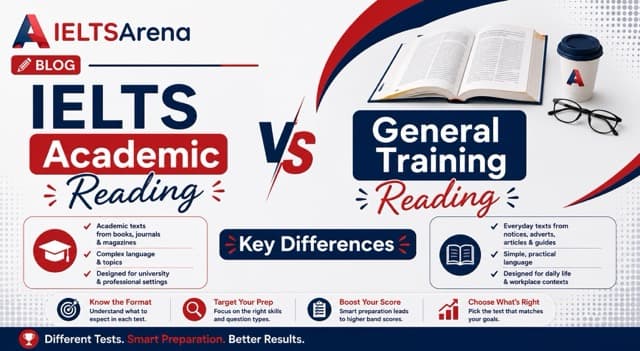
Two test-takers walk into the same exam room. One is applying to a university, the other is applying for permanent residency. They sit the same Listening and Speaking tests, but their Reading papers are completely different.
This single difference confuses thousands of test-takers every year. Many prepare with the wrong materials, walk in expecting one format, and face another.
Understanding IELTS Academic Reading vs General Training Reading is not a minor detail. It decides which practice tests you use, how hard the texts will be, and how the band scores are calculated.
This guide lays out every key difference so you prepare for the exact test you are taking.
What IELTS Academic Reading vs General Training Reading Means
Both versions of the Reading test last 60 minutes, contain three sections, and ask 40 questions in total. There is no transfer time, so whatever you write on the answer sheet within the hour is final.
The difference lies in the texts and their purpose. Academic Reading is for people applying to universities and professional registration bodies. General Training Reading is for people applying for work, migration, or secondary education.
In the IELTS Academic Reading vs General Training Reading comparison, the question types are largely shared, but the source material and difficulty curve are not.
Academic Reading uses three long passages taken from journals, books, magazines, and newspapers. These texts are written for an educated, non-specialist audience and often deal with abstract or research-based ideas.
General Training Reading uses a wider range of shorter texts in its early sections, then moves toward a longer, more complex passage at the end. The material is drawn from notices, advertisements, company handbooks, and general interest articles.
So the format frame is the same, but the reading experience differs significantly across the two versions.
Advertisement
Why Common Approaches to the Two Versions Fail
The first mistake is assuming the two tests are interchangeable. Test-takers download any IELTS Reading practice they find online and never check whether it matches their version. They then train on the wrong difficulty level.
The second mistake is underestimating General Training. Many assume General Training Reading is easy throughout. In reality, the final section reaches a difficulty close to Academic level, and unprepared test-takers lose marks there.
The third mistake is overestimating the gap. Some Academic candidates believe General Training is so different that no skills carry over. In fact, the core reading strategies and most question types are shared.
The fourth mistake is ignoring the band score difference. The same number of correct answers does not produce the same band in both versions, because General Training is marked on a slightly stricter scale.
The fifth mistake is practising without timing. Both versions demand 40 answers in 60 minutes with no extra transfer time, and pacing fails just as often as comprehension does.
A Realistic Student Story
Mei, an accountant from the Philippines applying for skilled migration to Australia, spent six weeks preparing with Academic Reading materials because that was what she found first online.
"I did not realise there were two different Reading tests," Mei said. "I trained on dense science passages when my actual exam used workplace documents and general articles."
Her practice was not wasted, because the strategies transferred, but she had been preparing for harder texts than she needed in the early sections, and she had not practised the specific format of General Training questions.
Two weeks before her exam, she switched to General Training Reading practice. The early sections felt manageable, but the final passage surprised her with its Academic-level difficulty.
She focused her remaining time on that last section. On test day she scored Band 7.5 in Reading, comfortably above the Band 6.0 she needed for migration.
Mei's experience shows why understanding IELTS Academic Reading vs General Training Reading early saves weeks of misdirected effort.
Data and Insight on the Two Reading Versions
According to IELTS official guidance, General Training Reading is marked on a slightly more demanding scale than Academic. To reach Band 7, a General Training candidate generally needs to answer more questions correctly than an Academic candidate would for the same band.
The British Council notes that Academic Reading texts are deliberately chosen to be challenging in vocabulary and concept, since they reflect the demands of university study.
IDP IELTS preparation material confirms that General Training Section 3 uses a single longer passage of comparable complexity to Academic texts, which is why the "General Training is easy" assumption costs marks.
Consider the band conversion. On a typical Academic Reading test, around 30 correct answers out of 40 maps to roughly Band 7.0. On General Training, reaching the same band usually requires closer to 34 correct answers. That four-answer gap matters when you are planning your target.
Examiner commentary consistently shows that pacing, not vocabulary, is the most common reason test-takers fail to finish either version within the hour.
The two Reading tests share a skeleton of strategy, but they live in different worlds of text difficulty and band scoring.
The Right Approach to Preparing for Each Version
Here is how to prepare correctly once you know which version you are sitting.
Step 1: Confirm your version first. Check your application requirement. University and professional registration almost always need Academic. Migration, work, and secondary schooling usually need General Training. Confirm before you buy any materials.
Step 2: Practise with the matching test type. Use Academic practice for Academic and General Training practice for General Training. The strategies overlap, but the texts and difficulty curve must match your real exam.
Step 3: Master the shared question types. Both versions use multiple choice, True/False/Not Given, matching headings, sentence completion, summary completion, and matching information. These skills transfer fully, so build them regardless of version.
Step 4: For Academic, train on dense, abstract texts. Read science and social science articles, practise paraphrase recognition, and build the stamina to handle three long passages back to back.
Step 5: For General Training, do not neglect the final section. Sections 1 and 2 are manageable, but Section 3 reaches Academic-level difficulty. Spend a disproportionate share of your practice on that final passage.
Step 6: Train pacing relentlessly. Both versions give you 60 minutes for 40 questions with no transfer time. Aim for around 20 minutes per main section and never spend too long on a single question.
If you prepare for Academic Reading, you are mostly prepared for General Training, because the question types and core skills are shared. The reverse is less true, since General Training practice does not expose you to the dense abstract texts Academic demands.
How IELTSArena Helps You Prepare for the Right Test
The biggest risk in the IELTS Academic Reading vs General Training Reading decision is practising the wrong version. IELTSArena removes that risk by supporting both Academic and General Training, so you train on the exact test you will sit.
When you create an account on IELTSArena, you choose your test type and practise with real exam-style passages and the full range of question types for that version.
Because IELTSArena replicates the real IELTS CBT interface, you read on screen with the highlighter and notepad tools, scroll through passages the way you will on test day, and build the on-screen reading stamina the computer-based test requires.
IELTSArena's progress analytics track your Reading accuracy by question type, so you can see whether True/False/Not Given or matching headings is costing you marks, and target your weak areas directly.
For General Training candidates, IELTSArena lets you focus practice on the harder final section, which is where most General Training test-takers lose marks they did not expect to lose.
More than 10,000 learners have used IELTSArena to prepare for both Reading versions, and the platform shows you a realistic band estimate after each test. The combination of real CBT simulation, both test types, and detailed analytics is what makes IELTSArena reliable for Reading preparation.
You can take a free Reading test on IELTSArena in minutes and confirm you are practising the right version before you invest weeks of study.
Self-Diagnosis: Are You Preparing for the Right Test?
Ask yourself these five questions before your next study session.
- Do you know for certain whether your application requires Academic or General Training Reading?
- Are the practice tests you use matched to your exact version, or did you download whatever you found first?
- If you are sitting General Training, have you practised the harder final section as much as the easier early sections?
- Can you complete 40 Reading questions in 60 minutes without running out of time?
- Do you know which question types cost you the most marks across your recent practice tests?
If you were unsure on any of these, your Reading preparation may be misaligned. Confirming your version and practising the matching format is the fastest way to protect your band score.
Start Practising the Right Reading Test Today
Do not lose weeks preparing for the wrong version. Confirm your test type, then practise the exact format you will face.
Take a Free Reading Practice on IELTSArena →
Frequently Asked Questions
Is the IELTS general training reading section easier than academic?
The early sections of General Training Reading use simpler, everyday texts, so they feel easier than Academic passages. However, General Training is marked on a slightly stricter scale, so you need more correct answers to reach the same band. The final section of General Training also reaches a difficulty close to Academic level. So the test is easier in places but harder to score in, and the last passage is genuinely demanding. In the IELTS Academic Reading vs General Training Reading comparison, neither version is simply easier overall. Practising the correct version on IELTSArena helps you judge your real readiness for your specific test.
What kind of texts appear in IELTS general training reading compared to academic?
General Training Reading uses everyday texts such as notices, advertisements, timetables, company handbooks, and general interest articles, moving from short practical texts in the early sections to a longer, more complex passage at the end. Academic Reading uses three long passages from journals, books, magazines, and newspapers written for an educated non-specialist audience, often covering abstract or research-based topics. The General Training texts reflect daily life, work, and study contexts, while Academic texts reflect university-level reading demands. This difference in source material is one of the clearest distinctions when comparing IELTS Academic Reading vs General Training Reading, even though both share the same question types.
Do IELTS academic and general training reading use the same question types?
Yes, both versions use largely the same question types, including multiple choice, True/False/Not Given, matching headings, matching information, sentence completion, and summary completion. This is why core reading strategies transfer between the two versions. The difference is not the question format but the texts those questions are based on and the difficulty curve across the three sections. Because the question types overlap, skill-building practice benefits both versions. On IELTSArena you can practise every shared question type and review your accuracy on each, which helps whether you are preparing for Academic or General Training Reading.
How do I prepare for IELTS general training reading part C which is academic level?
The final section of General Training Reading uses a single longer passage with difficulty close to Academic Reading, so treat it differently from the easier early sections. Spend a larger share of your practice time on this passage, focus on paraphrase recognition and True/False/Not Given accuracy, and build the stamina to stay focused on a dense text at the end of the hour. Practise it under timing, because pacing fails most often on this section. IELTSArena lets you target the harder final section specifically and tracks your accuracy on it, so you can see real improvement before test day.
If I prepare for IELTS academic reading am I also prepared for general training reading?
Largely yes. The two versions share the same question types and core reading strategies, so Academic preparation builds skills that transfer to General Training. Academic texts are generally harder than the early General Training sections, so if you can handle Academic passages, the first two General Training sections will feel manageable. The one gap is format familiarity, since you should still practise the specific General Training question style and timing. The reverse is less reliable, because General Training practice does not expose you to the dense abstract texts Academic demands. Practising your exact version on IELTSArena closes any remaining gap.