

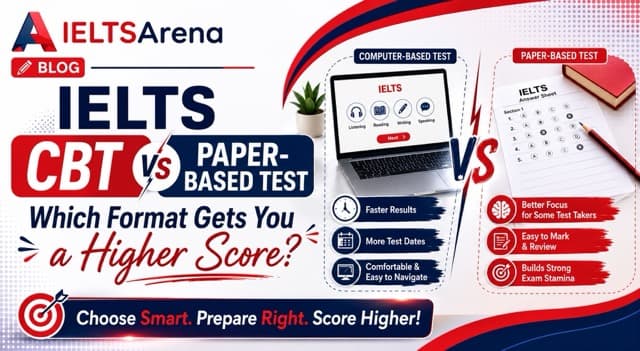
You are about to book your IELTS test and one question stops you: computer or paper. The wrong choice for your habits can cost you half a band before you have answered a single question.
The IELTS CBT vs paper based decision is one of the most searched questions in IELTS preparation, and for good reason. The content of the test is identical, but the experience is very different, and that experience affects how you perform on test day.
This guide breaks down exactly how the two formats differ, which one suits your strengths, and how to prepare so the format works for you instead of against you.
The Real Difference Between the Two Formats
First, the most important fact. The questions, the scoring, the band descriptors, and the difficulty are exactly the same in both formats. IELTS is IELTS, whether you take it on a computer or on paper.
What changes is the delivery. In the computer-based test, you read on a screen, type your Writing answers, and click your responses for Listening and Reading. In the paper-based test, you write by hand and mark answers on a paper sheet.
The Speaking test is identical in both. It is always a face-to-face conversation with a real examiner, whether you book computer or paper for the other three sections. This is the first thing to understand in any IELTS CBT vs paper based comparison.
Timing differs slightly in Listening. In the computer-based test, you usually get about two minutes at the end to check answers, instead of the ten-minute transfer time given in the paper test, because there is nothing to transfer.
Results also differ in speed. Computer-based results typically arrive in three to five days. Paper-based results usually take around 13 days. For test-takers facing a tight visa or admission deadline, that gap matters.
So the IELTS CBT vs paper based choice is not about easier or harder content. It is about which delivery suits the way you read, write, and manage time under pressure.
Advertisement
Why Choosing the Wrong Format Hurts Your Score
Many test-takers pick a format based on habit or fear, not on their actual strengths. That is where scores quietly leak away.
Some students choose paper because computers make them nervous, then lose Writing marks because their handwriting is slow and messy under time pressure. The examiner cannot reward what they cannot read.
Others choose the computer test because it sounds modern, then struggle because they have never practised reading long passages on a screen or typing an essay against the clock.
The mismatch is the problem. A strong typist who picks paper wastes their biggest advantage. A slow typist who picks computer adds stress they did not need.
Then there is the Reading section. On screen, you cannot underline a passage with a pen the way you would on paper. Some readers rely heavily on physical annotation and feel lost without it, while others love the on-screen highlighter and find paper slow.
The honest truth is that the best format is the one that matches your habits, and most test-takers never test their habits before booking. They guess, and the guess costs them.
The IELTS format does not raise or lower difficulty. It raises or lowers how much your own strengths can show.
A Real Student Story: The Format That Changed the Result
Sofia, a 24-year-old engineering graduate from the Philippines, took the paper-based test first and scored Band 6.5 overall, with Writing at 6.0. She needed Band 7 in Writing for her Australian skilled visa.
Her ideas were strong, but two things hurt her on paper. Her handwriting slowed her down, so she never finished checking her essays. And counting words by hand wasted minutes she did not have.
"I assumed paper was safer because I grew up writing by hand," Sofia said. "I did not realise typing would let me edit my essay and see the word count instantly."
For her second attempt, she switched to the computer-based test and practised typing essays under timed conditions for three weeks. She could now edit sentences without rewriting, and the on-screen word counter removed the guesswork.
Her Writing rose to 7.0 and her overall to 7.5. The content of her essays was similar. The format simply let her strengths come through.
Sofia's case is not unusual. For test-takers who type faster than they write, the computer test advantages in Writing alone can lift the band that matters most.
What the Data Says About Format Choice
The computer-based format has grown rapidly since IDP and British Council expanded it across test centres worldwide. Computer-delivered IELTS is now available in most major test cities and on far more dates than paper.
According to information published by the official IELTS partners, scores are statistically equivalent across both formats. No format gives an inherent scoring advantage, because the marking is identical and Writing and Speaking are assessed by trained human examiners in both.
The practical advantages cluster in three areas. First, speed of results, with computer results in three to five days versus around 13 for paper. Second, test availability, with computer test dates often offered multiple times per day. Third, Writing convenience, since typing allows fast editing and an automatic word count.
Consider the Writing impact. The 250-word minimum for Task 2 must be met, and an under-length essay is penalised. On paper you count words by hand under stress. On screen the count is automatic, which removes a common, avoidable error.
The pattern in the data is clear. Neither format is easier in content, but the computer format removes several practical frictions, and for the right test-taker those frictions are exactly where marks are lost. That is the real heart of the IELTS CBT vs paper based question.
The Right Approach: How to Choose Your Format
Use these steps to make the IELTS CBT vs paper based decision based on evidence, not fear.
Step 1: Test your typing speed. If you can type comfortably at 30 words per minute or more with reasonable accuracy, the computer test plays to your strength in Writing. If you hunt for keys, paper may suit you better unless you train first.
Step 2: Check your reading habits. If you rely on heavily underlining and writing notes on the passage, try the on-screen highlighter and notes tools before deciding. Many readers adapt quickly and prefer the cleaner screen.
Step 3: Consider your deadline. If you need results fast for a visa or admission cutoff, the computer-based test delivers in three to five days, which is a decisive IELTS CBT benefit.
Step 4: Think about handwriting. If your handwriting becomes messy or slow under pressure, the computer format removes the legibility risk entirely. Examiners cannot mark what they cannot read.
Step 5: Match your practice to your choice. Whichever format you pick, practise in that exact format. Taking a paper test after only screen practice, or the reverse, throws away your preparation advantage on test day.
One important note on Writing. The task types are identical between formats. Academic Task 1 still asks you to describe a graph or chart, and Task 2 is still a 40-minute essay. Only the input method changes, from pen to keyboard.
For most modern test-takers who can type, the computer test advantages in editing, word counting, and result speed make it the stronger default. But the honest answer is personal: choose the format your skills already fit.
How IELTSArena Prepares You for the Computer Format
The biggest risk with the computer-based test is walking in having only ever practised on paper. The screen, the timer, the navigation panel, and the on-screen tools all feel unfamiliar if you have never used them.
IELTSArena removes that risk by replicating the real IELTS CBT interface. You practise with the same on-screen highlighter, notepad, navigation panel, and timer you will see on test day, so the format feels familiar before you ever sit the exam.
This matters most for Reading and Listening. On IELTSArena you learn to highlight passages on screen, navigate between questions, and manage the click-based answer system, which is exactly where unprepared computer test-takers lose time.
For Writing, IELTSArena lets you type your essays in the real CBT environment with the on-screen word counter. You build the habit of hitting the 250-word minimum and editing efficiently, which are direct computer test advantages you can only gain through practice.
The AI writing feedback then scores your typed essay instantly, and the AI speaking feedback prepares you for the Speaking section that is identical in both formats. You get band-level feedback without waiting for a real test result.
Progress analytics track your performance across every mock test, so you can see whether the computer format is helping your scores climb. Over 10,000 learners have used IELTSArena to prepare for the exact format they booked.
You can take one full CBT-style mock test on IELTSArena and feel the real computer interface today. That single session tells you whether the format suits you far better than guessing before you book.
Self-Diagnosis: Which Format Is Right for You?
Answer these five questions before you book your test.
- Can you type an essay faster and more clearly than you can write it by hand under time pressure?
- Do you rely on underlining and writing notes directly on a reading passage, or can you work from an on-screen highlighter?
- Do you need your IELTS result within a week for a visa or admission deadline?
- Does your handwriting stay neat and readable when you are rushing in the final minutes?
- Have you ever practised a full test in the exact format you plan to book?
If the last question gave you pause, that is the real issue. The format you choose only helps you if you have practised in it, and most test-takers have not.
Try the Real Computer Test Interface Today
You do not have to guess which format suits you. You can experience the computer-based interface and find out.
Take a Free CBT Mock Test on IELTSArena →
Frequently Asked Questions
Is the IELTS computer-based test easier than the paper-based test?
No, neither format is easier in content. The questions, scoring, band descriptors, and difficulty are identical in the IELTS CBT vs paper based comparison. What differs is the experience. The computer test lets you type and edit your Writing, gives an automatic word count, uses an on-screen highlighter for Reading, and delivers results in three to five days. The paper test relies on handwriting and takes around 13 days for results. Whether the computer format feels easier depends entirely on you. If you type faster than you write and adapt well to screens, the computer test will likely feel smoother, but the actual difficulty is the same in both.
Can I get a higher IELTS score by choosing the computer-based test over paper?
The format itself does not raise your score, because marking is identical and Writing and Speaking are assessed by trained examiners in both. However, the right format for you can help your true ability show. A fast typist often scores better on the computer test because editing is easy and the word count is automatic, which protects the Writing band. A test-taker with messy handwriting also benefits, because examiners cannot reward what they cannot read. So you do not get free marks from the computer format, but you can stop losing marks to slow handwriting, miscounting words, or running out of editing time. Choose the format that fits your strengths.
What are the advantages of taking the IELTS computer-based test?
The main IELTS CBT benefits are faster results, more test dates, and easier Writing. Computer-based results typically arrive in three to five days, compared with around 13 days for paper, which helps test-takers with tight visa or admission deadlines. Computer test sessions are offered more frequently, often several times a day at major centres. For Writing, you type instead of write, so editing is quick and the word counter is automatic, removing the risk of an under-length essay. The Reading section offers an on-screen highlighter and notes tool. These computer test advantages remove practical frictions, although the content and difficulty remain identical to the paper test.
Is the writing section different between IELTS CBT and paper-based?
The Writing tasks are identical between formats. In both, Academic Task 1 asks you to describe a graph, chart, or diagram in about 20 minutes, and Task 2 is a 40-minute essay of at least 250 words. General Training Task 1 is still a letter. Only the input method changes. On the computer you type your answers and see an automatic word count, which makes editing and meeting the word minimum easier. On paper you write by hand and count words yourself. The assessment criteria, Task Achievement, Coherence and Cohesion, Lexical Resource, and Grammatical Range and Accuracy, are exactly the same. Practising typed essays on IELTSArena prepares you for the computer Writing experience.
How do I decide between IELTS computer test and paper test before booking?
Decide based on four factors: typing speed, reading habits, deadline, and handwriting. If you type comfortably and clearly, the computer test plays to your strength. If you rely heavily on underlining passages with a pen, test the on-screen highlighter first, as many readers adapt quickly. If you need results within a week, the computer test delivers in three to five days. If your handwriting becomes messy under pressure, the computer format removes that risk. The smartest move is to take a full mock test in the computer format before booking. IELTSArena replicates the real CBT interface, so you can feel the computer experience and choose your format with evidence rather than guesswork.
![Best IELTS Software for Institutes [2026]: The 4-Path Buying Decision Nobody Explains](/_next/image?url=%2Fblog%2Fcover-best-ielts-software-for-institutes.jpeg&w=3840&q=75&dpl=dpl_DXyM63YUHjigMzg2B75HT6s5tc1D)