
You finished medical school, passed your exams at home, and now a regulator in the UK, Australia, or Ireland is asking for an English certificate. Two tests stare back at you: IELTS and OET. The forums say OET is "easier for doctors." Your friends say IELTS is "more flexible." Both cost money and weeks of prep, and you can only afford to be wrong once.
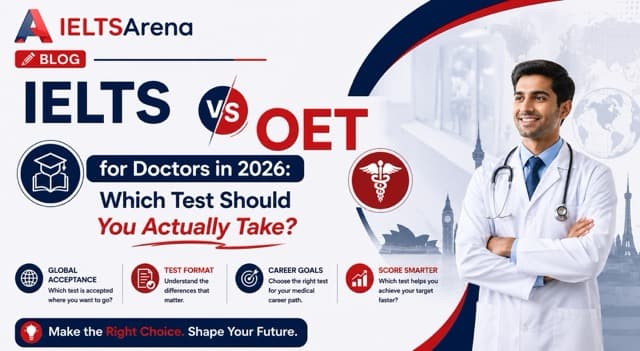
The honest IELTS vs OET for doctors question is not which test is easier. It is which test fits your regulator, your timeline, and your weakest skill. In 2026, with both tests on computer and both accepted by major medical councils, the right choice can save you a re-sit and a delayed start date.
This guide compares the two head to head on scoring, content, regulator acceptance, and difficulty, so you book the test you can actually pass first time.
IELTS vs OET: What They Are and Who Sets Them
IELTS (International English Language Testing System) is a general-purpose English test owned jointly by the British Council, IDP Education, and Cambridge English. Doctors take the Academic module, the same paper used by students and other professionals.
OET (Occupational English Test) is a healthcare-specific English test owned by Cambridge Boxhill Language Assessment. It has 12 profession-specific versions. Doctors take OET Medicine, where every reading text, listening recording, and writing task is set in a clinical context.
Both tests cover the same four skills: Listening, Reading, Writing, and Speaking. Both are accepted by the major medical regulators that ask for English evidence, including the General Medical Council in the UK, the Australian Medical Council, the Medical Council of Ireland, and the Medical Council of New Zealand.
The big difference is the content. IELTS asks a doctor to describe a chart about coffee consumption. OET asks the same doctor to write a referral letter for a patient with chest pain. Same English skill, very different texture.
Advertisement
How the Scoring Maps Between IELTS and OET
Regulators usually expect roughly the same English level whichever test you take. The labels just look different.
IELTS uses a 9-band scale per section and overall. Most medical councils want 7.0 to 7.5 overall on IELTS Academic, often with a minimum 7.0 in each section, in a single sitting.
OET uses Grades A to E per section. Grade B is the standard healthcare benchmark and is broadly equivalent to IELTS 7.0 to 7.5. Most medical regulators ask for Grade B in each of the four sub-tests, also in a single sitting.
In numeric terms, OET reports a 0 to 500 score per section. Grade B sits at 350 to 440. So when a regulator says "OET Grade B" or "IELTS 7.5," they are pointing at the same English ceiling, not a different one.
The validity window is the same too. Both tests are valid for two years for regulator submissions, after which a fresh certificate is required.
Why Most Doctors Pick the Wrong Test First
The first mistake is assuming OET is automatically easier because it is healthcare-themed. A clinician handling clinical content is more comfortable, but OET Writing is a strict letter format with strong penalties for irrelevant information. A doctor used to writing free-form notes can lose marks fast.
The second mistake is choosing IELTS because friends from other fields took it. IELTS Academic Writing Task 1 is a chart or process description that has nothing to do with medicine. Many doctors find it harder than the OET letter because the content is genuinely unfamiliar.
The third mistake is ignoring the regulator's exact rule. Some councils accept either test; some prefer one; a few list extra conditions like a maximum gap between sub-tests if you combine results. Sending the wrong combination can mean a rejected file.
The fourth mistake is preparing on paper for a computer-based exam. Both IELTS and OET are widely delivered on computer in 2026, and the interface affects pacing on test day.
Marianne's Choice: Manila to a Dublin Hospital
Marianne, a 32-year-old hospital doctor from the Philippines, accepted a clinical role in Ireland in early 2026. Her regulator pathway allowed either IELTS Academic 7.0 in each section or OET Grade B in each sub-test, in a single sitting, within two years.
She booked OET first because her colleagues said it was "the doctor's test." Her result came back: A in Listening, A in Reading, B in Speaking, C+ in Writing. The referral letter format had tripped her up. She had added too much background and missed the case-specific instructions.
I thought the medical content would do half the work for me. It did not. OET Writing is a letter exam, and I had not trained for the format.
For her second attempt, Marianne switched to IELTS Academic. Two factors decided it: she had four weeks until her start date, and her IELTS practice scores on a real CBT interface were already at 7.5 in Writing. She sat IELTS on computer, scored 7.5 overall with 7.0 in Writing, and cleared the regulator. Her lesson: pick the test that fits your weakest skill, not the test with the friendliest name.
The Numbers Behind the Choice
OET reports that healthcare professionals from over 40 countries take its tests, with the largest cohorts coming from the Philippines, India, Nigeria, and the UK preparing for council registration (Cambridge Boxhill Language Assessment, 2026).
IELTS remains the more widely sat test overall, with more than three million tests taken each year across all candidate groups, according to British Council and IDP Education market commentary (2026). That scale matters: there are more test centres, more test dates, and more practice material in the wild.
On difficulty, performance data published by both providers (2024 to 2025) and reviewed in independent healthcare prep summaries shows the same pattern: Writing is the lowest-scoring section for doctors in both tests. IELTS Writing globally averages near Band 5.9. OET Writing carries some of the highest fail-rate concentration among the four sub-tests, partly because the letter format is unforgiving.
So neither test gives doctors a free pass. The right choice comes down to which Writing task you can actually train for in the time you have.
How to Decide: IELTS vs OET for Doctors
Use this short framework instead of forum opinions.
- Confirm your regulator's exact rule. Which tests are accepted, what minimum per section, single sitting or combined, and what validity window. This is non-negotiable.
- Audit your weakest skill. If Writing is your weakest, ask whether a clinical letter (OET) or a chart description and essay (IELTS) is faster to lift to the required level.
- Look at your timeline. IELTS has more test dates in most countries, which can save you weeks if you need a re-sit before a start date.
- Check test centre access. OET is healthcare-specific and has fewer centres in some regions. IELTS is almost everywhere.
- Decide on cost and content fit. Both fees are similar in most markets. The real cost is the time to prepare for an unfamiliar format.
- Sit a full timed mock of both, on computer. One mock per test, under exam conditions, tells you more than any forum thread. Then commit to the one where your weakest section is closest to the regulator's bar.
Where IELTSArena Fits If You Choose IELTS
If your audit points to IELTS, the next problem is not information. It is hitting 7.0 in every section on a computer interface, with Writing as the most common gap. That is where IELTSArena is built to help.
IELTSArena replicates the real IELTS CBT interface, the same highlighter, notepad, navigation panel, and on-screen timer you will use in 2026. You stop losing marks to an unfamiliar UI in the first ten minutes.
Its AI Writing feedback scores your Task 1 and Task 2 against Task Response, Coherence and Cohesion, Lexical Resource, and Grammatical Range and Accuracy, then expert tutors give band-focused review on Writing and Speaking, the sections that decide most doctor outcomes. Progress analytics show your weakest band climbing week by week so you do not walk in hoping.
Start free on IELTSArena and see your current band before you commit a test fee.
Self-Diagnosis: Which Test Should You Sit?
Be honest on each one.
- Do you know which tests your regulator accepts, and the exact minimum per section in a single sitting?
- Have you sat a full timed mock of IELTS Academic on a computer interface?
- Have you sat a full timed mock of OET Medicine and scored your Writing letter against the criteria?
- Do you know your current weakest skill and the band you need to lift it to?
- Is your start date close enough that a re-sit on your second test choice is realistic?
If you cannot say yes to most of these, the question is not IELTS vs OET. It is whether you have enough information to commit to either.
Pick the Test You Can Actually Pass First Time
A test fee is not the most expensive part. The delayed start date is. The fastest way to choose between IELTS vs OET for doctors is to measure your current band on each, then commit.
Take a Free IELTS Mock on IELTSArena →
Frequently Asked Questions
Which is easier for doctors, IELTS or OET?
Neither test is universally easier for doctors. OET Medicine uses clinical content, which can feel more familiar, but its Writing section is a strict referral-letter format with heavy penalties for irrelevant information. IELTS Academic uses general topics, including chart descriptions in Writing Task 1, which many doctors find harder simply because the content is unfamiliar. The honest answer depends on your weakest skill and the format you can train for fastest. Sit a full timed mock of each on a computer interface, score your Writing against the criteria, and choose the test where you are closer to your regulator's required band.
Do medical regulators accept both IELTS and OET in 2026?
Yes, the major regulators that ask for English evidence accept both. The General Medical Council in the UK, the Australian Medical Council, the Medical Council of Ireland, and the Medical Council of New Zealand all accept IELTS Academic and OET, with specific minimum scores. Most require IELTS Academic 7.0 to 7.5 overall with a per-section minimum, or OET Grade B in each sub-test, in a single sitting within the two-year validity window. Always check your regulator's current rule directly, because conditions on combining results or minimum gaps between sub-tests can vary.
What OET grade equals IELTS 7.5 for doctors?
OET Grade B is broadly equivalent to IELTS 7.0 to 7.5 for the purposes of healthcare regulator submissions. On the OET numeric scale, Grade B sits at 350 to 440 out of 500 per sub-test. Most medical councils therefore treat "OET Grade B in each sub-test" and "IELTS Academic 7.0 in each section" as effectively the same English ceiling. The real difference is the format and content, not the difficulty level. Confirm the exact requirement with your regulator, since some bodies specify a slightly different IELTS minimum than the standard 7.0.
Is IELTS or OET more accepted for medical registration globally?
Both are widely accepted by the major English-speaking medical regulators, but IELTS has the broader global footprint overall, since it is sat by more than three million candidates each year across all professions and is recognised by universities, visa authorities, and employers far beyond healthcare. OET is healthcare-specific and accepted by medical councils, nursing boards, and pharmacy councils in the UK, Ireland, Australia, New Zealand, Singapore, the UAE, and several other markets. If you only need a healthcare licence, both work. If you may also need English evidence for a visa or postgraduate study, IELTS is the more flexible certificate.
Can a doctor pass IELTS with healthcare-only English practice?
Not reliably. IELTS Academic does not test medical content. Writing Task 1 asks for a description of a chart, graph, or process, and Reading uses general academic passages on topics such as history, science, and the environment. A doctor who has only practised clinical English will be surprised by the unfamiliar content under exam pressure. To pass IELTS Academic at 7.0 or higher, you need to train on the actual format, with full timed mocks on a real CBT interface. Tools like IELTSArena provide that environment along with band-level feedback on Writing and Speaking.