
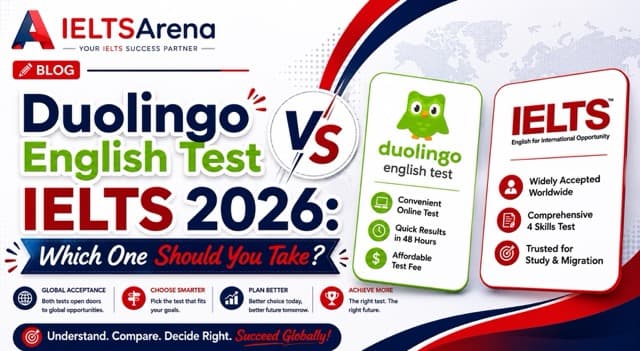
You have a university deadline in a few weeks. The Duolingo English Test promises a result in 48 hours, an at-home setup, and a fraction of the IELTS fee. IELTS asks for a test centre, a booking weeks ahead, and a much higher price. The shortcut looks obvious.
Then you read your offer letter again. Some universities and almost every visa authority still ask specifically for IELTS, and a Duolingo certificate will not unlock a Tier 4 student visa or a Critical Skills employer file.
The Duolingo English Test vs IELTS 2026 choice is not about which is "better." It is about which one your destination actually accepts and which one your timeline can survive. This guide breaks down acceptance, scoring, format, and cost so you only pay for one test.
The 30-Second Answer by Destination
| Your destination and purpose | Take DET if | Take IELTS if |
|---|---|---|
| US undergraduate admission | Your specific university accepts DET (5,800+ US institutions now do) | Your school prefers IELTS or you also need employer or immigration evidence later |
| US graduate or PhD | The department confirms DET is accepted (many still require IELTS or TOEFL) | Business, law, healthcare, or engineering PhD departments almost always require IELTS |
| UK student visa (Tier 4/Student route) | Never valid alone. DET is not on the UK SELT approved list | Always. IELTS for UKVI Academic is the SELT standard |
| UK Skilled Worker visa | Never valid. DET is not on the UK SELT approved list | Always. IELTS for UKVI is required |
| Canada study permit (post-SDS, 2026) | Your university accepts DET and you accept 8-week standard IRCC processing | You want maximum institutional flexibility across universities and colleges |
| Canada Express Entry / PR | Never valid. IRCC requires IELTS General or CELPIP for PR | Always. IELTS General Training is the standard route |
| Australia student visa | Your university accepts DET (some do, many still require IELTS) | Always accepted for both admission and visa file |
| Australia skilled migration | Never valid. DET is not accepted by DHA | Always. IELTS General Training is standard |
| Nursing / medical registration (NMC, AHPRA, MOH) | Never valid. DET is not accepted by healthcare regulators | Always. IELTS Academic or OET are the two options |
| New Zealand study or migration | Rarely accepted for visa purposes | Always accepted by INZ |
| Ireland study or work | Rarely accepted for visa purposes | Always accepted by Irish immigration |
The pattern: DET works for many university admissions, especially in the US and increasingly in Canada. IELTS is required for virtually every visa, professional registration, and employer file in the English-speaking world. If your file has any non-admission component, IELTS is almost always the safer single test.
Advertisement
What Each Test Actually Is
The Duolingo English Test (DET) is an adaptive, AI-scored online English exam developed by Duolingo. You take it at home on your own laptop, with a webcam recording the session. It scores you from 10 to 160 and reports a result in roughly 48 hours.
IELTS (International Language Testing System) is a standardised test from the British Council, IDP Education, and Cambridge English. You sit it at a test centre, either on paper or, increasingly, on computer. It scores you on a 9-band scale per section and overall, and results land in 3 to 13 days depending on the format.
Both test the same four skills: Listening, Reading, Writing, and Speaking. The Duolingo English Test does it in around an hour, fully online. IELTS does it in about 2 hours 45 minutes, in a controlled environment, with a face-to-face or live remote Speaking interview.
The big difference for your decision is not how they test you. It is who accepts the result.
Acceptance: The Single Most Important Comparison
The Duolingo English Test is now accepted by more than 5,500 universities and programmes worldwide (Duolingo English Test, 2026), with strong coverage in the US, Canada, the UK, Australia, and Ireland. For undergraduate and postgraduate admissions, DET is genuinely a viable option at many institutions.
IELTS is accepted by more than 12,500 organisations across 140 countries, including universities, professional bodies, employers, and immigration authorities (British Council, 2026). That wider acceptance is the single most important reason it remains the default for most international moves.
The decisive gap is visas. In 2026, UK Home Office, Irish immigration, Canadian IRCC, Australian Department of Home Affairs, and New Zealand Immigration accept IELTS for UKVI or standard IELTS for visa-linked routes, including Skilled Worker, Student, and most permanent residency applications. The Duolingo English Test is not on the approved Secure English Language Test list for UK visas and is not the standard accepted evidence for most national visa routes.
So the Duolingo English Test vs IELTS 2026 question splits cleanly. For pure university admission, DET often works. For anything visa-shaped, IELTS is usually the only test that does.
Why Students Get the Choice Wrong
The first mistake is reading "accepted in the US" and assuming the test works for every program. Many top-tier US universities accept DET for some courses but require IELTS or TOEFL for others, especially in business, law, or healthcare.
The second mistake is treating DET's speed and price as automatic wins. They are real advantages, but the cost is moot if your visa authority rejects the certificate three months later.
The third mistake is overlooking the Speaking format. IELTS Speaking is a real human conversation with an examiner. DET Speaking is recorded responses scored by AI. Candidates who freeze on camera at home often lose more marks on DET than they would in a live IELTS interview.
The fourth mistake is preparing the wrong way for a computer-based test. DET is entirely on a personal laptop. IELTS in 2026 is delivered on computer at most test centres, with the same on-screen tools every time. If you practise on paper for either, the interface will cost you marks.
A Real Story: Pham from Vietnam, Two Tests, One Visa
Pham, a 24-year-old computer science graduate from Ho Chi Minh City, accepted a master's place in the UK in early 2026. The deadline was tight, so he booked the Duolingo English Test for speed.
He scored 130 on DET, comfortably above the university's threshold. The university issued his offer. Two weeks later, his visa application stalled. The UK Home Office required a Secure English Language Test from an approved provider, and DET was not on the list for his route.
Nobody told me that the test the university accepted was not the test the visa office accepted. I had to start over.
Pham booked IELTS for UKVI Academic on the next available date. He prepared on a real CBT interface, scored 7.0 overall with 7.0 in each section, and cleared the visa just in time for his start date. Total cost: two test fees, six lost weeks, and a near-missed intake. His lesson: confirm the visa rule before the university rule, not the other way around.
The Numbers Behind Both Tests in 2026
The Duolingo English Test costs around USD 65 in most markets and reports results in about 48 hours, which is why it has grown sharply since 2020, with more than 7 million tests taken globally to date (Duolingo English Test, 2026).
IELTS in 2026 typically costs between USD 215 and USD 280 depending on the country, with results in 3 to 5 days for the computer-based version. The British Council and IDP delivered tests to more than three million candidates in the past year (British Council and IDP Education market commentary, 2026).
On scoring, a DET score of 120 maps to roughly IELTS 7.0, and 130 maps to roughly IELTS 7.5, according to the official concordance table published by Duolingo. So when a university lists "DET 120 or IELTS 7.0," they are pointing at a similar English level, just on different scales.
Where the data clearly favours IELTS is in the gates beyond admission. Visa, professional registration, and many employer files require IELTS in 2026, regardless of how strong your DET score is. That single fact decides the choice for most applicants.
The Canada SDS Discontinuation Changed the IELTS vs Duolingo Math
The biggest 2026 shift for anyone targeting Canada happened on 8 November 2024, when IRCC discontinued the Student Direct Stream (SDS). Under SDS, IELTS Academic Band 6.0 or higher in each section unlocked a 20-day study permit processing lane for candidates from India, China, Vietnam, the Philippines, and 10 other eligible countries. That privileged lane was IELTS's biggest structural advantage over DET for Canadian study permits.
Post-SDS, Canada study permit applications from all countries go through the standard processing lane, which takes 8 weeks on average and up to 12 weeks during peak season. IRCC now treats IELTS, DET, PTE, TOEFL, and CELPIP equally for evidence of English proficiency, subject to each university's specific acceptance list.
The practical effect on the IELTS vs Duolingo decision for Canada study permits:
Before November 2024: IELTS was almost always the right choice because the 20-day SDS lane was a decisive time advantage.
After November 2024: The decision now turns on your specific university's acceptance list (DET is accepted by most Canadian universities) and whether you might also need PR later (in which case IELTS General Training is required for Express Entry, so taking IELTS Academic first is a hedge).
For Canada study permits from India, Vietnam, the Philippines, and other former SDS countries: DET is now a viable choice for admission alone. IELTS still wins if you want the same test to work for future PR applications, professional registration, or employer files.
Verify current IRCC requirements before booking, since immigration policy can shift again.
How to Decide: Duolingo English Test vs IELTS 2026
Use this short framework instead of going by price alone.
- Check your destination's full file, not just the university. Identify whether you need a visa, professional licence, or employer English evidence in addition to admission.
- Read your university's exact rule. Confirm that DET is accepted for your specific course, not just by the institution in general. Some departments still require IELTS.
- Map your timeline. If your deadline is under three weeks and your destination accepts DET fully, the 48-hour turnaround is a real advantage. If your deadline is further out, IELTS gives you a certificate that opens more doors.
- Audit your weakest skill. AI scoring suits some candidates and penalises others. If you freeze on camera or struggle with on-screen tasks, IELTS's human Speaking interview can be the kinder format.
- Compare the true cost. A USD 65 test that fails to unlock your visa is more expensive than a USD 230 test that does.
- Sit a free mock of each. Measure your current band on both before you commit.
Where IELTSArena Fits If You Choose IELTS
If your destination needs IELTS, the next problem is hitting the band on a computer interface, with Writing and Speaking as the most common gaps. That is exactly what IELTSArena is built for.
IELTSArena replicates the real IELTS CBT interface, the same highlighter, notepad, and navigation panel you will use at a test centre in 2026. You stop losing marks to an unfamiliar UI in the first ten minutes.
Its AI Writing feedback scores your essays against Task Response, Coherence and Cohesion, Lexical Resource, and Grammatical Range and Accuracy, then expert tutors provide examiner-style review on Writing and Speaking. Progress analytics show your weakest band climbing week by week so you walk in with evidence, not hope.
Start free on IELTSArena and see your current band before you book the real exam.
If You Choose IELTS, Know the 2026 Rule Changes
The IELTS test in 2026 has 5 confirmed rule changes that affect how you prepare and what happens on test day. Read these before you book:
- The complete IELTS test day rules for 2026, including the 3-item bring list and 5 disqualifying mistakes.
- The IELTS Video Call Speaking (VCS) format now used at many test centres.
- The 2026 anti-memorisation penalty that caps memorised responses at Band 4.0.
- The IELTS Reading distribution shifts toward Matching Sentence Endings.
- The IELTS Listening 2026 changes including global accents and the You-Are-Here map marker.
Understanding these upfront saves you 0.5 to 1.0 band that candidates using 2024-era prep are currently losing on real 2026 tests.
Self-Diagnosis: Which Test Should You Sit?
Answer each one honestly.
- Have you confirmed that your destination accepts DET for your specific course and your visa route?
- Is your deadline tight enough that a 48-hour result is the deciding factor, not a nice-to-have?
- Are you comfortable with AI-scored Speaking on your own laptop with a webcam?
- Have you sat a full timed mock of IELTS on a computer interface to know your current band?
- Do you understand that a DET certificate may not unlock professional registration or many work visas?
If you cannot say yes to most of these, the Duolingo English Test vs IELTS 2026 question is not yet decided. One measured mock of each will give you a real answer.
Pick the Test Your Destination Actually Accepts
The cheapest test is the one you pay for once. Confirm the rule for every step of your destination plan, then commit.
Take a Free IELTS Mock on IELTSArena →
Frequently Asked Questions
Is the Duolingo English Test accepted instead of IELTS in 2026?
The Duolingo English Test is accepted by more than 5,500 universities and programmes worldwide for admission, with strong coverage in the US, Canada, the UK, Australia, and Ireland. However, it is not on the approved Secure English Language Test list for UK student or work visas, and it is not the standard accepted evidence for most national visa routes, professional registration, or many employer files. So DET often works for the offer letter but not the visa. Always check both your university's course-specific rule and your destination's visa requirement before booking, because admission acceptance does not automatically mean visa acceptance.
What DET score equals IELTS 7.0?
A Duolingo English Test score of around 120 maps to approximately IELTS 7.0, and a DET score of 130 maps to roughly IELTS 7.5, according to the official concordance table published by Duolingo. A DET 105 sits near IELTS 6.5, and DET 95 sits around IELTS 6.0. These mappings are approximate and universities sometimes set their own equivalency tables, so always check the rule on your specific course page. The two scales measure similar English levels but in different formats, so a strong DET score does not guarantee an equivalent IELTS result without targeted practice for the IELTS format.
Is the Duolingo English Test cheaper and faster than IELTS?
Yes, the Duolingo English Test is cheaper and faster. DET costs around USD 65 in most markets and returns a result in about 48 hours, taken from home on your own laptop. IELTS typically costs USD 215 to USD 280 and returns results in 3 to 5 days for the computer-based version, with a test-centre visit required. However, the cheapest test is the one your destination actually accepts. A USD 65 certificate that does not unlock your visa or licence costs you a second test fee and weeks of delay, which often makes IELTS the lower true-cost choice.
Which test do universities prefer, DET or IELTS?
Universities increasingly accept both, but IELTS is still the more universally recognised certificate, accepted by more than 12,500 organisations in 140 countries. DET is accepted by more than 5,500 universities and programmes and has grown rapidly since 2020, particularly in the US and Canada. Whether one is "preferred" depends on your specific course and country. Some departments, especially in business, law, and healthcare, still require IELTS even when the institution accepts DET elsewhere. Always check the course-specific rule on your offer letter rather than assuming the institution-wide policy applies.
Should I take the Duolingo English Test if I need a UK student visa?
No, not on its own. The UK Home Office requires a Secure English Language Test from an approved provider for most student and work visa routes, and IELTS for UKVI Academic is the standard accepted option for university-level applications. The Duolingo English Test is not on the approved SELT list for UK visas in 2026. Even if your UK university accepts DET for admission, you will usually still need IELTS for UKVI to satisfy the visa. The fastest path is to book IELTS for UKVI from the start so one certificate covers both the offer letter and the visa file.
Does Canada accept the Duolingo English Test after SDS was discontinued?
Yes for admission at most Canadian universities and colleges that accept DET. Canada's Student Direct Stream (SDS), which had given IELTS a privileged 20-day study permit processing lane for candidates from India, China, Vietnam, the Philippines, and other eligible countries, was discontinued on 8 November 2024. Post-SDS, all Canadian study permit applications go through the standard 8-week processing lane regardless of which English test was submitted. IRCC now accepts IELTS, DET, PTE, TOEFL, and CELPIP equally, subject to each institution's specific rules. For Canada Express Entry PR applications, DET is still not accepted; IELTS General Training or CELPIP remain the only options. Take IELTS Academic if you may apply for PR later; take DET if admission alone is the goal and your specific institution accepts it.
Is IELTS being replaced by Duolingo in 2026?
No. IELTS is accepted by more than 12,500 organisations across 140 countries in 2026, including virtually every visa authority, professional regulator, and immigration body in the English-speaking world. DET has grown rapidly since 2020 and is now accepted by more than 5,800 institutions, particularly for university admission in the US and Canada. Both tests are growing, not replacing each other. IELTS remains the single most-accepted test for visa, professional registration, and employer files, while DET is expanding fastest in university admissions. The 2026 pattern is co-existence, not replacement. Choose the test based on which specific institutions and authorities you need to satisfy, not on which test is growing faster overall.
![Best App for IELTS Preparation [2026]: The Honest Ranking (and the One Problem Nobody Mentions)](/_next/image?url=%2Fblog%2Fcover-best-app-for-ielts-preparation.jpeg&w=3840&q=75&dpl=dpl_DXyM63YUHjigMzg2B75HT6s5tc1D)
![Best IELTS Book for Self Study [2026]: The 2-Book Rule Nobody Tells You](/_next/image?url=%2Fblog%2Fcover-best-ielts-book-for-self-study.jpeg&w=3840&q=75&dpl=dpl_DXyM63YUHjigMzg2B75HT6s5tc1D)
![Best IELTS Software for Institutes [2026]: The 4-Path Buying Decision Nobody Explains](/_next/image?url=%2Fblog%2Fcover-best-ielts-software-for-institutes.jpeg&w=3840&q=75&dpl=dpl_DXyM63YUHjigMzg2B75HT6s5tc1D)