
![IELTS Test Day Rules [2026]: The Complete Checklist, 8 Confirmed Changes, and 5 Disqualifying Mistakes](/_next/image?url=%2Fblog%2Fcover-ielts-test-day-rules-2026.jpeg&w=3840&q=75&dpl=dpl_Bu2zNCe4N4mktQxBHB2Kpyj9nuGW)
The IELTS test day rules 2026 delivered are 8 specific procedural changes on top of the standard check-in flow, and 5 mistakes that get candidates disqualified before they answer a single question. The most important 2026 rule: only the original physical ID you used to book the test is accepted at check-in, and no photocopy, digital wallet, phone photo, or driving licence is valid, even if your booking includes them. Wrong ID means no test, no refund, and a full rebook at full cost.
This guide covers exactly what to bring (short list), what the test centre provides, what goes in your locker, what is banned outright, the check-in flow step by step, the 8 confirmed 2026 test-day changes, the 5 disqualifying mistakes to avoid, and what to do if something goes wrong before your scheduled slot.
The 4-Category IELTS Test Day Checklist for 2026
Every item in your test-day life falls into one of 4 categories: bring with you, provided at the centre, stored in a locker, or banned entirely. Getting these wrong is the most common single reason candidates lose their booking.
Bring with you into the test room:
- Original physical ID (passport or national ID, same one used to book)
- Clear unlabeled water bottle (label-free, no words printed on the plastic)
- Glasses if you wear them (case stays outside)
That is the entire in-room list. Nothing else.
Provided by the test centre inside the room:
- Pens and pencils (paper for CBT candidates' Listening notes)
- Headphones (CBT)
- Computer and keyboard (CBT)
- Speaker/audio equipment (paper-based, now discontinued globally after 27 June 2026)
- Test paper and answer sheets (paper-based, if still applicable at your centre)
Do not bring your own stationery. It is not permitted in the test room, even if it looks identical to what the centre provides.
Store in the locker outside the test room:
- Mobile phone (must be switched OFF, not silent)
- Any watch, including analog and digital (test room has a visible digital clock)
- Bag or backpack
- Wallet
- Glasses case
- Water bottle case or cover
- Jewellery beyond a plain ring
- Jacket or coat (if the room is warm)
Anything you bring beyond the "bring with you" list defaults to the locker.
Banned entirely (do not bring to the centre at all if possible):
- Notes, printed material, textbooks, dictionaries
- Food of any kind (eat before you arrive)
- Any digital device beyond your phone (smartwatch, tablet, e-reader)
- Second ID document or extra copies of your passport
Test centres will refuse entry to candidates carrying these into the check-in area, not just the test room.
The IELTS Test Day Rules 2026 Check-In Flow, Step by Step
Every centre worldwide follows roughly the same 8-step check-in. Knowing the flow removes 90% of test-day anxiety.
Step 1: Arrival at the test centre, 30 to 60 minutes before your booked start time as specified in your confirmation email. Registration closes on time regardless of who is still in the queue.
Step 2: Queue for the ID and document check. Have your original passport or national ID ready in your hand.
Step 3: ID verification against your booking record. Invigilators compare your physical document against the ID number and photo on your booking.
Step 4: Biometric collection. A fingerprint scan and a digital photograph are taken. The photograph is what appears on your Test Report Form.
Step 5: Belongings storage. All personal items except your ID, water bottle, and glasses go into a numbered locker or a supervised belongings area.
Step 6: Briefing and rules reminder. An invigilator explains the test structure, break rules, and what to do if you need to leave the room.
Step 7: Room entry and seating. You are assigned a specific desk with a computer or paper station.
Step 8: Equipment check. For CBT, you confirm the computer, headphones, and keyboard work. For paper-based (if still applicable), the invigilator distributes materials. The test starts on the invigilator's cue.
Total time from arrival to first question: 30 to 60 minutes. Arrive at the start of your registration window, not the end.
The 8 Confirmed IELTS Test Day Rules 2026 Changes
Eight specific procedural updates that did not apply in 2024, verified against IELTS.org, IDP, British Council, and 2026 examiner briefings.
Change 1: Black ballpoint pen only for paper-based writing. Since February 2025. Pencils are no longer allowed for the Writing section on paper-based tests. Note: paper-based IELTS was discontinued globally after 27 June 2026, so this rule now applies only at the "Writing on Paper" hybrid centres that launched mid-2026 in selected countries.
Change 2: Original physical ID only. No photocopies, digital wallets, phone photos, or driving licences accepted. Applied globally from May 2026.
Change 3: Biometric collection at check-in. Fingerprint scan and high-resolution digital photograph. The photograph appears on your TRF. Introduced in most centres by early 2026.
Change 4: Tighter ID verification during the test. Your ID is checked at least twice: once at check-in and once at the start of your Speaking section. Some centres also spot-check during Listening, Reading, and Writing.
Change 5: Digital Test Report Form (TRF) accepted by IRCC and UKVI. From 2026 onwards, Canada's IRCC and UK Visas and Immigration accept the digital TRF via electronic verification, so paper TRFs are no longer required for these destinations. Institutions verify scores via the IELTS Online Verification portal.
Change 6: No watches of any kind in the test room. Analog watches were previously tolerated in some centres. In 2026 the rule is enforced globally: all watches go in the locker, including analog. The test room has a visible digital clock.
Change 7: Confirmation email or booking reference required at check-in. Print it or have it accessible on your phone (before you lock the phone in the locker). Some centres refuse entry without proof of booking, even when your name is on the day's list.
Change 8: One Skill Retake option available globally on CBT. From 2026, if you underperform on one section (say Writing capped your overall band), you can retake only that section within 60 days of the original test at any CBT centre worldwide. Original test day rules apply for the retake too.
The 5 Disqualifying Mistakes Under IELTS Test Day Rules 2026
These are not "mistakes that lower your score." These are mistakes that end your test before it starts or result in a Band 0 result.
Mistake 1: Wrong or missing ID. Bringing a driving licence when you booked with a passport. Bringing a different passport from the one you booked with. Bringing a photocopy or digital wallet version. Any of these means no test entry and no refund. The rebook is at full fee.
Mistake 2: Phone or watch in the test room. Even switched off. Even in your pocket. Even accidentally. Any electronic device found on your person in the test room is treated as suspected malpractice. The consequence ranges from ID confiscation and test termination to a Band 0 result and a 2-year ban from IELTS.
Mistake 3: Late arrival after registration closes. Registration windows are strict. If your window closes at 8:30 AM and you arrive at 8:31 AM, you may be refused entry. The confirmation email specifies your window; treat the start of that window as your target arrival time, not the end.
Mistake 4: Refusing invigilator instructions. During the test, if an invigilator asks you to stop, move, or hand something over, you comply immediately. Arguing or refusing is treated as malpractice and can end your test. Save any complaints for the post-test procedure.
Mistake 5: Suspected malpractice during the test. Talking to another candidate, looking at another candidate's screen or paper, taking notes on anything other than the provided scratch paper, or attempting to memorise questions and remove them from the room. All produce Band 0 and a formal record.
Every one of these is preventable with 5 minutes of pre-test planning.
The IELTS Test Day Rules 2026 Timing You Should Actually Expect
For CBT (the format 90%+ of 2026 candidates now take):
Listening: 30 minutes of audio plus 2 minutes on-screen review.
Reading: 60 minutes for 40 questions.
Writing: 60 minutes for Task 1 and Task 2.
Total continuous test time for L, R, W: about 2 hours 35 to 45 minutes with no breaks.
Speaking: 11 to 14 minute face-to-face or Video Call Speaking session, scheduled the same day or within 1 to 2 days of the L/R/W test.
Total time at the test centre including check-in, briefing, and exit: 3.5 to 4 hours on L/R/W day, plus 30 to 45 minutes on Speaking day if separate.
Plan your day around 4 hours at the centre, not 3.
What to Do If Something Goes Wrong Before or During the Test
Real scenarios and the correct response.
You realise your ID is at home while queueing. If you have time (60+ minutes) to fetch it, go immediately and return before registration closes. If not, speak to the invigilator supervisor honestly and ask about same-day rebook. Do not enter without your correct ID.
You are sick on test day. Contact the test centre before your slot to request a medical postponement. A medical certificate from a registered doctor is required. Fees are usually partially refunded or credited to a new booking. Do not attend if you are seriously unwell; you cannot pause a test to see a doctor.
Technical issue during CBT. Raise your hand and the invigilator will resolve it. If a genuine equipment failure affects a section, the centre restarts you or reschedules at no cost. This is documented at the centre.
You lose track of time or misread the question in the last minute. Stay calm. Do not attempt to signal or ask the invigilator; there is nothing they can do mid-test. Finish what you can. Every partial answer is worth more than a blank.
The Speaking examiner asks you to repeat something. They may have needed a moment to confirm audio. This is not a signal that your first answer was wrong. Repeat naturally without changing your content.
A Realistic Student Story
Aisulu, an Almaty-based investment analyst applying for a UK MBA, had prepared for 4 months and was targeting Band 7.5 overall for a competitive scholarship. Her test was on a Saturday morning in Almaty. She arrived 45 minutes before her slot with her passport, water bottle, and glasses. Her phone was in her handbag.
At the belongings storage step, she realised her Kazakh identity card was in her handbag pocket next to her phone. She had booked with her passport, not her ID card. Both were physical originals, so she assumed either would work. The invigilator confirmed only the passport was accepted, since that was her booking document. She was allowed in with the passport alone. The identity card and phone went into the locker.
The near-miss was that she had almost checked the wrong ID at the front desk out of habit, before the invigilator caught it. A different centre or a different invigilator might have flagged the discrepancy as attempted misuse rather than an honest confusion.
She scored Band 7.5 overall. Her scholarship application was submitted on time with the digital TRF via UKVI electronic verification.
The 5-minute review of her booking confirmation the night before would have prevented the near-miss. She now recommends every candidate she coaches to re-read the exact ID and start-time on their confirmation the day before.
Where IELTSArena Fits for IELTS Test Day 2026 Readiness
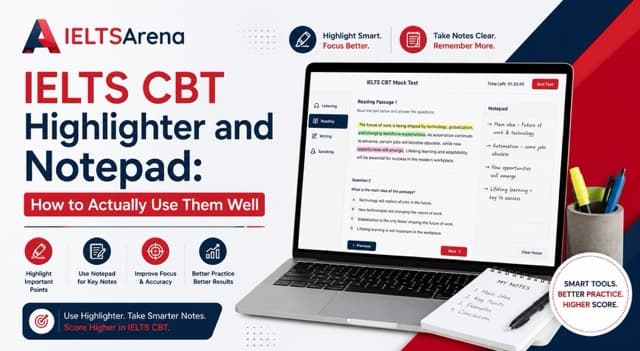
The single most powerful test-day preparation is one full timed mock in the exact CBT interface you will face at the centre, taken 3 to 5 days before your real test. IELTSArena's practice tests replicate the real CBT interface: the highlighter, on-screen timer, navigation panel, notepad, and answer entry fields all match the actual test centre software. Taking one full mock in that environment removes the "first time seeing this interface" surprise that costs candidates 0.5 to 1.0 band from format anxiety alone.
Every mock is scored on the same criteria the real examiners use, with AI feedback on Writing and Speaking. That means your last dress rehearsal is not just for stamina; it also gives you a criterion-level readiness check. Take one full timed CBT mock on IELTSArena as your dress rehearsal this week.
A Quick Self-Check Against IELTS Test Day Rules 2026 the Night Before
Do you have your original physical ID, the exact same one you used to book? Do you have your booking confirmation email accessible (printed or on your phone before it locks in the locker)? Is your water bottle clear and label-free? Have you set 2 alarms for arrival, targeting the START of your registration window? Have you taken at least one full timed CBT mock in the actual test interface within the last 5 days?
If any answer is no, that is the 30-minute fix you make tonight, not tomorrow morning.
Do Your Dress Rehearsal Tonight
The candidates who arrive calmest are the ones who have already sat through the exact format in a mock. Take one free CBT mock on IELTSArena tonight so tomorrow is a repeat performance, not a first-time experience.
More on the IELTS 2026 Changes
This guide is one of five on what changed in IELTS for 2026. Read the other four before test day:
- The IELTS Video Call Speaking (VCS) format now used at many test centres.
- The 2026 anti-memorisation penalty and how examiners spot rehearsed answers.
- The IELTS Reading changes for 2026, including the shift toward Matching Sentence Endings.
- The IELTS Listening changes for 2026, including global accents and the You-Are-Here map marker.
FAQ
What should I bring to IELTS test day 2026? Only 3 items go inside the test room with you: your original physical ID (the exact one used to book, no photocopy or digital version), a clear unlabeled water bottle, and glasses if you wear them. All writing materials, headphones, and computer equipment are provided by the test centre. Everything else, including your phone, watch, bag, and wallet, goes into a numbered locker outside the test room. Bringing personal stationery is not permitted even if it looks identical to what the centre provides.
What ID do I need for IELTS test day? The original physical ID you used to book the test, most commonly a passport or national identity card. No photocopies, digital wallet versions, phone photos, or alternative documents are accepted. If you booked with a passport, you must bring that specific passport, not a national ID card or driving licence. Wrong ID means no test entry and no refund; the rebook is at full fee. Verify your booking confirmation the night before to confirm which document you registered with.
What happens on IELTS test day 2026? The check-in flow is 8 steps: arrival 30-60 minutes before your slot, queue for document check, ID verification against booking, biometric collection (fingerprint and photograph), belongings storage in a locker, briefing on rules, room entry and seating, and equipment check. The test itself takes about 2 hours 35-45 minutes for Listening, Reading, and Writing with no breaks between sections. The Speaking test is a separate 11-14 minute slot scheduled the same day or within 1-2 days. Total time at the centre for the main test day: 3.5 to 4 hours.
What are the new IELTS test day rules for 2026? Eight confirmed changes: (1) original physical ID only, no photocopies or digital versions, (2) biometric collection (fingerprint and photograph) at check-in, (3) tighter ID verification with multiple checks during the test, (4) digital TRF accepted by IRCC and UKVI via electronic verification, (5) no watches of any kind in the test room including analog, (6) black ballpoint pen mandatory for the Writing on Paper hybrid format (paper-based IELTS was discontinued globally after 27 June 2026), (7) confirmation email or booking reference required at check-in, and (8) One Skill Retake available globally on CBT within 60 days of the original test.
Can I bring my phone or watch to IELTS test day? You can bring them to the test centre but not into the test room. Phones must be switched OFF (not silent) and stored in a numbered locker outside the test room during your entire test. All watches, including analog watches previously tolerated in some centres, must also go in the locker in 2026. The test room has a visible digital clock. Any electronic device found on your person in the test room is treated as suspected malpractice and can result in Band 0 and a 2-year ban from IELTS.