![IELTS Reading Changes [2026]: What Shifted, Why Matching Sentence Endings Now Dominates, and the 10-Day Retraining Drill](/_next/image?url=%2Fblog%2Fcover-ielts-reading-changes-2026.jpeg&w=3840&q=75&dpl=dpl_Bu2zNCe4N4mktQxBHB2Kpyj9nuGW)
The IELTS Reading changes 2026 delivered are a distribution shift, not a structural one. You still face 3 passages, 40 questions, and 60 minutes with the same 11 question types you have always seen. What changed is the mix: Matching Headings and True/False/Not Given questions appear less frequently, Matching Sentence Endings and Matching Information appear more frequently, and inference-based questions requiring writer's-opinion analysis have increased across all passages. Candidates who prepared for the 2024 distribution and rely on keyword-hunting strategies for Matching Headings are losing 0.5 to 1.0 band on test day compared to their mock scores.
This guide covers exactly what shifted, why the shift happened, how the now-dominant Matching Sentence Endings type actually works, and the 10-day retraining drill to swap your muscle memory before your test.
What Did Not Change in IELTS Reading 2026
Reassurance first, because the change is often misreported as a "new test."
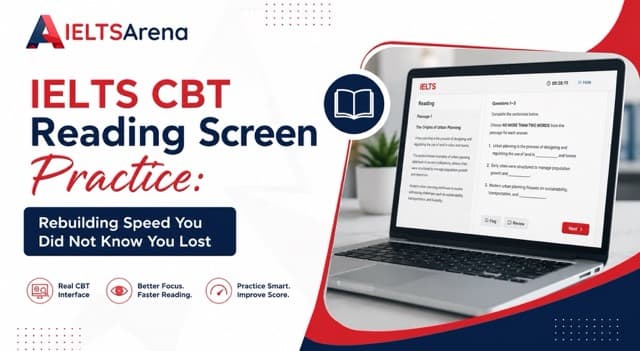
The structure is identical to 2024 and 2025. Academic Reading still uses 3 long passages from journals, books, and educated-audience articles. General Training Reading still uses shorter early sections (notices, advertisements, workplace texts) building to one longer passage. Both still deliver 40 questions in 60 minutes. Both still use the same 11 question types (multiple choice, True/False/Not Given, Yes/No/Not Given, matching information, matching headings, matching features, matching sentence endings, sentence completion, summary completion, note or table or flowchart completion, and short-answer questions). The band-score conversion is unchanged. The CBT interface (highlighter, timer, on-screen review panel) is unchanged.
Anyone telling you Reading is "a new test in 2026" is exaggerating. What changed is the mix of questions inside the same test.
The Actual IELTS Reading Changes 2026 Introduced
Four measurable shifts, confirmed across Cambridge practice book releases, IDP examiner updates, and independent tracking of recent tests.
Shift 1: Fewer Matching Headings. Previously the most-anxiety-inducing question type, appearing in almost every test and often as 5-7 questions on a single passage. In 2026 tests, Matching Headings appears less often, and when it does it typically uses fewer items. Candidates who spent 40% of their preparation on Matching Headings drills are now over-prepared for a type that may not dominate their actual paper.
Shift 2: Fewer True/False/Not Given. TFNG remains the highest-failure question type globally (average accuracy around 55-60%). In 2026, question setters have reduced TFNG frequency, apparently to reduce over-representation of a type that produces heavy guessing.
Shift 3: More Matching Sentence Endings. The single biggest new emphasis. Matching Sentence Endings tests whether you can locate specific information across the passage AND connect it grammatically and logically to a sentence beginning. It cannot be hacked by keyword-matching because the correct match must complete a coherent sentence.
Shift 4: More inference and writer's-opinion questions. Across multiple question types, the 2026 tests emphasise understanding what the writer implies rather than what they literally state. Yes/No/Not Given (opinion-based version of TFNG), multiple-choice questions with "the writer suggests" or "the writer implies" framing, and sentence completion questions that require synthesis across paragraphs are all appearing more frequently.
Combined effect: candidates trained to skim for keywords will find fewer questions rewarding that strategy. Candidates trained to comprehend the writer's argument will find more questions rewarding it. The exam is not harder; it is rewarding a different skill.
Why the IELTS Reading Changes 2026 Distribution Shifted
Three reasons stated across IDP and Cambridge communication in late 2025.
Real-world reading in 2026 is inference-heavy. Workplace English requires reading data-driven reports, comparing sources, and identifying what a document implies, not what a single sentence literally says. Reading test design is following this.
Matching Headings became too coachable. Coaching centres globally trained candidates on topic-sentence-first techniques so effectively that Matching Headings stopped separating genuine comprehension from technique. Reducing the frequency of the type that had been most-hacked restored discriminating power to the test.
TFNG produced too much guessing. When candidates cannot distinguish "False" from "Not Given," they guess, and a lot of correct answers become statistical noise. Reducing TFNG frequency reduces the guessing floor.
The shift is not arbitrary. It targets specific failure modes in the previous distribution.
Matching Sentence Endings: The Type That Now Dominates
If you learn one new question-type strategy for 2026, learn this one.
What it looks like: you are given 5 to 8 sentence beginnings and a list of possible endings (usually 3-5 more endings than beginnings, so distractors). Your job is to match each beginning to the correct ending using information from the passage.
How it differs from Matching Headings: Matching Headings gives you paragraph topics and asks you to identify which paragraph each topic describes. Matching Sentence Endings gives you a specific claim and asks you to complete it with the ending that both matches the passage AND is grammatically coherent. You cannot skim for keywords because the wrong endings often contain keywords from the passage too. You must comprehend the specific claim being completed.
The 4-step strategy for Matching Sentence Endings:
Step 1: Read all sentence beginnings first, before touching the passage. Underline the specific claim in each beginning (subject and specific detail).
Step 2: Scan the passage in order (answers appear in passage order for this question type, unlike some others). For each sentence beginning, locate the relevant section of the passage first.
Step 3: Read the section carefully to identify what the passage says about the claim. Do NOT look at the ending options yet. Predict your own ending based on what the passage says.
Step 4: Match your predicted ending to the closest option. Then check grammatical coherence: the correct ending must produce a grammatically correct full sentence when joined to the beginning.
The 4-step method works because it forces you to comprehend before you match. Keyword-hunters lose 3-5 marks per set on this type because distractor endings contain passage keywords that do not actually complete the specific claim being asked.
The Inference and Analytical Passage Shift
Two related trends worth naming separately.
Inference questions increased. Any question phrased "the writer suggests," "the writer implies," "the writer's attitude is," "which of the following best summarises the writer's view" is inference-based. The answer is not a literal sentence in the passage. It is the conclusion a careful reader would draw from what the passage says.
Strategy: for inference questions, do not look for exact-match sentences. Look for a pattern of statements across the passage that support one option and undermine the others. Eliminate options that contradict any part of the passage. The remaining option is usually correct even if it does not appear verbatim.
Analytical passages increased. Passage 3 in Academic and the final passage in General Training now more often includes data-driven content: charts referenced in text, comparative studies, mixed data sources. This is not new content per se, but the frequency of such passages has increased noticeably in 2026 tests.
Strategy: for analytical passages, practise reading with the assumption that the text and any referenced data must be integrated to answer questions correctly. Do not skip past chart references; they often contain answers.
The 10-Day Retraining Drill for the IELTS Reading Changes 2026 Distribution
If your prep to date used 2024-era materials with heavy Matching Headings focus, this drill rebuilds your muscle memory for the 2026 distribution.
Days 1-3: Matching Sentence Endings intensive. Do 3 Matching Sentence Endings sets per day using the 4-step strategy above. Target 30 questions total by end of day 3. Review every wrong answer to identify whether your error was comprehension, grammatical coherence check, or wrong prediction.
Days 4-5: Matching Information intensive. Similar to Matching Sentence Endings but you match statements to specific paragraphs rather than complete sentence endings. Do 2 sets per day, 8-10 questions each.
Day 6: Inference-focused mock. Take one full Reading mock test and specifically track your accuracy on any question phrased "the writer suggests / implies / thinks / views." If under 60% accuracy, spend day 7 on inference drills.
Days 7-8: Weak-type drilling based on day 6 data. Whatever your lowest-accuracy question type was, drill only that. IELTSArena's Reading module lets you filter by question type so you can drill Matching Sentence Endings or inference questions specifically without taking a full test each time.
Day 9: Timed full mock. Complete one full Reading section under exact 60-minute timing. Compare your Matching Sentence Endings accuracy to your day 1 baseline. Expect 15-25 percentage point improvement.
Day 10: Analytical-passage focus. Pick a data-heavy passage (any Cambridge IELTS 20 or 21 passage with chart references works). Do all 13-14 questions with extra attention to integrating text and referenced data.
By day 10 your instinct for matching questions has shifted from keyword-hunting to comprehension-first, and your inference-question accuracy is measurably higher.
Filter Reading practice by question type on IELTSArena and start the 10-day drill with a Matching Sentence Endings set today.
A Realistic Student Story
Sushmita, a Kathmandu-based Public Health graduate applying for an MSc programme in the UK, needed IELTS Academic Band 7 overall with no section below 6.5. Her mock scores in Reading were consistently 7.0-7.5 using 2024-era Cambridge IELTS 17 and 18 materials, heavy on Matching Headings drills.
Her actual test in July 2026 had 4 Matching Sentence Endings sets, 2 Matching Information sets, and only 3 Matching Headings questions across all 3 passages. She spent too long on the Matching Sentence Endings, ran out of time on Passage 3, and scored Band 6.0 in Reading. The overall broke her offer.
She retook after 14 days of the drill above. Cambridge IELTS 21 practice books (released April 2026 with the current distribution), question-type-filtered drills on IELTSArena focused entirely on Matching Sentence Endings, and one full mock on day 9. Her retake: Reading Band 7.5. The offer was reinstated.
Her comprehension had always been strong enough. Her question-type muscle memory was calibrated for a test that no longer exists.
Where IELTSArena Fits for IELTS Reading Changes 2026 Practice
IELTSArena's Reading module lets you filter practice by question type, so instead of taking a full mock every session you can drill Matching Sentence Endings 30 questions in a row, or inference questions across multiple passages, until the pattern becomes automatic. Every practice session records your accuracy per question type in a dashboard that shows exactly which types are dragging your Reading band down.
For candidates whose 2024-era prep left them heavy on Matching Headings and thin on Matching Sentence Endings, this filtered-drill approach closes the retraining gap in 10-14 days rather than the 4-6 weeks a full-mock-only approach takes. Start filtered Reading practice on IELTSArena with Matching Sentence Endings as your first drill target.
A Quick Self-Check on Your Reading Prep
Are you using Cambridge IELTS 21 (released April 2026) or older practice books? Do you know your accuracy rate for Matching Sentence Endings separately from your overall Reading score? Have you practised any inference-based questions (writer suggests, writer implies) in the last 30 days? Can you complete a Matching Sentence Endings set of 6 questions in under 8 minutes?
If any of these are unclear, your Reading prep is still calibrated to the pre-2026 distribution. That is fixable in 10 days using the drill above.
Take a Diagnostic This Week
The retraining works only if you start from an accurate baseline. Take one free Reading section on IELTSArena and check your Matching Sentence Endings accuracy against your Matching Headings accuracy. The gap between those two numbers is your 2026 retraining priority.
More on the IELTS 2026 Changes
This guide is one of five on what changed in IELTS for 2026. Read the other four before test day:
- The complete IELTS test day rules for 2026: what to bring, what is banned, and the 5 disqualifying mistakes.
- The IELTS Video Call Speaking (VCS) format now used at many test centres.
- The 2026 anti-memorisation penalty and how examiners spot rehearsed answers.
- The IELTS Listening changes for 2026, including global accents and the You-Are-Here map marker.
FAQ
What changed in IELTS Reading 2026? The structure did not change: still 3 passages, 40 questions, 60 minutes, same 11 question types. What changed is the distribution. Matching Headings and True/False/Not Given questions appear less frequently. Matching Sentence Endings and Matching Information appear more frequently. Inference-based questions (writer suggests, writer implies) increased across all passages. Candidates trained on 2024-era Matching Headings-heavy materials risk losing 0.5-1.0 band on test day compared to mock scores.
Is IELTS Reading harder in 2026? No, not measurably harder. The 2026 changes reward different skills rather than higher-level skills. Candidates who prepared for keyword-matching strategies find the shift harder because those strategies are less effective on Matching Sentence Endings and inference questions. Candidates who prepared for comprehension-first reading find the shift easier because the new distribution rewards their strengths. Overall band-score conversion tables are unchanged, and average band scores globally have not shifted downward.
What is Matching Sentence Endings in IELTS Reading? Matching Sentence Endings is a question type where you receive 5-8 sentence beginnings and a longer list of possible endings (with distractors). You match each beginning to the correct ending using information from the passage. The answer must both match what the passage says AND produce a grammatically coherent full sentence. Answers appear in passage order. This is the question type that now appears most frequently in 2026 Reading tests, replacing much of the Matching Headings space in the previous distribution.
How do I prepare for the new IELTS Reading 2026? Use Cambridge IELTS 21 (released April 2026) as your primary practice book because it reflects the current distribution. Drill Matching Sentence Endings and Matching Information as your priority question types. Practise inference-based questions specifically (writer suggests, writer implies). Use a platform with question-type filtering so you can drill the new dominant types 30-50 questions in a row rather than encountering only 5-6 per full mock test. Track accuracy per question type, not just overall band, so you can see whether your retraining is working.
Are Matching Headings still on IELTS Reading 2026? Yes, but less frequently and with fewer items per set. A 2024 test might have had 5-7 Matching Headings questions on Passage 2 alone. A 2026 test might have 3-4 Matching Headings questions total across all 3 passages, or none at all on some tests. Do not stop practising Matching Headings entirely; they still appear. Do reduce the share of your total Reading prep time spent on Matching Headings from 30-40% (typical 2024 prep) to 10-15% (appropriate for 2026 distribution).
![IELTS Listening Changes [2026]: 4 Confirmed Shifts, the You-Are-Here Marker, and the Global-Accents Drill](/_next/image?url=%2Fblog%2Fcover-ielts-listening-changes-2026.jpeg&w=3840&q=75&dpl=dpl_Bu2zNCe4N4mktQxBHB2Kpyj9nuGW)
![IELTS Video Call Speaking (VCS) [2026]: What It Is, How It Differs, and How to Practise It](/_next/image?url=%2Fblog%2Fcover-ielts-video-call-speaking.jpeg&w=3840&q=75&dpl=dpl_Bu2zNCe4N4mktQxBHB2Kpyj9nuGW)