IELTS CBT reading screen practice exists because reading speed on a screen is measurably slower than reading speed on paper for most people, at least initially, and this gap has nothing to do with comprehension ability. Studies on screen versus print reading consistently show a modest but real slowdown when people first shift from paper to digital text, and IELTS candidates who have practiced exclusively with printed materials often discover this gap for the first time during an actual timed CBT attempt.
Since paper-based IELTS ended worldwide on 27 June 2026, this adjustment has become something nearly every candidate needs to make deliberately, rather than an optional consideration.
Why This Gap Is Easy to Miss
Reading comprehension and reading speed are different skills, and most IELTS preparation, understandably, focuses on comprehension: understanding passage structure, identifying supporting evidence, recognizing paraphrased answers. Speed is often assumed to transfer automatically from whatever reading a candidate already does regularly. It does not transfer perfectly between paper and screen, and IELTS Reading gives you 60 minutes for three passages and 40 questions regardless of which surface you are more used to.
Candidates who test well on printed practice material sometimes find their real CBT reading time uncomfortably tight, not because their comprehension weakened, but because their reading pace on screen has never been tested or built up.
A Realistic Student Story
Chamari, a university lecturer in Colombo applying for an academic position in Australia, had read extensively in English for years and assumed her reading speed would transfer seamlessly to any format.
"I never worried about Reading specifically," she said. "In my first CBT mock test, I finished the third passage with barely five minutes left, when normally I would have had fifteen to spare on paper. My comprehension was fine. My pace on the screen simply was not where I expected."
She spent two weeks reading academic-style articles specifically on a screen, timing herself deliberately, before returning to full CBT reading simulations. Her pace recovered close to her prior paper-based speed, and her Reading score moved from Band 6.0 to Band 7.0 across that period, without any change in the difficulty of material she was reading.
Her comprehension had never been the problem. Her screen reading pace simply had never been tested before it counted.
Curious whether the same gap exists in your own reading? Take a free CBT mock test on IELTSArena and time your actual pace under real conditions.
What the Data Shows
Reading on a screen is measurably slower for most people during initial exposure, a well-documented effect in digital reading research, though it typically narrows significantly with deliberate practice. Since IELTS Reading gives a fixed 60 minutes regardless of format, and computer-delivered testing is now the standard for nearly all candidates following the June 2026 retirement of paper-based IELTS, closing this specific gap has become a priority rather than a minor consideration.
Deliberate IELTS CBT reading screen practice is the single most direct way to close it. Unlike broader vocabulary or grammar work, which improves gradually over months, screen reading pace tends to respond quickly to focused, timed repetition, often within a couple of weeks rather than a full preparation cycle.
How to Rebuild Speed With IELTS CBT Reading Screen Practice
Read substantial text on a screen daily, not necessarily IELTS material specifically, simply to rebuild general comfort and pace with digital reading. Practice using the on-screen highlighter deliberately while reading, since it can offset some of the speed loss by making it faster to relocate key information without re-reading entire paragraphs. Time yourself on individual reading passages before attempting full simulations, so you can track whether your pace is genuinely improving. Move to full, timed CBT reading practice once your general screen reading pace feels closer to your paper-based baseline.
What Actually Helps During the Reading Section Itself
Use the highlighter to mark key terms and qualifying words as you read, rather than re-scanning full paragraphs later to relocate them. Skim for structure first, then read more carefully for the specific information each question requires, a technique that works on any format but becomes more valuable when screen fatigue is a factor. Trust the navigation panel to track which questions are answered, rather than mentally holding that information while reading, which frees up attention for comprehension itself. These are small habits individually, but combined they make a measurable difference across a full 60-minute session, particularly in the third passage, where fatigue from screen reading tends to compound.
Where IELTSArena Fits
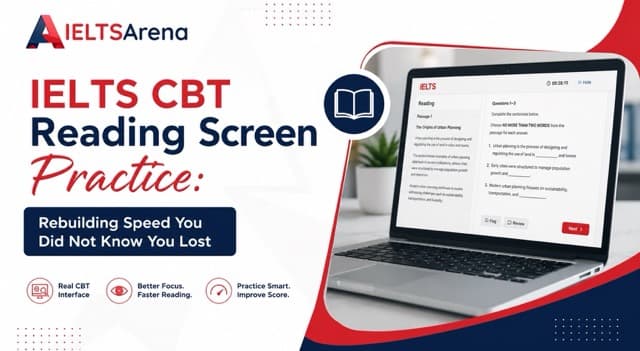
IELTSArena's Reading practice uses the same on-screen interface as the real exam, including the highlighter and navigation panel, so you can build genuine IELTS CBT reading screen practice under authentic conditions rather than guessing whether your paper-based speed will transfer. Timed practice passages let you track pace improvements session by session, and full mock tests confirm whether your reading speed holds up across all three passages in one continuous sitting. The full practice test hub has timed Reading sessions ready whenever you want to test your pace.
A Quick Self-Check Before Assuming Comprehension Is the Problem
- Do you know your reading speed on a screen specifically, separate from how fast you read on paper?
- Have you completed a timed CBT reading passage recently, or only paper-style practice?
- Are you using the on-screen highlighter to reduce re-reading, or ignoring it?
If your comprehension feels strong but your practice scores in Reading seem lower than expected, screen pace is worth testing directly before assuming a deeper problem, and a short block of dedicated IELTS CBT reading screen practice is usually the fastest way to find out.
Test Your Actual Reading Pace Today
The only reliable way to know your CBT reading speed is to test it directly.
Take a Free Mock Test on IELTSArena →
Frequently Asked Questions
Why is reading on a screen slower for IELTS CBT compared to paper?
Digital reading research consistently shows a modest, real slowdown when people shift from print to screen reading, especially during initial exposure. This is a pacing effect, not a comprehension problem, and it typically narrows significantly with a few weeks of deliberate screen reading practice.
How do I rebuild reading speed specifically for IELTS on computer?
Read substantial text on a screen daily to rebuild general pace, practice using the on-screen highlighter to reduce re-reading, and time yourself on individual passages before attempting full timed simulations. Most candidates recover close to their paper-based pace within a few focused weeks.
Is screen reading actually harder than paper for comprehension specifically?
Not typically for comprehension itself. The measurable effect is on reading speed and pace, not understanding. Candidates who read carefully on a screen usually comprehend just as well as on paper, but may need more time initially to reach the same pace.
How long does it take to adjust reading speed to the CBT format?
Most candidates see meaningful improvement within two to three weeks of deliberate, timed screen reading practice. The exact timeline depends on how much screen reading a candidate already does regularly outside IELTS preparation.
What practice actually fixes slow reading on the IELTS computer test?
Timed reading practice specifically on a screen, combined with deliberate use of the on-screen highlighter to reduce re-scanning, closes most of the gap. Full CBT reading simulations, like those on IELTSArena, let candidates track whether their pace is genuinely recovering session by session.