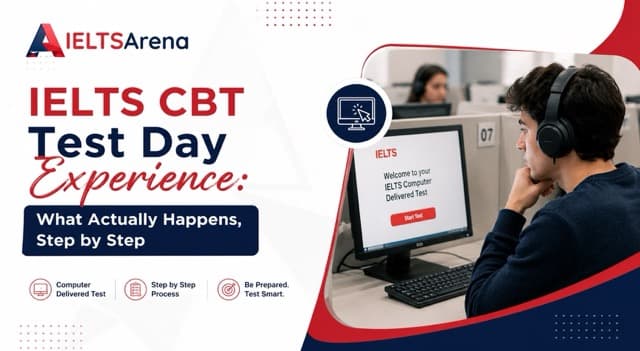
The IELTS CBT test day experience follows a consistent structure: check-in and identity verification, a seated computer session covering Listening, Reading and Writing in one continuous sitting, then a separate face-to-face Speaking interview with a certified examiner, either the same day or within a day or two after. Knowing this sequence in advance removes a surprising amount of exam-day anxiety, since uncertainty about logistics often affects performance as much as uncertainty about content.
With paper-based IELTS retired worldwide since 27 June 2026, this sequence is now what the overwhelming majority of candidates will experience.
Before You Arrive
Test centres typically ask candidates to arrive at least 30 minutes before their scheduled start time for check-in and identity verification. Bring the same identification document you used to book the test, since a mismatch can delay or prevent entry. Personal items, phones, bags and notes, are usually stored separately during the test, so plan accordingly rather than assuming you can keep anything with you at your seat.
Check-In and Identity Verification
Staff confirm your identity against your booking, often using photo identification and sometimes biometric verification depending on the test centre. This step exists at every test centre regardless of format, but photography or fingerprint scanning specific to your location may take a few extra minutes, so building in buffer time before your session avoids unnecessary stress.
The Computer Session: The Core of the IELTS CBT Test Day Experience
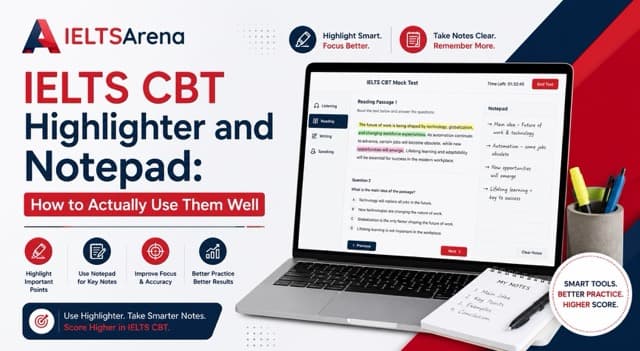
Once seated, you complete Listening, Reading and Writing in one continuous session, typically around two hours and forty minutes combined. The interface includes an on-screen highlighter for Reading, a digital notepad available across sections, a navigation panel showing which questions are answered or flagged, and a live word counter during Writing. Headphones are provided for Listening. Unlike the discontinued paper format, which allowed 10 minutes at the end of Listening to transfer answers, computer delivered candidates enter answers directly and get a shorter window, around 2 minutes, to review before moving on.
This computer session is the part of the IELTS CBT test day experience most candidates have never actually seen before arriving, since general English study does not introduce any of these specific tools. Knowing the sequence and interface in advance turns this from an unknown into a formality.
A Realistic Student Story
Bilal, a logistics coordinator in Islamabad preparing for a Canadian Express Entry application, had researched IELTS content extensively but had almost no idea what the physical test day itself would involve, and found this uncertainty more stressful than the exam content.
"I did not know if Speaking happened the same day, whether I needed to bring anything specific, or how long I would actually be sitting there," he said. "Once I read through an actual walkthrough of the day, most of my nervousness was about logistics, not English, and that part was easy to fix just by knowing what to expect."
Knowing the sequence in advance let him focus his final preparation week entirely on content and format practice rather than worrying about unknowns. He scored Band 7.0, matching his practice test results closely, which he credited partly to walking in without any surprises about the day itself.
Most of his pre-exam anxiety turned out to be about logistics he could have looked up in five minutes.
Want to remove content uncertainty the same way? Take a free CBT mock test on IELTSArena and know exactly where you stand before test day arrives.
What the Data Shows
Computer delivered results typically arrive within 3 to 5 business days, compared to roughly 13 days under the discontinued paper format, with some UKVI and location-specific tracks delivering results in as little as 1 to 2 days. Knowing this timeline in advance helps candidates plan university deadlines or visa application windows around their actual test day rather than guessing.
The Speaking Interview
Speaking remains a face-to-face interview with a certified IELTS examiner in both formats, unaffected by the computer delivery of the other three skills. Depending on your test centre, this may happen later the same day or within a day or two afterward. The interview runs three parts: a short introduction and general questions, an individual long turn using a cue card with brief preparation time, and a final two-way discussion on related, more abstract topics.
After the Test
You leave the test centre once your computer session and, if scheduled separately, your Speaking interview are complete. Results are typically available online within 3 to 5 business days, viewable through your test provider account, with the official Test Report Form following as the document your university, employer, or visa authority will actually require.
This is the last stage of the IELTS CBT test day experience, and for most candidates it is also the least stressful, since the uncertainty that mattered most, the interface, the timing, the sequence, is already behind you by this point.
Where IELTSArena Fits
IELTSArena's simulation platform reproduces the computer session portion of the IELTS CBT test day experience closely, including the highlighter, notepad, navigation panel and live word counter, so the parts of the day happening on screen feel familiar well before you arrive at the test centre. A free mock test lets you rehearse timing and pacing across Listening, Reading and Writing exactly as they will run on the actual day, with AI feedback showing where your preparation stands. The full practice test hub lets you rehearse the entire sequence, not just individual sections, before your real appointment.
A Few Things Worth Confirming Before Your Day
- Do you know exactly what identification you need to bring, and does it match your booking details precisely?
- Do you know whether your Speaking interview happens the same day or separately?
- Have you practiced under the same roughly three-hour continuous timing the computer session actually requires?
If any of these are unclear, resolving them now removes uncertainty that has nothing to do with your English ability.
Prepare for the Day, Not Just the Content
Understanding the sequence removes one source of stress. Practicing the actual interface removes the other.
Take a Free Mock Test on IELTSArena →
Frequently Asked Questions
What actually happens on IELTS CBT test day?
Candidates check in and verify identity, then complete Listening, Reading and Writing in one continuous computer session lasting around two hours and forty minutes. Speaking follows as a separate face-to-face interview with a certified examiner, either the same day or within a day or two afterward, depending on the test centre.
How early should I arrive for IELTS CBT?
Most test centres recommend arriving at least 30 minutes before your scheduled session for check-in and identity verification. Building in extra buffer time is wise, since some locations use additional steps like biometric verification that can take longer than expected.
Is the Speaking test still done in person on CBT?
Yes. Speaking remains a face-to-face interview with a certified IELTS examiner regardless of whether Listening, Reading and Writing are delivered on computer or, historically, on paper. This part of the exam did not change with the shift to computer delivery.
What should I bring to an IELTS computer delivered test?
Bring the same identification document used during booking, since a mismatch can delay entry. Personal items including phones and bags are typically stored separately during the test, so plan to arrive without needing access to anything beyond your identification.
How long does the whole IELTS CBT day take?
The computer session itself runs close to two hours and forty minutes for Listening, Reading and Writing combined. Including check-in time and, if scheduled separately, a Speaking interview later the same day, total time at or around the test centre is typically three to four hours.