![Best IELTS Book for Self Study [2026]: The 2-Book Rule Nobody Tells You](/_next/image?url=%2Fblog%2Fcover-best-ielts-book-for-self-study.jpeg&w=3840&q=75&dpl=dpl_Bu2zNCe4N4mktQxBHB2Kpyj9nuGW)
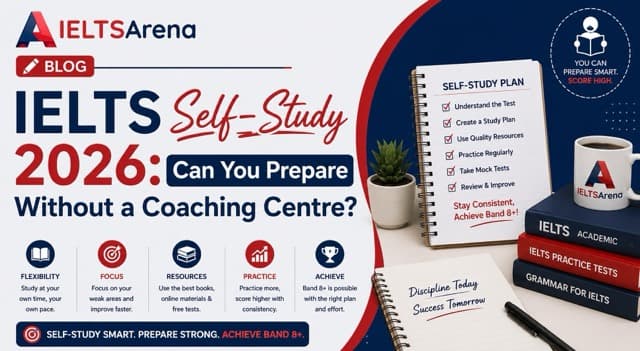
The best IELTS book for self study in 2026 is not 10 books. It is 2 books, or at most 3, chosen in a specific order: one Cambridge past-papers volume for authentic practice, one strategy guide for exam mechanics, and optionally one section-specific book for whichever skill is capping your band. Every extra book fragments your focus and slows your progress. And one honest gap sits underneath every book on the market: books cannot score your Writing or Speaking, and books cannot build the desktop computer typing habits your 2026 test now requires.
This guide names the exact 2-3 books to buy, in the order to buy them, based on your current band level, and explains where books stop and where a web-based CBT platform has to take over.
What IELTS Books Actually Do Brilliantly
Books remain the most effective single format for three specific parts of preparation.
Authentic past papers. Cambridge IELTS 21 (April 2026) and earlier volumes contain real IELTS exam papers from previous years. No third-party platform or app can match Cambridge's authentic-difficulty calibration because Cambridge is one of the three IELTS test owners. Every question in these books has appeared in a real IELTS exam.
Full-test structure and timing discipline. A book forces you to sit a complete Listening test, a complete Reading section, a Writing task, in one uninterrupted sitting. That is how the real exam runs. Chopped-up free online resources train the wrong endurance and pacing.
Answer-key discipline. Every Cambridge book includes complete answer keys with explanations, so you can self-check Reading and Listening accurately. This works because those two sections have objectively correct answers.
For these three, a Cambridge past-papers book is genuinely irreplaceable and worth the investment. Two hours of focused book practice is often worth eight hours of unstructured YouTube preparation.
What IELTS Books Cannot Do
Three parts of preparation are simply outside what any printed book can deliver.
Score your Writing or Speaking. Writing and Speaking are scored by certified examiners against four criteria each. Books give you model answers labelled "Band 7" or "Band 8", but those models cannot score YOUR essay against Task Response, Coherence and Cohesion, Lexical Resource, or Grammatical Range and Accuracy. Self-comparison against a model answer is a rough guess, not a band score.
Build 2026 CBT interface habits. IELTS Listening, Reading, and Writing are now delivered on a desktop computer at the test centre, since paper-based IELTS was discontinued globally on 27 June 2026. That means you will type your Task 1 and Task 2 responses at 45+ words per minute for 60 minutes. Books teach handwriting. Every hour spent on paper practice is an hour NOT spent building the typing speed and screen-reading stamina your test now requires.
Adapt to your specific weakness. A book presents the same content in the same order to every reader. If your Reading is Band 7 and your Writing is Band 5.5, a book cannot redirect 80% of your practice to Writing where it belongs. Only a diagnostic-first approach can, and that has to happen before you buy any book at all.
If you have never had your Writing scored against the four official criteria, buying a fourth book will not fix that gap. Take one free CBT mock on IELTSArena to see your criterion-level bands before your next book purchase.
The Core 2 Books Every Serious Candidate Needs
These are the only two purchases most self-study candidates should make. Any third book is optional and depends on your specific band gap.
Book 1: Cambridge IELTS 21 (April 2026 edition). The newest volume of authentic past papers, published by Cambridge University Press. Contains 4 complete Academic tests (or the General Training version if you need it) with full audio, answer keys, and Writing model answers. This is the gold standard for realistic mock practice. Cost: roughly $30-40 depending on region. Use it for your final 4-6 mock tests before your exam date, one every 7-10 days.
Older Cambridge volumes (17, 18, 19, 20) are also excellent and cheaper if you can find used copies. Use them for section-wise practice earlier in your preparation. Do not skip Cambridge 21 for your final mocks though, because it best reflects the current 2026 question distribution.
Book 2: The Official Cambridge Guide to IELTS (2nd Edition, updated 2025). The strategy companion, written by Cambridge's own test developers. Covers every question type across all four sections with worked examples and exercises. Contains 8 practice tests, 250+ pages of strategy explanation, and comes with app-based audio and Speaking video access. Cost: roughly $40-50. Use it in the first 4-6 weeks of your preparation to internalise the exam mechanics before you start timed mocks.
These two books, used properly, cover 80% of what any self-study candidate needs. Everything else is optional.
The Optional 3rd Book (Based on Your Level)
Pick exactly one, based on where you sit today. Do not buy all three.
If your baseline is below Band 5.5: Barron's IELTS Premium. Accessible strategy explanations, gentler difficulty ramp, and clear grammar and vocabulary chapters. Best for candidates who feel the Cambridge material is too hard on first attempt.
If your baseline is Band 5.5-6.5 targeting Band 7: Target Band 7 by Simone Braverman (fourth edition). Focused strategy guide specifically written for the 6.5-to-7 gap. Direct, tactical, and cheap (usually under $15). Best-value book on this list for its target audience.
If your baseline is Band 6.5+ targeting Band 7.5 or higher: IELTS Trainer 2 (Cambridge). Six additional practice tests with the first two carrying step-by-step guidance for each question type. Best for candidates who need more authentic material after finishing Cambridge 21.
Buying two or three of these together is one of the most common self-study mistakes. Pick one, work through it fully, then reassess whether you need more.
Section-Specific Supplements (Only If One Skill Is Clearly Behind)
If your practice mocks show a single section is consistently 1.0 band or more below your other sections, one section-specific book is worth adding.
Writing: Improve Your IELTS Writing Skills by Sam McCarter. Full worked examples of Task 1 and Task 2 essays at multiple band levels with examiner commentary.
Speaking: Speaking for IELTS by Karen Kovacs (Collins). Speaking-specific vocabulary and pronunciation drills organised by common topic.
Grammar: Grammar for IELTS by Cambridge. Focused drills on the specific grammar structures that separate Band 6 from Band 7 in Writing and Speaking.
These are supplements, not replacements. If you have not finished the two core books above, adding these will not help.
Where Best IELTS Book for Self Study Advice Meets 2026 Reality
Every self-study book on this page assumes you will handwrite your Writing practice, mark your Reading on paper answer sheets, and score your Speaking by comparing against a model dialogue. None of that matches the 2026 test experience.
The 2026 IELTS is delivered on a desktop computer at the test centre for Listening, Reading, and Writing across most markets. You type your Task 1 and Task 2 responses at test-day pace with no autocorrect. You click through Listening and Reading questions with a mouse. Your Writing and Speaking bands come from certified examiners using the four official criteria, not from your own comparison against a printed model.
The honest self-study routine in 2026 is a two-surface split.
In your book: authentic Reading passages, timed Listening sections, strategy chapters, worked examples of question types, the four core criteria explained in Cambridge's own words. Use the book for structure, difficulty calibration, and reference.
On a web-based CBT platform: every full mock test, every timed Writing task typed at test-day pace, every Speaking response recorded and scored on the four criteria. Use the platform for interface familiarity, real scoring, and progress tracking.
Books do the structural teaching. A web CBT does the real testing.
A Realistic Student Story
Tomas, a Prague-based software engineer preparing for Australian skilled migration, spent his first eight weeks of IELTS prep using four books: Cambridge IELTS 20, the Official Cambridge Guide, Target Band 7, and a Barron's Superpack. Ten hours a week, all on paper.
His diagnostic mock on the real CBT interface at week nine revealed the problem. His Reading paper score of 7.0 dropped to 6.5 on screen because his scanning technique had trained around flipping paper pages, not scrolling. His Writing paper time of 55 minutes stretched to 68 minutes typed because his typing speed had never been the training focus.
He kept Cambridge 21 and the Official Cambridge Guide as his reference sources. He moved every mock and every Writing task to IELTSArena. Within five weeks his Writing typed under time hit Band 6.5, up from a paper 6.0, and his Reading on screen hit 7.0. Actual test: overall Band 7.
His English was fine. His interface preparation had been wrong.
Where IELTSArena Fits Alongside the Best IELTS Book for Self Study
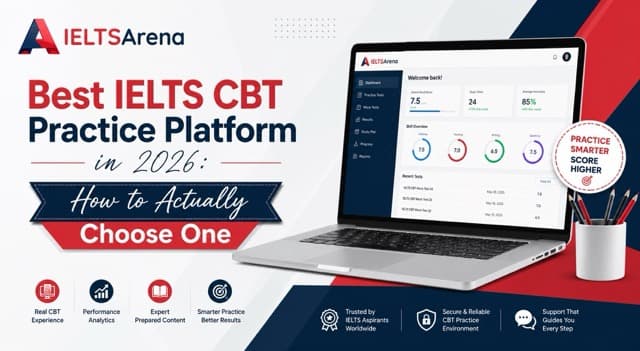
IELTSArena is the browser-based CBT layer that book-only self-study leaves out. Full mock tests on the real CBT interface, AI-scored Writing feedback on all four criteria, AI-scored Speaking feedback on Part 1, Part 2, and Part 3, and a progress dashboard that tracks whether your typed-under-time performance matches your paper-based practice. Optional expert tutor review for candidates within half a band of their target.
The recommended setup for 2026 self-study: your Cambridge IELTS 21 for authentic questions, the Official Cambridge Guide for strategy, IELTSArena for real CBT mocks, criterion-level Writing and Speaking scoring, and interface practice on the same screen you will sit your test on. Start your free CBT practice on IELTSArena before you finish your next book chapter.
A Quick Self-Check on Your Book Strategy
How many IELTS books have you bought, and how many have you finished cover to cover? Do you know your current Writing band scored against the four official criteria, or only against a printed model answer? Have you typed a full Task 1 and Task 2 under 60-minute timed conditions on a computer screen, or has all your Writing practice been on paper? Do you own Cambridge IELTS 21 (April 2026) or an older Cambridge volume that pre-dates the current question distribution?
If any of these are unclear, that is where your self-study plan is silently underperforming, and no additional book purchase will fix it.
Start With One Diagnostic This Week
Before your next book chapter or your next book purchase, take one free full CBT mock on the real interface. Try IELTSArena free and see your Writing scored on the four official criteria alongside your Reading and Listening bands. That baseline changes which of the books above you actually need.
FAQ
What is the best IELTS book for self study in 2026? Cambridge IELTS 21 (April 2026 edition) paired with The Official Cambridge Guide to IELTS (2nd Edition) is the best 2-book combination for most self-study candidates. Cambridge 21 gives you authentic past papers for mock practice, and the Official Guide gives you strategy for every question type. Optionally add one section-specific book if a single skill is clearly behind. Two books, used fully, beat ten books used partially.
How many IELTS books do I need? Two, or at most three. One Cambridge past-papers volume for authentic mock tests, one strategy guide (the Official Cambridge Guide) for exam mechanics, and optionally one book targeting your specific weak section or band gap. Buying more than three books is one of the most common self-study mistakes; it fragments focus and typically slows progress rather than speeding it.
Is Cambridge IELTS 21 worth buying? Yes, for your final 4-6 mock tests before your exam date. Cambridge 21 (published April 2026) best reflects the current 2026 question distribution, especially the Reading shift toward Matching Sentence Endings and the new inference-based Listening questions. If you already own Cambridge 18, 19, or 20, keep them for section-wise practice, but do Cambridge 21 last for the most accurate difficulty calibration.
Can I prepare for IELTS with only books? Only partially. Books deliver authentic content, timed structure, and strategy explanation excellently. Books cannot score your Writing or Speaking against the four official criteria, and books cannot build the desktop computer typing speed the 2026 CBT test requires. Book-only preparation caps most candidates at Band 6.5 because Writing and Speaking never receive real scoring. Pair books with a web-based CBT platform for full self-study.
Which IELTS book is best for Band 7? For candidates currently at Band 5.5-6.5 targeting Band 7, Target Band 7 by Simone Braverman (fourth edition) is the most focused strategy guide. It is short, tactical, and inexpensive. Pair it with Cambridge IELTS 21 for authentic mock practice and a CBT platform for criterion-level Writing and Speaking scoring, and the Band 7 gap becomes bridgeable in 6-8 weeks for most candidates already close to that level.