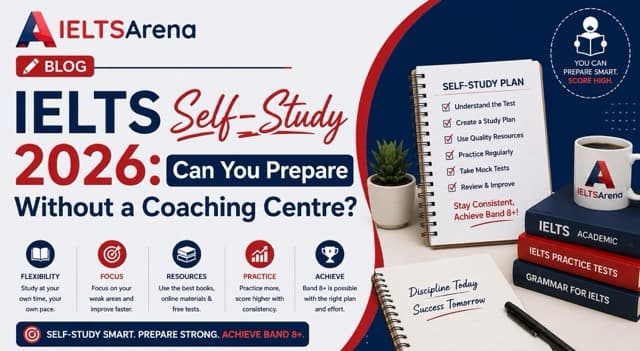
You have looked at the price of a three-month IELTS coaching course and done the maths. The fees, the travel, the fixed class times that clash with your job. And a quiet question keeps coming back: do you actually need any of it to hit Band 7?
For a large number of test-takers, the honest answer is no. Plenty of people reach Band 7 and above through structured IELTS self study, without ever setting foot in a coaching centre. What they do is replace the classroom with a system, and they never skip the one thing coaching gives that is genuinely hard to replace on your own.
This guide is about how to do IELTS self study properly. Not the vague "just practise more" advice, but a real plan: how to structure your weeks, which resources matter, how to fix the feedback gap that sinks most self-learners, and how to know whether you are actually improving or just repeating mistakes.
What Self-Study Really Has to Replace
A coaching centre is not magic. Strip it down and it gives you four things: a structure that tells you what to do each day, materials to practise with, feedback on your Writing and Speaking, and a deadline that keeps you moving.
IELTS self study works when you rebuild all four of those yourself. Miss any one of them and your preparation develops a hole.
Structure is the easiest to replace, because the IELTS exam format is fixed and public. You know there are four sections, you know the timings, and you know the question types. A study plan writes itself once you know your weak skills.
Materials are abundant. There are more free and paid practice tests available now than any single person can finish.
The deadline is your test date, which you control by booking it.
The hard one is feedback. Reading and Listening have answer keys, so you can mark yourself. Writing and Speaking do not. This is the single biggest reason self-learners stall, and it is the part you must solve deliberately rather than hope around.
Why Most Self-Study Plans Quietly Fail
The first failure is practising without marking. Many people do test after test and never check their answers properly, so they repeat the same Reading mistakes for weeks without noticing the pattern.
The second is ignoring Writing and Speaking because they are uncomfortable. These two skills carry half your overall band, yet they are the ones self-learners avoid, precisely because nobody is checking them.
The third is studying everything equally. Someone weak in Listening spends their time on Reading because Reading feels nicer. Self-study only works when you aim your hours at your weakest skill, not your favourite one.
The fourth is no realistic timing. Practising one question at a time with no clock builds a false sense of readiness. The real exam is a continuous, timed, high-pressure event, and untimed practice does not prepare you for it.
The fifth is the feedback vacuum. Without any external view of your Writing and Speaking, you cannot see your own errors. You will keep making the same grammar slip or the same Task 2 structure mistake, convinced you are improving, until the real score surprises you.
A Realistic Student Story
Mariam, a pharmacist from Nigeria, could not justify the cost or the schedule of a coaching centre while working full shifts. She decided on IELTS self study with one rule: she would treat the feedback gap as the main problem to solve, not an afterthought.
Her starting point was a full mock test. "I scored 6.0 overall," she said. "Reading was fine at 7.0, but my Writing came back at 5.5 and I had no idea why. That was the wake-up call."
Instead of guessing, she submitted every Writing task for feedback and recorded every Speaking answer for evaluation. She studied the corrections, rewrote each essay once, and tracked her band across attempts. She gave herself eight weeks.
"The difference was seeing my mistakes named," Mariam said. "Once I could see that I kept writing weak Task 2 conclusions, I could actually fix it. Coaching would have told me the same thing, but I got there on my own schedule."
Her final mock reached Band 7.0, and her real exam matched it. She had prepared entirely without a tutor in a classroom.
Self-study does not fail because people lack discipline. It fails because they practise in the dark, with no one and nothing telling them what they are getting wrong.
Data and Insight: Does Self-Study Actually Work?
Self-study is more viable now than it has ever been, and the data on where candidates lose marks tells you where to aim.
Public IELTS performance reports show that Writing is consistently the lowest-scoring skill for test-takers worldwide, with global average Writing bands sitting around 5.5 to 6.0 in recent reporting years. Speaking tends to score slightly higher but still lags Reading and Listening for many candidate groups.
That distribution is a gift for the self-learner, because it tells you exactly where your hours pay off most. Reading and Listening are largely a matter of strategy and timed practice, both of which you can drill alone with answer keys. The productive skills, Writing and Speaking, are where you need a feedback loop.
There is no credible evidence that classroom coaching produces higher bands than well-structured independent preparation. What matters is the quality of practice and feedback, not the location. A motivated self-learner with a real feedback system regularly outperforms a passive student sitting in a class twice a week.
The takeaway is simple. IELTS self study works when you spend most of your effort on your weakest skill and build a genuine feedback loop for Writing and Speaking.
The Right Approach: A Self-Study Plan That Reaches Band 7
Follow this six-step plan and adapt the timeline to your test date.
Step 1: Take a diagnostic mock test first. Before you study anything, sit one full, timed mock under exam conditions. Your scores tell you which skills are weak. Studying without this is guessing.
Step 2: Set a target for each skill, not just overall. If you need Band 7 overall, work out what each section needs. Pin your effort to the gap between your diagnostic score and your target.
Step 3: Build a weekly structure around your weakest skill. Give your weakest two skills the majority of your practice hours. Keep the strong skills warm with one session a week each.
Step 4: Solve the feedback gap deliberately. For Writing, get every task scored and corrected, then rewrite it. For Speaking, record your answers and have them evaluated on fluency, vocabulary, grammar, and pronunciation. This is the step that separates a Band 7 self-learner from a Band 5.5 one.
Step 5: Practise in real exam conditions. Use timed, full-length tests in a computer-based format if you are taking the CBT exam, so the interface is familiar on test day.
Step 6: Track your progress and adjust. Re-test every two to three weeks. If a skill is not moving, change your method, not just your hours.
How IELTSArena Makes Self-Study Work
The hardest part of IELTS self study is the feedback gap, and that is the exact problem IELTSArena is designed to close.
For Reading and Listening, IELTSArena gives you full timed practice tests in the real CBT interface, with the same timer, highlighter, and navigation panel as the exam. You get instant scoring, so your daily marking is automatic and your weak question types are obvious.
For Writing, the AI feedback on IELTSArena scores your Task 1 and Task 2 essays across all four criteria within seconds and names your specific errors, so you are no longer practising in the dark. For Speaking, the AI feedback evaluates your fluency, pronunciation, vocabulary, and grammar, giving you the external view that self-learners normally lack.
When you want a human judgment, expert tutors on IELTSArena review your Writing and Speaking and give band-focused corrections that an algorithm alone cannot offer. The progress analytics track every mock you take, so you can see whether your weakest skill is actually climbing toward your target.
This is what lets you prepare yourself without a tutor in a classroom and still get the feedback loop that coaching is supposed to provide. More than 10,000 learners have used IELTSArena, and it supports both Academic and General Training, so your self-study matches the exact test you are sitting.
Self-Diagnosis: Are You Ready to Self-Study?
Run through these questions before you commit to a coaching-free plan.
- Do you know your current band in all four skills, from a real timed mock test rather than a guess?
- Have you built a way to get your Writing and Speaking checked, or are those two skills currently going unmarked?
- Can you keep a weekly study schedule without an external class forcing you to show up?
- Are you aiming most of your practice hours at your weakest skill rather than your most comfortable one?
- Do you re-test yourself often enough to know whether your IELTS self study is working?
A "no" on the feedback question is the most dangerous one. Everything else you can power through with discipline, but unmarked Writing and Speaking will quietly cap your score.
See Where You Stand Today
Self-study does not start with a textbook. It starts with knowing your real numbers.
Take a Free Diagnostic Mock on IELTSArena →
Frequently Asked Questions
Can I prepare for IELTS at home without joining a coaching institute?
Yes. Many test-takers reach Band 7 and above through structured self-study at home, without any coaching centre. The exam format is fixed and public, practice materials are widely available, and you set your own deadline by booking the test. The one thing you must replace deliberately is feedback on Writing and Speaking, since those skills have no answer key. Using a platform like IELTSArena, which gives instant AI feedback on essays and speaking responses plus optional expert tutor review, lets you build the feedback loop a classroom normally provides. With a clear plan aimed at your weakest skill, home preparation is fully viable.
What is the best way to self-study for IELTS without a teacher?
Start with a full, timed diagnostic mock test so you know your real band in each skill. Then build a weekly schedule that gives most of your hours to your two weakest skills, while keeping the strong ones warm. Practise under genuine exam conditions, including the computer-based interface if you are taking the CBT. Crucially, set up a feedback system for Writing and Speaking, because you cannot grade these alone. Re-test every two to three weeks and change your method for any skill that is not improving. IELTSArena supports this entire loop with timed CBT practice, instant scoring, and AI plus expert feedback.
How do I get feedback on my IELTS writing and speaking without a tutor?
This is the main challenge of self-study, and the solution is a tool that evaluates these skills automatically. On IELTSArena, the AI writing feedback scores your Task 1 and Task 2 essays across all four criteria in seconds and names your specific mistakes, while the AI speaking feedback rates your fluency, pronunciation, vocabulary, and grammar. For a human judgment, expert tutors on the platform give band-focused corrections. This combination means you can see exactly why your Writing or Speaking sits at a certain band and what to fix, which is the feedback a classroom tutor would normally provide.
Is self-study for IELTS effective if I have never studied in English?
It can be, but you should be realistic about the timeline. If your overall English level is lower, build a foundation phase before exam-specific practice, focusing on everyday reading, listening, and speaking to raise your general fluency. Then move into IELTS strategy and timed practice. Self-study is effective at any level as long as your plan matches your starting point and you get regular feedback on Writing and Speaking. A diagnostic mock test on IELTSArena will show your true level so you can plan a realistic number of weeks rather than rushing toward a test date you are not ready for.
What free resources do I need to self-study for IELTS and reach band 7?
At minimum you need full-length timed practice tests for all four skills, answer keys for Reading and Listening, a way to get Writing and Speaking feedback, and a method to track your scores over time. The free practice tests on IELTSArena cover the first two needs inside the real CBT interface, and the platform adds instant feedback on Writing and Speaking, which most free resources cannot offer. Reaching Band 7 is less about how many resources you collect and more about how consistently you practise under timed conditions and act on feedback. Quality of practice beats quantity of materials every time.