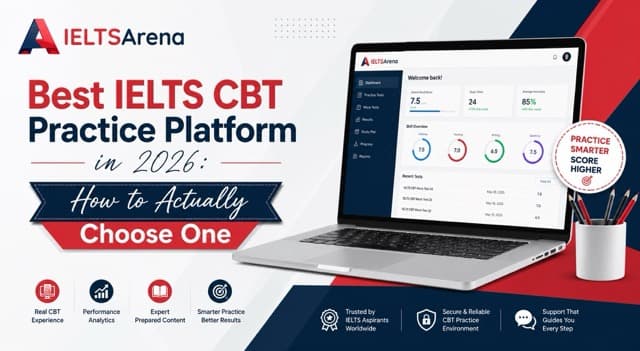
The best IELTS CBT practice platform is the one that replicates the actual computer-delivered exam interface, not just its questions, so you can highlight text, take notes, navigate between questions, and watch a live word counter exactly as you will on test day. Interface accuracy, not content volume, is what separates a real CBT platform from a page of recycled PDFs with a timer bolted on.
That question stopped being optional on 27 June 2026, when the British Council, IDP Education and Cambridge English jointly retired paper-based IELTS worldwide. Almost everyone reading this is going to sit the exam on a screen. This is not a ranked top-ten list repeating the same five names. It is the four checks that actually tell you whether a platform was built for that screen or just moved onto it.
What a Best IELTS CBT Practice Platform Should Actually Mean
A lot of sites that call themselves the best IELTS CBT practice platform are really just paper tests displayed on a screen. You read a passage, click multiple choice answers, and get a score. That is not the same thing as practicing the computer-delivered exam.
The real IELTS CBT includes an on-screen highlighter for marking text, a digital notepad for working notes, a navigation panel showing which questions are answered and which are flagged, and in Writing, a live word counter. None of these exist on paper. If a practice platform does not include them, you are not practicing the format, you are just practicing the content.
That distinction matters more than most students realize until exam day, when they fumble for a highlighter that is not where they expected it to be.
Why Common Approaches Fail
Most test-takers pick a platform the way they pick a restaurant: whatever shows up first, has good reviews, and is free. Three problems follow from that.
First, free question banks without real interface simulation train the content but not the format. You get better at reading comprehension, not at reading comprehension under CBT conditions.
Second, platforms built years ago for the paper exam and later relabeled "computer based" often just moved the same worksheet online. The highlighter is decorative. The notepad does not exist. Students find this out during the actual test, not before.
Third, chasing five different free sites for five different skills means five different login systems, five different scoring rubrics, and zero unified sense of where your actual weak points are. Progress tracking dies the moment your data is scattered across five browser tabs.
A Realistic Student Story
Chidinma, a nurse in Lagos preparing for UK registration, scored Band 5.5 on her first attempt using printed Cambridge books and a stopwatch app. "I thought I understood the reading passages," she said. "What I did not understand was how much slower I read on a screen, and I had never once used a highlighter during practice."
She switched to practicing exclusively on a real CBT interface for six weeks, focused specifically on rebuilding her reading speed on-screen and getting comfortable typing full Task 2 essays under time pressure. Her second attempt landed Band 7.0 overall, with Reading up nearly a full band. The content knowledge had already been there. What changed was familiarity with the format itself.
The gap was never her English. It was six weeks spent practicing on a screen nobody had told her to prepare for.
Curious whether the same gap is quietly costing you marks? Take a free CBT mock test on IELTSArena and see your band score under the real interface before you spend another week guessing.
What the Data Shows
By 2024, more than 80% of IELTS test-takers globally had already chosen the computer-delivered format even while paper was still available as an option, according to IELTS partner reporting. That was before the format became mandatory. Test-takers were already voting with their bookings.
Computer-delivered results also arrive in 3 to 5 business days, compared to roughly 13 days for the old paper track. For anyone working against a university deadline or a visa window, that gap alone changes which platform is worth practicing on, because speed to result only helps you if your actual performance on screen matches your performance on paper.
The Right Way to Choose the Best IELTS CBT Practice Platform
Run any platform you are considering through four checks before committing your study time to it.
- Does it replicate the actual interface, not just the questions? Look specifically for an on-screen highlighter, notepad, navigation panel, and word counter. If a platform's homepage does not mention these by name, assume it does not have them.
- Does it cover all four skills in one system? Switching platforms per skill breaks progress tracking. One system that handles Listening, Reading, Writing and Speaking under the same login gives you one honest picture of where you stand.
- Does feedback go beyond a raw score? A number alone does not tell you what to fix. You want feedback tied to the actual IELTS criteria: Task Achievement, Coherence and Cohesion, Lexical Resource, Grammatical Range and Accuracy for Writing, and the equivalent criteria for Speaking.
- Can you test it without paying first? Any platform confident in its simulation will let you try a real mock test before asking for money. Treat a platform that hides its interface behind a paywall with suspicion.
Where IELTSArena Fits
IELTSArena was built specifically because the four checks above kept failing on other platforms. It replicates the real IELTS CBT interface, including the highlighter, notepad, navigation panel and live word counter, so the screen itself stops being a surprise on exam day. You can see every tool in action on the full IELTS CBT practice test page, or read the complete section-by-section breakdown of how the computer-delivered format works if you want the format explained before you dive in.
It also combines instant AI feedback on Writing and Speaking with expert human tutor correction, so you get both immediate direction and a second, trained set of eyes on your weakest section. Progress analytics sit across all four skills in one dashboard, not scattered across separate tools.
You can try it without paying anything first. Start a free mock test on IELTSArena and see, within one sitting, whether your reading speed and typing speed hold up under the exact conditions you will face at the test centre.
Check Where You Actually Stand Before Choosing
Before choosing the best IELTS CBT practice platform for your own preparation, be honest with yourself about a few things.
- Can you read an academic passage on a screen at the same speed you read it on paper?
- Have you ever typed a full Task 2 essay in 40 minutes and checked the live word count as you went?
- Do you know your current band score under real computer-delivered timing, or only under relaxed, untimed conditions?
- Have you used an on-screen highlighter and notepad even once before considering yourself "prepared" for reading and writing?
If any of those answers is no, that is the gap a real CBT platform closes, not more content on a format you have not practiced.
Start Where the Format Actually Lives
Reading about the differences between practice platforms will not close the gap, and neither will a sixth free question bank. Sitting one real, timed CBT mock test shows you, in under an hour, exactly where your band score stands today and whether the screen itself is costing you marks.
Start a Free Practice Test on IELTSArena →
Frequently Asked Questions
What makes a platform the best IELTS CBT practice platform?
The best IELTS CBT practice platform replicates the actual computer-delivered interface, including the on-screen highlighter, digital notepad, navigation panel, and live word counter in Writing. Platforms that only move paper-style questions onto a screen train your content knowledge but not your familiarity with the exam format itself, which is a separate skill that affects your timing and comfort on exam day.
Is a paid IELTS CBT platform actually better than free practice sites?
Not automatically. Price is not the differentiator, interface accuracy and feedback quality are. Some free resources offer genuine CBT simulation, while some paid courses still use outdated paper-style layouts. Test any platform's free trial or demo test first and check specifically for the highlighter, notepad, and navigation panel before paying for anything.
Do CBT practice platforms actually match the real IELTS exam?
The best ones do, closely. IELTSArena, for example, is built to replicate the real IELTS computer-based test interface, so the tools you practice with, from the highlighter to the word counter, are the same ones you will use at the test centre. Platforms without this replication may still teach content well but will not prepare you for the screen itself.
How many practice tests should I take before deciding on a platform?
One full mock test is usually enough to judge fit. Pay attention to whether the reading and writing experience feels natural, whether feedback explains your mistakes against real IELTS criteria, and whether you can track progress across all four skills without switching tools.
Can I prepare for the IELTS CBT without paying for a platform?
Yes, at least to start. IELTSArena offers a free practice test with real CBT simulation and instant scoring, so you can assess your current band score and format comfort before committing to any paid preparation. Given that paper-based IELTS ended in most countries in June 2026, testing your comfort with the computer format early is no longer optional preparation, it is the baseline.