Knowing how to practice IELTS CBT at home the right way means recreating the actual test-day conditions as closely as possible, not just reviewing content in a relaxed setting. That means timed sections, a real on-screen interface with a highlighter and notepad, typed answers instead of handwritten ones, and no pausing halfway through to check your phone. Most home preparation fails not from lack of effort but from practicing in a way that does not resemble the exam it is meant to prepare you for.
Since paper-based IELTS ended worldwide on 27 June 2026, home practice for nearly every candidate now needs to be built around the computer-delivered format specifically, not adapted from older paper study habits.
Why Most Attempts to Practice IELTS CBT at Home Fall Short
Three habits quietly undermine most home preparation. Studying without a timer teaches content but not pacing, so candidates who "know the material" still run out of time on exam day. Reading on paper printouts while planning to sit a computer exam trains the wrong reading speed entirely. And handwriting practice essays, even carefully, does not build the specific skill of typing a coherent Task 2 response in 40 minutes while watching a live word counter.
None of these are effort problems. They are simulation problems, and they are fixable with a different setup, not more hours.
A Realistic Student Story
Deepika, a marketing graduate in Pune preparing for a Canadian study visa, spent her first month of preparation on printed practice books, confident her reading comprehension was strong. Her first mock test, taken on an actual computer interface, surprised her.
"I finished the reading section with eight minutes still needed for the last passage," she said. "At home with a book, I never ran out of time. On the screen, everything felt slower until I got used to it."
She restructured her home practice around full, timed CBT simulations twice a week, plus daily 20-minute typing drills for Writing. Within four weeks, her reading completion time matched her paper-based pace, and her overall band moved from 6.0 to 7.0.
Nothing about her English changed in that month. What changed was that her home practice finally matched the exam she was actually going to sit.
Want to check whether the same gap exists in your own preparation? Take a free CBT mock test on IELTSArena and compare your timing against real exam conditions today.
What the Data Suggests About Home Preparation
Computer-delivered IELTS results arrive in 3 to 5 business days, compared to roughly 13 for the discontinued paper track. That speed rewards candidates whose home practice already matches real exam conditions, since a fast result only helps if your first attempt reflects your true readiness rather than an unpleasant surprise about the format itself.
By 2024, more than 80% of IELTS candidates globally had already chosen the computer-delivered format even while paper remained available, a strong sign that most people who learn how to practice IELTS CBT at home properly find the format at least as workable as paper once they build the right routine.
A Practical Home Practice Setup
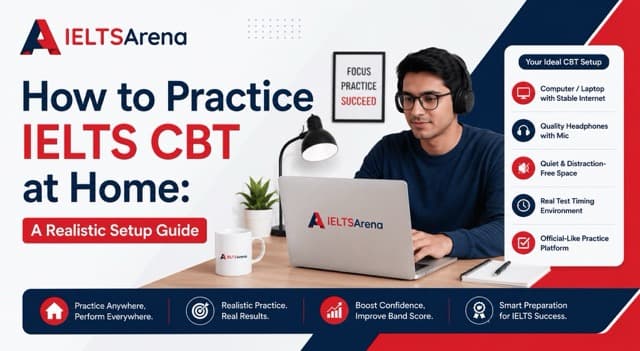
- Use a laptop or desktop, not a phone or tablet. The real CBT exam uses a full keyboard and a specific on-screen layout. Practicing on a small touchscreen builds habits that will not transfer.
- Find a genuine CBT interface, not a PDF with a timer. You need the actual on-screen highlighter, digital notepad, navigation panel, and live word counter to practice the format, not just the content.
- Practice at the same time of day as your actual exam slot, where possible. Energy and focus levels shift across the day, and matching your practice schedule to your exam time reduces one more variable on the day itself.
- Sit full, uninterrupted sessions. A real IELTS sitting runs roughly three hours across Listening, Reading and Writing, with Speaking separate. Practicing in short, interrupted bursts does not build the stamina the real test requires.
- Type every Writing practice response. Handwriting a practice essay, however well, does not train typing speed, on-screen editing, or word-count awareness, all of which affect your actual Task 1 and Task 2 performance under CBT conditions.
A Simple Weekly Routine to Practice IELTS CBT at Home
Early in preparation, spend most sessions on individual skills: timed reading passages with a highlighter, typed writing tasks with a live word counter, listening sections with the actual on-screen navigation panel. As your exam date approaches, shift toward full simulated mock tests, ideally one complete test under real timing each week, so your stamina and pacing are tested together rather than in isolation. This shift, from isolated drills to full simulation, is the part most guides on how to practice IELTS CBT at home skip entirely, even though it is where the biggest score gains usually happen in the final weeks.
Where IELTSArena Fits
IELTSArena is built specifically for candidates who want to practice IELTS CBT at home realistically, with a CBT-native interface that includes the on-screen highlighter, notepad, navigation panel and live word counter from the very first practice session. You can sit full, timed mock tests from home that closely mirror actual test centre conditions, then review instant AI feedback on Writing and Speaking to see exactly where your home routine needs adjusting.
Progress analytics track your performance across sessions, so you can see whether your reading speed, typing pace, or listening accuracy is genuinely improving week to week, rather than guessing based on how a session felt.
Questions to Ask About Your Own Setup
- Are you practicing on the same type of device you will use at the test centre?
- Do your practice sessions include a real timer with no pauses, or do you stop and restart when convenient?
- Are you typing your Writing practice, or still handwriting it?
- Have you completed at least one full, three-hour simulated session, or only shorter individual skill drills?
If several of these answers reveal gaps, that is exactly what a more realistic home setup, not more raw study hours, will fix.
How to Practice IELTS CBT at Home, Starting Today
Home preparation only works if it mirrors the real exam closely enough to matter.
Start a Free Full-Length CBT Mock Test on IELTSArena →
Frequently Asked Questions
How to practice IELTS CBT at home properly?
Recreate real exam conditions as closely as possible: a full CBT-style interface with highlighter, notepad, and navigation panel, typed rather than handwritten Writing responses, strict timing with no pauses, and full three-hour sessions rather than short fragmented practice. Platforms like IELTSArena provide this simulation for free from any home computer.
What equipment do I need to practice IELTS CBT at home?
A laptop or desktop computer with a full keyboard, a reliable internet connection, and headphones for Listening practice. Avoid practicing primarily on a phone or tablet, since the real exam interface and typing experience differ significantly from small touchscreens.
Can I fully prepare for IELTS CBT without visiting a test centre beforehand?
Yes, largely. A genuine CBT simulation platform reproduces the same on-screen tools, timing, and question formats used at the actual test centre, so home practice on the right platform closes most of the format-familiarity gap before exam day.
How is home practice different from a real CBT exam?
The main risks are self-discipline around timing and using tools that do not match the real interface. Home practice on a genuine CBT simulator, taken under strict timed conditions without pauses, closely mirrors the real exam. Practice on PDFs or with relaxed timing does not.
What mistakes do people make practicing IELTS CBT at home?
The most common mistakes are practicing on paper printouts despite sitting a computer exam, handwriting Writing tasks instead of typing them, skipping timed conditions, and practicing individual skills in isolation without ever sitting a full, three-hour simulated test before exam day.