
You read the passage. You understood it. You narrowed the choice down to two options. Then you picked the wrong one. Again.
If this keeps happening, you are not careless and you are not bad at English. You are falling for the exact trap these questions are designed to set. IELTS reading multiple choice questions are built around answers that look correct but are not, and most test-takers walk straight into them.
The frustrating part is that multiple choice feels easy. The answer is right there in front of you. That false sense of security is precisely why so many people lose marks here. This guide breaks down why it happens and gives you a clear, repeatable method to choose the right answer with confidence.
What IELTS Reading Multiple Choice Questions Really Test
The IELTS reading test has three passages and 40 questions in total, to be completed in 60 minutes with no extra transfer time. Multiple choice is one of the most common question types you will meet across those passages.
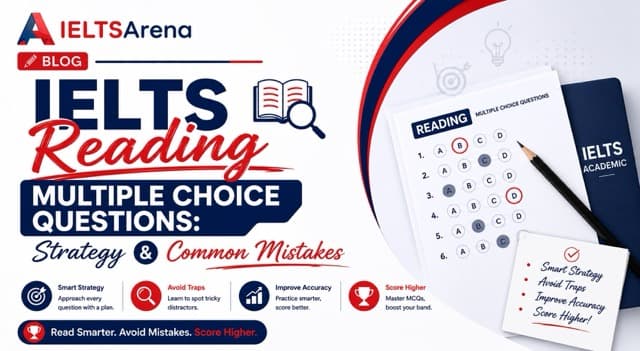
A typical IELTS reading multiple choice question gives you a question or an incomplete statement, followed by three or four options. You choose the one that matches the passage. Some versions ask you to pick two correct answers from a longer list.
These questions are not testing whether you can find a matching word. They test whether you truly understood the meaning of a specific part of the text. That distinction is everything.
The options are written so that wrong choices contain familiar words from the passage. The correct answer often uses different words that carry the same meaning. This is called paraphrasing, and it is the heart of the challenge.
So the real skill is not spotting words you recognise. It is matching ideas. A choice that repeats the passage word for word is frequently a trap, while the correct answer quietly says the same thing in new language.
Advertisement
Why Your Current Approach Keeps Failing
The most common mistake is choosing an option because it contains words you saw in the passage. Word matching feels safe, but the test rewards meaning matching, not vocabulary spotting. The familiar-looking option is usually the distractor.
A second problem is reading the options before the passage section and letting them plant ideas in your head. Once an attractive but wrong option is in your mind, you start hunting for evidence to support it, instead of reading neutrally.
Many test-takers also fail to read the full option. An answer can be 90 percent correct and still wrong because one word changes the meaning. Words like "always", "only", "most", or "never" flip a true statement into a false one.
Another failure is spending too long on a single hard question. The IELTS reading test gives roughly 90 seconds per question on average. If multiple choice eats five minutes on one item, you lose easy marks elsewhere.
Finally, people guess emotionally rather than logically. They pick the option that "sounds right" instead of the one the passage actually supports. Every correct answer in IELTS reading multiple choice can be proven by a specific line in the text. If you cannot point to that line, you are guessing.
In multiple choice, the obvious answer is bait. The correct answer is the one you can prove.
A Real Student Situation: Mariam from Pakistan
Mariam, a 24-year-old graduate from Karachi, was stuck at Band 6.0 in Reading despite strong vocabulary. She consistently lost three to four marks on multiple choice in every practice test.
"I would read a question, see an option with the exact word from the passage, and pick it instantly," she said. "I felt sure. Then I would check the answers and that option was the trap every single time."
Her problem was clear. She was matching words, not meaning. The test writers had predicted exactly what she would do and built distractors around it.
Mariam changed one habit. She started reading the relevant passage section first, deciding the answer in her own words, and only then looking at the options to find the closest match. She also forced herself to underline the exact line proving her choice.
Within six weeks her Reading rose from Band 6.0 to Band 7.5. "The questions did not get easier," she said. "I just stopped falling for the obvious option and started proving my answer instead."
Data and Insight on Multiple Choice Performance
Reading is one of the most improvable skills on the test, because gains come from technique rather than slow language growth. Study-abroad guidance services such as Shiksha and Edvoy note in their 2026 explainers that strategy-based question types respond quickly to focused practice.
The official structure is fixed and worth memorising. Three passages, 40 questions, 60 minutes, and no separate transfer time, which means roughly 90 seconds per question. Multiple choice usually appears in clusters within each passage.
Distractor design is consistent. The most reliable pattern across IELTS reading multiple choice questions is that wrong options reuse vocabulary from the text, while the correct option paraphrases the idea. Recognising this single pattern removes a large share of errors.
There is also a strong timing insight. Test-takers who set a strict per-question limit and move on when stuck tend to score higher overall than those who chase every difficult item, because they protect the easy marks that make up most of the score.
The practical conclusion is encouraging. Many learners gain a full band or more in Reading within four to eight weeks by fixing their multiple choice method alone, without dramatically expanding their vocabulary first.
The Right Strategy for IELTS Reading Multiple Choice
Use this exact sequence on every multiple choice question and your accuracy will rise fast.
- Read the question stem first, not the options. Understand precisely what is being asked before any answer choices can bias you.
- Locate the relevant section in the passage. Questions usually follow the order of the text, so the answer to question three sits after question two and before question four.
- Answer in your own words before looking at the options. Decide what the passage says, then go shopping for the option that matches your idea.
- Eliminate distractors deliberately. Cross out any option that reuses passage words but changes the meaning, that is only partly true, or that adds extreme words like "all" or "never".
- Read every word of the remaining options. The difference between the right answer and a trap is often a single qualifier.
- Prove your choice. Find the exact line in the passage that supports it. If you cannot, you have not finished the question.
- Respect the clock. If a question takes more than 90 seconds, mark your best logical guess, note it, and move on to protect easier marks.
Practised consistently, this method turns IELTS reading multiple choice from a guessing game into a controlled process you can trust under pressure.
How IELTSArena Sharpens Your Reading Accuracy
Knowing the strategy is one thing. Applying it calmly under a ticking clock is another, and that is where realistic practice matters most.
IELTSArena replicates the real IELTS computer-based test interface, including the highlighter and notepad, so you can practise underlining the exact line that proves each answer, exactly as you would on test day. This builds the proof habit that defeats distractors.
Because IELTSArena uses real exam-style passages and timing, you learn to apply the 90-second rule naturally. You stop over-investing in one hard IELTS reading multiple choice question and start protecting the easy marks.
IELTSArena's progress analytics show you which question types cost you marks most often. If multiple choice is your weak spot, the dashboard makes that obvious, so your practice targets the real problem instead of guessing.
After each mock test, you can review every wrong answer and see why the distractor fooled you. Over time you start recognising the trap patterns instantly. More than 10,000 learners have used IELTSArena to lift their Reading band this way.
You can begin with a free timed reading mock on IELTSArena and see your current Reading band within one session.
Self-Diagnosis: Are You Falling for the Traps?
Answer these to find out whether your multiple choice technique is costing you marks.
- When you choose an option, can you point to the exact line in the passage that proves it, or are you choosing by feel?
- Do you read the question first, or do the answer options shape your thinking before you read the text?
- Do you read every word of each option, including qualifiers like "only", "always", and "most"?
- When a question is hard, do you move on within about 90 seconds, or do you lose minutes chasing it?
- Do you know which question types lose you the most marks across your recent practice tests?
If you hesitated on any of these, your method is leaking marks that strategy can recover quickly.
See Your Reading Band Today
The fastest way to fix multiple choice is to practise under real conditions and review every trap you fall for.
Take a Free Reading Mock Test on IELTSArena →
Frequently Asked Questions
Why do I always get IELTS reading multiple choice questions wrong?
Most people get these questions wrong because they match words instead of meaning. The options are designed so that wrong choices reuse vocabulary straight from the passage, while the correct answer paraphrases the same idea in different words. When you pick the familiar-looking option, you usually pick the trap. The fix is to read the question first, decide the answer in your own words from the passage, and only then find the option that matches your idea. Always prove your choice by locating the exact supporting line. Practising this proof habit on IELTSArena's realistic reading mocks removes most of these errors within weeks.
How do I eliminate distractor answers in IELTS reading multiple choice?
Eliminate distractors by testing each option against three checks. First, does it reuse passage words but twist the meaning? If so, it is likely a trap. Second, is it only partly true, correct in one half but wrong in the other? Eliminate it, because a partly true option is a wrong option. Third, does it contain extreme words like "all", "never", or "only" that the passage does not support? Be very cautious. After removing these, read the surviving options word for word and choose the one you can prove with a specific line. This disciplined elimination is the core of strong IELTS reading multiple choice performance.
Should I look at the passage or the options first in IELTS reading MCQ questions?
Read the question stem first, then go to the passage, and look at the options last. If you read the answer options before the text, an attractive but incorrect choice can lodge in your mind and bias your reading. By understanding the question, locating the relevant section, and forming your own answer first, you read the passage neutrally. Then the options become a matching exercise rather than a guessing game. This order, question first, passage second, options last, is the single most effective habit for IELTS reading multiple choice and consistently raises accuracy for learners who adopt it.
How many multiple choice questions are in the IELTS reading test?
The IELTS reading test has 40 questions in total across three passages, completed in 60 minutes with no extra transfer time. There is no fixed number of multiple choice questions, because the test mixes several question types, but multiple choice commonly appears in clusters within each passage. On any given test you might see several multiple choice items alongside matching, true or false, and sentence completion tasks. Since you have roughly 90 seconds per question on average, it helps to handle multiple choice efficiently and avoid over-investing time in a single hard item. Practising full timed papers on IELTSArena builds this pacing naturally.
What is the most common trap in IELTS reading multiple choice questions?
The most common trap is the option that repeats words directly from the passage but changes their meaning. Because the words look familiar, your brain treats the option as correct, even though the idea does not actually match the text. The genuine answer usually paraphrases the passage, using different vocabulary to express the same point. A second frequent trap is the partly true option, which is correct in one detail but wrong in another. To beat both, never choose by familiarity alone, always read the full option, and prove your selection with a specific line. IELTSArena's review tools help you spot these patterns fast.