
The clock hits 55 minutes. You still have eight questions left, the final passage is the hardest, and your heart is racing. You start guessing answers just to fill the boxes, and you know your score is slipping away.
If this sounds familiar, you are not alone. Running out of time is the single most common complaint in IELTS Reading, and it has very little to do with your English level.
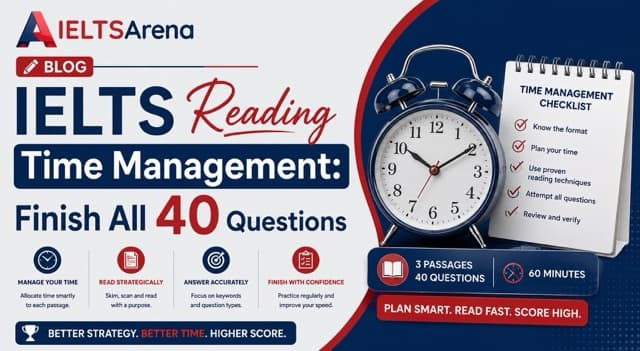
The IELTS Reading section gives you 60 minutes to answer 40 questions across three passages, with no extra transfer time on the computer-based test. Poor IELTS reading time management costs more bands than weak vocabulary ever will. This guide gives you a practical strategy to finish every question on time, with your accuracy intact.
Why the Clock Is the Real Test
The IELTS Reading section is the same length for Academic and General Training: three passages, 40 questions, 60 minutes. There is one crucial detail many candidates forget. On the computer-based test, there is no separate transfer time. Your answers are recorded as you go.
The passages increase in difficulty. Passage one is the most accessible, passage three is usually the densest. The questions are worth one mark each, whether they are easy or hard. A question in passage one counts exactly the same as a question in passage three.
This single fact shapes the entire IELTS reading time management strategy. If you spend too long on a difficult passage three question, you lose the chance to collect easy marks you would have answered correctly with more time.
The test does not reward perfect understanding of one passage. It rewards collecting the maximum number of correct answers across all three. Reading is therefore as much a time test as a comprehension test.
Advertisement
Why Students Keep Running Out of Time
The most common error is reading every word of the passage before looking at the questions. Full reading of three dense passages can take 30 minutes alone, leaving no time to answer. The questions tell you what to look for, so reading them first is essential.
A second mistake is refusing to leave a hard question. Students stare at one tricky matching-headings item for four minutes, determined to get it. Those four minutes could have earned three or four easier marks elsewhere.
Many test-takers also re-read sentences repeatedly because they are anxious. This habit, sometimes called regression, doubles your reading time without improving comprehension. Trust your first careful read.
Another problem is poor question-type awareness. True/False/Not Given questions follow the order of the text, while matching-headings questions do not. Students who do not know these patterns waste time searching in the wrong places.
Finally, many people practise reading passages without a timer. They build comprehension but never build IELTS reading speed. On test day, the unfamiliar pressure of the clock causes panic, and panic destroys accuracy.
How Sofia Stopped Running Out of Time
Sofia, a university applicant from the Philippines aiming for a UK master's programme, kept scoring Band 6.0 in Reading. Her vocabulary was strong, but she never finished the third passage.
"I always left six or seven questions blank," she said. "I understood the texts, but I read so carefully that I ran out of minutes every single time. It was heartbreaking."
Her problem was not reading ability. It was IELTS reading time management. She treated all three passages equally and spent far too long on passage one, leaving almost nothing for passage three.
Sofia learned to allocate her 60 minutes deliberately, to skim before answering, and to leave any question that took more than 90 seconds. She practised under a strict timer until the pacing felt automatic.
On her next attempt, Sofia finished all 40 questions with four minutes to spare and scored Band 7.5 in Reading. "I did not get smarter at English," she said. "I got smarter with the clock."
What the Data Says About Reading and Timing
Reading is often where strong English speakers underperform, not because of comprehension but because of pacing. Across global IELTS results published by the official test partners, Academic Reading averages hover around Band 6.0 to 6.3 for many candidate groups, with General Training Reading typically higher.
Examiner and preparation data consistently show that incomplete papers are a major cause of lost marks. Industry estimates from major IELTS providers suggest a significant share of candidates leave several questions unanswered, purely because of time.
The arithmetic is simple. With 40 questions in 60 minutes, you have an average of 90 seconds per question, including reading time. That average is the backbone of any sound IELTS reading time strategy.
Because there is no penalty for wrong answers, leaving a box blank is always worse than guessing. Yet many candidates run out of time before they can even guess. Closing that gap can lift a score by a full band, according to teaching data from preparation specialists.
Reading is not a test of how well you understand one passage. It is a test of how many correct answers you can collect across three.
The Right Approach to IELTS Reading Time Allocation
Use a deliberate plan for your 60 minutes. The goal is to give every passage and every question its fair share of time.
Step 1: Allocate roughly 20 minutes per passage. Since passage three is hardest, some students use 17, 20, and 23 minutes. Either way, never let passage one steal time from passage three.
Step 2: Skim the passage first for two to three minutes. Read the title, the first sentence of each paragraph, and the final sentence. Build a mental map of where information sits. Do not read every word yet.
Step 3: Read the questions and identify the type. Know whether the question type follows text order. True/False/Not Given and sentence completion usually do. Matching headings and matching information usually do not. This decides your search method.
Step 4: Scan for keywords to locate answers. Use the keywords from each question to find the relevant part of the passage, then read that section closely. This targeted reading is the heart of strong IELTS reading speed.
Step 5: Apply the 90-second rule. If a question takes longer than 90 seconds, mark it, choose your best guess, and move on. You can return if time allows. Never let one question sink your paper.
Step 6: Answer every question. With no negative marking, a blank is a wasted mark. In your final two minutes, fill any remaining boxes with your best guess.
Practise this plan until it runs automatically. Good IELTS reading time management is a trained habit, not a test-day decision.
How IELTSArena Builds Your Reading Speed
You cannot fix timing by reading articles at home with no clock. You build it by practising full Reading sections under real exam conditions, and this is exactly what IELTSArena provides.
On IELTSArena, you take Reading tests inside a real CBT interface that mirrors the actual computer-based exam, including the on-screen timer, the highlighter, and the navigation panel. You learn to pace yourself under genuine pressure, not in a comfortable, untimed setting.
IELTSArena tracks your performance across every mock test, so you can see exactly which passages and question types slow you down. If matching-headings questions always cost you time, the progress analytics make that pattern obvious.
The platform lets you practise both Academic and General Training Reading, so your IELTS reading time strategy matches the exact test you are taking. You build speed on the precise question types you will face.
Because IELTSArena lets you practise at your own pace, you can complete a timed Reading section every day and watch your speed and accuracy climb together. Start free on IELTSArena and take your first timed Reading test today.
Self-Diagnosis: Is Your Reading Timing Ready?
Answer these questions honestly before your exam.
- Can you finish all three passages and 40 questions within 60 minutes under a real timer?
- Do you skim a passage before answering, or do you read every word first?
- Can you recognise which question types follow the order of the text and which do not?
- Do you leave a question after 90 seconds, or do you get stuck on the hardest ones?
- When you practise, do you use a strict clock, or do you allow yourself extra time?
If you hesitated on any of these, your timing has a clear gap. The fix is repeated timed practice with feedback, not more untimed reading.
Start Fixing Your Reading Timing Today
You will not know your true Reading pace until you sit a full timed section in a real exam interface. Practising without a clock hides the exact problem you need to solve.
Take a Free Timed Reading Section on IELTSArena →
Frequently Asked Questions
How do I finish all 40 IELTS reading questions in 60 minutes?
Give each passage roughly 20 minutes and protect that limit strictly. Skim the passage for two to three minutes first to map where information sits, then read the questions and scan for keywords to locate answers rather than reading every word. Apply a 90-second rule: if a question takes too long, mark your best guess and move on. Because there is no negative marking, never leave a box blank. Practising full timed Reading sections in the CBT interface on IELTSArena builds the pacing habit so finishing on time becomes automatic by exam day.
How much time should I spend on each passage in IELTS Reading?
A balanced approach is about 20 minutes per passage, since all three contain the same number of questions worth equal marks. Because passage three is usually the hardest, many candidates adjust to roughly 17, 20, and 23 minutes, giving the toughest text a little more room. The crucial rule is never to let passage one overrun and steal time from passage three. Within each passage, spend two to three minutes skimming, then use the rest to locate and answer questions. Practising this allocation under a timer on IELTSArena helps you internalise the pacing.
Should I skip a difficult question in IELTS Reading and come back to it?
Yes. If a question is taking more than about 90 seconds, mark it, record your best guess, and move on. Every question is worth one mark regardless of difficulty, so spending four minutes on one hard item costs you the easier marks you could collect elsewhere. With no penalty for wrong answers, you should always leave a guess rather than a blank. Return to skipped questions only if you have time at the end. Training this discipline through timed practice on IELTSArena stops a single tough question from sinking your whole Reading score.
Why do I always run out of time in IELTS Reading even when I practise?
The most common reason is practising without a strict timer, which builds comprehension but not speed. Other causes include reading every word before looking at the questions, re-reading sentences out of anxiety, and refusing to leave difficult items. Strong English does not guarantee good pacing, because IELTS reading time management is a separate skill. The fix is repeated practice under genuine exam conditions with feedback on where you slow down. The progress analytics on IELTSArena pinpoint which passages and question types cost you time, so you can target them directly.
How do I balance accuracy and speed in IELTS Reading?
The balance comes from targeted reading rather than full reading. Skim first to understand structure, then scan for keywords to find the exact part of the text that answers each question, and read only that section closely. This protects accuracy while saving time. Apply the 90-second rule so no single question drains your schedule, and always answer every question since there is no negative marking. Speed without accuracy means careless errors, and accuracy without speed means blank answers. Practising timed sections on IELTSArena trains both together until they reinforce each other on test day.